Author: moseara

  • kingship vs kinship

    kingship vs kinship

    I hated twitter for a long time before I realised I knew nothing about it. What a snob. I had pictured a whole lot of people chatting about nothing – but had no personal experience to back this up. So over December and January this year, I conducted a twitter experiment.

    First I opened an account @cathoel and started saying things into the void. Like an ignorant guest at a dinner party who speaks without waiting to listen. I’ve since discovered a lot of people do this – broadcast rather than tune in. Me, me, me.

    My first interest was as a poet and writer – could such short morsels be a form of discipline? I sent out a few instant poems, line by line. Eventually I noticed that other tweeting poets interlarded their own work with banners & brandishings. “Come see my blog! I got published in Magazine X! My poetry’s great!” So I set another little candle in the water, @cathoeljorss. Plain poetry, no chaser, no commentary, no celebrity.

    As with facebook, it took me some time to work out what twitter could be for, in my world. Imagine television was invented right now. Wow! You might sit in front of it for a whole day. You might be going, Jeez, this is amazing, how incredible, it’s… kinda boring though. Much of twitter is like daytime television, only worse.

    After a while – if you stuck with it – you might start to discover the streams of cooler water, the refreshing elements that interested you. Animation. Arthouse movies. Indigenous programming. What I did was found someone whose approach I liked and then mined their list of ‘follows’ to find more interesting people to ‘follow.’

    I still can’t say ‘follow’ without inverted commas. It feels religious. I am not looking for a leader and I don’t want anyone to follow me. I think it’s retro. I think humanity and history are both at a stage where we need all hands on deck – everyone’s wisdom is essential, and the unheard voices are the ones we most need to hear. As the Transition Towns groundswell puts it, we need to start “harnessing the genius of the community.”

    With this in mind I went back to twitter and opened a third account: @exmalcolmfraser. Malcolm Fraser is a former Prime Minister I admire because (in part because) at the Ideas Festival in Adelaide in 2003 he said, to a packed house, he felt more kinship with the Labor leaders of the day than with his own former Liberal colleagues. He said he wasn’t sure how much the Left in Australian politics had just shifted to the conservative Right – and how much his own maturity as a person was evolving so that he had become more and more compassionate and humane. I admire his humility and his kindness, expressed in action.

    The tagline for @exmalcolmfraser is “an invitation to elders, mothers, statesmen, and all indigenous cultures to speak on public currents & events.” Which brings me to a difference I have noticed in the way I use twitter as opposed to the way it is most commonly used. I have little interest in promulgating Brand Me. I am a person, not a brand. I like my own work to be credited and read but I am more interested in society as a whole – @ustopia – and it seems to me by evolving several, more specialised little channels on twitter I can save people time so they get to subscribe to the one that interests them the most. I feel this new tool, still unwieldy in our hands, has a powerful potential for addressing one of the main issues that seems to me to be causing all this destruction and grief. Which is:

    We’re not listening to each other! We’re not hearing one another. An Aboriginal man peacefully protesting is bundled into the paddywagon as though he were a danger to the state. Indigenous Brazilians are driven off their land. Older women are routinely invisible, all the knowledge, all the love, all the adventuring they have amassed just swept aside as of no value. Environmental crises: we have a lot of the technology we need. Innovators have invented cars which run on recycled cooking oil; fans that mimic nature’s own whirlpool shape and don’t waste energy in heat pollution. City councils have reduced property destruction by putting ‘victims’ (an elderly lady whose fence was defaced) in contact with ‘perpetrators’ (a young man with no strong female role models who is now required to do her gardening). It’s all about making the links.


    I feel life is abundant and we have all the solutions we need. We just need to communicate. Including opening ourselves to the grief, anguish, wit and anger of our own hearts as well as the hearts of those around us. A patriarchal or matriarchal community survives on kingship – one central figure whose loss (hello, North Korea) causes everything else to dissolve into chaos. A sustainable community thrives on kinship – many weak links – like the internet. When the Egyptian government tried to shut down the web, there were plenty of individuals offering their own broadband accounts, opening phone lines etc to find ways round. This is subtle and powerful. It reminds me of language, perhaps the ultimate democracy outside of death itself.

    Language is not built by any one person: it is a treasure trove collected by many hands. Anyone can invent a word – Shakespeare has, Margaret Thatcher has, I have. No one can dictate that their word shall remain in use, or mean what they declare it to mean. So on twitter I have also opened @dictionarme and @inventedword, the first: to invite new words invented by anyone, the second: to offer up words I have invented myself. I am interested to see how these new technologies will evolve. I suspect they will grow as a joint effort, with flashes of illumination cast by individuals. I suspect this is true of our world in general, if we are to survive.

    The longing for a messiah is understandable, but dangerous I think. If there is a god, it is all of us together. Us is god. We add up. We are each necessary. We each contribute something unique. Individual responsibility – that is, individual freedom of action – is for me one of the most joyous lessons life teaches.

    Perhaps this is a way forward for our giant interlocking crises as well. Energy: nuclear is an attempt at a silver bullet solution. It seems to me more likely we will work well with a patchwork, co-operative approach: stop wasting the 30% that burns off in heat and office buildings lit all night. Solar panel on every house. Wave power where there are powerful waves. Wind power where there is powerful wind. Similarly the water crisis: governments boast they are building “an $8bn desalination plant” to appease those who say, as though praying, “the Government’s gotta do something.” A gentler, more lasting and more effective solution again seems to lie in ‘a bit of each.’ Replace washers so your taps don’t drip. Move agriculture to areas where it is suited – no more growing rice in the desert. Industry to reduce waste. A water tank on every house. The wonderful thing about this approach is, it starts with me as well as you, we’re all in it together, and we can start now. Let’s.
  • mind your peas & queue

    I realise it is an insufferable habit to peer into other people’s shopping trolleys and make guesses about their state of torpor and poor little stolid fat inactive kids as a result. And many people would see it as high-handed that I carry a thick black marker for amending signage that has missed its apostrophe. Never mind that our language is a treasury built by unremembered hands, a hundred thousand folk poets who first said, “male and female bolts” and “I couldn’t have got a word in edgewise.”

    Never mind that our bodies are treasuries of soul, each body carting a soul never before seen & irreplaceable, and we are filling them up with stodge and sludge. (“Ahh… you’re not feeding that to your kids, are you? I mean, cos you realise that’s not actually food…”) As for that noxious petroleum dishwashing liquid that will induce a mild autism to make it easier for your little ones to sit a lifetime on the couch – just because it has a green dolphin on the label and is “now with added lemon juice” does not make it biodegradable. Unless you consider that ‘biodegradable’ really means just, ‘it will break down.’ In which case no worries – even nuclear waste is biodegradable, if you don’t mind waiting a few million years.

    Everything you buy matters. Everything you eat builds you. Everything we say builds our world and nothing matters more than that.

  • waste land wastes us

    In a sense it is true that every inch of every block of every city centre we have is wasted. As we’ve made a lot of cities – that’s a lot of real estate.

    That’s real as in ‘commons’, ‘waste land,’ ‘abandoned land’, ‘no one’s putting it to much use.’ Oddly enough the same is true of many exceptional souls amongst us. True of each of us ourselves – to differing extents, and having had different opportunities. How can I bring all that I am to the world? Because otherwise I’m welshing out on a contract. The world needs you to be you.

    Vacant land, abandoned, covered, skirted. We’ve got all these little beaches & lofts of it. Imagine it inhabited, thriving, farmed. A bearded man for years in Brisbane tended an extended family of parcels on the slope between the roads, among the sprawling Moreton Bay fig roots. It’s easier where there’s a tree. Like Charlie’s Bamboo Yard, which nothing is like – a song, fruiting and faced in luminous toy gardens by the bamboo where the industrial lots meet the river, in LA*. Charlie locks gates now against simple-minded defacers but when he’s there – he made it for people to enjoy, and as his home. I loved it & I’ve never even been there.

    Why can’t any displaced person and most surely any indigenous community take up an unclaimed patch of land – as European settlers did in the year hereabouts in the far-distant land of notsolongago – and tend it? Make a sweet place: where they can feel comfortable, something they can profit from if they wish and greet the world from if they wish to? Where I grew up, there were street stalls: I miss that pleasure to walk past & walk amongst too. We have a lot of waste patches, unlike poorer countries. We got space. Pioneers can take up a claim. So it seems (look about you). Surely, then, they can build a claim shanty (look behind you). If they so desire.

    To me anyone choosing to live this way offers so peaceably their own effort, authority and stewardship over some nook that they ought to be cherished, thanked, left intact. Independent, equably respected. Any buffer community that could thrive would only be an unthanked boon, surely, for the morale, sensibilities, and sense of personal urban grooviness of many city dwellers travelling about our own business.

    The individual food-cart, the foldaway business in our nearest countries show the myriad ways a person without premises can be sovereign in his own manhood, in her own womanhood. In Melbourne fellows cartwheel through the traffic at the lights as if it were surf, tilting an almost irresistible bottle & squeegee toward windscreen after windscreen, light as a barista with the froth. They feel great about themselves, I feel great about them, it’s all good, we smile. Interacting with diverse and sifting communities can help us find out how we feel about each other and link actions with beliefs and in an amazing number of cases, this proves to be a good thing.

    Men in Adelaide, on foot for long distances in the heat or the cold, barrel a trolley bulging with ingenious spinnaker to sift every gutter and bin for recyclables. There are many forms of service everyone benefits from, that take a kingly humility and resolve, leave a man sovereign, and do the rest of us a gracious service.

    In a self-realised community, we all take our part of this beautiful effort. Look at traffic – a web woven, to an astonishing extent, of mutual co-operation.

    When you look up – way above the street there’s as much outdoors in any CBD as there ever was. Like allotments, the outdoor blocks are raised individually to roof level then neglected. Most of any city’s veges & all of its aquaculture could be grown in the heart of its sky. A local transition group here can farm this – another over there – transition groups are forming all over and I’ve met two groups who lost members when locals showed up itching to get stuck into some transformative, world-regenerating project & there was nothing but meetings to offer them. It’s what people want to do – and we lack opportunity: be engaged in some way that’s real in our community. Here’s one way. Surely food that is organically grown but inner-city farmed yet eaten within hours cannot be worse for me than sprayed since a seed & sprayed to last on the shelf. Historians say, “neglect of history is a form of despair.” Howard Thurman (1899-1981) said, “Don’t ask what the world needs. Ask what makes you come alive and go do it. Because what the world needs is people who have come alive.”

  • built from junk

    built from junk

    I wonder if the reason we are all so fascinated by vampires is that we are vampires, slowly draining the blood from our land.  By our habits we suck the life out of the soil, the seas, and each other, turning workers into slaves in distant countries, buying surface sprays that promise to transform our homes into havens of immaculate lifelessness.  Is that why we want to see this as desirable and glamorous?  Is that why we long to confess?

    It seems to me equally understandable that we are experiencing gluttony (obesity) as a leading cause of death, and sex as ‘an addiction’.  These are the functions of survival: we need to eat, and we need to reproduce.  At present our survival is threatened.*  So naturally we can’t stop eating – or dieting, in some cases.  We can’t stop thinking about sex – including all the primping, dyeing, shopping for killer shoes, posing, and choosing facebook profile pics.

    I realise ‘we’ is a convenience, a generalisation so broad as to have very little meaning.  But I mean it.  We are in trouble.

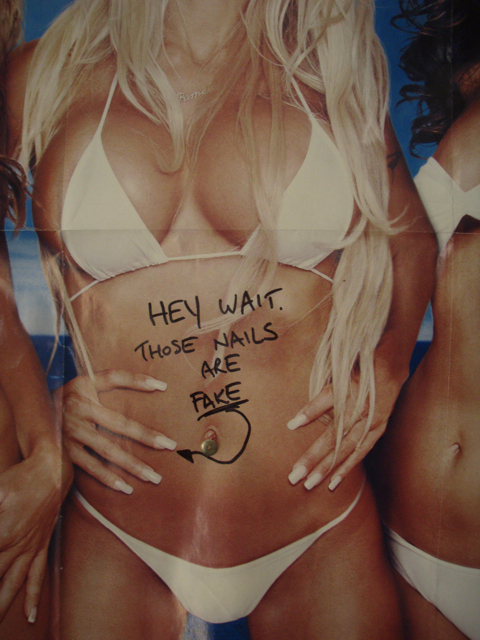
    On the high street I have been noticing a giant poster advertising skinny jeans.  The models stand in a pouting row, bare-breasted, coyly protecting their chests with splayed and manicured hands.  These are porn poses – the kinds of postures that ten years ago I would have never have seen, unless I had sought them out in specialist magazines.  Now they are normalised on the high street, a flagrant yet oddly unsexy display.

    Selected through a punitive auditioning process, photographed at the pinnacle of youth and freshness, these beautiful girls are highly socially desirable.  To get here they have passed through the eye of the needle: dieted, dyed, denied themselves.  The four of them embody what every eight-year-old girl dreams of.  Yet on closer examination they seem weirdly unhealthy.  That glowing skin tone has been artificially applied.  Round the midriff they are pudgy with incipient rolls of fat.  These beauties are not built as their mothers were out of fruit and fibre, vegetables and meat.  In fact they are the first generation raised on hormones and additives, preservatives and complex fats.  They are built from junk.

    As Michael Pollan points out, processed foods that do not break down on the shelf are not in fact foods at all.  And if microbes won’t eat them: neither should you.  Drifting down the alleys of supermarket aisles in a torpid trance of sugar overdose, slow-moving with fats, we are all busy building ourselves out of junk.  If fashion models show signs of deterioration at their physical peak – what does that say about the rest of us?

    …………………………………………

    *To those still clinging to the driftwood of climate change denial: your arguments are built from junk.  If science is mistaken. If our actions, unprecedented and massive in scale, cause only some tiny fraction of the natural cycle of climate change. Therefore it’s overwhelmingly urgent we make every effort in that tiny percentile we influence. Use your logic: it’s imperative. All hands on deck at this point. You’ll be welcomed.

  • overheard

    overheard

    Girl on the tram, to her friend: “It made me wanna throw up. And not in a good way.”

  • shaped like a fish

    Pouring out dry biscuits for the cat I wonder: why are they fish-shaped?  It can’t be for her sake.  She’s not thinking, Hey, this reminds me of a fish!  Cats don’t abstract.  So though she is attached to me, and will follow when I move to another room waiting to climb back onto my lap, what she feels for me is not actually love.  If I were tiny enough, she would eat me.

    On the first day of life-drawing class the teacher said, the mistake you all keep making is, you are trying to draw the outline.  ‘The outline is an abstraction,’ he pointed out: ‘it doesn’t exist.’  If you glance down at the page & look up again with your head on a different angle, the outline you have started to draw no longer makes sense.  As the model tires and her hand begins to droop, everything looks different.  Now the lines you have made are unhelpful; are, in fact, an obstacle.  Abstraction becomes an obstruction.

    One of the challenges in learning to draw for the first time, as an adult, is to see past your own expectation of what ‘a face’ looks like.  Two eyes, and they lie parallel.  What ‘a body’ looks like: breasts are round.  Deftly the drawing teacher made sketches as the model stood patiently naked.  ‘Abstraction,’ he said, ‘actually interrupts us from learning to really see what we are seeing – and draw from that.’

    A 14-month-old child visited this week, the day he had just said his first word.  ‘Dog,’ he said.  Now the cat, crunching her fish-shaped biscuits, was ‘dog’, the birds in the flowering gum were ‘dog’ – he had learned that there exists a class of creatures who are warm and independently mobile, but are not humans.  His first steps into the abstract: now he can invent and worship gods, make art, fall in love.  There were three little stuffed toys in a row on the windowsill which we gave him to play with.

    They are three pigs, collected from op shops, each one different entirely to the others.  One is of pink plush and sits upright, with long puppet arms and a curling tail made of felt. Another is stout, almost legless, and looks more like a piggy-bank.  As sketches they appear almost unrelated, yet the mysterious principle of pigliness unmistakably joins them.  The cat will never be hungry for biscuits just because they resemble fish.  But in a few more years little Harlo will look at this array of furry inanimates and say, ‘three pigs.’

  • sex as a spectator sport

    sex as a spectator sport

    There are two sex shops nearby amid the shoes, discounted make up, flimsy summer dresses and cheap suits. Assuming they don’t sell sex itself any more than garage sales sell garages, I am guessing they sell implements. Outfits. Toys. Exciters & enhancers.

    I’ve never been much interested in football. If someone turns up at my door with a ball, saying, Come down the park & let’s play – I’ll be there. But why watch other people doing it? Pornography seems to me strange like this. Sex is not a spectator sport. It happens between, and within. And the sex shops with their bristling array make me feel sad for their clients. If you need the Red Bull, the special lighting, the tools and the costume drama – if you are not overwhelmed by the breathing closeness of the one you want, standing before you in their naked body that has carried them here over worlds you will never know – it seems you are missing the point somehow. The reality. The experience.

    How is it not unbearably moving, exciting, to take hold of someone you long for? Years ago in a trash magazine I read a confessional interview with an American rock teenager. His band is not up to much. But he fell in love with a famous girl, and had married her, and was boasting. He told how their first encounter took place in a famous hotel – o! the fame! the fame! the glory! – and in that hotel the bedroom had a long mirror behind the big bed. He said, I was pinching myself, I was saying, man, you’re balling Actress X! And you’re watching it in real time!!