Category: i wish

  • brandy barter

    brandy barter

    I must have lived in Berlin too long because it’s screeching hot on a Sunday afternoon, I am exhausted, and somehow the idea has crept into my head that I would like to drink a martini. It won’t dislodge. Opening my parents’ liquor cabinet is a dispiriting experience. It is a small, oval, glass-panelled thing on turned legs and inside, it resembles a brown mouth half-filled with decayed molars. An uneven semi-circle of discoloured flasks: these are the bottles of something your old workmates gave you for Christmas and that no one enjoys enough to actually drink. Plus a bottle of cheap brandy from which I made the pudding butter five days ago. Outside, Brisbane sprawls on all sides, as far as the sea and the hills, suburban and stupefied by shimmering heat. I cannot accept that there isn’t some strange punk bar or pirate bar within a block’s walk, opening late and staying open even later, candles on the tables, dogs under them, where a charmingly incompetent twenty-five-year-old bartender will make me a martini that begins with him holding up a Cinzano bottle that is actually labelled ‘Martini’ and showing me, “It’s empty.” After that I will explain that you don’t need a bottle marked ‘Martini,’ you need gin. I wish I could buy a vile martini for three euros, or a sublime martini for four, and have the bartender bring his black leather wallet to my table afterwards and have to remember that when you pay, it is customary to tip, but advisable not to say “Danke” when you hand over a twenty-euro note: this means, in the German sense, “Nein, danke,” which means “keep the change,” and it took me almost all of an eighteen-month stint there to learn this.

    On Christmas Day I met for the first time in three years my uncle, with whom I had been having a feud. He lives across the road and is stubborn, a unhelpful family trait shared by us all. Our feud arose because three years ago I was staying with my folks a few months before moving to Melbourne. During that time I had set up a writing room in their dining room and pinned out the manuscript for my poetry book along the tongue and groove walls. It was a quiet, dim, and sacred space. The first song in my album was recorded there, on a single microphone propped by the couch. But for now it was just me in there every day, working, working. The walls were lined with shelves and high up above the rows of books lay three ugly old clocks, stained wood, with various pieces missing. I made a joke, apparently: we should sell these on Ebay. My uncle, who spent his childhood immersed in the story of these clocks, one of which had belonged to a great-uncle who died in the Great War, took me seriously. It had not occurred to me that such hideous objects might be of value to anyone. I was at my desk one afternoon when the door opened without a knock and my uncle strode in. He is a train driver. He was wearing hubcap shorts and a huge pair of dusty boots. Without a word he climbed onto my desk and started reaching down the clocks. I was milling at his feet, wringing my hands, saying Please get off my desk! Don’t stand on my stuff! That’s my work! If you want the clocks I will get them for you! My uncle took all three clocks in his arms and climbed down, grunting. He set off down the hall with the clocks anchored under his chin and me beside him being flicked aside like a fly. He confiscated the clocks and later told Mum it was in order to protect family heirlooms from being sold online. The idea that I could live in my parents’ house whilst secretly selling family treasures online was disgusting to me. I marched over to his house to demand he apologize. I could not accept that anyone could know me all my life and believe me capable of such selfishness. We had been mates since I was three or four – how could he not know that hey, she’s a royal pain but at least she is painfully, irritatingly honest? The feud simmered slowly for all the years I was away. No one had been sure whether to invite this lonely uncle to Christmas lunch or whether to leave well enough alone. Christmas morning everybody cooked. My sister-out-law made a magnificent salmon and wrapped it in foil, my brother cut up foothills of potatoes, we worked out that we had almost one whole joint of meat or fish for every adult at the table. I made a pavlova and a Christmas pudding and followed the most labour-intensive recipe for custard I had ever seen. It required the milk to be slowly heated to a simmer and then allowed to cool. Halfway through it said, “Now transfer custard to a clean saucepan.” I made the brandy butter. Then I went to the phone. I rang my uncle. “It’s Cathoel. Are you coming over soon? Because I have a problem and I need your help.

    “My problem is that I made the brandy butter and it’s got so much brandy in it that it literally won’t absorb any more. There’s actually a puddle of brandy sitting in the top of the butter. Everyone’s telling me I’ve wrecked it and I need you because you are the only person in the world who can come over and tell me ‘this needs more brandy.’” My uncle said, “You need back-up.” “Exactly,” I said. “I’ll need to make myself beautiful,” he said. “I’ll need to have a bath.” I said, “Don’t get too beautiful. The rest of us have settled for only moderately attractive, so don’t be too long.” When he came in the door half an hour later he handed me a drinking straw. “Is this for slurping up the excess brandy off the top?” I asked. “Yes,” he said. Then he took a spoonful of my brandy butter and said, wonderfully, “It’s perfect.”
     

  • feast of increments

    Christmas can be excruciating. All this talk of love and family throws heartache, loss and loneliness into relief. A woman I used to know killed herself this week, from sheer isolation it seems. In German it’s called self-murder.

    It happens sometimes that the people we love are not within reach, or they have died, or we are separated by sheer human awfulness. Sometimes you just haven’t met them yet and can’t be sure they are real. This year I feel bloody lucky to be living in a brimming household, spending the holiday with people I love and where trust is rebuilding. Other times I’ve been separated from my family for geographical and also more graphic reasons and there was one Christmas I spent alone entirely, in a deep sharp almost unendurable pain. You know that special holiday feeling: that you are shut out from some cosy universal nesting time all framed in glowing windows, everyone else has a family to come home to, a loved one to choose for, trusted friends to cook for and visit and call. I wish there was a sure way of dispelling this treacherous fantasy. I wish I had a way of reaching those who suffer this season, including my former self, to ask them to hold on, to try to let the joy emerge again.

    Because it will. I remember seasons in my life when I asked myself, can you die of loneliness, and heard the answer in my heart: yes – yes, you can. I’m so grateful I survived the unsurvivable times. I feel exhausted but I want to embrace life, its torment and its sweet. The perpetual leisure and the frenzy of modernity, these new tools that can take us further into life or distance us from each other. Maybe as a race we are learning in tiny, clunking, incremental steps to please stop injuring each other, to stop neglecting and ignoring, to welcome one another to the day and to embrace the golden joys of solitude. I hope we all keep on quietly learning one another’s languages. Like shade on a hot day I long for peace. In myself, and the quivering peace of many hearts. All of our hearts have struggled and been tormented. Yet here we all are. Merry Christmas to all our strange golden stained souls. And I wish for a wonderful year. A turning point. A gateway to a liveable, lovable future. A freshness that learns from old wisdoms, particularly the still-most-human communities in remnant rainforests and on deserts who have most to teach. Between the future and the past: a door.

  • a man who cooks

    A man who loves to cook but cannot bake is so good for a girl’s convenience and ego. Years ago I lived with a guy who thought “hundreds of thousands” were called “thousands of millions” and that croissants were a cross bread. He wasn’t wrong but his dyslexia was a continuing delight and I always had pen and paper beside the phone. Once toward Christmas we had a craving for custard and he opened the pantry sadly to show me, “there isn’t any.” When I whipped up a slow custard on the stove top using an actual egg and pan of actual milk he was so wonderfully astonished. It made me feel I had alchemical superpowers: the power to make custard without custard powder. Non custard powder custard power. I rocked!

    Tonight I showed another man how you can tell your egg whites are beaten. He was lying on the bed reading and his gasp when I held the bowl upside down over his head was so terribly gratifying. Next week: the creation of a delicious pudding using nothing more than a bowl of scrambled egg mix and loaf of stale dry bread.


  • the narrow rainbow

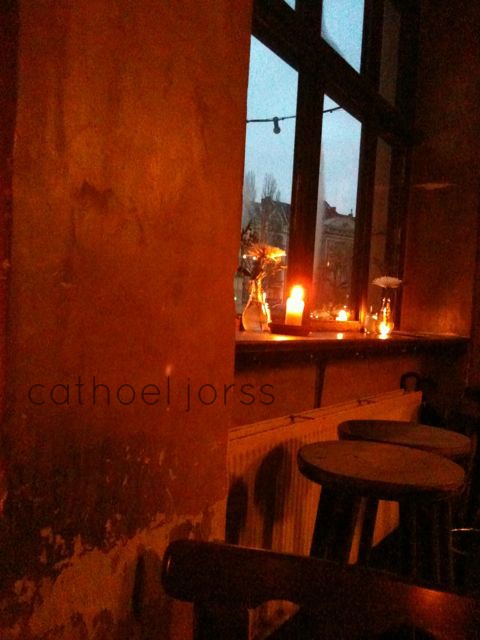
    So the skies are white, the rooves are grey, the buildings brown and cream… the either dreary or soothing winter pallet of Germany is restful to the imagination. In every cafe, candles flicker. Little pots of gold.

  • I wish I drank more

    Accidentally went into a restaurant for dinner in which I realized too late all the men were wearing suits. I tore off my two layers of wool, hot from walking, and sat there in very shabby jumper with a t-shirt over it which I sleep in, pressing slices of bread into a bowl of olive oil, reading the menu. I felt so tired and overcome by thoughts I could barely read menuese: a first-world problem. My elbows through the sapped weave of my jumper stood on sharp crumbs on the white cloth.

    The waiter was an exhausted but mildly gleaming Woody Allen man with a soft sunken pavlova of hair not quite reaching the centre of his scalp. He brought me wine. I polished the excess oil into my fingernails and admired them by candlelight. At the next table a woman about a decade older than me was unleashing her ribald laugh for the delectation of her companion, even older still. She glanced at me over his shoulder and began to whisper. Her eyes were fixed not on my face but on my peeling jumper, my bony wrists thrust from it like over-plucked hens. “Unglaublich,” she said, “unbelievable.” I am shy and had stood outside the teeming with smiles restaurant for fully five minutes working up the courage to come in. But I let my eyes fix hers to let her know that she’d been understood. She looked away. It was almost fun. I watched her for several minutes while she looked everywhere but at my face. The power one gains by being (sometimes, not always) unafraid to look someone in the eye. The uninterestingness of power except as a kind of parlour trick, or party favour. The banality of parties, at which everyone who’s best dressed can resemble a tricked-out and groomed dog, leashed and booted, with a lampshade on their head.

    I wish I were a bulb, tonight. Either a “Glühbirne” or else the kind that grows under the soil. I wish I were a better dressed kind of human, or that I sometimes combed my hair. I wish I were 21 and radiant. I wish I drank more.


  • the peace yard

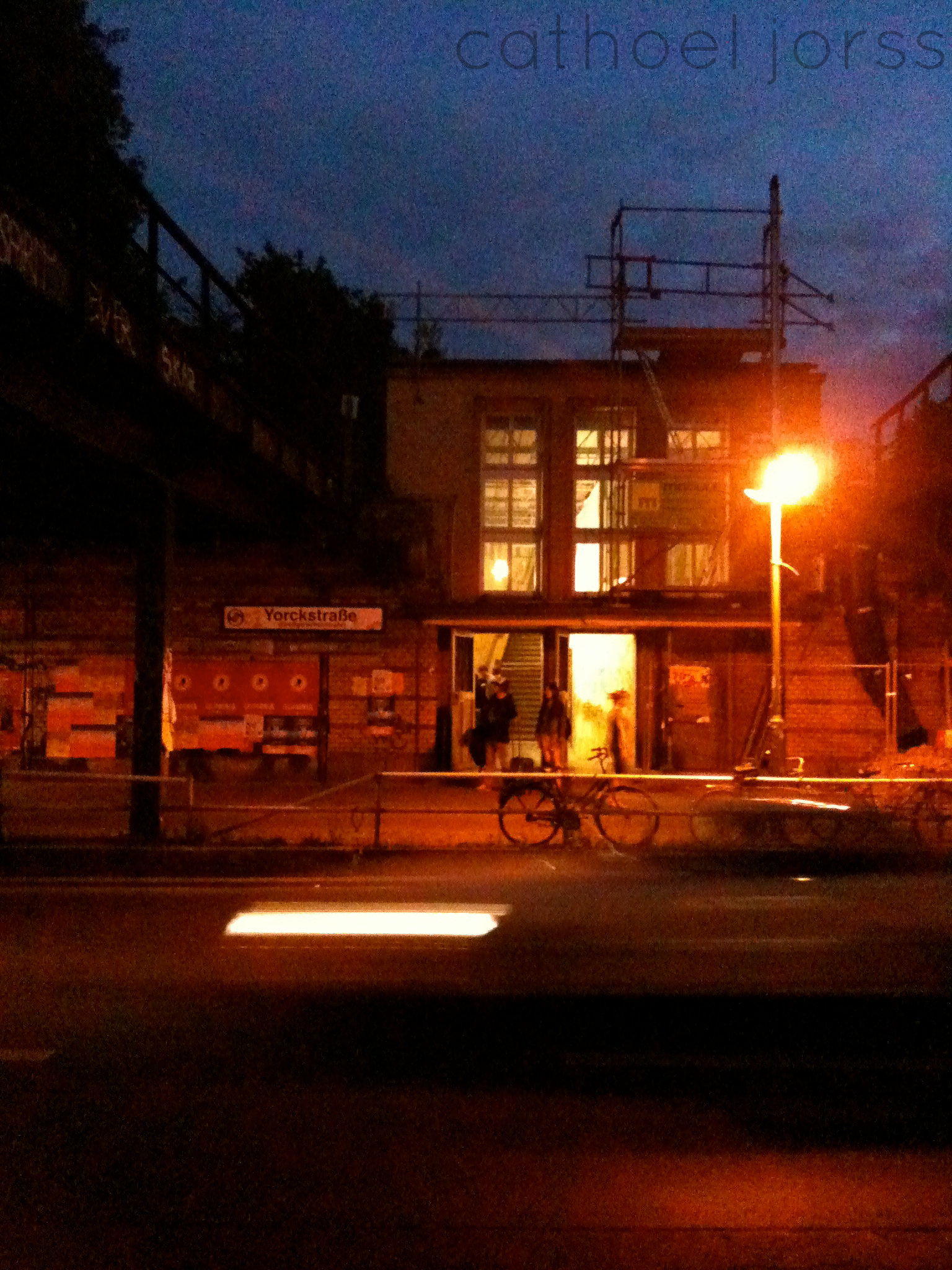
    Walking home down rainy streets my last night in this house. Tomorrow unnest, budge myself, nudge, shift. Winter has landed with its big wings. Now the warmth of the indoors folds us in, the subway’s roaring throat, we all descend, we bring our dogs and biscuits. I saw two small boys fighting in the subway train, one slammed his hand down on the other one’s shoulder their sister put back her head and roared. They were hipheight to everyone’s delicate glances, the mother looked estranged. In this city if they serve you tea it is a mess of hot water in a clear jar (hard, chalky water, that dries white) and with spoon and bag of leaves laid on the white milky ceramic… neatly. Effervescent neatness, the German delight: effortless neatless and high art and kitsch. German joy, Friede; German graveyard, Friedhof. I’m leaving I’m leaving. I’m coming I’m coming: Australia wait for me. Maybe forever as jet blurting travel grows inexcusably wrong. Standing stranded on the traffic island as the creamy lights pour in three strands down the hill like pearls and the crimson lights pour like Christmas up: I said something aloud to myself in German, I started to cry. Thank you for your hospitality, your kindness, your warmth to all the strangers, your strangeness, your calm. The leaves shaped like webbed hands that wave in the wind. The strings of lights under the lip of each awning. The Grüss dich, the Tschüssi in shops, the dogs. In 24 mornings more, I’ll be gone.


  • between the fingers of Fidel Castro

    between the fingers of Fidel Castro

    I know an eighty-year-old cafe where the day passes smooth and coiling as molasses poured out of a dented tin. I sit in the smokers’ room, not because I smoke but because of the candlelight and conversation. Today I stopped at an antiquarian bookshop that has trestle tables out front. A recent conversation reminded me I had never yet read Machiavelli’s The Prince. The bookseller had two copies, an Everyman and a Penguin; two different translators; a quick skim decided me I would buy both, and I carried them to my favourite table and curled up there, thinking if I read these two versions both at once, maybe I’ll be able to triangulate.

    I read very slowly, laying each book face down at the end of a chapter and taking up its companion. Three tall, lanky, and very good-looking men came through in waterproof jackets, carrying boxes and boxes of lettuce and potatoes. Afterwards they sat down at a small table under the pastel portrait of Fidel Castro (cigar) and drank coffee and argued for over an hour. I tried something new off the menu: it’s German food, everything is new. Fidel Castro’s fingers resembled an abstract of a human hand carved from potato. Everything carved from potato. After the War Berliners relied on an American Rosinenbomber (the “raisin bomber”) dropping boxes of foodstuffs and dug up the forest called Tiergarten in order to sow vegetables. I thought of the various cafes I know in Brisbane and wondered how it will feel to adjust. The temperature has plummeted, and isn’t that a most marvellous word: like a fruit yet unripened on the branch, that finally gives in and plunges to the ground. Last night returning from a long forest hike it was perishing, four degrees. I ate my Weisswurst and Brezel and thought about the differences between reading in a cafe full of other people reading, and the dinner experience of last night, in an unreconstituted jazz and blues pub, where the cute barkeep turned down his infestation of immemorial blues and turned on a large white roped-up screen. Oh, God: Tatort. The awful detective show Germans watch as Sunday religion. Somehow the roomful of unstirring people watching a fourteen-year-old girl’s character get raped – the oldest man put his head into his hand, others watched unmoved – was so blinding and so effing awful, we got up and left. That household full of habitual viewers sharing the dirty hot tub of popular TV had somehow less in common than the people crouched in corners at my newly beloved red checked clothed cafe: reading newspapers or, in three cases, books, we were each of us turned away from our commonality but yet reminded me of swimmers foraging deep in the saltiest water, where the sunshine is sweet, where the strands of warmer and colder waters pass over one’s legs caressingly and there is always something further to be discovered. In only the one ocean, in always the one sea.


  • to stars

    to stars

    In an unpretentious Italian restaurant where all the pasta had been made by hand, the chatting-family atmosphere fell into something much deeper and richer and darker. A cellist had walked in and in his overcoat sat down on a backless chair in front of the servery and began to play. Something, I don’t know what. He drove his fibres of unholy sound into the great grail of all of us, each of us, like an ochre long-blown off the palm of his hand. I saw the small boy with dark lozenges of eyes climb down from his chair at the corner table in the second room and go to stand, unconsciously in the waiter’s path, his head a jar for the tadpoles of surety this man was making for us. He stood and stood, listening and watching, lost to every other thing. Behind him his parents and their friend kept chatting and only the older, grizzled, quizzical looking man at another table let his gaze rest on the little music lover so fondly, brimming with acceptance, and I let my gaze rest on him in turn and the music rested on all of us, like snow, that spares no needle in the pine forest and lifts its shifting darkness turn to stars.

  • night witches past

    Cycling through the park. It’s very dark but the sky is purple. Passing alongside the old Bahnhof I see the lights leap from one long window to the next. The medieval bridge with its turrets, the dark towers, the choppy dark water. The entrance to the park is guarded by forty black men. They own it, they share it, they deserve it. This is how you make your living until citizenship arrives. Their faces are hard to distinguish in the shadows. Alles klar? they say, cheerfully, Alles klar? It means, all clear, which means, is everything clear? do you need anything? do you want to buy drugs?

    All clear, and I’d like to keep it that way. Danke, danke. The trees along the broad straight path lean over me as I speed along in a gust of wind, gathering and whispering like old women with long fingers.

  • picked it up & have kept it

    Walking along a quiet street feeling grumpy I heard a loud, juicy burst of fat laughter. Coming towards me was a man on his phone, shortish, gleaming, African, with laughter rolling through him, like a wisp of weed rolling in the sandy sea. Further down the street I saw a dog waiting in the laundromat, wistful with big eyes turned to the door, and passed a middle-aged punk whose hair had almost entirely balded away. But he had worked the few strands growing over his forehead into a messy quiff, stiffened with product but still with his own native old man’s/little boy’s curls escaping, as though he were saying to Death “You’ll never take me alive.” Coming back to the house I found a small square of white paper stuck to the cobblestones, entirely blank on both sides, and I picked it up and have kept it.