Category: imagine if

  • all of Switzerland

    all of Switzerland

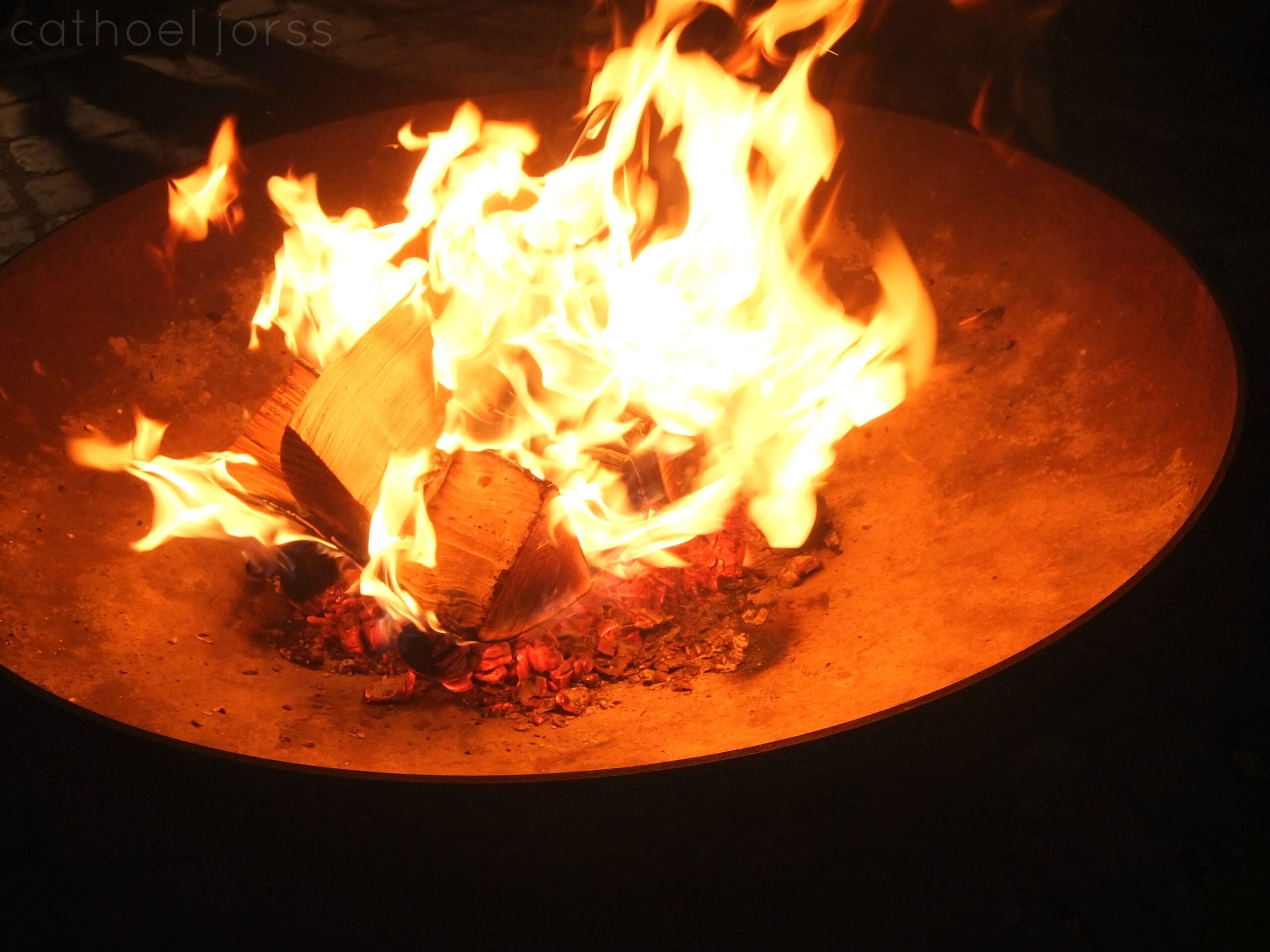
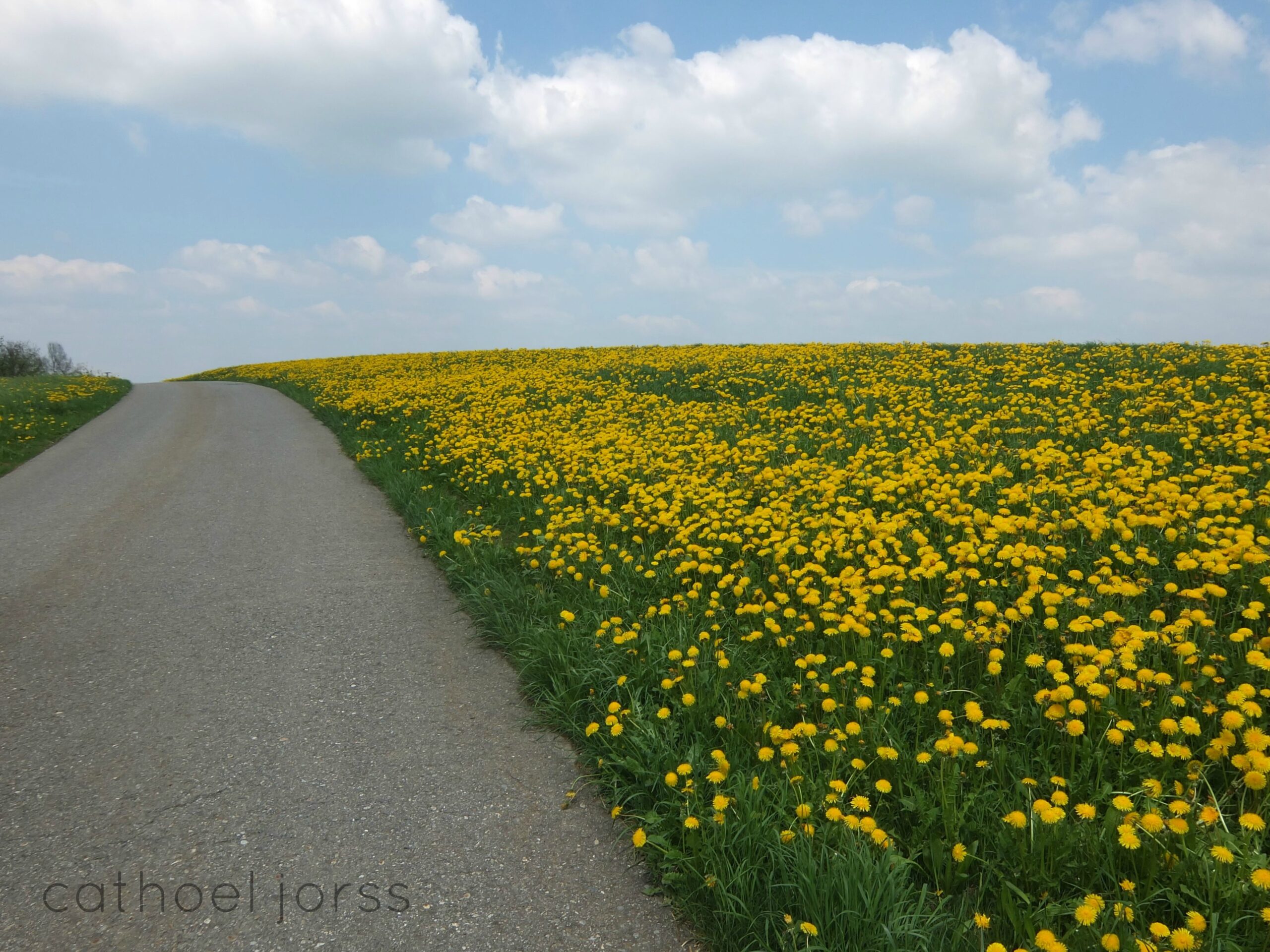
    At the top of a very high hill yesterday, what in Holland or Denmark would be called a mountain, with a view over all of Switzerland ~ so it seemed ~ my friend taught me to peel dandelion stalks so that they spring into pretty green silvery curls. Behind us a family with very young parents were playing hide and seek. They had built a fire and the father, when we showed up, was juggling with three sticks. As we sat on our sedentary bench facing the green nation, he sprinted round in front of us and flung himself panting on the ground, his eyes gleaming, intent on the figure of his youngest daughter who was counting “eis, zwöi, drü, vier, füf…” Our legs and the legs of the bench blocked him from her and pure animal concentration blocked him from us. It was as though he didn’t see us. My friend gazed down the length of his back then flung her spooling dandelion out into the green. “We used to play that when we were children, too,” she said to me.

    H2O HoL dandelion road

  • Master Georgie

    Master Georgie

    To turn the tide of a rainy & dismal afternoon I started reading. Beryl Bainbridge’s elegant eloquence has cheered me up no end… as her characters in this novel might say. This is from Master Georgie:

    “It began to rain before I reached the Washington Hotel. I hadn’t my shawl, but a spot of damp was nothing to me. In winter, when the wind howled up from the river, I huddled in the doorway of the Star Theatre. Once, an actor came by and said I was pretty and why didn’t I come inside to get warm by the Green Room fire. I didn’t go because the rouge on his cheeks made him look more angry than kindly. Besides, I knew he was buttering me, the line of my mouth being too determined for prettiness and my eyes too deeply set, which lends me a melancholy look. Another time, in December, my feet turned quite blue and Mrs O’Gorman had to rub them with goose-fat to restore the circulation. What did I care! I’d freeze stiff for Master Georgie.

    “In summer, my favourite place was on the granite steps at the entrance to the railway station in Lime Street. From there I could see down the slope to where the hotel stood within its square of garden, the red roses bobbing tall in the wind. On clear days, beneath high blue heavens, the humps of the Welsh hills rode the horizon. Now, the grey river met the grey sky, and a low white sun, sliced by the masts of ships, sailed through a splash of scarlet petals.”

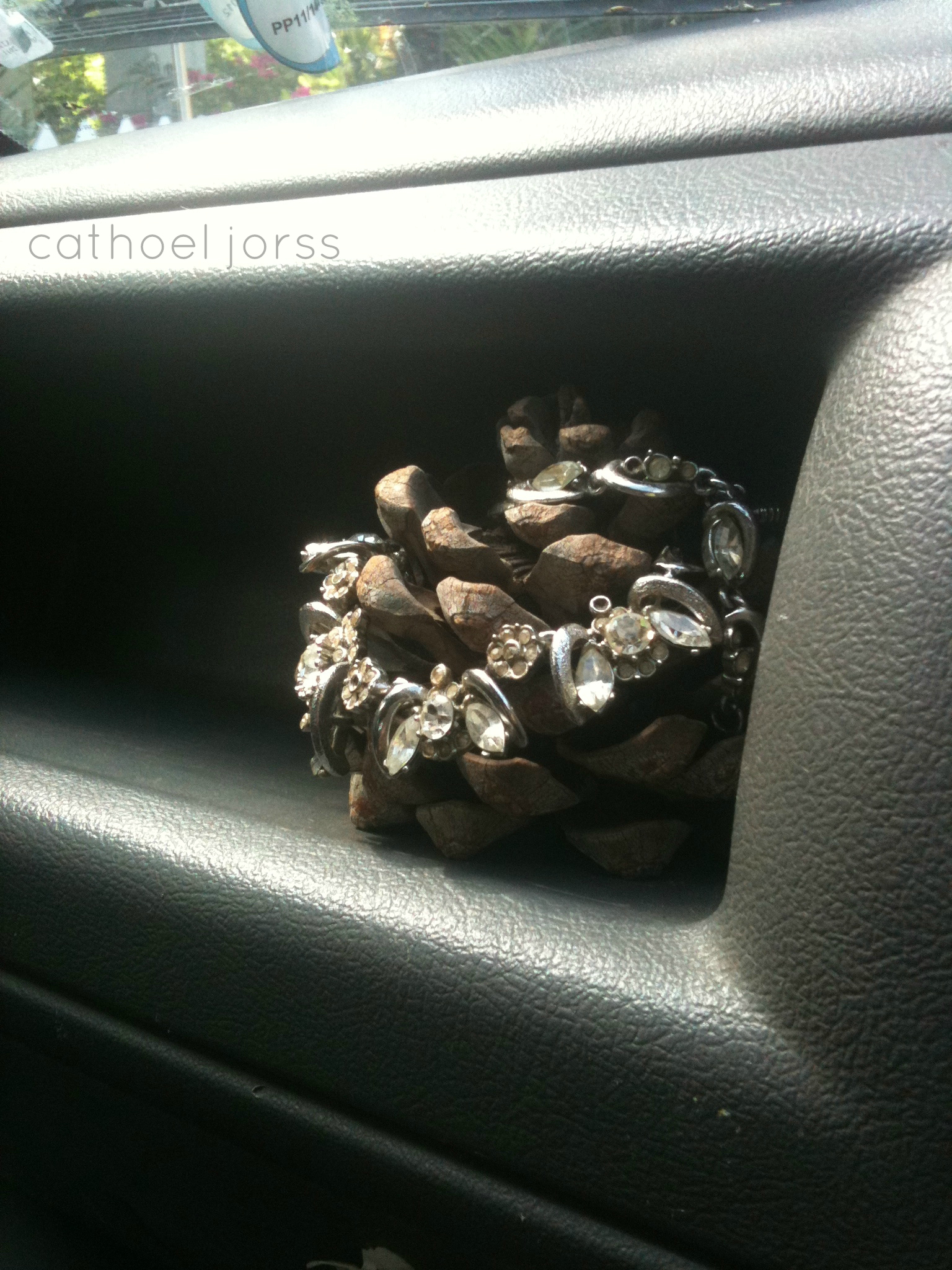
    H2O HoL dashboard pinediamonds

  • all that love

    all that love

    Robert Peston’s preface to Sian Busby’s posthumously published last novel, as quoted in The Guardian. He transcribed the novel from her notes after his non-smoking wife had died of lung cancer. “My motive was selfish: I wanted to keep talking to her. I still do.”

    He writes: “Life became punctuated by terrible shocks and emergencies. Yet those who met her at pretty much any point in this ordeal encountered the Sian they had always known: solicitous, supportive, witty, insightful, unselfish. The cancer did not haunt us. If anything, it helped us understand what matters in life: family, first and foremost; work that fulfils; friends, beauty and fun.”

    As I read his words it occurs to me everything he values most highly in the face of bereavement is love. Even beauty is a form of love: isn’t it? A mechanism for our appreciation? “Work that fulfils” is our service to the world, as well as to our own character, daily life, and development. Love is all.

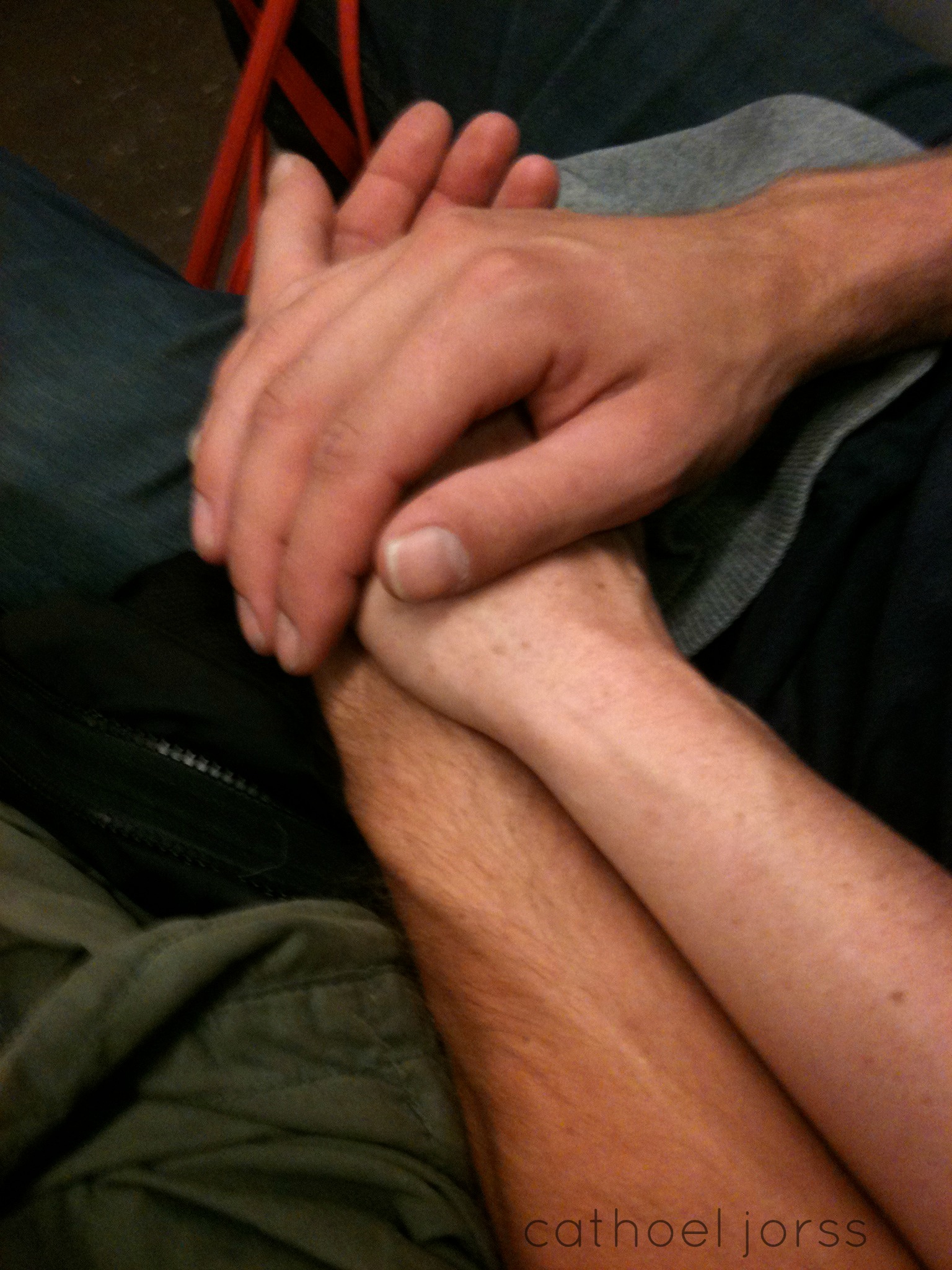
    H2O HoL handfasted

  • the dreaming

    the dreaming

    You see, I am still living in the dreamtime, where my ancestors are my brothers & sisters and trees my playmates. Sometimes I’m wiser and sometimes they’re wiser. We hold hands on the street. There are streets everywhere and everything is streets. Sometimes the world overwhelms me. I cannot move & I cannot speak, cannot use the keypad & the online booking form & can do nothing to understand anything at all. Would follow a guttering candle flame for miles along the quiet river in the dark. Stare in through the golden windows, row after row after row after row, longing for a way into the wilderness. That is the only world that tames my heart. I’m so lonely, I’m only longing, and I cannot settle. Underneath it all there is a roaring like fire or water.


  • “high, wild, savage and frightening”

    “high, wild, savage and frightening”

    What is that book you’re always carrying? my friend wanted to know. So I opened it and read to him:

    “But the first of the thunder and lightning was always high, wild, savage and frightening. Every year people in our part of the land were killed by lightning. Yet long before I learned at school that lightning was electricity, and all else physics had to say about it, I caught the symbolic ‘other’ from Klara, for whom it was a pure phenomenon of the spirit. While the women of our community on their different farms would fold up the silver and metal in the house in sheets and blankets in the belief that otherwise they would attract the lightning, hanging towels over all the mirrors and drawing the curtains in their haste, Klara would sit with me on our great verandah and make me look at the lightning because she said that every human being had the same light as the lightning in his eye, and the fiercer the lightning outside, the brighter the light with which the eyes must look directly, steadily and without swerving, back at the lightning. She believed that if the light in one’s own eyes did not respond and flare all the brighter because of the example of the lightning, there was a form of lightning that would go black and invisible, and that that form of lightning was the lightning that killed.

    “This was for me one of the earliest and most convincing illustrations of how symbolic the Bushman spirit was, how rich in the primordial wisdom stored up in that two-million-year old being of which Jung spoke to me later, describing at as ‘a living treasure of the all the experience and knowledge gained since the beginning of time’, and warning that if one lost touch with this innermost source and its symbols, life, rootless and adrift on the tides of fate, would fail and die. Fairly early in my life, thinking of the Bushman symbolism as I had done from the beginning, I thought of the lightning and the light in the Bushman eye staring back at the lightning as images of consciousness and awareness, and I ended up where I still stand today by thinking of lightning as the call to the battle for increase of awareness which is the imperative in creation.”

    ~Laurens van der Post, The Voice of the Thunder

    HoL blue point tree

  • pink for the body, blue for the sky

    chapter xi: the window does not trap what it views

    At the wilderness fundraiser we are third from the top, through no merit of our own. We are a last-minute substitution, they’ve bought tickets expecting to see a rockabilly quintet from Melbourne. It’s two months since we last played. From backstage we can hear the crowd talking in a dull roar between sets. I am perched on a stool with Sid’s drumsticks, riffing along the back of the rank green room couch trying to dispel a sudden onset of nerves.

    Pommie Dave the bass player leans like a bouncer against the green room door, trapping the five of us in. His bulging arms are folded, he is retelling an interminable story. His marriage – that doghouse, that hobble, that curse – has finally come to an end, and inexplicably he’s decided to fight his wife for custody of the three kids whose birthdays he forgets year after year. The repetition of his bewilderment, the gloomy force of his aggrieved pursuit, have driven both the name bands out of the room towards the bar. He is used to holding court with endless tales of his wife’s cupidity. Now he is reduced to an audience of one: the borrowed fiddle player, a wiry folkie seconded from our guitarist’s Celtic project, who is too much of a guest, presumably, to tell Dave where to get off.

    The fiddler lays out his borrowed chord sheets and frowns over them. I hope he’s had time to learn the songs. I wish Dave would leave him to concentrate. I have met the wife a couple of times, and liked her: a leathery, crop-haired woman who does not in any way resemble the sailor girl tattooed on Dave’s left bicep.

    Secretly I applaud her feist in quashing his outrageous bid. Through her lawyers she has made allegations of drug use (true) and mental incompetence (debatable). As a result Dave has had to undergo ‘a state test’ of his sanity, and he is spluttering from sheer insult. “I mean, a test of your sanity?” he half-shouts, for the dozenth time. “What does that even mean?”

    The fiddler’s name, I suddenly remember, is William. He calls himself Sweet William, but I can’t bring myself to. Behind him Sid hunches over his mess of rolling papers, dropping splinters of wiry tobacco. I feel for my own packet, deep in my bag. Like a wounded boxer Dave lurches his head, looking for a response. None of us is game to meet his eye.

    “Seriously,” he says again. His voice rises. “What’s sanity, anyway. How can you test it. How can any of us prove our sanity?”

    Rashly, I snort. He swings on me, points his trembling finger. Terror nibbles at me, vague and tiny and far away. “You, for example,” he says bitterly. “You crazy hippie chick. What could you possibly offer to prove your sanity to a court?”

    Could I? What could I? I look from one face to the other. The others stare blearily back, too lazy for hostility. Is this my life then? I ask myself. That I should be shouted at by angry guys, be penned in the back of a beer-stinking hall, be pleased to be playing for free in someone else’s stead?

    My mediocre guitar, my vague ambitions. The ill-formed songs I labour over in the middle of the night, with their lyrical subtleties no audience ever hears. Outside the crowd begins to roar and I catch a blur of movement in the long bank of mirrors. It is me, lissom and wiry in a tank top and sequinned shorts.

    “Come on then,” accuses Dave doggedly. He levers himself upright at last. “Just name one thing you could prove in court – to prove your so-called sanity.”

    This malice is new in him. Performance adrenalin kicks in. Something in my gut turns, a key in the lock of me, and I say quietly, “Any aspect of my fucking life, mate.”

    “What’s that? Speak up!”

    I stand up, knocking over the stool. I throw down the sticks. “I said,” I say, through clenched teeth, “any – aspect – of my – fucking – life.” I suck in a deep breath and all of a sudden I am shouting. “Go through my private papers, I don’t care! It’s all me! It’s all proceeding from the same intersection!”

    Dave retreats, muttering. “Well that’s all very well,” he mutters. Behind me I hear a strangely unexpected sound. William the fiddle player is humming, actually humming. He has taken up the drumsticks where they fell and is plying them like a pair of chopsticks, pretending to be picking up letters off the chord charts and gleefully eating them. Our eyes meet, his are smiling, he offers me a secretive encouragement. From his couch at the far side of the room Sid stands up. “They’re done,” he says, and it’s true: the MC is back onstage, this is it, we’re on. “Ok!” says Dave. “Ok!” He touches my arm lightly as we pass through the narrow door.

    We start hard. We play a tight set, angry, gradually unfolding, becoming joyful. Up the front people are holding out their hands across the lights. Dave shoots me a glinting glance of apology or challenge. We are in it for the music, and the music is in us. The low ceiling glints with lights. Men up the back leaning against the bar are bobbing their heads over their beers. We have set up a good pulsing dirty old blues with plenty of forwards but plenty of side-to-side. By the fourth number the whole place has that groove on, it has grown into a massive solid swaying, back and forth as though all of us were growing out of the sand on some shallow, shared seabed.

    “Integrity means integrated,” Trix likes to say. I can hardly hear the fiddle over the din of the drums. But on the last song William steps forward into the light. He raises his bow and lets it descend, his long arms taut with an unexpected muscle. I step back, humming a backing vocal to give him the room. With a half nod he turns to stare at me hard, over the red-shining body of his old violin. He is mouthing something and I almost start forward, catching myself, gaining the chorus. The song crashes to an end and we are stumbling off in the dark, jostling one another at the door.

    In the long narrow hallway William slows infinitesimally, letting me come alongside. He leans in and says, “You looked like the queen out there.” I take a breath, feeling the coils of my blood pulsing hard under his words. “Well,” he says, the other blokes pushing from behind – “not The Queen. But queen of some other, nicer world.”

    Somehow it happens that after the bump-out and shoulder-slapping William offers me a lift in his old postal van. I climb in, sweating under my sequins, and we hurry home, screeching through the streets perhaps not fast but with the feel of speed, from his ill-tended brakes and the gleam in his eye, his flying scruff of hair and reckless cornering.

    The city is sultry under low cloud. I follow him up the dark staircase to his flat. We crawl under the covers like two sleepy animals. Then he turns, and takes hold of me, and our animals are not in fact sleepy at all. We are racing, singing, climbing, falling, finding eachother and falling away, grimacing with a certainty that is fleeting and false but compelling. Compelling. Compelling.
  • built from junk

    built from junk

    I wonder if the reason we are all so fascinated by vampires is that we are vampires, slowly draining the blood from our land.  By our habits we suck the life out of the soil, the seas, and each other, turning workers into slaves in distant countries, buying surface sprays that promise to transform our homes into havens of immaculate lifelessness.  Is that why we want to see this as desirable and glamorous?  Is that why we long to confess?

    It seems to me equally understandable that we are experiencing gluttony (obesity) as a leading cause of death, and sex as ‘an addiction’.  These are the functions of survival: we need to eat, and we need to reproduce.  At present our survival is threatened.*  So naturally we can’t stop eating – or dieting, in some cases.  We can’t stop thinking about sex – including all the primping, dyeing, shopping for killer shoes, posing, and choosing facebook profile pics.

    I realise ‘we’ is a convenience, a generalisation so broad as to have very little meaning.  But I mean it.  We are in trouble.

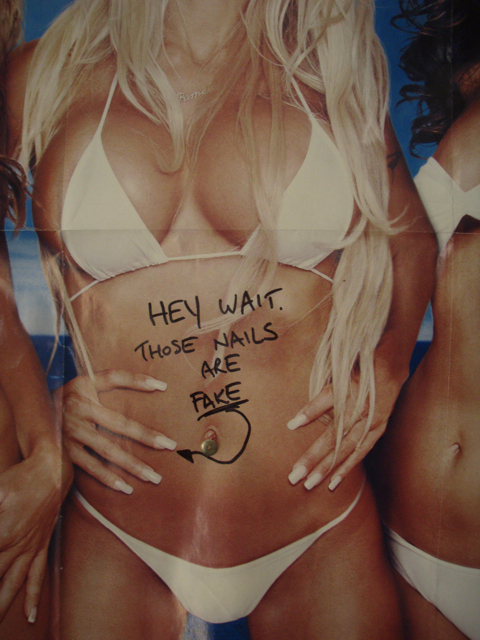
    On the high street I have been noticing a giant poster advertising skinny jeans.  The models stand in a pouting row, bare-breasted, coyly protecting their chests with splayed and manicured hands.  These are porn poses – the kinds of postures that ten years ago I would have never have seen, unless I had sought them out in specialist magazines.  Now they are normalised on the high street, a flagrant yet oddly unsexy display.

    Selected through a punitive auditioning process, photographed at the pinnacle of youth and freshness, these beautiful girls are highly socially desirable.  To get here they have passed through the eye of the needle: dieted, dyed, denied themselves.  The four of them embody what every eight-year-old girl dreams of.  Yet on closer examination they seem weirdly unhealthy.  That glowing skin tone has been artificially applied.  Round the midriff they are pudgy with incipient rolls of fat.  These beauties are not built as their mothers were out of fruit and fibre, vegetables and meat.  In fact they are the first generation raised on hormones and additives, preservatives and complex fats.  They are built from junk.

    As Michael Pollan points out, processed foods that do not break down on the shelf are not in fact foods at all.  And if microbes won’t eat them: neither should you.  Drifting down the alleys of supermarket aisles in a torpid trance of sugar overdose, slow-moving with fats, we are all busy building ourselves out of junk.  If fashion models show signs of deterioration at their physical peak – what does that say about the rest of us?

    …………………………………………

    *To those still clinging to the driftwood of climate change denial: your arguments are built from junk.  If science is mistaken. If our actions, unprecedented and massive in scale, cause only some tiny fraction of the natural cycle of climate change. Therefore it’s overwhelmingly urgent we make every effort in that tiny percentile we influence. Use your logic: it’s imperative. All hands on deck at this point. You’ll be welcomed.