Category: kindness of strangers

  • tattoo virgin

    Wandered into a cavernous caff in West End and the girl there was showing me her tattoos. I am squeamish and have never pierced my ears. Tattoos are beyond me, I wouldn’t, I couldn’t. We stood poring over her long brown arms, turning and tracing the story which evolved from something simple into something faceted. “It’s nice talking with like-minded people,” she said.

    I thought about this word like-minded and what it means. The people I hear using it seem to be people I feel comfortable with. I wondered is it just what I’m hearing, or is it that people who use this word tend to be people I get along with and like. Is it a less judgmental and more fluid term than for example “they have values I respect.” Is it less confining and more welcoming and free from expectation than the older “we have a lot in common.”

    This girl bristled with insignias I don’t desire or share. There was an age gap. We were strangers. I was her customer. What was it that lept the gap in such a brief conversation, that left us feeling comfortable, feeling even a mild affection? How did we divine our like-mindedness? Well, through expression and language and tone and eyes, the languages of the soul and body. Does like-minded maybe mean not so much “our minds are alike” as “we both tend to like people’s minds”?

    I think about the conversations I have with the people I would call “like-minded.” Every week, some spark, and some do not. There is something exploratory. An acceptance of difference. A failure to require the stranger to conform to a recipe either of us have arrived with, or that has been ready-handed to us.

    In the miracle bowl of my brain and the miracle foreign world of hers, something gleamed. There was an element like sunshine or moonlight or rain that we could enjoy in one another that was universal and therefore shared. The sparkling sea of rain that sloshes round a souvenir: an experience there are more than fifty words for: two separate worlds stood side by side for a fleeting instant, worlds transparent yet ineffable, in a shared kind of frame, like snowdomes for entirely different monuments.

  • plain clothes police

    This cafe installed in a loading bay has floor-length open windows, I am sitting with my back to the sun reading an ambitious local free paper. It has a row of Brisbaneites each standing holding their sign, the sign of what they’d love best to see, the signs of the kind of world they want. Invariably, or infinitely variably, it is a form of ‘everyone accepted for themselves’ or ‘a world without prejudice’ or ‘an end to war’. However underneath the idealism are pragmatic and tousled lists of self-love, love in the most measly sense: what I’m wearing? Label X jacket, shoes by Label Y. Even the youngest, even the oldest, are able to parse their outfits breezily, ‘a loafer,’ ‘a pant.’ Where I like to eat? Groovy Bar Z.

    Last week we read an earlier issue of this publication in the same two seats in the loading bay, then as now a cold breeze running through the crooked, open space like large, stately passages of cool sea water. A fly tried to drown in my eggcup of honey, I fished him out with a teaspoon. Flung him out into the sunny breeze and he flew free, a kite trail of honey sprinkling the grass. Moments later my companion nudged me: Butterfly! Indeed, as if out of thin blue sky, her brown wings velvety light and tremoring she supped the round drops of honey. She laid her wings open in an ecstasy. I scooped a little more out and flung it wide, see if I could make her dance. She did.

    A police car pulled up under the tree. A man in casual clothes got out. He was unshaven and looked rumpled and sweaty. He slammed the door then thought better of it, reached back in to retrieve something, a folder, locked up behind himself and came past the long draughty doorway. I began to laugh and pointed past him at the police car, accusingly. “Did you steal that?” “No,” he said, surprised, good-humoured. “I know,” I said, “just it would be so funny.” I cracked myself up. My tablemate reported the off-duty officer was still laughing when he crossed past the open passageway which is their galley kitchen and which ends in a slice of street. Two men came in and sat across from each other at our next table. The table was white-legged with a polished wooden top; of a series of mismatched chairs the guy in neon pink singlet drew out the one painted egg-yolk orange. I went over to them and crouched by their table. They looked startled. “I’m sorry to interrupt. I have this friend who’s obsessed with orange. Would you mind if I took a photo of your shirt and the back of that chair?” He waved his hand and the other guy barely smiled. “Sure, knock yourself out.” But twenty minutes later when they had finished talking and I had filled three more pages of my notebook they got up to leave and stopped off with us. “Did you get it?”

  • tell me in tongues

    Yesterday three of us went along to a workshop whose purpose is play. They say, there is no wrong way of doing this. If you run into someone whilst crossing the room, say “Thank you.” This saying of thank you rather than sorry has transformed my street life. I no longer apologize simply for being here nor do I feel they owe me apologetics either. In this workshop we had to sit in partners and explain to each other something using a made-up language, or any sounds: “the last film you saw,” decided the convenor, 70. My mind flooded with The Great Beauty. I described it to my companion in a torrent of what doesn’t exist. Now, it does. The room was filled with people’s sounds and the great flooding windows stood open. Afterwards she said to me her dark eyes glittering with tears “I was nearly crying. That film was just so moving.”

  • people’s republic of woodford

    Woodford. What I forgot is that it is less of a festival, more of a place. Wherever you go and whomever you see, the valley grounds hold everyone up to the sky and in the natural amphitheatre right up back the venerable trees stand watch. It must be ten years since I was there, the farm is becoming a forest. I looked for the three trees I have planted and could not, as ever, recognize them though I know which creek they bed. People streamed past dressed as butterflies, faeries, warlocks, saggy pyjama case bears, acrobats. A girl in a hammock turned her head and smiled the slowest smile. Children who had just learned a skill in a workshop busked it. Last time I was on this land was for the Dreaming, a festival of indigenous cultures from around the world. That was in winter and only lasted a few seasons of massive fire pits attended by volunteers. My MCing friend said It’s a good day to come, the dust has settled yet it’s not actually raining. At the gate I was nervous, a reflex response from the old days when I always had to perform. This was my first festival as a punter. The ease! We saw in the year on a hillside opposite a booming stage spilling execrable local dub (“all the people are here & the people are grooving, we got the music and the music is soothing”) and then, because someone had decided they would book a Hogmanay theme, blithering Scottish dance music. I have inherited Scottish blood but musically, no Scottish soul. It struck me as comical: imagine the Scottish composers composing this music: they’d have been saying to themselves, Well, we’ve got the solid wall of screeching bagpipes. But it’s just not screechy enough. I know! Let’s add in a screechy fiddle or two! And wait, we can also have screeching penny whistles. It’ll be magic!

    Quiet on the hillside soaking in the presence of the large, grave, lit trees I was glad when a girl came on and announced, “I’m here to calm you down.” She sang a lovely slow ballad and then everybody across the whole site lit candles and stood or sat together in a three minutes’ silence. I stared into my candle and cried, in silence. The wax burned down leaving little fiery blobs on my palm and I peeled them off, in silence. The flickering silence swept all down the hill and you could hear and more, feel it extended over everybody, not one person broke trust to bellow Happy New Year, everybody “set their intention” as the girl handing out tiny turreted birthday candles had advised and I could feel the piety, the wishes of a dozen thousand all resembling one another. Afterwards the band invited yet more people on stage and in front everybody danced. The set-up between the acts was filled with tap-dancers. Body percussionists led the crowd: “Peace and rhythms!” A bare-chested boy tumbled down the hill turning somersault after somersault. A man climbed up past us, almost bent double from the gradient, dressed in a suit made of light bulbs. Five girls stripped off their clothes and danced naked under the new moon, repelling with raised hands the lit LED necklaces with which an infatuated boy wanted to garland them. The grass was filled with tiny creatures biting and climbing, we were barefoot like the moon. The t-shirt I coveted on a bamboo stall had a tiny figure in silhouette standing with a walking stock, head thrown back, among the giant trees that here surrounded us like immense quiet candles and its legend ran along the ground, legend like a snake, Respect Your Elders. Coming down from a noisy dawn in a noisy trail of irreverent pilgrims we rounded a corner and a really drunk man coming uphill said, beholding our two great heights (“Oh look! A giant!”), “Oh. Wow.” Then he folded us into a big drunken hug, a kind of Come here, you, and the three of us murmured into each other’s shoulders “Happy New Year. Yes, You too. Have a good one. Have a great one.”


  • trepanned

    A confluence of kindness in the Sunday cafe this morning. People were slouched about, eating their brunch. A series of wan songwriters entertained us from the speakers. When we first walked in a classical guitarist had just done playing, and when he walked around the tables with his cupped hand outstretched, everybody gave. Then a commotion at the doorway. A very very drunk lady sloshed her way in. She shouldered her way between two quite closely placed tables and sat down. Oof. Began talking to the woman on her right, who clearly didn’t know her. It was a long bench seat along the wall so now all three women, ladies who brunch with a lady who lurches tucked between, were sat shoulder to shoulder like pigeons under the framed oil paintings of Karl Marx. The place is called Cafe Marx, been there for years apparently. The drunken one pulled off her filthy beanie, revealing sparse tufts of grease-darkened hair. She was loud. And she looked smelly. The woman she’d spoken to rose to the occasion like the Queen. “I know,” I could hear her saying agreeably, “it’s freezing outside.” The drunk one said something inaudible, affable. “Ja,” said her invaded neighbour, “gemütlich.” Gemütlich is a word like the Danish word hyggelig: cosy, it means; warm, comfortable, comforting. The kind of word you invent when you live in a climate where a person consistently turned away from every door can die just by sleeping in the park overnight. The waiter came over to reason with her. Her voice rose, she waved her beanie at him. At first he said, Can you go, please, and You will have to leave, and Do you want me to call the Police? “I am the Police,” she said grandly, settling her beanie back over her ears. But the women either side of her and their companions were wonderful. Unworried. Well, worried but cool. They started suggesting to her, Perhaps you’d be more comfortable in the corner there, that looks so cosy, wouldn’t you like to have a table to yourself? Why shouldn’t you have your own table? “Yeah,” she said, in tones of worn aggrief, “yeah, why indeed.” And as she staggered to her feet and lurched towards another table (ours) the waiter once again stepped in, more respectfully, more kindly this time. His customers had taught him that – or rather, reminded him, as we do for one another. Gently he took her arm. “Could I ask you to sit outside?” he said, in such courteous tones that she was able to pretend she had been given a choice, to deliberate a moment and then decide, “Also dann.” Ok then. He escorted her to the door, more like a nephew than a bouncer suddenly. The people on the bench seat shifted and laughed quietly, restive with relief. You know how belligerent you get when you feel like your humanness has been ignored. She was aggro. But lost. In the wind outside she sat down with some difficulty. I went over to the counter and spoke to the waiter in a low tone. “Das haben Sie so schoen gemacht,” I said, “so freundlich.” You did that so beautifully: so friendly. “Aw,” he said, looking down. He was putting something on a plate behind the high counter. I said, I would love to buy a coffee for that lady, if… you don’t mind providing one for her. (Thinking of the risk to his china). But by the time he brought the coffee, hot and rich with crema in a takeaway cup, she had gone. The overturned table and smashed ashtray on the ground were all she’d left behind. I walked up and down the square for a while looking for her but she had moved on. And would continue to be moved on, I imagine, all the rest of the winter. And would perhaps be picked up by the Winter Bus that goes around collecting people who have fallen asleep in the snow. And whose fire in the belly, lit and swollen from the magic bottle, might not be enough to keep them alive til morning, in the dark cold lonely treesung night.

  • replanting

    “Aw!” ‘What?’ “Aw just… somebody’s torn this little plant out, and now it’s gunna die.” I could hear my surprised, injured tone of voice, high like a disappointed child. My friend stopped and I had already squatted in front of the dismal garden bed built round the trunk of a tree, in which someone had planted four or five tiny evergreens and a wilting marigold. It was two degrees this morning; I had on leather gloves. Ideal for scraping out a hole in the soil. Took up the tiny shrub, lying on its side in what seemed to me a foetal position, and stowed it in it new hole, tucking soil around its roots and talking to it as I pressed the dirt into place. “There you go, that’s better…” I stood up, brushing my gloves against one another, and turned back to my friend and our conversation. A woman on a bicycle had stopped to watch. She gave me this head-tilting, compassionate look with two very very slow blinks of her eyes, acknowledgment.

    At home on my kitchen windowsill I have a shred of pelargonium stolen from someone else’s window box, a present for a friend who cannot keep sprigs of basil from the supermarket alive yet dreams of being a gardener. He only has a tiny, bricked-in, West-facing balcony that looks dismally over a supermarket car park. I’ve shown him photos of how, in an Australian climate at least, you can grow a lot of food in such a space. When I saw this still-flowering window box with not just red and pink but also the darker, sultrier, more sophisticated velvetty maroon flowers, I filched a bit, peeled from the undermost hem of the plant where the person caring for it would lose least enjoyment. A few paces further on I found an empty plastic cup. Scooped up a cupful of leaves for the bottom layer and then a handful of rich dark friable soil. Stowed the incipient plantmonster in there and will nurture it until it has begun to send out some roots, hopefully before I leave Berlin, so then it can be passed on to its new owner with hopefully some chance of surviving the grey winter.

    As a child in the tropics I used to worry about the trees, who seemed to me buried to the neck in hot, foetid soil, unable to move, >trapped!!< It took me years to work out that this kind of simple projection is not really compassion, does not help anyone. Years, and some lambasting from a Tibetan Buddhist nun who yelled, “You have too much compassion & no wisdom! No wisdom!” In any case one imagines suffocating heat is less of a problem for a German tree.

    H2O HoL white river flowers

  • unforgiveably gone

    Today my hair kept tangling in the buttons at the back of my coat. I spent a long time standing in doorways or under trees, thoughtfully fishing there with my fingers, dreamily, gingerly unwinding. I’ve been spending time in a cafe that was opened “ca. 1930” by the stout pretty dark-haired woman whose blurred photograph on the front page of the menu (hand-written) may have been one of the last ever taken of her. Berlin’s dark, sour, staining history runs alongside every step, like the raised seam of bricks which traces where the much more recent Wall has been carted off and destroyed: maybe she was torn down, maybe deprived of her life and livelihood, maybe dispatched, grossly outraged, starved, murdered, ruined, unforgivably gone.

    The brass plaques, size of a cigarette packet, that here and there replace one or two cobblestones with a name or a family of gone names are, I found out, the work of one artist.

    I spent much of the day in her cafe, writing and writing, had a bowl of broth with pancakes rolled and thinly sliced into it, lingered, in the air spiked with smoke, over a menu of dishes I couldn’t understand. Because even where I can translate, the concepts are unfamiliar and dim: Leberknoedel, Schupfnudeln, alles mit Kartoffelecken.

    When I came out the blue hour had struck and everything felt festive. I went into a hat shop and wound my way along the walls right to the back. I picked up and fingered things, stroking and probing. I stood in front of their long polished mirror wearing a crimson top hat that was too big and came down over my brows.

    My new Kiez is studded with turreted buildings, an old tollhouse, an old gatekeep. Many of them now are restaurants and the golden interiors, the white clothed tables, the solicitous bending of waiters in the windows – the shimmering, old-glazed, inviting windows – were so irresistible. I resisted. I went into the supermarket which bursting like fruit from a basket was so much more vivid, more lively than the dreamily acquiescent twilighttime street, and filled with families. Stubbornly determined to cook in my two-room palace of hired minimalism which has no pepper grinder, no chopping block, and no knives, I snatched up a small sack of potatoes, some garlic and onions, a roll of butter. I have powdered stock and a Swiss army knife and I reckon it’s enough to make soup.

    It’s so cold. The insides of the windows are cold. Not too cold. Not just yet. Deliciously so. My landlady hovers like a ghost in the hollow of her white apartment, her beauty, her wide frightened blue eyes with their large pupils staring like bullets. I found our bed last night to be beautifully cosy and soft, woke to a window of tree. Once I’d had a bath there seemed little else to do and I felt so happy about that.

    In the evening after I’d moved in, before the bath, I went out exploring, feeling hollow and hungry inside. A restaurant golden and beckoning softened the corner of my new street. I stood shivering in the dark for ten minutes and walked up and down and up and down again before I found the courage to walk in the door and thus enter its enchanted, entire, intact civil world. It was disconcerting, after all this long travel, how hard it felt just to walk in. Intruding on the community of this new district, unknown to me like a new city, by this decision to eat out took far more courage than I’d expected. I so often eat alone and I like that. But I guess my adventurousness is exhausted.

    In Melbourne I used to notice this, every morning even when I’d been writing over my breakfast in the same cafe every day for months: the forcefield that people establish or emit when they form an unconscious community, shiftingly, by being all in the premises, by forming a varied, large party, strikes me like shyness buzzing electric across the doorway of every new cafe, and always has; this felt far harder.

    Now, this evening, everything feels different. I can feel I have found my way. The new part of town is becoming my Kiez. Its dark streets of houses feel now already less intimidating and austere, more quietly homey and interesting and wan. My sublet in its dank courtyard is divided from the welcoming bustle of shops by a river of rushing lights pouring the hill, like sand, from one glass to another. My sight clears and I start to see. Not everyone here has money. Between the lifestyle shops are the lifeline shops, where hungry people find what they eat. I am hungry. I’m always so hungry. At the supermarket checkout a man in front of me said to the cashier, Holst du mir mal vierzig Cent? Ich habe keine Brille mit. Can you grab me the forty cents? I don’t have my glasses. Obligingly the guy sorted through the coins, patiently, turning them and showing them til he found the right ones. The guy behind me made a friendly remark and I turned it to advantage – a politician! Laying a finger on his bright yellow toilet rolls I asked, Have you ever thought of trying out the recycled kind? No, he said, in a tone that showed it’s never crossed his mind. It’s just that the trees take such a long time to grow, I said. And it takes a long time to replace the ones we chop. He gave me his twinkling smile. Next time, he promised, I’m going to remember that. I piled the stuff into my knapsack and took up the mesh bag of potatoes by its uppermost root. The corner of the sack yielded a perfect potato, an archetype, shaped and sized exactly like an egg. I closed my fingers and palm right round it and used that to carry them home, internally a handle. The high blue wintery sky and red lights were so absorbing that I accidentally walked right past my street and found a brand new park. The grass was still dimly green but the trees already blackened by night. Little children darted round the path, excited, calling out. As I turned back for home I saw a little family, with very young children, slowly climbing the damp stone steps carrying candle lanterns. The parents’ lamps genteelly leap-frogged each step, one by one, the candles swinging three feet up from the stone. But the littlest child, to whom walking is still a labour of concentration, held his lantern outstretched and swung it right forward with the effort of each step’s climb. I came home and put the potatoes on and put on all her lamps. The window above the bare desk is a square of black in this white soft room and I can hear as I’m typing the dark-throated toll of some old church’s beautiful, wild, German bells.

  • little flower

    little flower

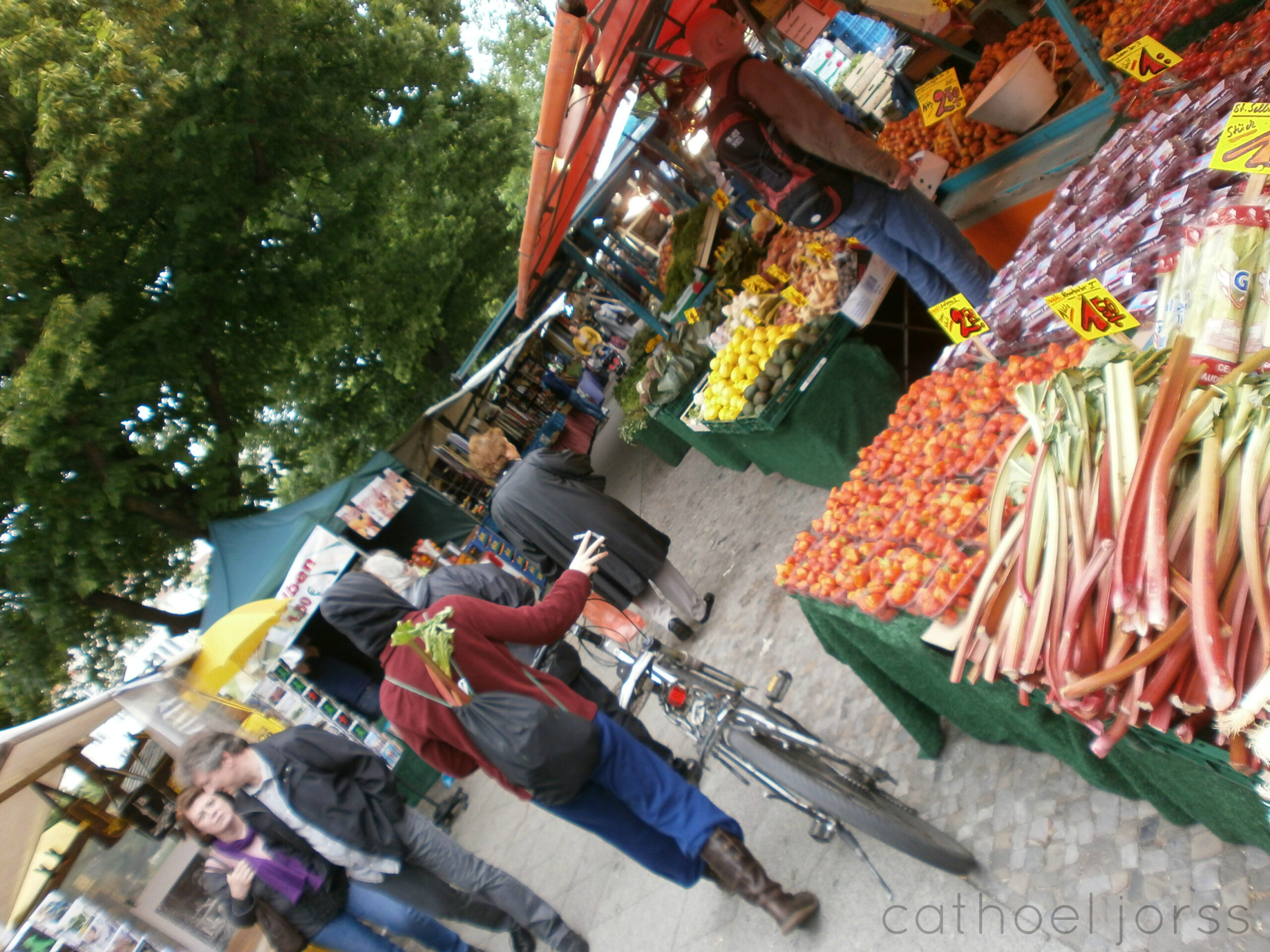
    Went onto the market, transformed now with its leafiness half on the ground, and half overhead; I wanted parsley, and something else leafy, maybe spinach, and potatoes. So many types of potato, each ugly in its own precious way, it would be nice to buy one of each and label them with toothpicks (i, ii, iii… xii, xiii, xiv) in order to find out once and for all how in flavour and texture they veer. The buying of parsley I always find a puzzle here: what is the German for a bit, or a bunch? I didn’t like to ask the grumpy lady in mittens who served me today smilelessly. At the smoked fish van in dappling shade I hesitated over the golden reams. A guy was playing steel drums in a kind of trance, which he had transmitted to the several small families swaying in front. I said to the fish seller when he came back in, I’d like a couple of those fillets please. I said, ein Paar: a pair, a married couple, a few. He picked one up in his long curving tongs, like a beak. How many is ein Paar? he asked. Well, I said; actually, two. Ah, he said, laughing: so an actual pair! He began wrapping the fish, chuckling softly to himself. Ego stung me and I wanted to find a cunning way of letting him know this is a second language for me, over just a few sentences people don’t always pick it up. You know, I said, artlessly, guileful: This everyday stuff is the part I find hardest, in German. How many is a few? How much parsley do I need? Is it a posy, a bouquet, a… well, ein Bisschen: a little bit?

    He knotted the paper bag and spun it with that deftness so stylish in stallholders. He was considering my question. Well, he said at last, you can’t go wrong with a little bit. Ein bisschen. It’s not a posy or a “little flower” (“Blümchen”, I had said). Ein Stück, a piece… yes…. you can always buy a piece of parsley.

    Peter Pepper. I took the parcel of fish and stowed it with the parsley in my bag. Thanks, I said. He handed over my change. “And now, you get ‘a little bit’ of money back, too,” he said, using the familiar form of “you”, which gave me a warm feeling as I stowed the piece of money in my pocket and wandered back past all the closing stalls with their shrieks and two for ones.

    H2O HoL markets colourful

  • someone else’s rage

    A girl with a most glorious voice started singing as the train took off, she was hidden by a mess of passengers who cleared, instinctively, to give her some room. Playing a tiny ukelele and letting the song free like a bird: her fond little scratchings on the instrument suited the sweet, round spiciness of her voice. She sang “Leaving on a Jet Plane” and somehow turned it into a kind of confident kvetch. “Don’t know when I’ll be back again ~” or if, babe, if you don’t shape up. Her hair sprang up out of her head like fireworks, fizzing in spiraling coils. She was relaxed, she was vivid. I searched all my pockets: not a single coin. But I could applaud, and the lady sitting opposite, huddled in the shoulder of her stolid-looking husband, sat up and clapped as well. I was about ready for some music, having had a close encounter this morning with somebody else’s pain and bewilderment, a massage therapist who had told me too much of her personal stuff and now retreated behind a wall of rage so sudden as to be rather terrifying. Why are you now so angry with me, I said, and she said, because we keep talking about my stuff. Now just lie down and let me treat you. I had said, when we found ourselves back on That Topic, you need to take action, and she snarled: I’m so sick of your opinions! How did we get ourselves into this? It was my fault, she told me, because on arriving I had asked “How are you.” So I was riding home sore from a non-massage and felt glad of the girl with her spunky round voice and her star-spangled stockings crossed over each other, comfortably loosely, as she leaned against the door. Glad of the blue sky when I came out of the train, its creamy little penguins of cloud. I stepped round nine Australians in the street who were saying to one another, patiently, “I want to do the museum and then the Wall,” “Well, I thought you wanted to do the club park”. I stepped into a bakery and said, “Haben Sie Brezel?” “Alle weg!” she told me, looking up from her scrubbing and then saying, ah, no, look – there’s one more left here. I took my pretzel into a corner store and bought it a beer. Because, fuck it. The girl at the counter was so divinely beautiful I had told her so before I realized I’d opened my mouth. “You! are beautiful as a picture!” Thanks, she said, laughing, perfectly familiar with her personal splendour. It was such a joy to look at her and laugh and to walk home along the slow, clogged, crowded street with bread in one hand and with beer in the other. If I could find the desert here and the beach, if I could find a way to make a living, I would live in Berlin for ever and ever and ever and never sleep.


  • the godfather underground

    Riding on the train underground I feel like a caterpillar carving through the belly of the city. The hungry metallic smell of the train’s breath is become familiar as I jog down the steps to Underworld. Sitting and writing and sitting and writing. I glanced up and caught the eye of an elder gentleman standing with his son against the glass doors, watching benignly. He said, across the carriage, “Schoene Schrift!” Lovely handwriting. Oh! I said. Thank you. And he nodded and nodded. I went back to my page. Filled it and turned to another and smoothed it down. Finished what it was I was saying and capped my pen and slipped the book into my bag. The doors opened onto the platform and this man and his son, my age, were standing beside me. He stepped back to let me past. “Alles schoen aufgeschrieben,” everything nicely written up, he said, with great satisfaction. Unintrusive and approving, like a kind of fairy godfather.