Category: street life

  • elephant in the womb

    elephant in the womb

    A punker girl crossed the street under the shady trees, shouting at some invisible or internal enemy. She was dressed in black from boot to root, her ears infested with silver and bone. Parts of her bristled and other parts erupted with pus. She scraped a chair out at the cafe where we were reading the paper. I can read German upside-down, almighty me. A little girl of eleven who escaped an arranged marriage showed her luscious unformed face and said, if you make me marry “ich werde mich umbringen.” Meantime the blackclad punk had sunk into some suicidal nirvana of her own. Maybe she was married too young, against her will. Heroin came and took her in his boat, she paid the ferryman, they rattled off knocking and whining on the water. Twenty minutes later two police officers appeared, wearing plastic gloves, and stood over her til she roused enough to stagger to her feet and fall to the ground. We felt sad in the belly and my companion pulled me away. Death in public, and the underworld that clings to the surface. Drugs and their many-splintered joys. Just say nowt.

    H2O HoL outback elephant eye

  • duck surfer

    duck surfer

    Watching an adolescent duck flying upstream and surfing down, flying up and surfing down, over and over on the fast-moving river. Finally he hauls himself out on a low-hanging branch and sits there, drying in the sun, quacking with satisfaction.

    H2O HoL stream indonesien

  • they don’t speak

    they don’t speak

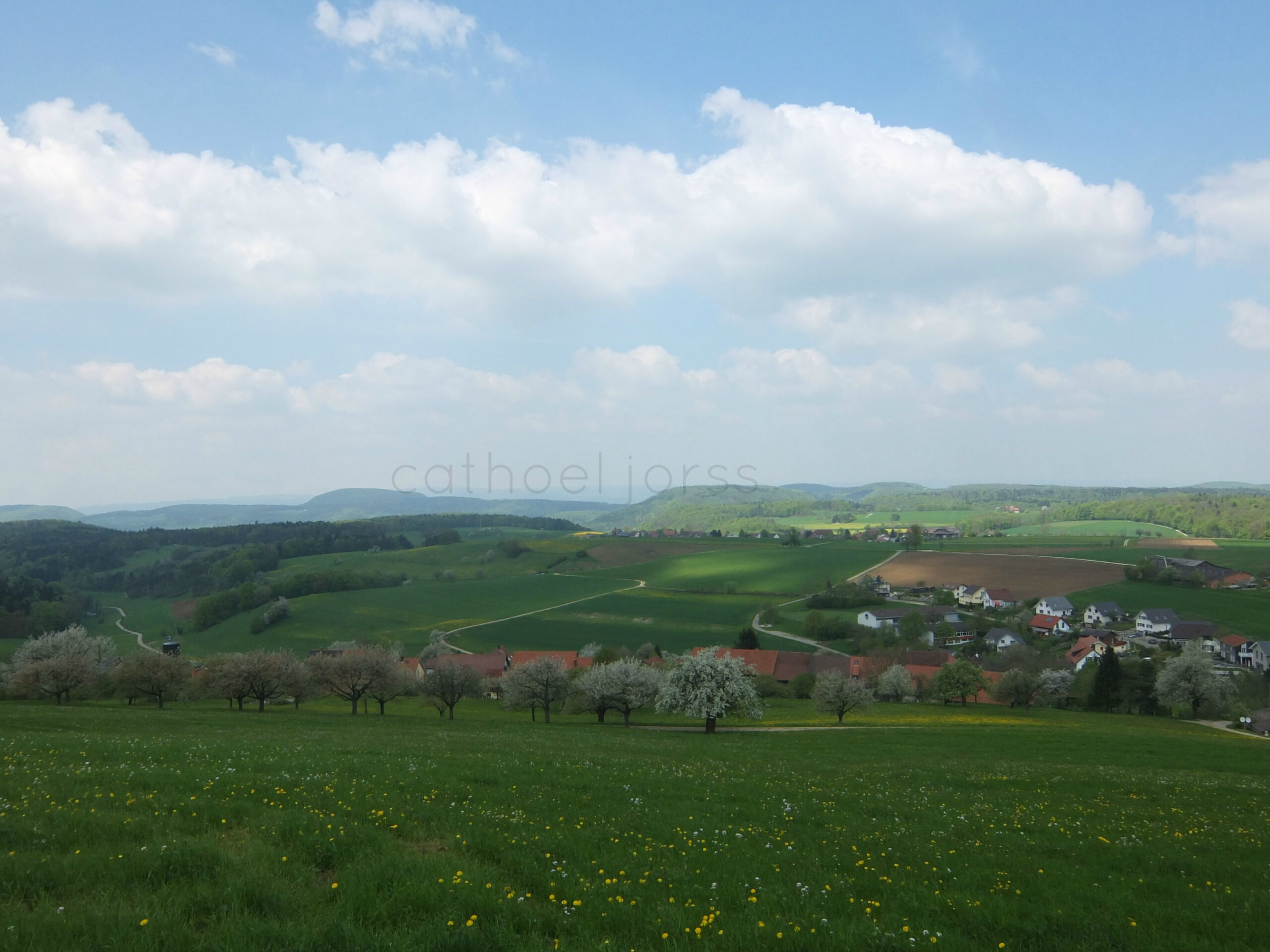
    Switzerland: land of milk can honey. I am back and the milk from the Bioladen is fresh and sweet and creamy. Honey-coloured cattle browse along the path flicking fat mosquitoes with paint-brush tails. It’s all pretty: even the oversized Lego industrial landscapes. Life is orderly and a little prim. A church on every hillside: Catholic and Protestant (they don’t speak). The building of minarets on mosques is now forbidden here, it contravenes the Constitution. The snarling sprawl of Berlin overgrown between upright German houses, climate chaos and poverty seem very far from shore.

  • the human scenery

    the human scenery

    On my last day in Berlin I visited at last the Museuminsel, Island of Museums. It feels strange to ride an arched bridge onto an island on your bike. The island being castled with stately buildings filled with treasures only makes it the stranger. My favourite was the first, which holds treasures rescued or stolen from ancient cultures around the world, many of them excavated and painstakingly reconstructed by Berlin historians. Bits are still missing. You walk into a temple rebuilt under a soaring roof and begin to feature on a hundred fellow tourists’ documentary records. So few people were examining the faulted relief work with their eyes. They carried screens, like bashful eighteenth-century ladies shading their virtue with fans.

    I was wearing a comical and very old beanie bought in a bead shop in Copenhagen. The lady who sold it to me bought it in Cameroon: she wanted a good price, saying, I am too old now to go back there and find more of them. “Kings wear them,” she told me, and showed me a photo of several kings standing about splendidly wearing hats like mine – it is woven out of navy and soiled cream yarn, and has all over little inch-long prongs sticking out like a fully occupied pincushion, a sea anemone. I went back to the shop three times and every time I put it on my head I felt a warmth and powerful groundedness rise down in me. In the third chamber of the museum a vast and mighty gate became the most beautiful thing I’d ever seen. It was clad in tiles in marine blue, sea green, round white daisies plopped one by one along the base of each wall. So beautiful, so moving, when my companion who had been reading the signs sidled up to me and whispered, Babylon, all at once I understood and my eyes filled with hot tears. I stood in front of the giant gate with my head tilted back, lost in that world, feeling some shard or fragment of how it might feel to live in a city of Babylon. I could feel the song in my blood, you know the song you have as a child and that revisits at odd occasions. Like lying face down in the hot sun watching the insects burrow among grass-stalk forests. Like half-waking, half-sleeping. Like sliding into a lake. When I turned there was a scampering behind me as a small tableau dissolved. Three Japanese ladies, elbow-height to me, were posed less than two feet from me as their friend, holding a camera and shooing them together like school children, took their picture using me, the giant with sprouting head, as colourful blue background.

    Sure, we all do it. At least, I do. But I try not to hurt or molest or offend people. I either ask permission with a lift of the brows or if discovered, make a laughing confession out of it and offer to show the picture. Sometimes if I happen to take a beautiful photo that has someone in it, a stranger, I’ll go up to them with it and ask if they’d like me to send them a copy. These women’s refusal to meet my eye was irritating and unnerving. I spoke to them, gently enough: Excuse me. It’s not very comfortable for you to use me as human scenery. They put their heads down and scurried away, whispering to each other as though an animal had spoken. I wanted to be heard, to be human. I went over to the lady who was packing up her camera. “Excuse me, do you speak any English? I really wish you wouldn’t use me for your pictures without acknowledgement. It’s unkind.” She too ducked her head and backed, holding up both hands and waving them flat to ward me off, an invisible windshield. I could imagine the stories accompanying this picture in the slide show: And then ~ she attacked us~! I saw a security guard look up and went over to him, feeling assailed and dismissed, wanting to talk to someone. “I just had a kind of upsetting experience,” I told him, in German, “those ladies used me as human scenery in their photos and then when I spoke to them, they wouldn’t answer me.”

    The expression on his face changed minimally. “Lord,” I said, “this must happen to you, like, 57 times a minute!” He said, “I hide in the corner there sometimes to get away from it. They look past me like I’m not even there.” “How awful!” I said. We were smiled by now, we kind of loved each other. “And don’t you feel… it’s as if, if I photograph everything instead of seeing it directly… am I really actually here?”

    Leaving the museum hours later I waved to the guard and he waved back. “Danke!” On the way in his colleague who’d collected our tickets had said, pointing at my head, “Tolle Mütze!” “Danke!” I said. The old man who snatched a photograph when he thought I couldn’t see him I followed around the corner til he stopped, then raised my own camera and took his picture, expressionless. That felt better. But mostly my bones and my blood were immersed in the sacred, cool atmosphere of the place, a whiff of many places, the ‘first megacity’ Uruk which was one of the seats of writing. They had small clay tablets like gingerbreads propped on clear plastic feet and telling how many fish had been provided for the workers, how to repel the evil left behind by an expected eclipse of the moon. Afterwards we walked to the Bodenmuseum where people had carved marble into lace. Many many Marys and many small Christs, the repetition struck me as humidity does when you return home to a tropical climate. “I finally get it!” I whispered to my friend, on tiptoe (he is 6’8″). “The Mary worship – it’s about motherhood!” “Yes,” he said, shrugging, raised on the stories. “Mother and son. And the son becomes king. And is murdered for love.” I think that’s what he said, I was in a daze with the old, perfect works, the high wooden ceilings, the light lapping over them when you tilt your head back reflected from the green canal lying outside the Museum’s windows. At the top of the Bodenmuseum is a tea rooms with lovely long windows and not, when we visited, a single customer to absorb and be blessed by its splendid, gently-urging, lace-stitching music.
  • following a stick

    following a stick

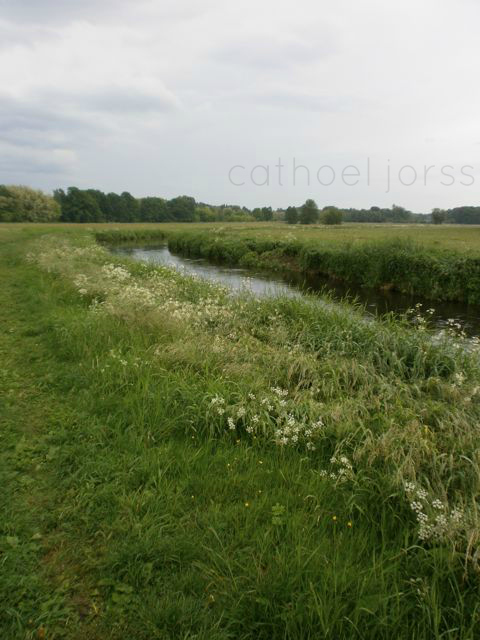
    My arms are full of scratches from traveling among the trees along the river. It’s interesting how so much of what we see is due to attention. A woman passed behind me as I was crouched in a mossy hollow this morning, poking the water with a stick, and until she was almost on top of me I did not see or hear her, though I could hear in her voice she’d seen me. A dozen stick-lengths away, on the water, passed a long pointed boat filled with army recruits. They were wearing bright orange life jackets and looked like ducklings. By remaining quiet and focussing on my bent stick, dragged by the green current, I stayed hidden though my white t-shirt and dirty orange sneakers must have been in plain view. I used to think of mindfulness as awareness of everything. Now it seems more like acceptance, and focus. There will often be a train clattering over the high arched bridge. There will often be an opal drake, steering absently in the water as though floating on his back. And presumably every leaf, every petal of the shower of gold blossoms overhanging the narrow path has its own sensation of the feeble sunlight trickling through the branches.

  • tufty

    tufty

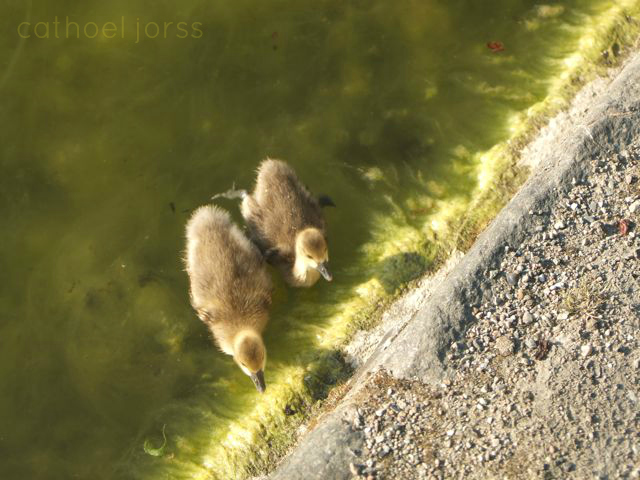
    Under the trees I saw two people riding side by side, holding hands between the bicycles. Not far away a duck plunged earnestly beak-first into the water, its tufted tail and downy bum held upright by the twin prongs of its feet on the scummy surface.

    H2O HoL ducklings

  • rodney the radish

    rodney the radish

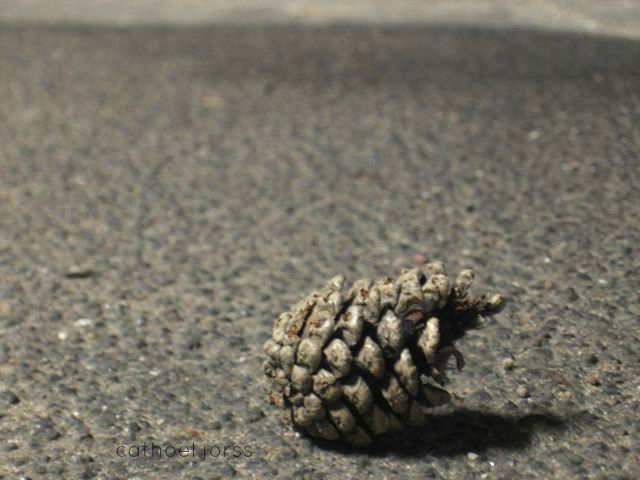
    I found a radish! Just sitting in the middle of the road all by itself. It looked a little bruised and chipped. Poor little radish.

    H2O HoL pinecone caspar

  • find your kind

    Heart-curdling rage in the city today. I was in a crowded shopping street when a man began to roar at his son. He was bantam-weight, wiry, blond, apoplectic: the boy looked six or seven at most. His little sister, used to keeping out of it, hung her head and looked away. Around them hundreds of people turned their heads – it was loud, roaring, full-bore, insanity’s volume. Shopping bags rustled, buskers busked. I stopped. A teenaged boy on a bicycle stopped too. I laid my hands flat on the air in front of my stomach, a placatory gesture. “Please,” I said. “Calm yourself. Your children are frightened.”

    He didn’t hear, didn’t answer, knew in that instant no one but themselves and his own swollen, massive entitlement to rage. He roared and roared, putting his face close to the child. The boy was bent double, both his arms rigid, pulling back and curving his body away from the danger as far as he could. The man held him by both hands in one large fist, the other hand making big threats in the air. I exchanged glances with the boy on the bicycle. I put one hand on each little dark head, smoothed and cupped them. Their soft hair, their stiff little faces. “There’s no need to shout like that. He can hear you. We can all hear you. You’re frightening him.”

    Giving me a vile look he dragged the child away. The girl followed willingly, willlessly I suppose. The man was blond and Nordic, red in the face; the little children looked to be Moroccan maybe or Egyptian. To my shame I was wondering how did this blond man get hold of these two small, dark children. Perhaps he was married to their mother. Perhaps they were his by blood, though none the more his to abuse and to frighten. Perhaps they were adopted. Maybe, stolen. I walked round the corner where they had gone, fretting and wondering, my heart a drum. The teenaged man on his bicycle came behind and I saw him swoop past the man and call out something. The man shouted back. My ears were filled with an army of blood. Making a determined effort I crossed the narrow laneway and caught up with them. “Sir,” I said, “sir, do you speak English? Please stop. Let me talk to you.”

    He turned and snarled, he raised his fist and planted it two feet from my face. “You’re not from here,” he sneered, “you know nothing.” I said, “Listen. You don’t need to frighten your children. Look at them: they’re terrified of you. Be gentle. Be kind. Find your kindness. Please!”

    He made a feint at me, not meaning it, just wanting to put me off. “Fuck you,” he shouted. “Fuck off!” I cupped my hand round the little boy’s nape. Probably he spoke no English at all. “Are you alright, little boy? Are you ok?”

    The poor darling. His father, the monster, dragged him away, gesturing curtly for the girl to follow. He was still detailing to the child in coarse roaring snorts how the boy was at fault, was faulty, would amount to nothing. I hope for the boy’s sake he saw that of those six hundred people who didn’t know what to do, there were two who could not accept he be treated that way. It’s not ok, you are someone, you exist and we can see you. Maybe that is a candle that keeps him alight until he can run away into the world. I did nothing, I made it worse, it’s not about me. Despairing I bellowed after the man, a last effort: “Be a real man and protect the children!”

    A girl came out of a shop, wondering. I showed her what had happened – the boy dragged around the corner, disappearing now, hanging back as hard as he could. She said, “Oh, my god. How could he.” We stared into each other’s gentle, sane eyes. “If he’s that loud, in public,” I said, slowly, “if he feels that entitled to shout and scream in the middle of a Saturday afternoon right here – imagine what he’s like at home.”


  • Clive James

    Perception is a funny thing. I’m feeling, though cheerful enough, somewhat tired & old, chubby & worn. Men are looking at me. One of them twisted his head to look back and came close to walking himself into a pole.

    Another time I was feeling all fresh & funky, I had on this beautiful green print sundress, I scampered early out of the Adelaide Writers Week crowd and began lolloping up the hill. I was laughing with shame, having just inadvertently told Clive James I thought his poetry was quite good, “especially lately.” Argh. As I passed a group of people sitting on the low wall a young man raised his head and sang out, “Ew! You’re old. Get away from me! I hate old people.”

    That was fifteen years ago. Today it’s all smiles & waves. Is it the dungarees? The grubby sandshoes? The sunshine? The moon? Billy Bragg puts it neatly, mortality: “Like a pale moon in a sunny sky/death gazes down as I pass by/to remind me that I’m but my father’s son.”


  • the splay

    the splay

    People in coffee shops who wipe down their table with the paper napkin and push their splayed chairs back in. People at bus stops who engross three seats for their handbags and parcels when elderly women are standing. I’d rather give a shit than be one.

    H2O HoL copenhagen ladybird