Blog

  • a bowl of apples

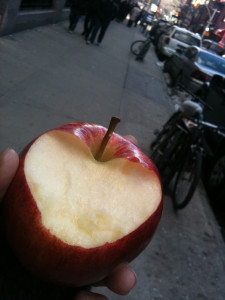
    Cafe I used to work in, in Berlin, had sometimes a dozen Apple computers (mine included) lined apple to apple, cheek to cheek across the counters. People forget ‘branded’ is what they used to do to the rumps of cattle. To show they are *owned by somebody*. We think it means, “Now I Own This.”

    ‘Maverick’, incidentally, comes from the name of the one guy who refused to burn brands into his cattle. So when a steer turned up who had no sign of ownership, they knew: one’s a maverick. But for all those who so proudly claim the term: still means you are somebody’s property. It’s just that the chains are invisible.

    ny2 appleheart

  • hole in a glacier

    Climbed a mountain today in a steep mist. We had to cross a lake to get to it, this was from Lucerne, shared a table on board with a godfather and grandfather and their little charge, who had unbelievably long eyelashes. After his biscuit and orange juice he grew sleepy, the godfather pointed, showing me, “See? his pupils get smaller,” and when they handed him his favourite thing, a green handkerchief called Noushy, he made a point of the corner of it and prodded himself thoughtfully in the ear with that. Then he brought it to his opposite palm and touched himself gently, thoughtfully several times in the middle of his little pink palm with the handkerchief point; then back to the ear; to the hand.

    All four of us were laughing at him in the gentlest possible way. They said, he always does this: Handkerchief in the ear, handerchief in the hand. The little boy’s nickname was Noushy, too. What a solemn little fellow.

    At the far side of the long and complicated lake that covers it seems several counties, and incorporates a steep-sided volcanic-island-looking outcrop that appears as if it would house a villain from James Bond in an eyrie reached only by helicopter, we reached a tiny town like a picture. Having late lunch there after our descent we saw a freshly married couple get off the same boat and start up the hill towards the only hotel, wheeling one small suitcase. She was still carrying her bouquet but had changed into a chic red frock matched with hot pink spike-heeled shoes. The bell of her hair swung forward every time she looked down at her flowers. At the souvenier shop they paused to talk to an elderly lady and then the bride tucked her hand under the groom’s arm and they climbed upward again.

    Upward, upward; windward, snowward. Most of our climbing was done by train and part of it was done on foot. The train is scarlet and shiny, groaning and steep. A series of steel teeth run up the centre of the line to prevent the loaded car from sliding backwards. We got out and walked into a mist that raced down the sides of the mountain exactly as cold air snakes out of a fridge. In the mist we passed a large group of botanists standing with heads bowed as they listened to their group leader, who had crawled under the fence to grab a flower, describing something green and rare. Or something common and brown, I couldn’t tell which, to me Swiss German is an impenetrable dialect. Higher up we passed a woman in sturdy walking boots but dressed in immaculate white pants and a spotless white shirt. We passed many couples on alpenstocks, the cleated walking sticks you use on steep hills, wearing serious but also immaculate hiking gear. So many cows crowded round the dairy that was shaped like an after-ski chalet their bells clattered like a Tibetan or Bulgarian choir. My friend said, the farmer knows the sound, he can tell if one bell is not sounding. On our way back down from the sightless summit, where we had sat for an hour watching mist spurl round the base of the huge communications tower, one of those farmers left his house and picking up a sagging rucksack lying in the open doorway went striding down the hill, looking well-fed and cheerful. He lept the electric fence. We were both wishing we’d brought extra jumpers but this mountain man was dressed in surfer shorts and a dark blue t-shirt. In the tunnel into the summit that leads, mysteriously and lightedly, to a great double-doored lift that brings you up inside the giant restaurant and hotel, it was so cold I wanted to suck on my fingertips. I remembered touching the icy wet wall as we walked into a hole cut in a glacier when I was ten. It wasn’t so cold as that but the chill of forboding forbad me to wander any farther into the leaden heart of this mountain, I had to turn back towards the light.

    On the restaurant terrace I watched a woman who looked like Yootha Joyce smoke a cigarette after her meal. Her husband didn’t smoke and it was pretty evident from the way she took in the smoke that this was the love of her life. Her lips pursed on the orange cork-patterned filter sucked and fondled at it so slowly, so intently, I almost felt had she not had a hold of it with her long fingers the entire cigarette would have flown into her windpipe. It was like she was finally breathing. “Please fit your own mask before helping others.” The movement of her cheek muscles, langorous and strong, made me think of the little boy Noushy who had fallen asleep on the ferry.

    After the ride back down and our lunch we walked around the pretty foreshore. The Rigi, the mountain we had been on, is called by the Swiss “queen of mountains” and is where in 1903 I think the surveying process began. They built a marker there and from it measured to another mountaintop, and then a third, and then they triangulated. Now they have mapped out all of the surrounding peaks and beautiful etched steel landscapes showed what we would have seen had we been able to see anything. A sign cut into a steel plate fixed on the ground said, Sydney 16520km, with an arrow.

    The train down was filled with elderly people, many of them German. The town at the bottom is like a clam growing at the base of a mighty pier. Evidently people honeymoon there. The red and white striped awnings and terraced cafe feel so 1950s I kept fantasizing Sophia Loren was about to saunter around the corner, or maybe Frank Sinatra. It felt like Monaco. In the foreshore park a semi-circle of chairs faced a three-walled corrugated iron shed. A trio was playing, tiredly, dispiritedly, and on the concrete apron in front was an overdressed lady slowly spinning her plump son, chivvying in a sing-song voice, as though making a bear dance. The music was awful. Saccharine and slowed. As we walked past I said to my friend, It’s like the world’s dreariest private function. Writing that, now, I add in my head: I don’t mean all of Switzerland.


  • or anything but

    “I’m not racist or anything, but… [racist remark]”

    vs: “I’m not a feminist or anything, but [women are people too.]”

    Why is it still embedded in our use of language that we need to apologize for opposing hatred of women the same way we need to apologize for hating people of other races?


  • they don’t speak

    they don’t speak

    Switzerland: land of milk can honey. I am back and the milk from the Bioladen is fresh and sweet and creamy. Honey-coloured cattle browse along the path flicking fat mosquitoes with paint-brush tails. It’s all pretty: even the oversized Lego industrial landscapes. Life is orderly and a little prim. A church on every hillside: Catholic and Protestant (they don’t speak). The building of minarets on mosques is now forbidden here, it contravenes the Constitution. The snarling sprawl of Berlin overgrown between upright German houses, climate chaos and poverty seem very far from shore.

  • the human scenery

    the human scenery

    On my last day in Berlin I visited at last the Museuminsel, Island of Museums. It feels strange to ride an arched bridge onto an island on your bike. The island being castled with stately buildings filled with treasures only makes it the stranger. My favourite was the first, which holds treasures rescued or stolen from ancient cultures around the world, many of them excavated and painstakingly reconstructed by Berlin historians. Bits are still missing. You walk into a temple rebuilt under a soaring roof and begin to feature on a hundred fellow tourists’ documentary records. So few people were examining the faulted relief work with their eyes. They carried screens, like bashful eighteenth-century ladies shading their virtue with fans.

    I was wearing a comical and very old beanie bought in a bead shop in Copenhagen. The lady who sold it to me bought it in Cameroon: she wanted a good price, saying, I am too old now to go back there and find more of them. “Kings wear them,” she told me, and showed me a photo of several kings standing about splendidly wearing hats like mine – it is woven out of navy and soiled cream yarn, and has all over little inch-long prongs sticking out like a fully occupied pincushion, a sea anemone. I went back to the shop three times and every time I put it on my head I felt a warmth and powerful groundedness rise down in me. In the third chamber of the museum a vast and mighty gate became the most beautiful thing I’d ever seen. It was clad in tiles in marine blue, sea green, round white daisies plopped one by one along the base of each wall. So beautiful, so moving, when my companion who had been reading the signs sidled up to me and whispered, Babylon, all at once I understood and my eyes filled with hot tears. I stood in front of the giant gate with my head tilted back, lost in that world, feeling some shard or fragment of how it might feel to live in a city of Babylon. I could feel the song in my blood, you know the song you have as a child and that revisits at odd occasions. Like lying face down in the hot sun watching the insects burrow among grass-stalk forests. Like half-waking, half-sleeping. Like sliding into a lake. When I turned there was a scampering behind me as a small tableau dissolved. Three Japanese ladies, elbow-height to me, were posed less than two feet from me as their friend, holding a camera and shooing them together like school children, took their picture using me, the giant with sprouting head, as colourful blue background.

    Sure, we all do it. At least, I do. But I try not to hurt or molest or offend people. I either ask permission with a lift of the brows or if discovered, make a laughing confession out of it and offer to show the picture. Sometimes if I happen to take a beautiful photo that has someone in it, a stranger, I’ll go up to them with it and ask if they’d like me to send them a copy. These women’s refusal to meet my eye was irritating and unnerving. I spoke to them, gently enough: Excuse me. It’s not very comfortable for you to use me as human scenery. They put their heads down and scurried away, whispering to each other as though an animal had spoken. I wanted to be heard, to be human. I went over to the lady who was packing up her camera. “Excuse me, do you speak any English? I really wish you wouldn’t use me for your pictures without acknowledgement. It’s unkind.” She too ducked her head and backed, holding up both hands and waving them flat to ward me off, an invisible windshield. I could imagine the stories accompanying this picture in the slide show: And then ~ she attacked us~! I saw a security guard look up and went over to him, feeling assailed and dismissed, wanting to talk to someone. “I just had a kind of upsetting experience,” I told him, in German, “those ladies used me as human scenery in their photos and then when I spoke to them, they wouldn’t answer me.”

    The expression on his face changed minimally. “Lord,” I said, “this must happen to you, like, 57 times a minute!” He said, “I hide in the corner there sometimes to get away from it. They look past me like I’m not even there.” “How awful!” I said. We were smiled by now, we kind of loved each other. “And don’t you feel… it’s as if, if I photograph everything instead of seeing it directly… am I really actually here?”

    Leaving the museum hours later I waved to the guard and he waved back. “Danke!” On the way in his colleague who’d collected our tickets had said, pointing at my head, “Tolle Mütze!” “Danke!” I said. The old man who snatched a photograph when he thought I couldn’t see him I followed around the corner til he stopped, then raised my own camera and took his picture, expressionless. That felt better. But mostly my bones and my blood were immersed in the sacred, cool atmosphere of the place, a whiff of many places, the ‘first megacity’ Uruk which was one of the seats of writing. They had small clay tablets like gingerbreads propped on clear plastic feet and telling how many fish had been provided for the workers, how to repel the evil left behind by an expected eclipse of the moon. Afterwards we walked to the Bodenmuseum where people had carved marble into lace. Many many Marys and many small Christs, the repetition struck me as humidity does when you return home to a tropical climate. “I finally get it!” I whispered to my friend, on tiptoe (he is 6’8″). “The Mary worship – it’s about motherhood!” “Yes,” he said, shrugging, raised on the stories. “Mother and son. And the son becomes king. And is murdered for love.” I think that’s what he said, I was in a daze with the old, perfect works, the high wooden ceilings, the light lapping over them when you tilt your head back reflected from the green canal lying outside the Museum’s windows. At the top of the Bodenmuseum is a tea rooms with lovely long windows and not, when we visited, a single customer to absorb and be blessed by its splendid, gently-urging, lace-stitching music.
  • following a stick

    following a stick

    My arms are full of scratches from traveling among the trees along the river. It’s interesting how so much of what we see is due to attention. A woman passed behind me as I was crouched in a mossy hollow this morning, poking the water with a stick, and until she was almost on top of me I did not see or hear her, though I could hear in her voice she’d seen me. A dozen stick-lengths away, on the water, passed a long pointed boat filled with army recruits. They were wearing bright orange life jackets and looked like ducklings. By remaining quiet and focussing on my bent stick, dragged by the green current, I stayed hidden though my white t-shirt and dirty orange sneakers must have been in plain view. I used to think of mindfulness as awareness of everything. Now it seems more like acceptance, and focus. There will often be a train clattering over the high arched bridge. There will often be an opal drake, steering absently in the water as though floating on his back. And presumably every leaf, every petal of the shower of gold blossoms overhanging the narrow path has its own sensation of the feeble sunlight trickling through the branches.

  • all police are souls

    all police are souls

    Entering the park at dusk we passed four very drunk men with maybe three full sets of teeth between them, squatting round a fire in a little glade of trees. Their enjoyment was loud and coarse and strong. We broke into the open and trudged up a slight hill, overtaken by a swoop of bicyclists. They were a family: mum, dad, teenage sister, and falling behind came the 9-year-old girl in her pink down jacket who wailed, Mamma, das geht nicht! (Mamma, this isn’t working). From the other side of the path came unexpected encouragement. A grizzled woman crouching over a joint called out in her throaty, smoky voice, “Du schafft es! Du kannst das!” You’ll make it! You can do it! The little girl put on a burst of speed, possibly out of terror or surprise, and the woman roared after her, “Yes! Yes! You’re doing it! You’re doing it! You’ve done it! YOU MADE IT!” It was such a beautiful, generous, Berliner thing to have witnessed. God love ‘er. With her scars and tattoos and her All Police Are Arseholes jacket.

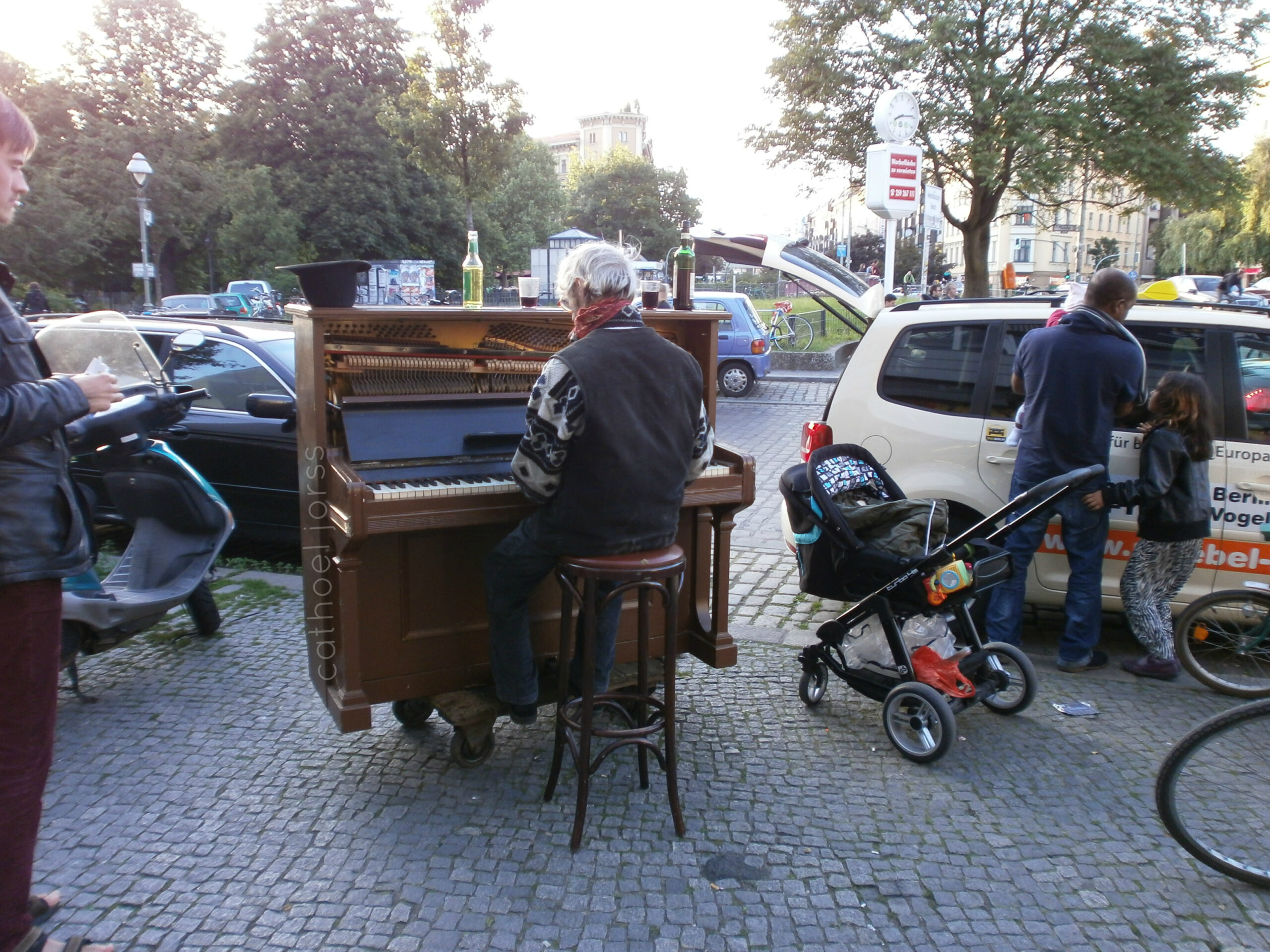
    H2O HoL browsing piano player

  • hero, shero

    hero, shero

    Are ignorance & arrogance the same thing? I think they are. My friend and I argue. He says, ignorance goes inside, arrogance goes towards the outside. Yes I say; but as you destroy your ignorance, as you realize we are all connected and part of one another, it becomes impossible to be arrogant. (Arrogantly I am thinking: I’m not arrogant!) Well but then, he says, you become cynical. And then… you become sarcastic. I’m not cynical, I remind him (arrogantly). No, he says: you’re not. And you’re not ignorant.

    I am preening. But! he suddenly realises: you are far more arrogant than me! Yes, I say proudly, it’s true, I am. I’m a horrible snob. You have Adelbrain, he says, synthesising a new German-English compound: aristocrat’s brain. I have no money and come from a family of farmers but I realise: this is true. Leaving the room he says over his shoulder: No. You’re not arrogant. You’re just a queen. Perching four splayed fingers over his breastbone like an insect walking on an upright wall of water he explains: Birthright.

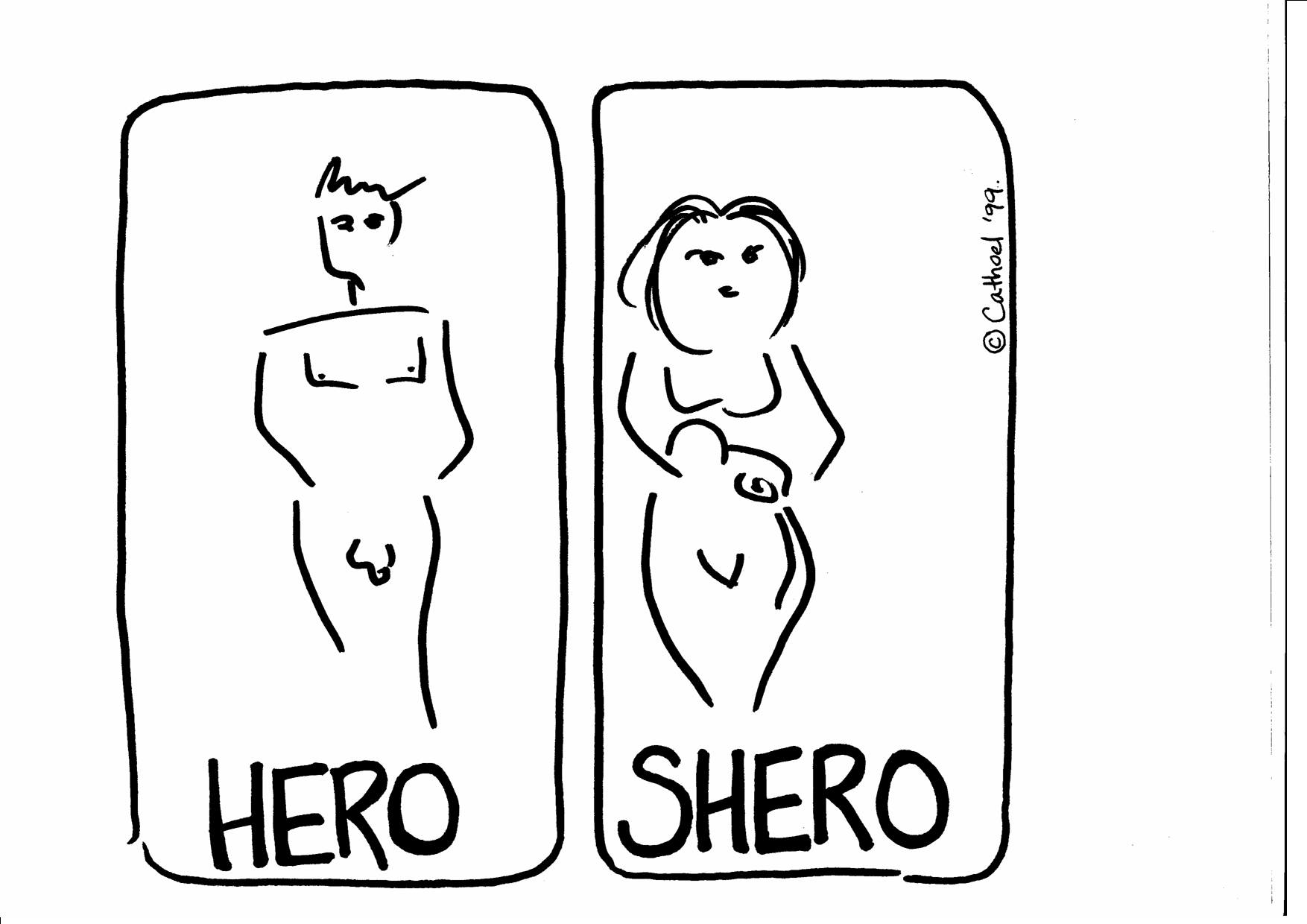
    Queen Latifah, I have heard, calls herself so because she believes every woman is a queen. Similarly I began in my 20s signing my name Cathoel Shero, having made up the word ‘shero’ to serve as an equal opposite to ‘hero.’ Here’s a cartoon I made for it in 1999. In my mind I was imagining every woman signing herself Sarah, Blessed, Dewi, Dagmar Shero: a race of super women. I thought by recognising the dignity in ourselves and calling it out, being unafraid of our strength, we could call up men all around us to be heroes. Kings and princes. Titles would be common as muck. We’d all be happy as pigs in straw castles. My theory fell to pieces when I discovered Oprah Winfrey had invented the same word around the same time and instead of feeling pleased ~ the light is rising! ~ I was annoyed. This self-centring response felt not very sheroic; not very princely. But I like to be queen of my own inner world and I like that other people are king and queen of theirs.

    hero shero

  • Germaniac

    Favourite German-English idiomcy of the week: a friend confesses to ‘bunch-watching.’ That’s when you borrow an entire season of some tv show on dvd and watch the lot.

    Favourite personal neologism of the night: idiomcy. I didn’t have the right word (it’s not exactly ‘mistranslation’) and didn’t want to insult my friend’s English. As I typed, out it came.

    I guess his invention can be applied in all sorts of ways. Bunch-drinking. Bingey-jumping. The Brady Binge, a story of blended families.

    H2O HoL angled orange train

  • tufty

    tufty

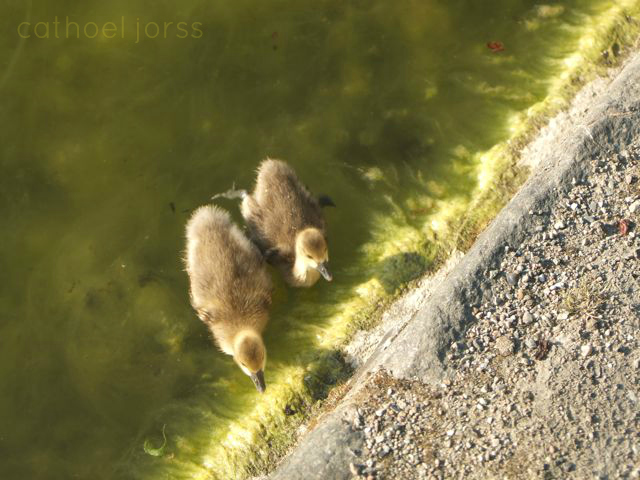
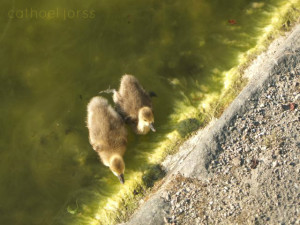
    Under the trees I saw two people riding side by side, holding hands between the bicycles. Not far away a duck plunged earnestly beak-first into the water, its tufted tail and downy bum held upright by the twin prongs of its feet on the scummy surface.

    H2O HoL ducklings