My mother’s best friend is sick with coronavirus. She also suffers from dementia, so she likely won’t know about it or be able to understand what is happening to her – she’s just going to endure a terminal period of painful breathing, agony and frustration, medical isolation: a bodily grief.
Like many people, this woman has suffered enough. I’ve known her since I was seven, we all lived together in the luminous Seventies expatriate community of three- to five-year residents from foreign countries in Jakarta. We used to holiday together, cheaply in a row of bamboo cottages along the coast; I babysat her daughters. In 2016 I was home from Germany to care for Dad before the cancer ate him; as the only Labour and Green voters in the extended family the two of us hopped gleefully in her tiny, scuffed green car and hared off to the polling booth set up under huge spreading fig trees at a local primary school. We voted and felt good about ourselves. She hailed her former comrades handing out how to vote righteously leaflets. Then in the car her manner changed, she grew confused and started pulling out wadded clots of tissues from her bottomless bag. She was unable to explain what she wanted, only saying over and over, I know it’s here somewhere. I began to fear for her ability to drive. She was like a stage magician emptying out his pockets of their meaningless props, unable to produce the rabbit blinking with real life and twitching its nose.
As I digest this difficult news my timeline is clogged with people celebrating Boris Johnson’s identical diagnosis. He too may die in agony. “Karma!” people crow. They sound uncannily undissimilar to Johnson and his cronies, or Trump and his ilk, gnashing their hands in satisfaction when a raped women gets what’s coming to her, or a sexually active teenager falls pregnant, or an entire population of Jewish Germans are rounded up and eliminated because they are less human than Us.
This tyrannical Us. How it bonds us to our best humanity. How it can render us judgemental and pious, mean and censorious, dangerous, cruel. I want to know why people feel justified in celebrating the suffering of a man they despise because he seems, from his comfortable position of Etonian lifelong power, to celebrate others’ sufferings. Of course we are enraged by his deeds. We needn’t spend our time pining for him. All hail our sanity and survival and our ability to detach from those who have done us harm. But let’s not celebrate his – or anyone’s – suffering and painful death. Let’s not become more like what we loathe.
It’s my experience that sociopathic acts get easier for insensitive people the more they get practiced in ignoring cries of pain from their victims. Ordinary Englishwomen and Englishmen don’t have the power over Boris Johnson that he has over their lives. On the other hand, ‘involuntarily celibate’ incels who murder crowds of women invariably feel disempowered and victimised, not powerful. However delusional this feeling on the part of a man wielding an AK-47 or setting a carload of his children on fire, it is still dangerous.
Celebrating the release from bondage which Thatcher’s death brought her populace is very different from being savagely glad she herself is dead. How many rapists and murderers of women are spitefully glad the bitch got what she deserved? I will not allow my heart to become dehumanised, that is, less compassionate, by celebrating the suffering of anyone I abhor. By seeing our commonality I honour and celebrate my very real capacity to distinguish myself from such people.
How do rapists rape women? By dehumanising. How does Boris cut funding to the NHS? By dehumanizing sick people in need. And if you feel offended by the implication that you yourself are in any way comparable to this ‘subhuman piece of trash’ whose diagnosis has so filled you with glee… you are forgetting what he has forgotten. We all have the same capacities for good and for bad. It’s how we choose to use them.
That is, we are each of us *fully and utterly human.* I will never bend on this point, which is exactly what Johnson and his ilk have lost. My mother’s dear friend gave birth in the early 60s and was instantly separated from her child. Shein her seventies courageously chose to announce to her friendship circles that she was a mother to this lost son, and tracked him down, and loved him. Boris Johnson has been directly responsible for the deaths of thousands. If you feel able to separate ‘good’ persons, such as my mother’s friend, who don’t ‘deserve’ suffering, from ‘bad’ persons like Johnson who do, you are treading a most dangerous path. I hope I’ll never go down that road. I hope I will choose to use my humanity, today and forever, whatever the provocation, in the opposite way to how Boris Johnson uses his.
Blog
-
best friend’s unacknowledged son
-
cherry tree, wait for me
Today I would give anything to run outside into this suddenly warm sunshine. I woke to birdsong and discovered I had left my window open all night. This is the first night since October that’s even been possible. I don’t feel the icy breezes snaking round my feet in the chilly living room, I can’t hear the ticking of the heaters. When I stood in front of the glass and gazed out I could feel the sun’s mighty warmth on my face. My eyes sting with tears thinking about it. It’s reached us.
This winter staining gradually into pink blue yellow spring is now extended indefinitely, perhaps eighteen months, perhaps twelve, perhaps three, as if by a bad council order. Such a long winter under such low grey sunless skies.I miss cafes, I miss walking past people and feeling the foreign-communal energy of their own brisk, or vague preoccupations. The feeling of their thoughts and breathing fringing and wrinkling my air. I just miss them being there. I miss the little coughs and the unconscious throat clearings and sighs and the faint breeze as my neighbour in some plinking humming bistro turns a large page in his sagging newspaper.That’s how we sit, that’s how I spend time with people. Cafes are my communion. I love the delicacy of their shared but parceled space. All along the old wall strip, the dead zone through Berlin that divided families like a terrible quarantine, the decades of no mans land that now is all overgrown with trees and nested with sweet birds, torn down one by one for new apartments as the city swells, one Japanese cherry tree after another will be touched by the sun and burst into its perfect ineffable colour, its blossoms fluttering and the sky a web of blue trapped in its branches. I want to lie there dazedly noticing the comings and workings of ants for whom springtime is an unending toil. I want to hear the punks on their houseboat creaking and clinking at beers in their foldout chairs. I want to feel a fast bicycle zip past me. Lie under the trees and feel their placid embrace, like two hands turned slowly outward to show me something.
-
smuggler’s bonnet
the place my fingers gladly guard
snugglers’ cove, my cloven hoof
woody and strong, it toughens me,
a stain that’s impossible to shift
the long chain of life lies down in me
space station that soothes the hemless sea
and the cat likes to sleep on my little headland
this crook, the limb that invented home
this narrow fissure in the bone
above a private beach, and others like it,
domesticate everything within reach
to make a country of myself I swim
but my strokes never stitch the grieving water
albatross wings follow me
like flies tied to a flock of strings
for years I’ve worked my passage home
with the sounds of the sea always chafing the shore
when the moon relinquishes its bone
I lay my eggs above the tide
a country full of strangers
the sleeper cell awakes in me
a dog stiffening on the leash
a meerkat, a ferret could have me now
collapsing the wet sand into the sea
for solitude reproaches
my heart approaches again and again
with charcoal fingers its inbuilt cousin
pushing a flower of soil in my mouth
lining me with humus
like a grave turned inside-out
dreadnought
.
Europe is a frozen seawhere I have walked on water.
Clumps of folk, like barnacles,
disturb my landscape, like graffiti
but I hardly see them.
This is my terra nullius.
The river belly is invisible beneath me
and it strikes me that from up on deck,
the world is flat.
A ship’s a hemisphere. The mast, a stolen tree,
an infinitely tall flagpole and cross
combines the heresies of government and god.
Woollen to the eyeballs now
I skate like an Australian
writing in my head postcards: The sky
is white. The trees are white. From here the world
is white. God must be white.
Each a Southern hemisphere
the first sweatshops were ships
overcrowded with workers
gold and spice and sweet timbers.
Overseers commissioned by their God
to walk on water
with their three sticks
gun and flag and cross
privatised entire nations
like cheeses of the world
shown on a board.
Carving the frozen water with my blades
I make a map. The globe stretches in front of me
bare of any footprint
as far as the eye can see.
My breath evaporates as guilt
evaporates, like exhaust. A flag
like any flag, indicating piracy.
I have come alone here
from the far Antipodes
teaching myself how to skate
and with the sheep’s back riding on me.
I will strike entitlement to freedom’s ingenuity.
Like a scarf I lose my fear
without knowing I’ve lost it.
Terra nullius must be Strine,
I think, for I fear nothing.
the hunt
.
I want a seed to grow me fatto push my belly into the world
before me, like a pram into traffic
making me big from above, like a hat
I stink up my blankets, roiling, mute
any man a father who pauses to roost –
sprinter, guest star, Gastarbeiter
dictator rapidly deposed. I am young, almost:
they throng my shore
fatherhood is a range of shoulders I climb
to scan the horizon for my home:
gathering, polishing my sharp stones.
He will pass; I will flush him out.
In the ribald empire of my waist
I will reconstitute bean from sprout
motherhood is a crown in a tree
my landscape will reorient to portrait
in childbirth, nature’s aristocracy
in my dream I fall like you
in my dream I fall like you
dividing for a second or two
the stacks of poste restante water
which flow round the piers like ice
I have revisited many times
the scene of your crime against us all
for suicide is a punishment
and we have suffered
that dismal repair of corrugated iron
tacked across the shipping shed roof
on the wharf, where you probably didn’t intend to end up
which swallowed you slower than water
coughing you up on the rebound
broken open like a cup
and lying, like a statistic,
spread out like a public thing
even those of us who never knew you
have lived with the patched roof
and your name,
which must never be spoken
driving across the completed bridge
I always talk to you
I’ve two fine brothers –
weren’t you curious?
did you farewell your wife, a woman sometimes cruel
but newly delivered of a son (my youngest uncle,
three weeks old. Still lives alone)
when Dad’s immediate maternal progenitor
as our uncle called her
lay dying, I visited.
Only once.
Watching your widow sink among pillows
right in the centre of the bed,
I began to cry. Vehemently nodding,
‘Good,’ she said.
The last words of your generation for mine.
room service
2am: sleep has not come for me.
Bells thresh against the double-glazing like wheat.
The air-con whispers of towels in a drier. I lie
stacked beneath layers of strangers
like eggs frozen in ice-cube trays.
In my mind’s eye a numbered ball
slips pipe to pipe from floor to floor
down thirty-five floors to the city’s sewage.
Another hairy, farting, scab-nosed child
has scorned my offer of mortality. I am a bag of feathers
lying still, reading the pillow menu.
I wanted you to embark on me; climb on my shoulders
with your sandy feet; make me the stone in a rich stone soup.
Hours pass. Again I conduct myself
over the white tiles, cupping a hand, and crouch,
confiding my hinge to the ear and dark throat of the drain.
On this chock-a-block earth I am an ill-planned city
that has built too many tower blocks
for industry that never comes.
Along both sides of the street houses march, denuded of gardens,
piled like debris in the forks of trees
years after the last flash flood has passed.
I’ll give you something to really cry about
i.
O Cleopatra, darken your eye. I loved you how you were.
You are a cell. Whittling while I work
you shovel fingers down your throat
in the camp with the million dollar views:
a silk to stain the moon by day.
ii.
Every time an egg lets down I lie awake all night.
It took me years to find the pattern in this sleep.
No book engages me. I’m unengaged.
This latest round child, fretted slightly
spurred with its impending age
lets go –
a sigh – a whisper –
and commutes to the city centre.
iii.
The after-dinner binges
I transliterate with costliness
to because I’m worth it from self-loathing.
Buying the expensive tub.
Buying the organic.
Standing in the hall of mirrors naked
as at some reunion
This is what I have become, I say.
Laying out the cloth for one.
iv.
I’m tired. It’s tidal.
Love is a black bear rarely sighted.
v.
Childless celebrities
who can never retire gaze wearily from their pages. Everywhere
a campervan can go, a moon can follow.
I wrap my woundedness in towels.
I have cake. I’m a psychologist. My kitchen drawer
a door cut in a glacier. But
though I don’t eat standing at the sink
and though there’s silverware involved
this is not luxury. It’s barely sensuous.
I’m tired, it’s tidal. The remoteness
of the stars and moon and all seems to me at such times
quite unremarkable.
vi.
I wish I liked chocolate.
It’s cheap, it’s always available, it’s legal: it’s a cult.
A solitary habit wiping masturbation’s loneliness
it’s duty wrapped up as a treat
lace trim, pole dancing; mascara.
Such poor copies of girl power. Like a bride or childhood’s Arab I wear
tea towels on my head. Scissoring
beauty spots at great expense
from glossy magazines. If I freckle far enough
I’ll be brown all over.
These are my thirties, this is love’s
sad second honeymoon’s dry hollow
where I rest my hand.
In the master bedroom
I am mistress to my fate. The striped
with sunlight sheets embrace me
like a visitor. Lake Eyre, Tasmania.
I wear a placemat on my head.
vii.
Upstaged by death
and hopelessness – and hope –
I toss, grinning in my sleep
with sly humiliation.
The Last Post plays again outside –
a long, drawn-out farewell.
I am slow and strobe the sea
labouring, like a soothsayer, to please the always-visiting man.
Meanwhile across town somewhere
– on the internet – he sleeps.
Oblivious in sleep.
He heals himself in sleep. He’s going to leave his life
who doesn’t understand him like I do.
viii.
As I peel the ceiling back and the ceiling on top of that
the stars are pearls who freckle the night sky
my hair curls in the water
this bath is my bed until soaked skin
reveals my sixty. Candles rim the tub.
In so black, so restless an untrod world
the firelight flickers on the can of VB my intended holds
catalogues floss the slumping fence
and intermittently, Christians knock
like the 360 days of Christmas. Soon enough
midnight feasts on me –
then 3am. –
then dawn.
I rustle at the liquid sheets.
I sight up the streetlight’s moon.
ix.
Fucking might have saved us, if we’d done it long enough.
But we used imperial for a sum so wretched small
it could only be counted up in centimetres
if at all.
x.
Put your hand here, put. The lizard pulse
of reproduction’s tawdry old tired old art form
rises and falls like France. My red-stained palm grasps the pillow
I’m a mess, I’m a disgrace, and at my door from India
telephone salesmen offer plans
the way swards of India-rubber trees used to offer
India-rubber bands.
xi.
Crumbs on the sheets
keep me awake, for I am sensitive.
Until ten months ago
I was mistress to my fate.
And years of needling pricks
have pierced me
threaded but not awake. Now like childhood’s Arab
I wrap tea towels on my head.
Lake Eyre. Tasmania.
The straw scatters and sinks.
xii.
Sometimes I’m angry but there’s no mileage in it.
xiii.
My grandmother’s Christian name
– shortened to Aud –
meant ‘I have studied.’ She had studied,
she was bored. Her porn name
if they’d had prom night in those days
might have been Winkie Cawmore.
I turn and turn again. Give me the keys, she said,
and shut the door. A child’s abstraction of a bear
worn thready at the ear, I did. All the little trees
along our road were polite like soldiers. We tore apart the family home
for good, just having fun with it.
Happiness is hereditary
(she said) and I’m not done with it.
reaching for the remote
Come, the mighty, slumbering under your hill
no giants sleeping but goodwill
inside of us
a corporation’s a body still; a company is of people
to turn them inside-out reveals
as ever the wavering sea-frond steeples
even the spray dissolved in peaches
is a kind of love, speaks
the dream of keep this safe:
death is organic. death is ungloved.
though the trees seem such unnatural greens, and lit at night
and placed around us while we sleep
as if instructed to keep us in sight
and all the matter that’s the matter
hulls in cities and the soil; the work we do is making
everything worse yet nothing ever spoils
though sleep, a bumbling Creole now
mows across a billion screens
the zeroes, the ones, the zeroes, the ones
that all mean ‘I just want to go home’
every purchase has a rope
leading up to it and a rope
leading away. carries sweat,
carries knots, carries a hill.
who mined this.
who made it. how are their lungs & eyes.
the water. waste. offgas. freight.
knots uncounted slipping hand
over hand into the filth astern
are a rosary-coloured tell
and we know it
struggling, but not very hard
to make right the wrongs our fear
our loneliness
and causeless isolation do
in his bulb of peace as in a cage
philosophy devises
pilgrims come to the carpet’s
edge and say, and then turn their backs,
You’ve inspired me.
bishop has the actress
on his talk show on YouTube
she played ugly outside Delhi
Bollywood blares that love and war
are the romances
for women, and the romances for men
to keep us partial O
Your Wholeness, she tells, nuzzling:
all my darlings are stones –
lamp-eyed with starvadoration –
standing in platinum prongs like an Emmy –
you wanna know where I keep my Oscar?
in the loo
adopting mantras, daughters, can’t give away no satisfaction
harvesting the genetically modified seeds of compassion
like Prada, the Algonquin, anti-fracking legislation
seeds from Big Pharma, manna mamma, gazing
moonfaced from the fence
a god with an addiction
it turns out, no kind of god at all
they contemplate the third-world projects
funded by her five-earth footprint
‘In every child I see myself ’ –
‘You ought to make the effort
to remind yourself of them’ – o, Father,
you are awful! she frolics in such floral aisles
pharmacy in the dell
in the dark World Bank the lights
are left on all night but
in deference to Earth Hour
management have closed the blinds
they & the cleaners
only want to retire
in time to spend time with the family
meanwhile, alone. 2D or not 2D?
I blame logonhorrhea
behind the screen, the window
where forgotten in the curve of the earth
the arc of banished animals
the only living creatures other
in the universe
eternity is here
and we ignore it. if you’re lost in the bush
and you’re looking for water
don’t go uphill.
everything real is modest and near
and not being told
all the water rushes
all downhill, as water always will
too much attention on too little life
and stores as far as the eye can see
like castles: take your envelopes, take your gold
it’s as if none of our foodstuffs can die
it’s as if neither can we. nor live – no time –
as if the glossiness of things
extends its personal guarantee
or quarantine, for we will go on wanting
that thing nameless & not marked down
for we are little gods
at heart, and cannot keep ourselves
from reaching for the remote
the bristle and thrum of buildings
marks a creche of hollowed hills
and under it all and through it all
the song of Country sings us still
Come back, singing
Come back
Come back to me.
©Cathoel Jorss
Comb the Sky with Satellites, It’s Still a Wilderness
-
cemetery days
I just spent a few precious hours working in a greensward where I could be safely distant from everybody and they could be safely distant from me. Then a woman approached me. She was wearing uniform. It is not permissible to sit in this space, on the grass: you must sit on a bench.I gazed at her. “I understand you, but… isn’t it somewhat exceptional circumstances? I have hardly left my house in six days, I need the sun. People need a place to sit that’s not hard surfaces which can retain the virus for hours.”
She repeated exactly, “Es ist nicht gestattet” I think it was – it’s not authorised. At home, on Twitter, I found two resourceful Italians playing table tennis, from window to window, one right-handed and one left-. They’re just going to keep playing until they lose the ball. I live for this sense of playful joy. As this lady approached me I was just thinking, ‘now: I have peace in my heart.’ It is hard-won. It’s mine. She cannot have it, no, indeed, I will not drop this ball, it is airy, it is light and it bounces.
-
staying at home in the Spring
It’s wonderful to be cheerful and I will be cheerful. We are alive and are blessed with refrigerator and bath tub, bookshelves and beloveds, hot and cold running comfort in which to be trapped.Also, the sky today was wild blue outside. Our little drawing group normally meets. I longed for the bicycle ride across town, the hours of shared and quiet concentration, the chat. The trees are filling out slowly with leaves. It’s occurred to me that Australian friends have no idea what it feels like to have to stay inside for days on end and potentially months… right at the tail end of the winter when we have blue skies literally for the first time in months. My mother is staying home more in Brisbane, a dense and singing garden quarantines her house. Most Berliners and urban Europeans don’t have even a balcony. There are a few open spaces large enough to be safe but they are hard to reach. We can open the window and take sips of still cold air. The pinkening buds will be bursting soon and we’ve been trapped indoors since October.
-
the surprise
Things my African boyfriend wants to know: Why do white people need to take coffee or tea every morning? Why don’t you eat the head? It’s the best part. Can I have the bag? Let me carry that for you, let me help you with that.
He has left Africa for the first time, left Ghana. When I want to visit my friend, he wonders – why don’t I just drop round? When we are watching a movie together and I get tired, too tired to walk home – why don’t my friend and I just climb into bed together and fall asleep?
If you even have two or three friends watching, you may all climb in. Or perhaps the host sleeps on the floor. He is the host.
Everybody sleeps.
He says things to me like just relax, Cathoel; enjoy yourself. He asks, why are we rushing? And yet he is incredibly hard working. He scours the bath house then calls me to inspect it. He washes everything by hand. When I say, idly, late at night, oh there is a hole in that cushion, we have to stitch it up before we leave for Ghana, he fetches needle and thread and fixes it.
When I show him the laundromat he wants to know, does the machine also squeeze it? That is, will the washing machine wring the water out of our clean clothes?
Or do we do that ourselves, after carrying the heavier load home on our bicycles.
We found him a bicycle, second hand, and a heavy coat and scarf, second hand. Two pairs of second hand gloves, which he wears one on top of the other then complains his hands are cold. He has never been below twenty five degrees before in all his life. When I was visiting during the rainy season several of his friends rang to assure me I should bring a jumper or a jacket, “It’s cold here.”
He rides his bicycle like a Berliner, with both hands tucked smoothly under his armpits. My boyfriend doesn’t believe ladies should have to carry their own bicycles. Yet he thinks women make the best business owners, the best presidents. In Ghana women own the majority of businesses. He’s never watched porn and I can feel it in his touch. I can feel it in his gaze. At the store on the corner he says gravely, “Good morning.” He asks, “Why don’t you guys cherish each other?” When we reach the train station he carries both bicycles upstairs on his shoulders.
-
Ghana get it
Today in Ghana I ran into my friend Kwame, who sells jewellery from his lap in a wheelchair in Osu and thus supports a family of five. Kwame’s dream is to be a lawyer. We shook hands seven times. We were so happy to see each other we were nearly in tears. I told him my visa trouble in Berlin: I cannot sell the lovely recycled glass beads I brought back which should include an opportunity for sponsorship or reparations to somebody like Kwame, because I got turned down for a business visa, they are worried I would not be earning enough money (true) and thus not paying enough taxes in Germany (also true). I told him I will keep trying. I rode home by trotro and jumped off when I passed a heaving Spot where hundreds of groovy people all dressed in black were dancing and drinking and ceaselessly embracing. They looked so cool and helpless. ‘Excuse me. Is this a funeral? I don’t want to intrude.’ ‘Welcome, welcome! Our friend died, he was a dancer. Only thirty years old.’ The bar man agreed he would stand me a drink even though I had no money. We both touched our hearts, I will come back tomorrow, thank you for trusting me. Funeral goers in matching black t shirts lifted their glasses and bumped fists as we all began dancing in the crowded road. ‘We all wish white people would dance like that. You are a Ghanaian now.’ I wish. What I wish is if I had my way, some combination of eco conscious Berliners and forthright outrageously excellent Ghanaians and thoughtful land respectful Indigenous Australians would be ruling this world. ‘Why can’t you tell Trump he is not allowed to do this thing?’ ‘I’m trying! I tweeted him. He doesn’t mind me.‘ In Ghanaian English this means, he takes no notice of me. ‘Why does he treat Iran this way?’ asked Pious, who had taken my number to send a selfie we all made. ‘I don’t know,’ I said. His friend chinked his glass against my glass. ‘Is it because he’s a mother fucker.’ Yes, I said. That’s why.
-
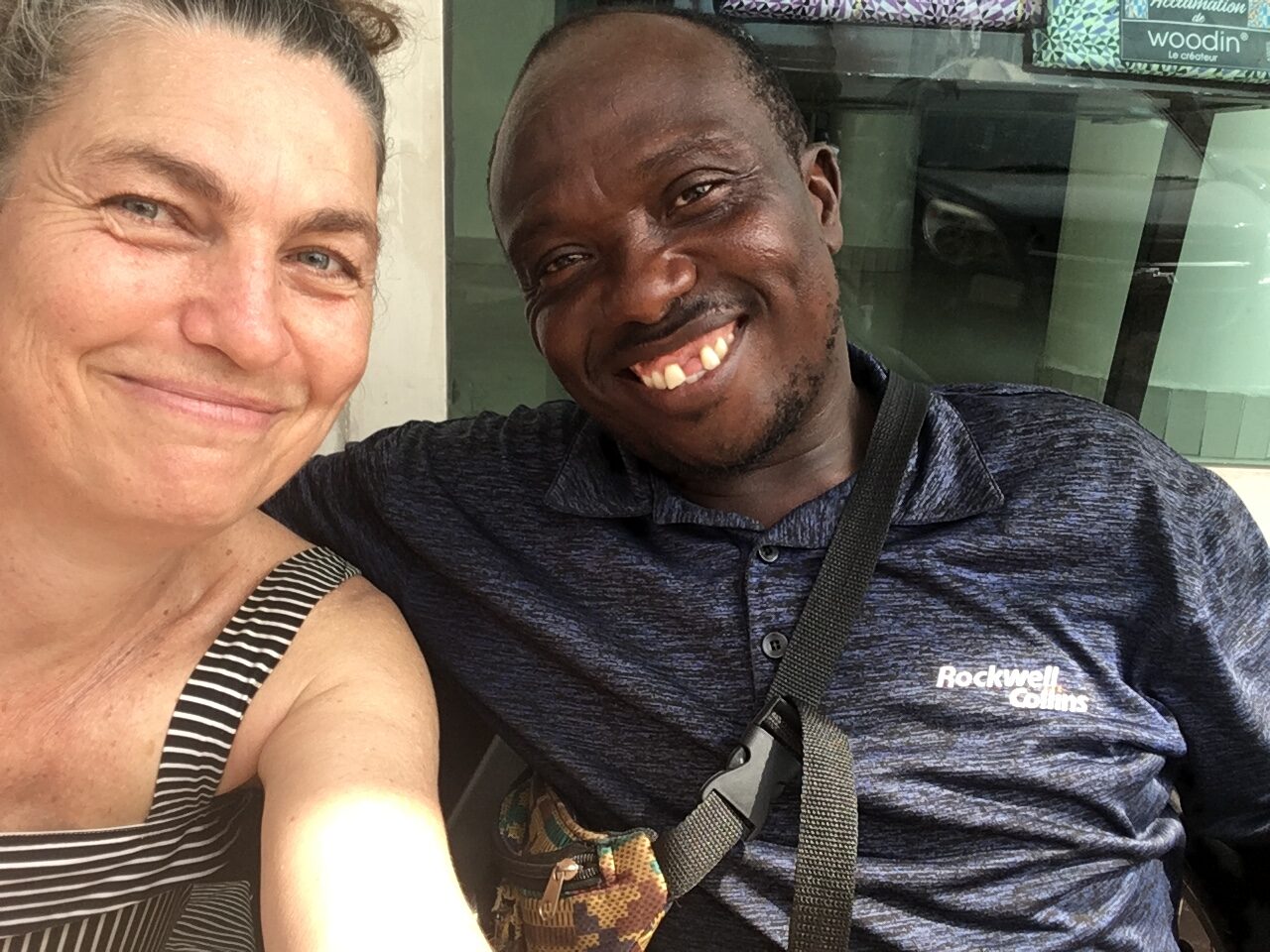
Ghana get it
Today in Ghana I ran into my friend Kwame, who sells jewellery from his lap in a wheelchair in Osu and thus supports a family of five. Kwame‘s dream is to be a lawyer. We were so happy to see each other we were nearly I years. We shook hands seven times. I told him my visa trouble in Berlin: I cannot sell the lovely recycled glass beads I brought back which should include an opportunity for sponsorship or reparations to somebody like Kwame, because I got turned down for a business visa, they are worried I would not be earning enough money (true) and thus not paying enough taxes in Germany (also true). I told him I will keep trying. I rode home by trotro and jumped off when I passed a heaving Spot where hundreds of groovy people all dressed in black were dancing and drinking and ceaselessly embracing. They looked so cool and helpless. ‘Excuse me. Is this a funeral? I don’t want to intrude.’ ‘Welcome, welcome! Our friend died, he was a dancer. Only thirty years old.’ The bar man agreed he would stand me a drink even though I had no money. We both touched our hearts, I will come back tomorrow, thank you for trusting me. Funeral goers in matching black t shirts lifted their glasses and bumped fists as we all began dancing in the crowded road, ‘We all wish white people would dance like that. You are a Ghanaian now.’ I wish. What I wish is if I had my way, some combination of eco conscious Berliners and forthright outrageously excellent Ghanaians and thoughtful land respectful Indigenous Australians would be ruling this world. ‘Why can’t you tell Trump he is not allowed to do this thing?’ ‘I’m trying! I tweeted him. He doesn’t mind me.‘ In Ghanaian English this means, he takes no notice of me. ‘Why does he treat Iran this way?’ asked Pious, who had taken my number to send a selfie we all made. ‘I don’t know,’ I said. His friend chinked his glass against my glass. ‘Is it because he’s a mother fucker.’ Yes, I said. That’s why.