Tag: addiction

  • to the friend who couldn’t quit

    I still spend an hour every morning coughing earnestly and can’t laugh without coughing. I thought I was trapped for life. So I hear you and I just want to say: nicotine cravings last four minutes in the body. The rest is mindgame. If you can ‘delay, drink water, do something else’ for four minutes at a time…

    Well it feels like you’d be losing your closest companion and beloved/loathed best friend, but what I found: that forest fire I dreading walking into turned out to be a wall of flame like in Hollywood and I walked through it so much faster than I could have believed. And: I have literally never missed it. Not once.

    You can. If you ever really want to – you will. Think of all those years you never missed it before you started and… I hope you might feel ready one day, so that the rest of us can treasure and enjoy you, for longer.

  • pity flamingo

    Every week I cross town on the train and we pass a tower block of identical grey-frame units which have grey balconies. One balcony, at eye level with the train, has a bright pink inflatable flamingo hanging like a lurid fern, I guess somebody went to Florida or Havana and brought it back with them to bring back the tropics. It doesn’t look tropical. It looks more defeated. The air has shrivelled out of it, or perhaps shrunk in the bitter chill of Berlin’s below-zero winter. The bird sags, motionless, its head drooping over its breast and hanging down to the shrivelling feet.

    Poor tropical bird, alone trapped in glassy Berlin and its colourless end of year season, after all the other bright birds have vanished down to the southern shores to caw and preen.

    Snow lies on the ground in greying patches. Hardened scars of black ice have been strewn with sharp pocks of gravel from the big grey plastic bins. This fake bird is the only pink thing. Apparently flamingoes, naturally flamboyant or perhaps insecure on their wavering stalk legs, will not make babies unless a crowd of other bright pink flamingoes stands round them watching.

    Zoos have had to set up elaborate peacock tails of mirror to encourage them to breed. Gazing out at this sad blow-up bird sometimes I think about staging an intervention. What if every passenger put on a pair of Edna Everage sunglasses. What if we all stared out the windows and flapped our arms. Maybe the dying flamingo would stir on its still leaf of string. Maybe the neck would waggle and stretch, and the tiny head come up again to display proudly its improbable and superciliously curled coconut ice pink swan lip.

    But Berlin’s trains are courteous and pragmatic. People stand back tiredly to let each other on. This week I’ve passed a junkie shooting up right into the arm, against a pillar at my nearest U-Bahn station; five people in a row who were all reading books but seemed unaware of each other; and a sturdy Polish tourist who rolled, under my nose, a plump head of ganja into his palm so that when we all got off the train, he could light it.

  • where it hurts

    What a strange feeling to watch Mitch Winehouse, father of the Amy who died young, telling the camera after her death how he felt it was not his place to save her. You can’t force treatment on somebody, he says, and shrugs. Meantime he is running the Amy Winehouse Foundation, his income derived from her work. After everything that’s happened, still an unawakened person: living in an unreflecting stupor, so it seemed, entirely selfish, he has milked his cow to death and still has no idea what went down, or who she was, or what life is like for a sensitive – that is, a wakeful – person.

    It is cold in Berlin at night the end of the summer, I drew my feet up on the chair. Two dogs kept tangling in a hassle of growls every time someone got up to buy a beer. Would be great, said the announcer in English and in German, if you could all carry your deckchairs over to the stacks afterwards, and bring your ashtrays back. Her fingers tangling in her afro loomed larger behind her like fame.

    The last film I saw here, a month ago, was about another tormented musical artist: Brian Wilson. I remember afterwards standing in the queue laughing as though crying again, watching all the Germans patiently waiting, chairs folded, to hand back their deckchairs to the two fellows rapidly stacking and folding.

    Today I discovered I have cried so much in the last week that the skin round my nostrils is all chapped and eroded. Standing in front of the mirror rubbing oil into it in little tiny circles I was thinking of the psychologist I spoke to on Friday, a much younger woman I have met a few times now, who is Danish. We speak in English. She said, I am sorry that these sessions just involve an hour and after that I have to let you walk out into the world all alone. I wish I could come with you for a few hours, and spend the afternoon beside you, just sitting with you. “There is nothing I would like more,” she said. I walked across the bare floor of the old sewing factory to the bathroom and dunked my face in the cold water several times, patting down the aggrieved and swollen skin, the red. I tipped my bag onto the floor and twenty-one sodden tissues rolled out on the tile. Later that night woken by street noise and unable to stop from weeping I rang my parents’ house. It was 3am here, there almost noon. “Have you tried concentrating on the positive things in life?” My dad searched for something to say when I became so entrailed in sobs I no longer could speak. “I meant to tell you,” he said, “about the friend from Engineers Australia I ran into at the spinal clinic. Lovely bloke. But he has broken his neck and now he’s paralysed from the neck down.”

    Amy Winehouse’s ex husband, the reprehensible Blake Incarcerated, lounged in his splendid corner chair. He was being made up for a biopic about his famous wife, had filled out, was feeling self-assured. He spoke about himself and then rolled on over her, already dead. Wha’ I fought was, he said Londonishly, the emblem of fake punk, I’m earning good money now, I’m a good looking man, I dress well – what ve hell am I doin’ wasting my time wiv ‘er? He had drawn her into the tiny heroin room, and left her there. In the film she climbed onstage, booed by the people who’d been chanting her name, and began beseechingly hugging one big black man after another – musicians who reminded her, I would imagine, of one of her only true friends, a bodyguard who used to stop her from going out for more booze. Her girlhood friend’s voice broke describing how they had rung the father imploring him, please, do not let her tour. But she ‘ad commitments, innit. So he put his wretched daughter, skinny and cowering, on stage in Belgrade, where she stood trembling and evasive until she was booed off.

    In the outdoor audience, no one stirred. The story was heartbreaking and base. A person eaten alive by the public, undefended by her nearest loves. We were aware in our deck chairs that we had all feasted on her, like Diana, like Marilyn. We are entitled to feed on the female: the role of a woman is to cater our eye.

    A slight wind rattled the screen. In eerie silence they showed slowly the unhappy photographs she had taken of herself in her house in a daze, a woman hounded on the street. She only had to show her face at a window to be blinded all over by mega flash bulbs. Her husband himself and her father, deserter of his family when his daughter was ten, are in their own ways mega-flash bulbs, though dim: yet both have survived and now flourish on the messy heap of her memory and her fame.

    We are a cruel culture. We trash the wild. The queue round the corner to see this girl’s life, the silence that spread from one person to another, were a searching in the self and a tribute. The film makers had pieced it all delicately together from the home movies she’s left behind – and from footage in the vocal booth – and from interviews with those who loved her and those who exploited her gift.

    This outdoor cinema is set up in the green in front of a famous smoking squat, where rivers of drugs have been consumed. It now houses galleries, the summer cinema, and a restaurant which is always booked out. Gift in German means poison. Tony Bennett said, she had the true jazz voice. Jazz singers don’t want to be up in front of 50,000 people.

    A breeze stirred the trees in the prolongued, painful silence. It was cold and growing dark round half a moon. We were Berliners, many of us people who have tried at some stage to suicide by substance. Four lights came on in the big house, a hospital before. She drank so much that her heart just stopped. The treetops stood there stately, shaking a little. I drew a sigh in the immaculate silence.
  • what ate New York

    The film poster that has Godzilla tearing up great chunks of the city and eating alive New York City should have been a giant Pacman, I think. For technology has eaten New York. And not only New York: Copenhagen, Madrid, Berlin: these are cities where I have witnessed this carnage, sinister and almost silent. We noticed it on the plane, a ride through the sky which has transformed from what was a quiet space, a time of dreaming and half-sleep, into a wilderness of seatback screens. Everything flickers. People feed themselves perpetual stimulation by the handful, like a supersized bucket of chips. As soon as we land out come the phones. Soon the aisles are crammed with people stooping under the bulkhead and standing over each other, so intense is their desire to be free of the traveling life and meet with the destination city, yet all have pulled out small devices and are keenly, yet dutifully scrolling. Oh, the dullness, pervasive and wee. Why travel five thousand miles through the ferocious universe only to read up on what’s happening at home? Instantly to rejoin the same long conversations we were wrapped in on our own soft couch.

    We drag our cases to the A Train. My heart is pounding. This line is the subject of so much damn jazz. But when we get inside and the familiar orange seats are filled with black folks, every one of them inimicable, cool, and beautiful, the place proves to have changed somewhat since 2011. The suddenness of these changes and that nobody notices sometimes makes me despair and grieve. I miss my community, who have turned away from each other. Now even in the most exciting city anywhere, every third person is staring down into their lap, hung over the miniature news from elsewhere.

    Used to be I was the annoying or crazy one, preoccupied and dreaming in a hyperalerted world, clogging up the pavement as I stopped short to stare upwards, to notice detail or jot things down, writing as I walked, holding my breath, my train of thought, my pen. Now I’m the passenger in everybody else’s aquarium world. In the street, people scroll as they stroll. City that never sleeps seems halfawake. And it’s all so iconic. The subway car that looks like every movie scene, the puddles and paddocks of outermost Thingie Island where the airport lies marshily. The Rockaways, Blvd and Ave. “We are passing under the East River,” I report. “We are passing under the World Trade Center. A lot of people died here,” reading the map, my eyes filling with sentimental tears. “True,” says my companion, “and then their friends went out and slaughtered many, many, many times more around the world.” After an hour of train travel, after nine hours of airplane travel, after an hour of bus travel in Berlin we come up out of the subway station at last, at 42nd Street, and the noise – the smell of French fries and traffic and metallic dust – the people and the way they pass, the hoardings, the sidewalks, the way they hold themselves – both of us standing their marooned by suitcases, we each burst into tears separately and hug across our baggage.

    The lights, cameras, action are all around. We drift through the traffic of souls, uncounting. This explicit town, alive in all our dreams, overwhelms with its gross drama and chaotic splendour and decay, while at the same time it speaks to everyone individually. We find the New York Times, Dean and Delucas, the cafe. We find my friend, her black hair everywhere and her familiarity so moving. Even she, an artist, a true lifelong artist, ravels her phone at every opportunity. We buy burgers and a jar of beer, at the counter I worry we are taking too long to order and look up. There she is, hunched over her phone, as thought it were a knot in her hair she is unable to stop from worrying and untangling. Oh New York! Oh humanity! Come back to me! I miss the dreaming, the uncertainty, the hesitation and lostness. This striving, blaring, rushing, overstimulated community premium among the anthills we have built over the world is a place I experience through the dreaming comb, the honeycomb, of sweet nature, and the wild. Within eight stops of the Howard Beach station where the airport train meets the A train I have given up my seat to a pregnant lady and he’s given up his to an elder woman who rewards him with a sweet seamed smile, we’ve admired the pretty girl with green-tinged hair who has filed her front teeth into sharp vampiric points, I’ve passed on the name of an excellent book to a women who accepted my scribbled note and stashed it in her pocket, have told four people how beautiful they are, the tiny lady whose friend took his seat has paused at her stop, the stop before ours, to say, You have a nice day, now, and the beautiful man whose face was so somber and cold has smiled, shyly and ironically, when I said as he got off, You are a really beautiful man and I hope you have a really beautiful life. He said, drawlingly, Thank you. I love him.

  • up in the smoke

    Something annoying I remember from the endless days of smoking and working is how ganja made me very prone to toppling off the painstaking and yet somehow effortless vertical tower of rope bridge that is composition and new invention. I so easily got sidetracked into nitty-gritty nothingry. Looking back it was as if my mind, stoned, could not readily distinguish between these two states: thus I’d be sailing along with a belly full of sailing wind, writing some glorious new tale that had never in the history of Man been told before, and my mind would go: hang on a minute, is that really how you spell epiphany? Or I would look up hours later to find I’d been bogged down somehow in the endless researches or adminiaturism, a smaller and narrower form, a kind of thinking that is usually available to any poet when they’re not stoned, when they are bored, or when they can’t actually come up with a new poem to write. It was frustrating and I’m glad not to inflict it on myself no more.

  • a strange moustache

    Lady Barista and I made each other laugh today, or maybe I just made myself laugh, which is lamer but still enjoyable. I turned up with my curly-handed mug and passed it across. “Just the uzh?” she said, which is her uzhual question. I was reading the band posters behind her. “Oh! I’m performing in that!” “What?” she said. “Queensland Poetry Festival. We have this fantasy that my poetry book & my CD will be out by that time but I think…. it’s not going to be both.” She picked up my loyalty card and said, “Hey! You’ve got a free one here.” Instead of throwing the full card away she passed it back. “You should keep that.” It had a bright yellow postage sticker on it, for tracking an overnight bag. “Ok,” I said, “but I think you better stamp it anyway. Just in case I try to come back and claim that free coffee again.” She said, dryly, “I think I might recognise you.” I said, “Wearing a fake moustache.” We started to laugh. “Dark glasses,” she said. She said, “I think the cup might give it away.” I was lying on the counter, laughing. “So if someone turns up,” I gasped, “in a plastic moustache – and a big hat – and dark glasses… and a shonky foreign accent – ‘Chello. Do you haff ze decaf?’ – I have to confess that might be me.”

  • hark

    What if the things we are most dependent on are insufficient substitutes for something else? Walking home from my first independent visit to the gym – no trainer – and feeling throughout my body how free and magnificent I felt, and noticing the autumnal leafy breezy feel of Brisbane’s deep winter and how the traffic stop-started like jazz, I saw the signs over me and around everywhere advertising the drugs I am trying to do without. Coca-Cola, takeaway coffee, chocolate and sugary fats. Seeing the slumped walk and depressive expressions of many of the world’s wealthiest people – I mean, all of us in the couch-collapsed industrialised world – and the lit contentment and adventurous joy that is so noticeable when such people visit far poorer areas, spending-money to hand, I wondered about grace and how it can be disposable. Aren’t alcohol, marijuana, anti-depressants, and heroin emotional rescuers, overlaying the pain of unhappy life, loneliness, past abuse, dissatisfaction and boredom with softer emotions, wow-wonder, contentment? Aren’t sugar and caffeine and fats just blood spikes which replace, though inaccurately, that feeling we’re all familiar with of joyous bodily movement? Within the past decade we’ve seen children strapped down and reduced to vehicles. It feels like the training regime for a lifetime of slumping on couches, travelling by road and rail, sitting in front of a screen: sitting, sitting. Glimpsed through windows the business and manufacturing life of a city reveals itself transformed from the thousand different kinds of tasks people used once to do to run a workplace to now, always someone sitting gazing out the porthole, into the wonderunderwaterland of what we call the web or the net, a tangling ocean we all seem to get stuck in. Physical exercise is a renowned antidepressant; fresh fruit and vegetables are known cancer fighters. Do we prefer the pill. Do we want to dispense with the outdoor life, random and wild and where fresh encounters happen, in order like hamsters rewarding themselves in the cage to dispense bullets of information, and intrigue, and brief entertainment, and treats: the best bits of the roasted beast (crispy, salty, fatty crinkle packets) eaten all day every day, the high points of breasting the challenging hills (chocolates, lattes, soft drinks, sugared canned foods and everything manufactured) gulpable in near-death quantities, always nearby and available twenty-four hours a day, under a dollar: life under the dollar. I’d call it the dollar-drums if I were not afraid that coining new phrases and writing about it were my own sugar high, my own adrenalin rush, my addiction to healing the pain rather than the cause.

  • great barrier grief

    I feel so ashamed and disgusted and frightened at what’s happening in my country. The inhuman way the world’s oldest civilization are treated. The lack of generosity towards people needing help who arrive on our shores. The decision to dump dredging waste from the expansion of a coal port within the National Park created to protect the world’s largest living organism, the Great Barrier Reef. The carte blanche offered to quick-buck miners who gouge what they can from our ancient resources – I’m including forest-strippers and tree-pulpers here as ‘miners’ – at the cost of sacred sites, irreplaceable rock art, and whole mountains which have withstood millenia but crumble before the dreary dollar. The cars stoked with air conditioning in which we transfer ourselves from one over-stuffed mansion to the next. Malls filled with landfill. Food which is hardly food, young people’s beauty marred by the treacherous marbling fat that comes from addiction to additives and inactivity, trans fats and sugar. We are so rare and beautiful and our earth, on whose surface we are still a minority, exquisite beyond words. There is more microbial life in a teaspoon of soil than there are humans who have ever lived, all counted together. My heart is sick and heavy and I don’t know how to drag us to the point where how we live remembers that.

  • lost girl

    lost girl

    Last night a lost soul brushed past me on the street and I could feel the black, sucking wind. She was very beautiful, extremely young, just-enormous eyes. Bare feet and ankles swollen like stumps. Bruises. Old bruises. She was leaving the curb as I reached it to cross the street, making a decision, counting out some kind of breath or strange fairytale with soft beats of her hand on the air. She crossed halfway and came back. Same again. Described a formal square on the asphalt with sober steps, watching her own feet, slightly smiling. In the middle she balanced herself on the white lines and turned to open her arms at the approaching traffic imploringly. I said, We have to help that girl. She cannot have heard me but her gaze focussed on me vaguely, like air. She came back over the road and put herself beside me, very close, her head yearning towards this source of passing kindness with a tilting raise of the chin. I stood beside her. I said, Kommst du mit uns? and invited her to cross the street. Now it was safe. The traffic gathered at a distance, thrumming bulls. She was so surrounded by the sense of imminent threat, or so it seemed to me, it was like she was towing a thunderstorm on a kite string.

    She looked into my eyes like a dog. A slow blink. “Alles ok?” I said. “No,” she said, very quietly, in English, very distinctly. I said, “Do you need help?” She sort of spread her hands on the air, two floating castles. Helplessness, helplessness: mine, hers, ours. A young girl like a flower, a roaring jungle infected with needles, coins, tricks. We crossed the road without her, her attention dissolved from me as love dissolves. I looked back and two friends had surrounded her, they carried her back in their intent to the side of the road. She was reasoning with them. In the park one of the African dealers caught my eye and I smiled and he smiled. Then he looked self-conscious, shy. “Are you laughing at me?” “No!” I said. “I’m smiling at you, because you’re beautiful.” He walked on a couple of paces alongside. “That,” he said, thoughtfully, “is a really nice thing.” The girl in my mind made a feint at the traffic from the roadside again, describing circles and air squares all paved in asphalt, more than a dog but less than her altered self, a welter of physical injuries, little fiend no doubt who would steal and shame and was lost in helplessness, waiting for her accident, a ghost already.

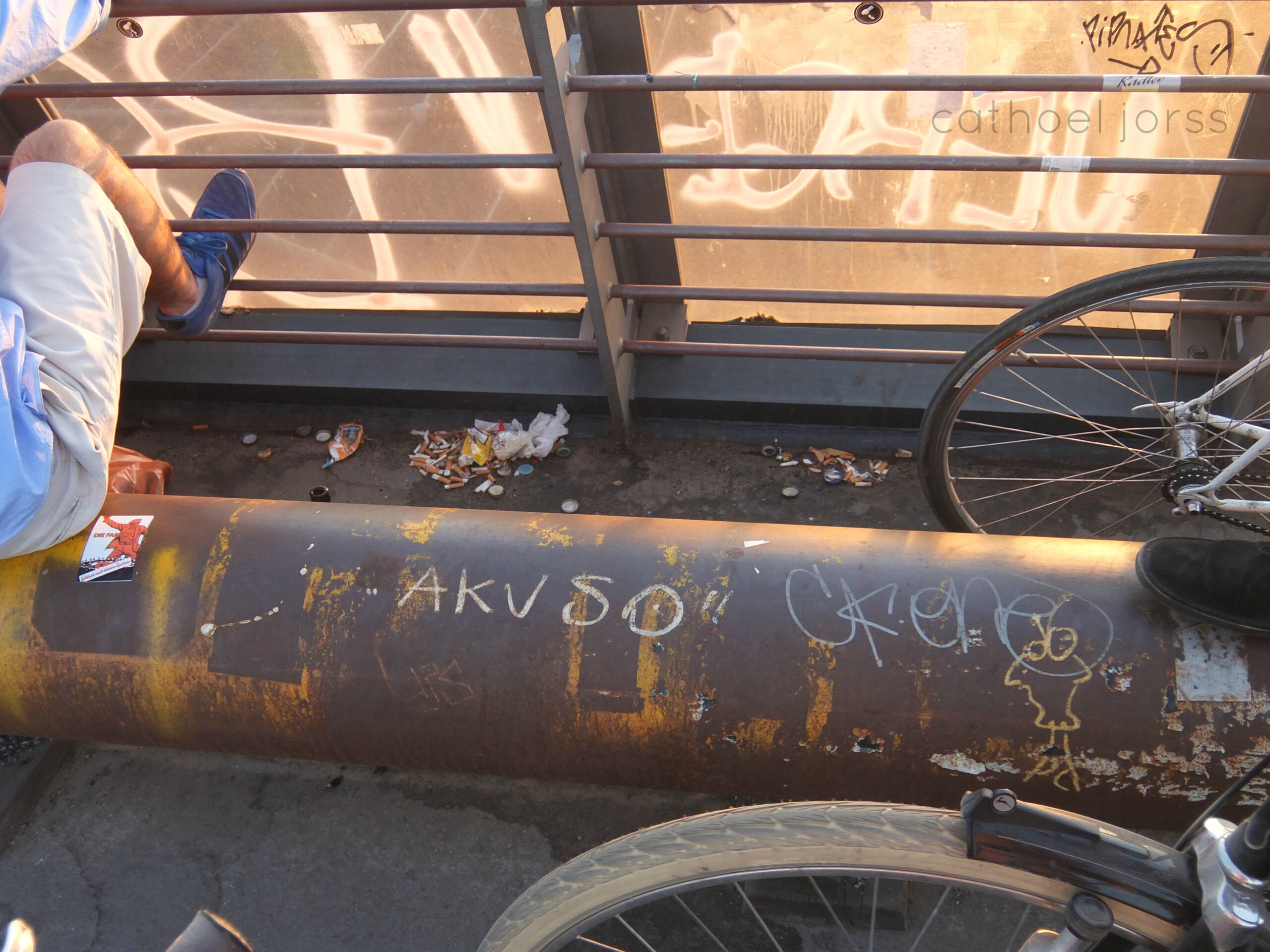
    H2O HoL bridge ashtray

  • elephant in the womb

    elephant in the womb

    A punker girl crossed the street under the shady trees, shouting at some invisible or internal enemy. She was dressed in black from boot to root, her ears infested with silver and bone. Parts of her bristled and other parts erupted with pus. She scraped a chair out at the cafe where we were reading the paper. I can read German upside-down, almighty me. A little girl of eleven who escaped an arranged marriage showed her luscious unformed face and said, if you make me marry “ich werde mich umbringen.” Meantime the blackclad punk had sunk into some suicidal nirvana of her own. Maybe she was married too young, against her will. Heroin came and took her in his boat, she paid the ferryman, they rattled off knocking and whining on the water. Twenty minutes later two police officers appeared, wearing plastic gloves, and stood over her til she roused enough to stagger to her feet and fall to the ground. We felt sad in the belly and my companion pulled me away. Death in public, and the underworld that clings to the surface. Drugs and their many-splintered joys. Just say nowt.

    H2O HoL outback elephant eye