Tag: Africa

  • men in dreads

    Two men unfolded themselves and stood up. One of them grabbed my hand. I was passing in front of the crowded colourful stalls which sell Bob Marley t shirts and long Ghanaian dresses. They had jangly sandals on display and drooping felt hats so dusty and untouched they might have been made for Stevie Nicks. “There she is!” cried the taller one, swinging hip length dreads. “Our sister from another mother.”

    I stood still, as they must have guessed I would do. The expression on my face was conscious, self conscious, enquiring. “We have met before,” his companion told me, “we spoke with you the other day.”

    I was quite certain I had never seen them before but fear of racism held me silent. Later I wondered how many Western women they trapped each week using this same trick: liberal women, hippie women, who are afraid of seeming prejudiced. Who feel responsible for the prejudice of others and when they travel the world, labour to make up for it.

    “We love your walk,” said the man in dreads. “So free and you walk like a soldier.” Do soldiers walk free? Aren’t they more inclined to march? But I knew what he meant. I was striding and looking about me. I was swinging my hands. African women, I suppose, undulate.

    There is a faceted splendour in all the people round me that keeps me always smiling and staring. I love that we find each other so compelling. People stop me in the street to say, “I love your height.” Men say outright, “Give me your number and I will call you.” I spend all day saying, “Thank you.” I say, “Thank you! Good evening!” “Thank you, but no.”

    I buy a ripe plump mango and the stallholder slices it for me with a curving blade into the palm of her hand. Walking home I eat it with a cocktail fork. I buy a Coke bottle filled with popped millet, like tiny buds of popcorn, and groundnuts – peanuts – which is perfectly salted, and in the morning I pour it on the bowl of mixed fruit I have chopped up for breakfast. My companion has never seen fruit salad and he looks askance at my heap of mango, banana, papaya, custard apple, and popcorn. Then he starts to eat and we both fall on it, good, delicious, fresh. I was not keen on the goat gizzard skewers. I am nerving myself to try grasscutter on a stick, which is a little rat-like creature grilled over the coals and eaten off a skewer. I buy kelewele, which is plantains rubbed in spices and grilled at the roadside. It’s sweet with a toffeed sharpness round the rim. I buy a coconut and the man lops it expertly, and after I have drunk the juice he chops the wood open so I can gouge long loops of slippery flesh and drop them like fishes to a seal into my mouth.

  • moon over Accra

    It’s a beautiful night in Ghana and the moon is very full. Immodestly so. What need has a moon of modesty? She has already pledged her love. “I will follow you though it turn me in circles all the rest of my rocky dry days.”

    I am sitting nursing a less and less cold beer at a local spot, at the junction. In Accra. These eight days I have sampled four of Ghana’s beers and I like this one. It has bitter local herbs and I am drinking it with a little sack of ripe plantain chips. I went back over to the lady nursing her child who bakes eight different kinds of chips and sets them out in little crisp cellulose bags. When I reached for the plantain chips she said, “Have you tried this one? It is ripe plantain. It’s better.”

    My first morning we went strolling through the hot dusty streets and, in my case, the jet lag, and found a lady selling mangoes from a bowl, who sliced me one, and a lady selling fat ripe bananas, and a woman with a tiny stall roofed in tarpaulin who fried up rice and beans with a headless fish and a curling slab of beef skin. She served it wrapped in a banana leaf and then two plastic bags. The beef skin quivered, nearly transparent, and I stared at it a long time before putting the corner very gingerly in my mouth. Oh, no.

    Jet lag is gone now and I am subsiding into this beautiful world. The moon is squared between four overhead wires and I gaze up, rustling the crisp cellulose bag with my fingertips, thinking of nothing at all. A man drawing a cart behind him heaped with yams stops to talk across the narrow garden bed to the spot’s owner. “How come you never buy my yams anymore? You buying from the other guys?”

    “No,” he says, “I will buy them soon.” I have watched this man, so relaxed under his awning of pink and white bougainvillea, tending his garden with a pointed stick to loosen the soil and a jar of tap water. The yam vendor creaks on and a man I don’t know, as I know nobody in Ghana, comes over the road and joins his friends. He says, “Good evening, madame. How are you.”

    “Good evening, sir. Thank you, I am well. How are you?”

    And he says, “You are feeling at home.”

    I raise my hand. I let it drop with its palm up and open. “It’s so beautiful here. I’m so happy. Your wonderful city.”

    Can one fall in love with an entire country? This one has.

    I came here on my second evening when the object of my visit was at work. I drank a cold beer and tried out the plantain chips. The owner of the little beer terrace invited me to share his table. Another man was sitting between us and he began drumming on the table’s edge, a rapid, complex rhythm, with his two stiffened fingers as though they were blades. I said, “Are you a musician?”

    And he said, “I hope so. I’ve got a couple of albums out.”

    Such a creative, thriving, diving, cormorant city. And so noisy. Wherever I go it is to a concert of honks and toots as every passing cab driver tries his luck. I joined Uber, with some nervousness, never having used it before, and was offered lifts in immaculate cars by drivers named Ernest, Ebenezer, Divine, Lord, Sumaila, and Wallestine. I spoke to a man on the street whose t shirt said LOVE and the O was the shape of Africa. “I love your t shirt.” “Where are you from?” And as we got talking he offered,

    “Let me give you my phone number. We just live in that house over there, the blue gate behind the plantain palms. If you need anything, or if you ever get in trouble or need help: you can call me.”

    This genteel, educated culture. This overwhelming sense that I am walking amongst gods. The tall, fit, gracious, courteously and warmly smiling people. Their patience and kindness. The sense that I’ve been right all along, and in our spoilt countries we have forgotten how to live. That these people in their exploited country are holding out something we are too miserable to grasp. Racism is envy. I have always known it and now I see it everywhere.

    The night passed serenely around us and I finished my beer and got up. My drummer acquaintance was at the next table. “What were you writing? A poem?”

    “Oh,” I said, touching my bag self consciously. “I was just writing about the moon.”

    He tipped his head back. “I hadn’t noticed it.”

    “Powerful moon, tonight.”

    “Eh,” he said, “Yes: it is full.”

    And I said, “Yes, and the crimes of passion and incidents of insanity are spiking tonight all round the world. The moon controls whole oceans. What are we but little seas? Sloshing with seawater.”

    “Seawater?”

    “Well,” I said, “salt water. We are mostly salt water. So the moon.”

    This is black Africa. The night treads endlessly on the sky. The lighted shop fronts with their sagging awnings and the smoke from the goat gizzard stall and the woman walking by with her fleet of buckets on her head are a world I have not met before and always, always longed for. As we stood there, a young man shot past on his bicycle, dressed all in white. A man carrying on his head a stack of neatly folded bright batiks walked by. “I am waiting for the pineapple woman,” my friend said. “I want pineapple.” Don’t we all. The heaps of fresh fruit, the dried fish, the bright plastic buckets. I have stepped off the planet of Europe and I may be gone some time.

  • the young man with a long way to go

    The young man in the place where we are staying is Moroccan and comes from the desert, which he describes to me as ‘sympa’, sympathetic, a kind place. As opposed to the hustle and throng of the medina where people greet us ‘welcome, welcome,’ and return smiles with great warmth and ease and employ the most genteelly probing sales techniques in (they say) the world.

    This young man is named ‘given by god,’ or ‘gifts of god,’ and we looked up his name in a list of the 99 names of Allah which, I only slowly realised as we were discussing these names with a nearby restauranteur, are perhaps not so much names as qualities. God the good, god the great, god the compassionate, god the wise. Similarly it dawns on me, belatedly, decades after the life on Java I so cherished as a child where we lived between three mosques and stayed indoors during the ferment of election week, that the prayers which play continuously in some hole-in-the-wall shops in the souk are not petitions, in the sense that I would understand prayers, in the sense I sometimes grope for in extremis and despair, longing in the depths of my pained heart to have someone to pray to; they seem perhaps more like resolves embedded in long and winding stories. And so they came upon a beautiful oasis. And there they could water their camels and have something to eat. And so god said to them…

    I am improvising, here. Who has any idea what god might be saying? not even the solemn Jehovahs Witnesses who came to my door with their beguiling brochures and then, when I grew just a little too interested, felt honour-bound to warn me away from the technicolor gloriosity of the illustrations. “This only… artist impression of heaven.”

    Ah – then. But god or, as I would put it, kindness, knowing, understanding, meaning, the connectivity of us with the world and with one another – a kind of exalted humanness, in fact – speaks to me in the trees and in the wind pouring through them; a sort of devotional prosperity I have dwelt in since childhood, when I used once to wander the markets in Jakarta and the coconut groves on the shore opposite Krakatau in a scintillated state of constant and ever-changing concentration.

    So, Gift of God has come to the city in the north, leaving his desert homelands behind, and he tells me he has been here in Fès only three months. He had a job in another pension but it was a bad place. He came to this house a week ago. Ah! I say, cupping his shoulder with my hand, from the side rather than from above because of the war between affection and a horror of condescension. Then you have been here only four days longer than us! Yes, he says, creasing his face in a serious, shy smile.

    This morning as I was lighting out across the courtyard with my books in my bag this young man approached me on his soft shoes. Would I like my breakfast now? I said, You know, thank you, but actually I think I might go into the adventure and just eat somewhere on the markets, today. Oh! he said, and dropped his head and an expression crossed his face that hurt me, as though I had hurt him.

    “It’s not because I don’t like the food! It’s just – I wake up and go, I’m in Morocco! And so I just have to go out and…” On the sunstricken square my lengthy sweetheart joined me where I was so deep in the book I was reading, a book about politics that I find difficult to understand, that when he crossed the sun and grasped me by the shoulder I started. Around us gentlemen of Morocco discussed – I imagine – politics, I imagine their talk is dry and knowing and cosmopolitan, world-weary, courteous, and wise, I hear words which are the names of countries and think, they are speaking of world events. The first morning I was almost too shy to sit down and had to approach the cafe, whose restful shelter I craved, by way of a huge loop up and around the street before I could cross the road at a tentative, oblique angle and ask the courtly waiter diffidently in my execrable French, excuse me? am I allowed to come in here? even as a female? I was the only woman in the cafe, almost the only woman in the square, and when I wanted to go downstairs to the bathroom they flew into a flurry of small-scale preparations and I was handed a door handle, by which to access the second stall – for women and for, I guess, tourists, as it has a Western toilet and sometimes even a roll of paper.

    The second morning I sat down in the blaring sun at a tiny table and was moved almost to tears when the man who had been sitting by me yesterday and whom I had greeted said, inclining his head, “Bonjour,” and even asked, “Ça va?”

    To have a courteous neighbour, who is reading the newspaper in Arabic and a battered paperback in English; to sit in the sun, after months in wintry Deutschland – it sends me down into a contentment that is very much like sleep.

    The young man in the pension, Gift of God, smiled his grave smile on our third night in Africa when we asked, where would be a good place to eat. He told us he had made a very small number of ‘connections’ in Fès, since he came here three months back alone, and his friend Mohammed runs a good place, very cheap, under the large tree which is a landmark as there are so few trees in the medina at all. “That young man has a long way to go,” says my companion as we cross the square. and for a few moments I am startled, before it clicks into place: that he will go far. We eat at his friend’s cafe, treated royally. We practice the gesture courteous Moroccans use, of a hand pressed level across the breastbone, touched to the heart, moved, thank you, I am sorry. Walking the medina I also use the fellow gesture which takes place a little lower, pressing across the tummy with my other hand, saying, “On a manger.” I hope this means, thank you, we have eaten, and use it to reply to the touts who hand laminated menus outside every restaurant (“We have wine!”) My German companion thinks the tummy is called the stummy, and recently revealed in conversation that to him this is because the stummy is the seat of all stamina. This makes sense. Stomach, stumina, stummy for short. Now I find out he is calling the guys who hawk the restaurants ‘shouts’, perhaps a better word than touts. Meanwhile in German, he says, I make ‘sweet’ childlike errors in a thicket, or fog, of laughably elaborate courtesy. Elaborate formality – to a German! that kingdom where a Keep Off the Grass sign will begin: Very honoured forest wanderers and forest wanderesses, please be advised…

    So on our first week in Fès we navigate our way with his terrible French and my awful French and the few paltry words of Arabic we have learned: principally ‘choukran’, thank you (hand across heart), and ‘la choukran,’ no, thank you, to which I’ve improvised a kind of Bollywood head-waggle of the hand.

    By the fourth night the influx of new sensations and sights have exhausted us and we go back a second time to the same restaurant. Mohammed greets us with cries of warmth and manifests a place to sit when almost every seat was full. He flaps the fancy tablecloth like a magician producing a bunny. I watch him do this over and over, I remember the rapid-fire thought processes and sly courtesies of hospitality work and comment, when he comes by to tip more bread into our basket, that it is like surfing. “Yes!” he says, jubilant, “exactly – like surfing.”

    This man has learnt all his English by listening to customers and he asks, what is the word in German for I will be awaiting you. Germans sometimes say to him, “Vielleicht später,” maybe later, when he offers a menu. We search among our words before lighting on Ich bin für Sie da, I am here for you, explaining this is “very gracious,” making gestures of graciousness like a king. “Ah!” he says, satisfied, Moroccan: “Ah! Yes! That – is most important.” He asks us to speak it into his phone so that he can learn it, and I take a photo of the two them with their sweet heads together, listening in on one departed French or Spanish or German tourist after another, speaking in all their different voices the phrases which comprise his vocubulary, each of them adding a drop to his store of hospitality.

    To my right, five Chinese students are spending the night with their phones. They are so absorbed that even when food arrives they ply their forks round it, scrolling onwards through the fascinating replacement world. A commotion of drums festers in the distance, around a corner in the narrow lane which is hung with handicrafts for sale. “Hand mad” says a sign above the racks of point-toed slippers. “Prix fixe.” I have seen tourists walking through the busy markets with expressionless faces shielded by devices set to continuously record, and I wonder how it must feel to be videoed a thousand times in a year by people who don’t seem to bother to even acknowledge one’s humanity. The students issue their drink orders (avocado juice, banana and orange juice, freshly pressed, with sugar and without) free from any thank yous or any please and Mohammed presses his palm across his heart as though it aches, saying in English, “Thank you, guys, I bring it right away, great, please, certainly.”

    The clatter of drums is coming nearer and I am craning to see past the French family who have stationed themselves in the passage to wait for a table. Two men, gaily dressed in such bright robes and complex festoonments my eye cannot grasp them, holding up their tiny drums, the skin of the drum painted with henna, stamping their soft leather boots and singing splendidly – I ask if I can take their photo and the taller says, “Foto!” and they both fall to attention, and then he puts his cupped hand out and I realise I have no coins. Mohammed is passing with a clutch of creamy avocado juices from the stall across the way. On his way back I put out my hand. “Est-ce que vous pouvoir me louer un peau de l’argent pour les musics?” This doesn’t exactly mean, Can you please lend me some silver to give to the musicians? but it’s the closest I can get.

    Sure, he says, without pause, digging in his pocket and showing me the coins. He selects for me and presses them into my palm: three, four dirham is plenty.

    At the end of the meal we want to pay and I say, “Plus the four dirham,” and Mohammed looks puzzled. “You lent it to me, for the musicians,” I say.

    “Ahh!” He shakes my hand, pressing his heart. “My friend.” “Thank you so much,” I say, “We love it here, we love your restaurant,” and behind us the French family jostles forward, scenting seats at last, and we say goodbye to the other Chinese students on our other side who have been telling us they woke up this morning in tents in the Sahara and could see the ‘galaxy’ but it was spoilt rather because there was ‘no service’.

    “You went on a self-catered tour?” I said.

    “No service,” the good-looking leader repeated, jabbing his finger at the sky. We walk away, tired in the stummy and thinking as we come home how extremely gentlemanly, how classy it is of Mohammed to have lent me the money for the buskers and then to have instantly forgotten the debt. Morocco seems to me so complex and inspired, I have the feeling of a rich, fine intricacy, am rejoiced to see how gently and tenderly anyone with a disability is handed up the stairs or into vehicles, I see the brutality, I feel my heart aching with the real inevitable charge of life that in ‘our kindergarten countries’ as my Berlin companion has called them this week is simply absent, or at least invisible, and when we are not afforded the luxe protection we experience as our right, we sometimes grumble at god, who has not given enough, whom we can call on with praise for sparing the floods our children, as though this were not an insult to the humanity of all the other children swept and drowned, as though the Acts of God excepted in the fine print of every insurance policy were not just and not our desserts, but rather an interruption to the service we expect, and for which we would pay nothing but our words.
  • a fortunate wander

    Today a very fortunate wander took me into a place I adored: several places and all of them new. I couldn’t handle the surly manner and derisory service, the lack of smiles from the waiters who work year in, year out with tourists treating their town like a fun park, nor my fellow tourists themselves, not even the six English ladies made up like drag queens with giant, winged eyebrows painted on their pink foreheads who got drunk at the next table on Friday afternoon and asked the man, Is the chicken salad thigh or breast meat? And then when he didn’t understand, their ringleader (biggest brows) insisted, Breast! You know? Breast? putting her cupped hands under her own mammoth bust and jiggling herself at him invitingly. They made me laugh and they made him laugh but also, enough is enough. I went walking and kept walking, without looking at the map, just following whatever alleyway or lane seemed inviting and counting the geraniums in people’s windows.

    Down a steep hill I rounded a corner into this long, elliptical square – a rhomboid square – just filled up with Indian restaurants. There was a grocer’s selling plantains and yams and cheap calling cards, and on the other side where the pavement swung out from the houses maybe ten or a dozen restaurants ran down the hill. About a hundred tables were crowded with afternoon revellers. I found a seat under a giant umbrella and read from the cheap, fantastic menu. All around me people were eating and chatting, it felt like a very laid-back party. I put my hand round my jarra of beer and a terrific commotion struck from uphill, drummers, dancers, forty or fifty lanky African men came bursting slowly out of the narrow road between the houses and they had skin drums, shakers, all kinds of noise makers and were dancing. Really dancing. They tumbled down the hill gradually like an intricacy of shells washed in the surf. Round the hems of this raggedy band half a dozen fellows carried pots and hats, which they danced among the tables to offer deftly round. People remonstrated, laughed, threw in coins. They were irresistible. When I had done eating I got up from my chequered table cloth and followed downhill the shaggy brown dog who was carrying a whole soccer ball in his mouth. The ball was saggy and deflated but he clearly loved it. At the bottom of the road where it met the next street was another plaza, ramshackle and traffic-stained, where dozens of people lounged on bollards and under trees, many of them African. And as I was coming up again towards, I thought, the part of the old town I know I found a little bookshop open all day until midnight, in which quiet prevailed and concentration reigned so much that when people came in from the street they instinctively lowered their voices. It was like the opposite of the meat cave I had found on the shopping street, Paraíso de Jamon: it was a paradise of non-ham. Three people in alcoves and under bookshelves were writing. They serve coffee and the windows are encrusted with flyers. I sank down by the cardboard carton of old vinyl and took out my notebook and my pen. People turned pages and moved very little. The guy serving sat behind his computer peacefully reading all afternoon. We were there for hours.

  • bella Africa

    Beautiful African woman, standing with her back to the street in a luscious canary-yellow dress. She is facing the vast windows of a display of swank cars, why? The windows rise away into the night above her head like an airport. Ah, I see. Beautiful African man, whom I didn’t see until he moved, in the dark, standing with his back to the car he has chosen for dreams, she has her phone up, he is posing. They are built like gods and light the night. I walk past with my head down, my hands full of posies of stolen plants roots and all gleaned from the gardens outside the shopping centre which I plan to propagate rather than just steal, beautiful in my way.

  • stolen man

    An African guy who lived in the apartments near me had the warmest smile always courteous and would wait on the pavement if I walked behind him so I could go by was taken away by police, five weeks ago I think, and the pot plants on his verandah are dying and now there is no cooking the evening meal on his tiny barbecue and no whistling to himself and singing as he pegs out his wash, always neatly, always pairing the socks, alone.

  • true dat

    I saw a gorgeous black girl climbing off the train yesterday in this heatwave, her hair was intricately braided in pulpy masses and then the braids woven into a long plait, her cork soles were three inches high and a tiny skirt swished around her legs. Her shoulder bag said in huge letters, AFRICA IS THE FUTURE.

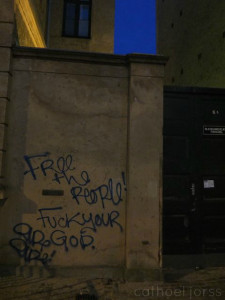
    H2O HoL free the people fuck your god

  • “high, wild, savage and frightening”

    “high, wild, savage and frightening”

    What is that book you’re always carrying? my friend wanted to know. So I opened it and read to him:

    “But the first of the thunder and lightning was always high, wild, savage and frightening. Every year people in our part of the land were killed by lightning. Yet long before I learned at school that lightning was electricity, and all else physics had to say about it, I caught the symbolic ‘other’ from Klara, for whom it was a pure phenomenon of the spirit. While the women of our community on their different farms would fold up the silver and metal in the house in sheets and blankets in the belief that otherwise they would attract the lightning, hanging towels over all the mirrors and drawing the curtains in their haste, Klara would sit with me on our great verandah and make me look at the lightning because she said that every human being had the same light as the lightning in his eye, and the fiercer the lightning outside, the brighter the light with which the eyes must look directly, steadily and without swerving, back at the lightning. She believed that if the light in one’s own eyes did not respond and flare all the brighter because of the example of the lightning, there was a form of lightning that would go black and invisible, and that that form of lightning was the lightning that killed.

    “This was for me one of the earliest and most convincing illustrations of how symbolic the Bushman spirit was, how rich in the primordial wisdom stored up in that two-million-year old being of which Jung spoke to me later, describing at as ‘a living treasure of the all the experience and knowledge gained since the beginning of time’, and warning that if one lost touch with this innermost source and its symbols, life, rootless and adrift on the tides of fate, would fail and die. Fairly early in my life, thinking of the Bushman symbolism as I had done from the beginning, I thought of the lightning and the light in the Bushman eye staring back at the lightning as images of consciousness and awareness, and I ended up where I still stand today by thinking of lightning as the call to the battle for increase of awareness which is the imperative in creation.”

    ~Laurens van der Post, The Voice of the Thunder

    HoL blue point tree