Tag: airport

  • the Nazi airfield in summer

    I will tell you what Berlin is like in the summer. As I cycle home from a far-distant errand I cross over an overgrown field. Near the hangars, part of the largest manmade structure outside the Great Wall of China, a thicket of neatly rowed white demountable houses has bicycles parked and pot plants blooming. These are some of the one in two hundred Germans who are now Syrians escaping the war.

    Six police officers in flak jackets are guarding the asylum seekers, lounging in the afternoon sun. The other side of the wire fence a summer circus has set up its tents; then a rippled concrete path runs past and on the other side of that, a fake beach is lined with volleyball games.

    Behind the volleyball courts people have built themselves a tumble of pallet gardens. All of this takes place in the old Nazi airport, which also hosts Berlin’s emerging designer festival in its cavernous and sombre hangars.

    On an obsolete airplane bumper of concrete with fading scarlet stripes a woman in a beehive and three-inch stack silver heels is picnicking, with her shirtless golden boyfriend, silver-chested, with his skateboard lying by them. They are both in their sixties. Further into the field two young women are learning to kite surf on vast sails. The runways divide meadows filled with wild flowers and dredged by butterflies, because half the local taxes are paid by artists and the city can’t afford to mow.

  • possessive hand

    The little cat puts her hand possessively on my arm. After a moment’s thought her other hand creeps up to join it and I remember the day I finally found her again, after she had been lost for a lifetime, five months at large in the laneways of inner Melbourne, and a man rang in response to one of my incessant posters saying, I think your cat is living in our backyard, and I went there and she came out warily from among the ferns, panting with thirst and telling me all about it, Mwowl, wowl, wowow, and she wrapped her forearms around my thigh and pressed her length along the length of me, ferocious with love.

    Today I am going away again forever and she knows something is up. She doesn’t like it. She has slept in the private cave between my knees, purring. She comes along after her night walks and nudges the blankets with her little nose, so that I half-wake and raise the covers up for her, and she slides in. Our physical intimacy has always been a most remarkable element, to me. When I found her it was through a cattery out at St Kilda, the other St Kilda, a coastal hamlet miles out of Adelaide. The lady who ran it was dotty about cats and had simply bred too many. The local council told her, you have to get rid of some, or cull. She’d put a notice up in the papers saying, free purebred kittens. I went out to her farm and there were four large sheds brimming with yowls. In the middle one a concrete floor writhed with kittens. I sat down to watch and find the cutest one, the prettiest. I liked the golden baby with caramel points. I liked the dark brown. I looked down and a skinny, ugly, funny-looking teenage cat with a smudge on its nose had crept up onto the table silently and crouched in against my hip. She laid her sharp pointed head in the hinge of my thigh and closed her eyes.

    I didn’t want her. I wanted the pretty ones, ones who still had all their growing to do. The next week I visited again and the same thing happened. It was summer and my bare toes in their sandals were rimmed with little kittens who chewed softly at the salt. Oh, they were all adorable. But this freakish, peculiar, not particularly attractive animal stretched to the length of her growth had chosen me. With ill grace I packed her in a banana box and stowed her on the seat of my ute. She had never been away from her extended family before, never been alone or in a car. She gave out rhythmic little bleats. I was driving and could only fit the crook of one knuckle in the narrow slot by which banana packers lift bananas. I felt her soft face come up against the tip of the knuckle and she sat down right away and stopped crying.

    It is twenty past seven and everyone is sleeping. I leave Brisbane in a few hours. I was sitting up in bed writing with my early morning cup of tea and I glanced up and met the eye of a big muscular Maori man I had never seen before. He was creeping round the side of the house, wearing a hi viz vest. When I went to open the door he boomed, Hello! But when he heard me answer far more quietly, he glanced up at the house quickly, and said far more softly, “Aw sorry, don’t want to wake everyone up.”

    This was Robbie, lifting all my precious things into a truck to drive them out to the ship. He took especial care of my guitars. These guitars have been in storage in Melbourne for three years and my cat has been in storage here. My mother calls her the grey nurse. When Dad is sleeping, which he mostly does, she curls in him and sleeps too. He’s her perfect companion: warm and available and never standing upright so he always has a lap. When the constantly changing rota of Blue Care nurses visits she sits on the side of his bed and keeps guard mistrustfully. I would so love to take her to Berlin with me but it would be cruel to all of them. My father would be bereft. And Tisch is a little wild animal with her afternoon frolics in the bamboo, her insouciant saunters under the old house next door to taunt their verandah-caged dog and to leave her scat. During the day I hear my father talking to her. She is his grave, watchful, lazy companion.

    There was another cat here who was dying when Tisch first arrived, four years ago when I went to Berlin, for a week, and ended by staying for three months. I met a man and stayed on and now our future is uncertain – just in the last 24 hours. I had parked Tisch in a cat hotel in Richmond and when I went in to pick her up the girl on the desk said, in a bored tone, “Name?”

    I said, “Tisch. T, I, S, C – ”

    “Oh!” she cried. “Tisch! Oh, does she have to go? Can’t she stay?”

    She brought me my cat and I couldn’t help noticing Tisch had grown substantially rounder. “We take her out whenever it’s quiet,” the girl confessed. “We play with her round the desk and give her biscuits.”

    The year before, Tisch had been lost for so long that my friends were telling me, You’ve got to give her up. She is dead, or she’s found another family. I walked the streets calling and calling. I collected sightings. I rang a cat retrieval specialist who suggested a poster saying, This Cat Has a Serious Illness. “But she’s healthy!” I protested. “She’s a sweet little healthy girl.”

    The retrieval specialist said darkly, “You’ve got to appeal to people’s lowest common denominator.” I said, “No. I’m going to appeal to the love.”

    My poster had photographs of Tisch curled in my lap and on the rug and it said, This is Tisch. She is lost. I miss her like sleep. A flood of text messages followed. Can I put up your poster at our school, I have copied your posters for our office, don’t lose hope, “this is our dog Wendy. She is watching tv. I thought a picture of her might cheer you.” A neighbour wrote, “I know how you feel. I lost my little while dog eight years ago and I still stop every little white dog in the street, just in case it might be him.”

    So now my guitars are on their way to the sea and will be freighted like so many piles of t shirts. I have only a temporary home in Berlin and the reason I couldn’t come to visit Dad sooner was my offensive landlord had taken me to court. We have a contract but he seems to think he can bully me into leaving, for his friends to use the apartment, by dint of phoning and shouting at me, screaming at the door. The loving relationship I was going back to, the person who has kept me sane in our whispered late-night conversations, has turned his back and folded his arms. It’s all hard. I leave my father and my cat wrapped in each other’s skinny arms. I salute death, the enchantress who makes life possible, as ably and courteously as I can. I remember my uncle’s cat Putschen, after the uncle had died in a scurf of urine stained cushions and skittering letters to the government about his fears of his various neighbours; Putschen was big and wild and I had to coax him into the car. Years later after Tisch had also moved in, Putschen had cancer. The cancer ate him away from inside and I was visiting and for some reason the spot he wanted to curl in all day and all night was the wardrobe in my room. He had become transcendent with pain and was skinny and hollow and purring so loudly all night that I finally had to move him, into the next room, through whose wall I could still hear him. The other cat, Tisch, would come in of an evening and the two of them touched noses, “Still the cancer?” “Yup, it’s ok.” I began to call him the Dalai Putschen. My father has not reached this state and the death which seemed imminent now perhaps may be more uncertain. We can’t know. My father says to me every day, Can’t you stay one or two more weeks? and I have. But now it is time and I am heading out into the wilderness, a country whose language I don’t speak, a blessed breather of solitude that now with my relationship on ice seems more like a lonely sojourn in foreign parts. I will get to Berlin in eleven days and don’t know if he will be there to meet me, or not. I leave my cat behind and she is the worst possible correspondent. She doesn’t phone, she never writes – not a postcard – but my mother has said, when I telephone and she hears my voice, sometimes she comes and writhes around the implement. A hollow love long distance. A house of bamboo grief. I don’t even know what I am saying any longer and the plane is waiting, opening up its maw.
  • New Zonked

    In New York we had dinner with two New Yorker friends, one from Chicago, who are both broadcast journalists, and a Southern boy one of our friends had picked up in the street and they had bonded. Southern boy had on a Hallowe’en pumpkin shirt over an American flag t shirt. My German companion made me laugh by innocently mispronouncing his views (sane) on American gun laws (insane): you walk into a school and it’s like that film, he said: The Texas Chainsaw Moussaka.

    Many Americans have a naivete that makes me feel protective of them, and not just about guns. More than once I have been complimented on speaking such excellent English, for an Australian. It doesn’t always seem to be because the speaker has confused us with Austria. I guess the sensation of believing one’s nation the centre, and pinnacle, of the civilised world – the use, even, of phrases like ‘the civilised world’ – might engender a certain self-satisfaction. On my very first visit, a few years back now, to New York I would marvel to anyone who’d listen how much better of a time I was having than I’d expected. “That’s because New York is the centre of the universe,” explained four or five unrelated New Yorkers, innocently.

    At JFK we had queued with our passports and I overheard the officer herding the line answer an anxious tourist’s question with, “I’m just doing my job here. Anything else you’re asking – is irrelevant.” “They’re handling people like goods,” said my companion, shuffling forward. Three days later up in the Bronx we went walking through one of the giant parks that make that part of town so beautiful. As we were coming down the hill a crocodile of children was climbing up. A little girl in front was walking rapidly backwards, her head tilted round to guide herself. “You can do it,” the teacher encouraged. “I believe in you, Destiny!”

    I said, to make her laugh, “We believe in you too, Destiny!” A second group of students followed them. One little girl was walking with her teacher, saying, “I’m serious!” “You can’t call a taxi,” the woman told her, “in a park.” It occurred to me I’d never said I believe in Destiny, before. I’m just… not American. Yet the sense of kinship with random passersby as we wandered up Central Park right from the bottom to the top, as we ventured into Harlem, as I got tangled in conversation with fascinating people on the D train, forever a stranger, was so spicy to me and so sweet. I loved the guy on the subway whose Superman socks were pulled high to the knee and inside out. I loved the wide-eyed baby whose daddy was so stoned he gave off a pungent weed reek. I loved the crazy Christian lady who tried to pick up my companion and when she’d asked, are you alone, looked at me and said, “And is that your… sister?” I loved the man who glanced into my camera’s screen when I stopped short at the top of the stairs into the subway station at Canal Street and said, “Nice photo.” It felt as it always to me feels in New York city, one of earth’s prototypical cities, as if we all are engaged on some giant endeavour, and none of us will ever see the outcome – in completion – we are fragments in a kaleidoscope like moths, we are our own art, we are brushing up against each other every day all day long as we go, handling the good like it was people.

  • New York meets Berlin

    It’s 3am now in New York but when we landed in Berlin, it was 7 o’clock on a sunny Sunday morning. It is colder. I am tired. My first time arriving in Berlin from the States and the subway, the U Bahn, seems immediately different. People are different and I can’t put my finger on it. “Thinner,” he says, and I gasp. He is right. They do not seem to be eating themselves to death. They are playful with one another, with strangers, in a way that seems to me to take a different kind of things seriously. They chatter and laugh, fall asleep, excuse themselves to one another as they pass. There is a different kind of facial expression, something hard to quantify. There are many many fewer really giant large people. They seem, I don’t know if it’s more alive or simply more awake. I do not cherish myself making these observations but in between the long spells of sleeping sickness on the swaying bus and the whispering silky smooth train I keep noticing. The train platform is not a kind of caged forest. It feels spacious and light. I didn’t expect to feel this way. There is a lot less staring into phones. People look to me fresh somehow. They seem grimmer and less disheartened.

  • brisbylvania

    brisbylvania

    Brisbane screams and Berlin roars. Can that be what it is. I ask what do you notice and he says, It’s noisy. Brisbane is noisy and Berlin is loud. My anxiety for formulations. Can there be two towns more unlike. We can hear the freight trains on the opposite hill, buildings are no barrier. Everything is liquid, the hills, my heart, the air, my fears. So many new buildings on the way home from the airport. The tender awfulness of long haul travel, the heart that stays a leg behind. The Inuit woman who said to my writer friend at a first nations’ conference in Canada, Stand on the tarmac and holler out your name so that your soul can find you. The sense that my soul cannot find me. The walk in the dark at eight a.m., which is midnight, down along the river between high screaming trees. The frantic squealing purr of fruit bats. They are huge. The slinky broad river in no hurry to get anywhere. The long roads of hideous Eighties buildings, the tradition of tearing things down. And the empty lonely streets. The lava of cars. The shimmering stench of fuel. The yowling thin cat who purrs as soon as I put my hand on her but keeps her neck high and her ears laid back. The overgrown undergrowth. Of nature and of business. The ruthless wretched finds. The mud and mangrove flats, the sense of things nesting and hidden. The screaming air. The shaft of sun through 6a.m.’s window that is too strong and heats me unbearably, heats into me, the stickiness of me from sleep, I have to shelter from myself in the walls.

    The flimsiness of buildings, walls are no shelter at all.

    “What do you notice?” “It’s so alive.” Not for me. Ghosts of everything, everywhere I look. Ants on the jar of ironbark honey unopened. Everything is teeming with the sense that life is brief, unasked for, lacks deliberation, rots from birth. The blood under the river. The lingering spirits in the trees. The desire to climb and to recline, the rough bark on my dry-skinned face. The passport officer who says, “Thanks, guys.” Peaceable, welcoming, stolen, so laid back. Noisy, rampant, tangling up towards the money. Mining town, rainforest trading camp three days’ journey up the river, flimsy stadium, boat. Leaking boat. Oyster shell. Sharp, sour, over-sweet, festering growth spurt. The few people, who don’t respond when I greet them. Pedestrian place of real estate dreams. This awful, deep, disorienting fatigue. Lost world of flowers, big, as scentless as fabric. Put up adventure and find some shade. Where is art. I mean the sap extruding from the living blood. Not what the anxious local government says is art. The money and the festivals, arranged rather than brewed. The thrumming art of things, the compost heat of ever regeneration, the shelter of the water, the tireless tides. Down among the mudflats. The 1950s. Motor city.

  • why am I having to go through this??

    The last time I was at the airport I watched a band of six merry hipsters in beards (boys) and ballet flats (girls) and narrow cuffed jeans stop at the boarding gate to take a picture of themselves. One volunteered to be not in the picture and the rest fell instantly into a Tommy Hilfiger pose, falling comfortably against each other, one shoulder sliding up and another down, all of them availed of a facial expression they could hold for many seconds without distress or strain. We went through the glass gate one by one holding our passports and our passes. The sixth and final hipster made an unhappy discovery: unlike his five friends, he had not paid extra for “speedy boarding” and was compelled to turn right where they all turned left and wait in the longer queue with all of us schlubbs. His face fell apart. It was wonderful to watch. He was tall and broad-shouldered and carrying a dense brown beard. His shirt resembled a lumberjack’s jacket. His voice came out whiny and high and aggrieved. He went all the way round behind the counter to reason with the airline crew member, waving his boarding pass: But you don’t understand! We’re all travelling together! Her expression was priceless. She tried a couple of times to explain the airline’s policy, too polite to point out that he and his friends were probably seated together and would all be reunited after fifty metres of tarmac in another four or five minutes. He looked as though he was going to cry. The woman rolled her eyes and let him pass. On the tarmac I saw two people kneeling in front of their carry-on suitcases, called out of the queue, stuffing in the extra handbags they’d thought they alone would be allowed to bring onboard. The tickets had cost around 70 Euros each and the airline’s posters at Schoenefeld Airport said, showing a man in a wheelchair, Travel Is Everyone’s Right. It seems to me equality and access are everyone’s right but jet travel is a fast-ending luxury. When we got on the bus at the other end of our short flight a beautiful milky-skinned red-headed girl was just in front of me. She showed the driver her pass and explained in careful German where it was she wanted to get to. He told her she would have to buy an extra ticket, her Eurail or whatever it was didn’t cover that. “But…” she said. She showed it to him again. With great courtesy he explained that this airport was outside the metropolitan zone, therefore: fresh ticket. She threw her head back and wailed. In English: “Why am I having to go through this?”

    At the Turkish place round the corner from my street the guy rolled out a long streak of dough and made me a Turkish pizza from scratch, although rain was falling outside and it was five minutes to closing. I carried it home warming my hand, walking through the soft rain, watching how the illustrated stickers of snowy revellers in the windows of the Apotheke blared colourful contrast to the black sticky wastes of nighttime in December in Berlin. A small woman on the subway train had made a speech about how she is “im Moment Obdachlos”, homeless right now, and because she cannot live on “Luft und Liebe” alone, on air and love, she would be grateful for any small donation anyone could spare. Then she walked the length of the carriage stopping to ask everybody, and thanking with her musical voice anyone who put their hand in their pocket and gave her a small part of the passport to the travel that is everyone’s right.

  • a bitten grin

    a bitten grin

    Wonderful, wonderful Copenhagen. I just love it here. Invited by some new friends, in fact someone I’d met once, to spend ten days roosting in the writing cabin in their garden. We got talking at the airport last time I was here. We liked each other so much. I was shy about coming to stay, off one meeting so many months ago. The plane got in late and we drove through the long unfamiliar softlit suburbs, speaking in English and my three words of Danish, lapsing into silence with a sense of relief. “This is my desk,” she said, “I’ve cleared it off, feel free.” Her husband is a drummer, with quiet, gentle eyes. At the top of a steep pine ladder in the little attic room I fell into a deep, long sleep. An advertising sign at the Schoenefeld airport said, To travel is everyone’s right, but to me, travel is exhausting, it’s a piercing privilege. It takes me days for my soul to arrive. Over breakfast our host sliced an onion into large rings, a raw onion, built a layer ~ a layer of raw onion ~ onto his dark bread and pickled fish and curried egg. He saw my expression. “Even by Danish standards,” he confessed, “this breakfast is rather…” “Rather punk?” Today we took the train and explored the old city, with all day that happy, blessed feeling this place always gives me. I just love being here so much, I love it, and always have a sense of wellbeing. It makes me feel I must indeed be Danish, in part. Our surname, which we pronounce jerz, comes from Lübeck but sounds to me more Danish than German, even if ineptly or creatively Anglicized. So floating on sunshine like two leaves on water we wandered about all the livelong day long today. The old town is a maze of quiet stories. People sat in cafes by the narrow canals and disported themselves on cobbled squares. Summer is short and wears a scarf. The temperature gauge on the side of a building goes up to 27, then stops. We came out under the church tower past the high prancing fountain. Under the low arched bridge a shadow moved. Slowly the nose of a broad canal boat came into view, low on the water and brimming with motionless tourist folk. They looked half asleep. The boat was about three feet narrower than the stone arch, being steered by a young skipper with immense concentration. Behind him people lounged, a few couples chatted, one lady stood up as she came free of the low bridge and began filming a long round sweep on her phone. We watched, awestruck. He had to nose the boat almost into the stones of the opposite wall before he cleared space behind him to start to turn. With inches to spare he cleared the curve. A beautiful piece of piloting, wonderful to watch. I could feel the warm railing against my ribs. When the boat finally started to turn cleanly past the narrow bend in this ancient, odd passage of water I began to clap. “Woohoo!” I said. People on the boat looked up, woke up, and amazingly a burst of twenty or thirty up front also bloomed into smatterling applause. The sense of joy spreading was almost palpable, you know that feeling. The skipper bit his grin. Two men also leaning over the railing gave me sideways, wry, prideful smiles. For a moment we were all alight with each other. In aircraft a difficult landing in rough conditions will be greeted by decorous applause from the cabin, like an audience in a concert hall encoring a solo. It feels like the habit of an earlier age. “That felt good,” I said to my darling friend. We walked away under the walls of the museum. “Maybe,” I said, hopefully, “next time those people see something wonderful they might think, how lovely this is.” How sweet that I am here to see it. How skilfully that person plays. How dear and rich. My friend gave me a tolerant, affectionate glance that flooded warm water through my heart. I feel lucky.

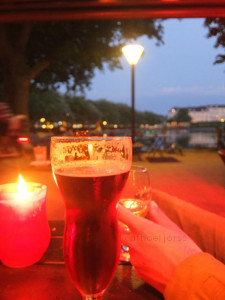
    H2O HoL red beers

  • higgle & piggle, hither & yon

    higgle & piggle, hither & yon

    Felt overcome by everything today & could not get out of my room until 4. So I went for a bike ride and found this basement cafe with a fireplace in the corner, right down the toe end of the sock on some higgledy-piggledy medieval street. O, comforting, o, deliciousness! But oh, no. Going up to pay I realized I had left my bank card lying on the desk at home. I could see it: scarlet, round-sided, shiny. The guy serving had made me the richest hot chocolate of my entire winter and didn’t look as though he wanted to call the police. We spread all my coins on the counter and sifted them. Australian cents with bandicoots on them, or are they bilbies? Or tiny wrinkled dugongs? A coin from the United Arab Emirates – on a long flight you pass through so many airports. There were three flattened rusted bottlecaps, valid in my own personal parallel universe, a shard of blue-painted china thrown out by the sea, and a badge which says Without Me You’re Just Aweso-

    I turned over the docket and grabbed his pen. “Can you draw me a mudmap so I can find my way back here? These little tiny streets. I’m not used to them.” He did, with much head-scratching, and then we both looked at it: a long, wavering straight line with a dot on one end (the cafe) and a dot on the other (an intersection I would recognize). “This is a terrible map,” he said. I said, “It’s a great map. And it has your address on the back so I can ask someone. See you in two hours, max.” Probably his name is not Max but I daresay we understood each other.

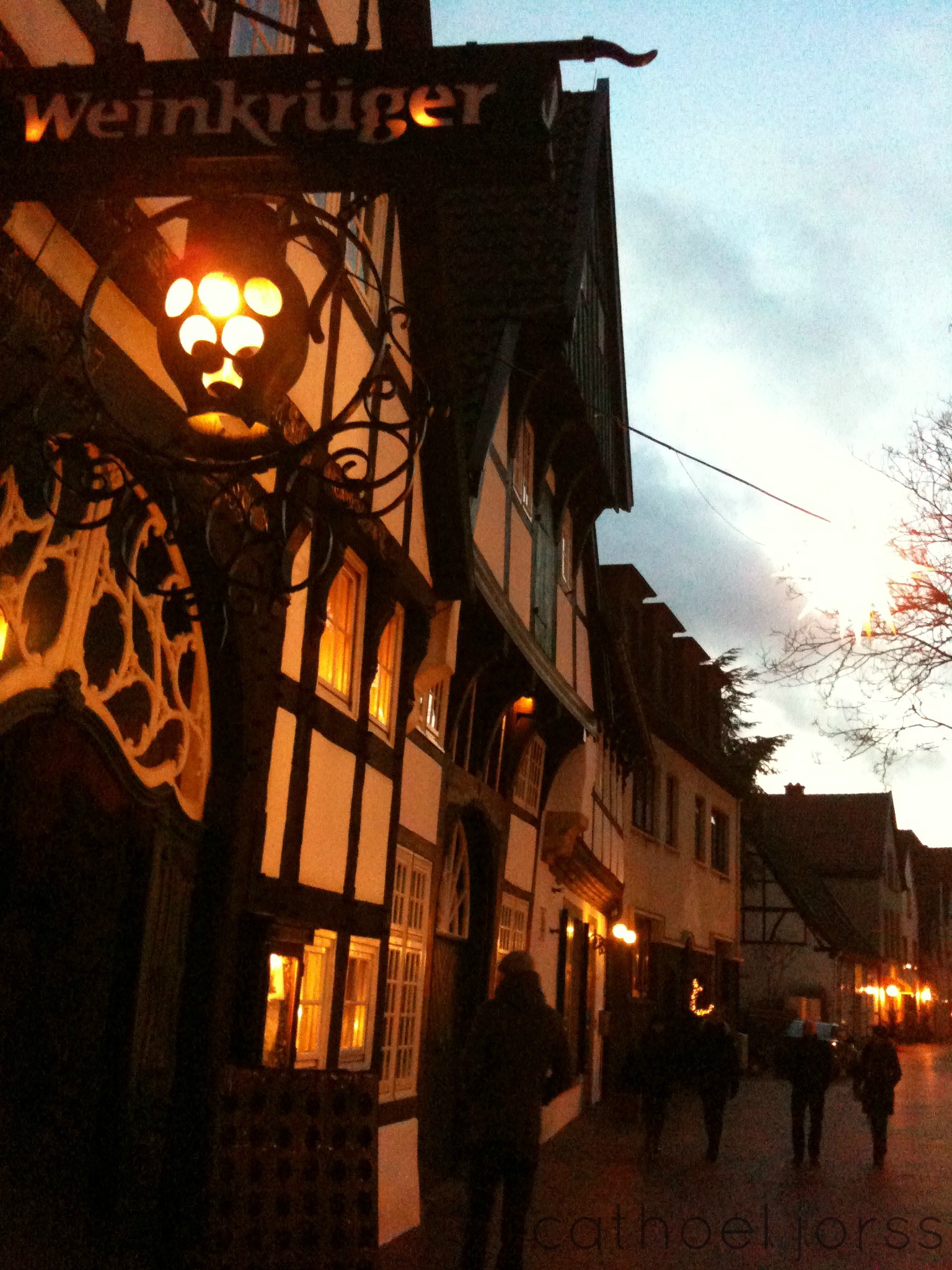
    H2O HoL traditional gold pub