In the late afternoon I walked down to the square. I’ve been indoors now every day of eight weeks. People were sitting round the edge of the grass as though it were a swimming pool they were dangling their legs into. The trees overhead are finally thickening with green.
A man who doesn’t have much had his tiny barrel-shaped speaker out and was blaring the blues. A bystander, so drunk he had lost his consonants, pitched forward and then arced backwards from the hips, hollering the blues. We have all been indoors since winter finally ended. We know the urge to holler. We know the blues.
Here the blues come marching back again, pouring from the settled sky, finally at rest and displaying all its sunny virtuosity which is kept from us in this dark city eight months of the year by thickset cloud.
The sky — the gorgeous preposterously cloudlit heaven of the springday sky. I sit down among the crumpled cherry blossoms, almost grey now in the grass. The sixth floor balcony where two weeks back a man had serenaded us with his saxophone is empty and the windows all dark. I sit watching two stout men drinking their beers, asking myself how is it I would know anywhere in the world they are Germans. Someone across the square sets up a rival speaker blurring AC/DC. Highway to Hell! screams the drunken singer, able to enjoy everything at once. A Turkish man who cannot afford to quarantine is collecting beer bottles, asking everyone first, may I have this. His face has patience and great sweetness. He stows each new bottle in his clanking bag. The pizza shop is open again but only for takeaway, ‘every one of our pizzas is nearly round’, their blackboard boasts. Last year at the end of the summer they had a drinks special chalked there: Soup of the Day — Gin Tonic. A man in a black Volkswagen sleek as a Beemer edges right in to the kerb and leaps out. He is prematurely casual in pink linens with a knotted sweater, it’s not really all that warm but he seems insouciant, he plugs in his car, a rental car, an electric car, and locks the keys inside the glovebox and goes strolling perfectly pinkly away. Like all of us, he is in rehearsal for summer, which is the future: summer 2021 perhaps, we’ll be able to travel, we’ll all be lightly and attractively attired, we will be slim and competent in public places, we’ll be free.
Tag: beer
-
Make Africa Great Again
We went out to the white people’s restaurant, as he calls it, which is a street stall on a dirt laneway behind the supermarket. There’s no street lighting, no cutlery. Collapsible plastic tables are set up between the parked cars. Vivid local tunes blast from the tiny bar across the road, which brings icy beers in brands no one drinks in Europe. We sit there for hours eating chicken and fish with our fingers. Last week a white girl got up and went over to the bar, carrying her phone. She persuaded the barkeep, who is a rapper, to link up her tunes to his speaker. Within seconds this wholly fresh and salty sound bathed the scene, and at their work and in their seats everyone was dancing.
Tonight a man sitting against the wall behind us had on a MAGA hat. A black man. I looked closer. MAKE AFRICA GREAT AGAIN. I got up and went over. Close up his red baseball cap read MAKE AFRICA HOME AGAIN.
I crouched beside his table to say hi as I do occasionally when a table of visitors have stiffed the boy dancers. “We can’t afford to give money every day,” they say, reasonably, demonstrating they can afford to eat out every day and I spread my hands, “I know, me too,” and persuade them that it’s ok not to give, it’s not ok to turn your stiffened faces away and keep eating while someone is standing there, sweating with performance, holding out an upturned cap. He is standing there. Treat him like a human. You are not greater nor less. Make whiteness great again.
Since so much of our cruelty comes from diffidence, I offer scripts. “I say, I’m so sorry, I cannot help you this time.”
“But then they don’t go away!”
“Just be direct. It’s courteous. ‘I’ve said no three times, you have to leave now. Bye.’” I tell them the dancer who stuffed fire down his pants but was yet to bloom in puberty “came to our table after you, and he just looked so wounded.”
Poverty is all around us like jackrabbits in the grass. Poverty, hard work, resourcefulness and struggle. We are like big birds of prayer gliding like clouds across the sun, idle on the air and wondering which one next we will swoop on to assist or exploit. Building our bullshit churches, insulting sufferers with thoughts & prayers in place of action, rendering free men into slaves, free woman into sex slaves. Calling the children they raise from rape ‘half caste’, as though only that portion of their humanity fell into any class we recognised.
Next morning four boys came to the low wall around our house which keeps the goats out. Their upturned faces were lower than the wall and I had to go and peer over, to hear. “Please, we want you go buy us four bicycles.”
Oho! I said. Well I would love to buy you four bicycles. I wish I could. I explained that I would love to have a bicycle, myself. But of course, I meant a second bicycle, here in my second home at which I arrive by jet plane.
The spokesboy suggested, “Or maybe a ball.”
My heart flooded with regret and shame, yearning and heat. Why shouldn’t these smiling, reasonable, kindly, and well spoken courteous boys have a ball? A ball to play with. A boy standing behind him said, “Bicycles!” and got cuffed for spoiling the deal. I asked, “Ee gon be how much?”
They reasoned. “Well, ee cost 25 cedis.” Five dollars. The spokesboy explained, you can get them for 18 cedis, but… “They get spoilt?” I suggested, using a word that in the wealth world we use to describe unhappy children but which here means, I had a phone once, second hand from the markets, and now it doesn’t work.
I tried to respond to this adventurous, eminently reasonable, and brave request the best way. I didn’t want them to feel that if this ball got spoilt they could just come ask the white lady for another, that a ball was nothing to me. I didn’t want them to feel I gave something which was nothing, it seemed insulting. I explained I had little money right now. All Africans know little money. It’s the most usual form of money. “But I will try. I’m going to try to find some money for you so we can buy a ball. I can’t promise you,” I said. “But I will do my best. Do you get me?”
Of course I’m going to buy them a ball. I just want them to have a week of looking forward to it. I see school children carrying their homework under the awning of a shop which has a light. I see people eating yam for breakfast, just boiled yam. If you have a sauce on your rice, the sauce is a couple of spoonfuls of garnish; in Europe garnish is the main dish. The man in the MAKE AFRICA HOME AGAIN cap made me at home at his table and we spoke for some few minutes. Neither of us mentioned Trump. We exchanged our numbers, as Europe and Africa should do. We are so few and have so much. They are many, and have little. We, they. We spoke about the music. The rapper who brings beers played his own song again. Coming back to our table I was dancing, a little. In Ghana I always want to give everyone everything and as I build my tiny business I am finding out a way we might be able to do that, one transaction at a time. It’s not giving everything: it’s not giving at all. It’s giving up what we can afford of what we stole. It’s giving part of everything back.
-
the Nazi airfield in summer
I will tell you what Berlin is like in the summer. As I cycle home from a far-distant errand I cross over an overgrown field. Near the hangars, part of the largest manmade structure outside the Great Wall of China, a thicket of neatly rowed white demountable houses has bicycles parked and pot plants blooming. These are some of the one in two hundred Germans who are now Syrians escaping the war.
Six police officers in flak jackets are guarding the asylum seekers, lounging in the afternoon sun. The other side of the wire fence a summer circus has set up its tents; then a rippled concrete path runs past and on the other side of that, a fake beach is lined with volleyball games.
Behind the volleyball courts people have built themselves a tumble of pallet gardens. All of this takes place in the old Nazi airport, which also hosts Berlin’s emerging designer festival in its cavernous and sombre hangars.
On an obsolete airplane bumper of concrete with fading scarlet stripes a woman in a beehive and three-inch stack silver heels is picnicking, with her shirtless golden boyfriend, silver-chested, with his skateboard lying by them. They are both in their sixties. Further into the field two young women are learning to kite surf on vast sails. The runways divide meadows filled with wild flowers and dredged by butterflies, because half the local taxes are paid by artists and the city can’t afford to mow.
-
a homemade flower festival
A woman in my neighbourhood has put up little signs all round the flower gardens in our local park. Her signs are handwritten, but laminated.
“INVITATION TO THE FLOWER FESTIVAL, JUNE 16. Yeah maybe ‘festival’ is somewhat high flown. But I will bake a cake and hand a slice of it to everyone who feels themselves somehow connected to these plants and who wants to come by. There have been so many lovely engagements and so much enabling mutual assistance taking place locally, I would really love to offer my friends an impression of it all. And in case we haven’t yet met, then this will provide us an opportunity.”
She writes a smily face, in her own handwriting.
“It would be practical, if youse (the informal German you) would bring something to sit on and some stuff that goes with cake eating and coffee drinking. I’ll be glad if you come along!”
Flowerbeds in Berlin are always overgrown, because the city is broke and there’s no money to pay people in fluorescent vests to destroy our every Sunday with leafblowers. Nearby, even more overgrown and underkempt, a tiny meadow has evolved where consistent and assiduous neglect year after year has allowed all the native flowers and butterflies to come back.
On the main road, when I reach it, a man with a ZZ Top beard has settled himself and his paunch next to my favourite seat outside the writing cafe. He turns the pages of his newspaper with noisy harrumphs. We exchange a few words. “I’m going inside to order,” I tell him, as Berliners do, “are you here a few more minutes?”
The informal ‘you.’
“Then would you mind keeping an eye on my stuff?”
“Either that,” he says, “or I’ll be gone, with your little red rucksack,” and he laughs, and I laugh, as I’m heading inside where it is shady and the bartender on his stool is reading Camus, in French.
-
moon over Accra
It’s a beautiful night in Ghana and the moon is very full. Immodestly so. What need has a moon of modesty? She has already pledged her love. “I will follow you though it turn me in circles all the rest of my rocky dry days.”
I am sitting nursing a less and less cold beer at a local spot, at the junction. In Accra. These eight days I have sampled four of Ghana’s beers and I like this one. It has bitter local herbs and I am drinking it with a little sack of ripe plantain chips. I went back over to the lady nursing her child who bakes eight different kinds of chips and sets them out in little crisp cellulose bags. When I reached for the plantain chips she said, “Have you tried this one? It is ripe plantain. It’s better.”
My first morning we went strolling through the hot dusty streets and, in my case, the jet lag, and found a lady selling mangoes from a bowl, who sliced me one, and a lady selling fat ripe bananas, and a woman with a tiny stall roofed in tarpaulin who fried up rice and beans with a headless fish and a curling slab of beef skin. She served it wrapped in a banana leaf and then two plastic bags. The beef skin quivered, nearly transparent, and I stared at it a long time before putting the corner very gingerly in my mouth. Oh, no.
Jet lag is gone now and I am subsiding into this beautiful world. The moon is squared between four overhead wires and I gaze up, rustling the crisp cellulose bag with my fingertips, thinking of nothing at all. A man drawing a cart behind him heaped with yams stops to talk across the narrow garden bed to the spot’s owner. “How come you never buy my yams anymore? You buying from the other guys?”
“No,” he says, “I will buy them soon.” I have watched this man, so relaxed under his awning of pink and white bougainvillea, tending his garden with a pointed stick to loosen the soil and a jar of tap water. The yam vendor creaks on and a man I don’t know, as I know nobody in Ghana, comes over the road and joins his friends. He says, “Good evening, madame. How are you.”
“Good evening, sir. Thank you, I am well. How are you?”
And he says, “You are feeling at home.”
I raise my hand. I let it drop with its palm up and open. “It’s so beautiful here. I’m so happy. Your wonderful city.”
Can one fall in love with an entire country? This one has.
I came here on my second evening when the object of my visit was at work. I drank a cold beer and tried out the plantain chips. The owner of the little beer terrace invited me to share his table. Another man was sitting between us and he began drumming on the table’s edge, a rapid, complex rhythm, with his two stiffened fingers as though they were blades. I said, “Are you a musician?”
And he said, “I hope so. I’ve got a couple of albums out.”
Such a creative, thriving, diving, cormorant city. And so noisy. Wherever I go it is to a concert of honks and toots as every passing cab driver tries his luck. I joined Uber, with some nervousness, never having used it before, and was offered lifts in immaculate cars by drivers named Ernest, Ebenezer, Divine, Lord, Sumaila, and Wallestine. I spoke to a man on the street whose t shirt said LOVE and the O was the shape of Africa. “I love your t shirt.” “Where are you from?” And as we got talking he offered,
“Let me give you my phone number. We just live in that house over there, the blue gate behind the plantain palms. If you need anything, or if you ever get in trouble or need help: you can call me.”
This genteel, educated culture. This overwhelming sense that I am walking amongst gods. The tall, fit, gracious, courteously and warmly smiling people. Their patience and kindness. The sense that I’ve been right all along, and in our spoilt countries we have forgotten how to live. That these people in their exploited country are holding out something we are too miserable to grasp. Racism is envy. I have always known it and now I see it everywhere.
The night passed serenely around us and I finished my beer and got up. My drummer acquaintance was at the next table. “What were you writing? A poem?”
“Oh,” I said, touching my bag self consciously. “I was just writing about the moon.”
He tipped his head back. “I hadn’t noticed it.”
“Powerful moon, tonight.”
“Eh,” he said, “Yes: it is full.”
And I said, “Yes, and the crimes of passion and incidents of insanity are spiking tonight all round the world. The moon controls whole oceans. What are we but little seas? Sloshing with seawater.”
“Seawater?”
“Well,” I said, “salt water. We are mostly salt water. So the moon.”
This is black Africa. The night treads endlessly on the sky. The lighted shop fronts with their sagging awnings and the smoke from the goat gizzard stall and the woman walking by with her fleet of buckets on her head are a world I have not met before and always, always longed for. As we stood there, a young man shot past on his bicycle, dressed all in white. A man carrying on his head a stack of neatly folded bright batiks walked by. “I am waiting for the pineapple woman,” my friend said. “I want pineapple.” Don’t we all. The heaps of fresh fruit, the dried fish, the bright plastic buckets. I have stepped off the planet of Europe and I may be gone some time.
-
graffiti confetti butt
I was cycling along the river where the water meets the trees, there is a little grove there which is sacred to me and it seems to be a forest in a parallel universe. It is a dreamy Spring day, grey like the winter but unlike Winter, studded with flowers; and I had just finished all the painful difficulties for the day, spending time in the bank explaining for the fourth time, you don’t understand, my card was lost, I had already reported it and blocked the card before this handsome spending spree happened; and then on the phone crouched on a bench at the local junkie corner explaining to one debt collection agency after another: see, you don’t understand.
Somehow or other they understood. Now all I needed do was scan and email, or photocopy and mail, the stack of documents the nice pregnant police officer had provided to me; and this two month saga during which I had spent entire half days in her company would be finally vorbei.
So I took some time to just cycle slowly along in my billowing favourite skirt, under the trees, listening to the voices of people who were quietly chatting on the benches and one man, very beautiful and with an outstandingly strong, slender ankle cocked, cross-legged reading his book and turning a page as I passed. I saw the glimpse of his natty sock and the gleam of his wonderful shoe. I saw the girl feeding compliments to her baby in its pram, in a sultry coo, and I followed down the path a little sister and much bigger brother, cycling end to end like a tiny chain of donkeys.
Her little legs in their candy pink zebra stripes were pumping earnestly; she barely managed to keep up on her little silver bicycle, and as I watched, the big brother, who was barely pedalling, looked back to check up on her and as he did so, he flung up his hand and opened its fist. Out flew a perfect confetti of torn up bits of leaf and as he’d intended, from her delighted squeal, the fragments fell over her and all around her and it made her happy and it made me happy.
A few weeks back late at night I was cycling home in the dark and my mind was drawn by the voices to the cluster of English-speaking Berliners, or touris, as real Berliners – old school, German Berliners, often themselves migrants who have fled Bavaria or Cologne – sometimes contemptuously call them. Maybe they tend to be loud and expressive; maybe they have money and push the prices up; maybe sometimes ’true’ Berliners can be seen in t shirts which say Berlin ♥ You but with the ♥ struck out; or merely ‘du bist kein Berliner.’ You… are no Berliner.
From behind me a lighted arc flew up and over and it landed in amongst this group who were talking and clinking their beers. It is a delight to young people from Barcelona, from Zurich and Copenhagen, and from Seoul, to learn they can buy beer for about a dollar and can drink it here anywhere they please, just about; when you’re done you just leave the bottles standing for some less privileged person to pick up for recycling; maybe the place feels like one great big nightclub; maybe it feels like a music festival that goes on unending and to which you need have bought no ticket and where there is no ID check. Who knows.
So it took me some time to work out that this lighted missile flying so gently through the air like a badminton shuttlecock was in fact a lighted cigarette butt, and it had landed — I could see it — in the black hoodie crumpled at the back of one girl’s neck, they had started slowly to go, Whut? Hey… and she had turned her head, just slightly, and I could see the dense cloud of her hair and that in another second she’d have swept her curls across the lit butt and she would go up in flames.
I was shouting, in English through sheer discombobulation: Hey! Look out! Hey! Cigarette! There, uh — there on your back, it’s just —
Slowly the group of them gathered what had happened and she stiffened and her friend brushed his hand round the back of the neck and shook the lit thing off and then I realised that the slowly strolling trio who had now caught up with me had sent this flying in on purpose, it was a tiny form of terrorism.
They were Turkish Berliner kids, from the accent, and they snarled at me lazy and unhurried when in English I shouted, Hey, you — next time, don’t throw your fucking cigarettes at people. “Ja, ja, mach mal weiter,” said the girl who was already lighting another, yeah just keep walking, get lost, she was not interested in being told by one touri how she must treat another touri on her own god-given turf.
I was pedalling again as my bike started to wobble and I felt a fear of this girl, with her massive sense of entitlement, and switching to German, hurried, unkempt German, I tried, “That was idiotic. It’s dangerous. Don’t fucking throw your fucking butts at people’s heads.”
And I rode home, past the hipster cafe where I wrote every day all through the winter and which some local person with a very distinctive handwriting had labelled in great big black spider letters out the front where people sit in the sun, “If you want — to speak English — go to New York. Berlin hates you.” I had marched into the art supplies shop and bought my first ever spray can, in a decent hot pink, in order to amend this so it read, “Berlin hates hate.” I put a ♥. Because I so strongly felt that in this city with its devastated history of what can happen once you let hatred of Those Kinds take hold, we ought to be more conscious, and we ought to take more care.
It did no good. My amendment stood for a month or two and then the disgruntled local struck again, writing boldly, harshly over my edited text and reinstating their insistence on hate. It is still a world though where older brothers collect bridal confetti for their playful little sisters; and graffiti and confetti and hurled butts of half-smoked cigarettes conflated in my mind and at the far end of the same street I passed the second instance of this same graffitied complaint which I had also amended, in full view of the people standing outside a restaurant across the street, where eventually the Hausverwaltung sent painters to clean it up by whitewashing the whole conversation away, but not without leaving the love. The painters chose to blot out everything that had happened on that stretch of wall except for the neon pink heart I had left there and there it stands, for all the world like it was put there on purpose, for all the world to see, for all the world — from me to youse.
-
bullying
On the bridge I pass two young women pushing prams walking with a guy chugging beer. They have their responsibilities, he has his beer. He is much larger than his baby mama, and in order that he can burp, twice, deliberately, right in her face, he has to crouch. Her head is down, she keeps pushing, and that is what makes me want to learn how to say in German: “You are in an abusive relationship.”
-
what ate New York
The film poster that has Godzilla tearing up great chunks of the city and eating alive New York City should have been a giant Pacman, I think. For technology has eaten New York. And not only New York: Copenhagen, Madrid, Berlin: these are cities where I have witnessed this carnage, sinister and almost silent. We noticed it on the plane, a ride through the sky which has transformed from what was a quiet space, a time of dreaming and half-sleep, into a wilderness of seatback screens. Everything flickers. People feed themselves perpetual stimulation by the handful, like a supersized bucket of chips. As soon as we land out come the phones. Soon the aisles are crammed with people stooping under the bulkhead and standing over each other, so intense is their desire to be free of the traveling life and meet with the destination city, yet all have pulled out small devices and are keenly, yet dutifully scrolling. Oh, the dullness, pervasive and wee. Why travel five thousand miles through the ferocious universe only to read up on what’s happening at home? Instantly to rejoin the same long conversations we were wrapped in on our own soft couch.
We drag our cases to the A Train. My heart is pounding. This line is the subject of so much damn jazz. But when we get inside and the familiar orange seats are filled with black folks, every one of them inimicable, cool, and beautiful, the place proves to have changed somewhat since 2011. The suddenness of these changes and that nobody notices sometimes makes me despair and grieve. I miss my community, who have turned away from each other. Now even in the most exciting city anywhere, every third person is staring down into their lap, hung over the miniature news from elsewhere.
Used to be I was the annoying or crazy one, preoccupied and dreaming in a hyperalerted world, clogging up the pavement as I stopped short to stare upwards, to notice detail or jot things down, writing as I walked, holding my breath, my train of thought, my pen. Now I’m the passenger in everybody else’s aquarium world. In the street, people scroll as they stroll. City that never sleeps seems halfawake. And it’s all so iconic. The subway car that looks like every movie scene, the puddles and paddocks of outermost Thingie Island where the airport lies marshily. The Rockaways, Blvd and Ave. “We are passing under the East River,” I report. “We are passing under the World Trade Center. A lot of people died here,” reading the map, my eyes filling with sentimental tears. “True,” says my companion, “and then their friends went out and slaughtered many, many, many times more around the world.” After an hour of train travel, after nine hours of airplane travel, after an hour of bus travel in Berlin we come up out of the subway station at last, at 42nd Street, and the noise – the smell of French fries and traffic and metallic dust – the people and the way they pass, the hoardings, the sidewalks, the way they hold themselves – both of us standing their marooned by suitcases, we each burst into tears separately and hug across our baggage.
The lights, cameras, action are all around. We drift through the traffic of souls, uncounting. This explicit town, alive in all our dreams, overwhelms with its gross drama and chaotic splendour and decay, while at the same time it speaks to everyone individually. We find the New York Times, Dean and Delucas, the cafe. We find my friend, her black hair everywhere and her familiarity so moving. Even she, an artist, a true lifelong artist, ravels her phone at every opportunity. We buy burgers and a jar of beer, at the counter I worry we are taking too long to order and look up. There she is, hunched over her phone, as thought it were a knot in her hair she is unable to stop from worrying and untangling. Oh New York! Oh humanity! Come back to me! I miss the dreaming, the uncertainty, the hesitation and lostness. This striving, blaring, rushing, overstimulated community premium among the anthills we have built over the world is a place I experience through the dreaming comb, the honeycomb, of sweet nature, and the wild. Within eight stops of the Howard Beach station where the airport train meets the A train I have given up my seat to a pregnant lady and he’s given up his to an elder woman who rewards him with a sweet seamed smile, we’ve admired the pretty girl with green-tinged hair who has filed her front teeth into sharp vampiric points, I’ve passed on the name of an excellent book to a women who accepted my scribbled note and stashed it in her pocket, have told four people how beautiful they are, the tiny lady whose friend took his seat has paused at her stop, the stop before ours, to say, You have a nice day, now, and the beautiful man whose face was so somber and cold has smiled, shyly and ironically, when I said as he got off, You are a really beautiful man and I hope you have a really beautiful life. He said, drawlingly, Thank you. I love him.
-
doesn’t that seem unusual?
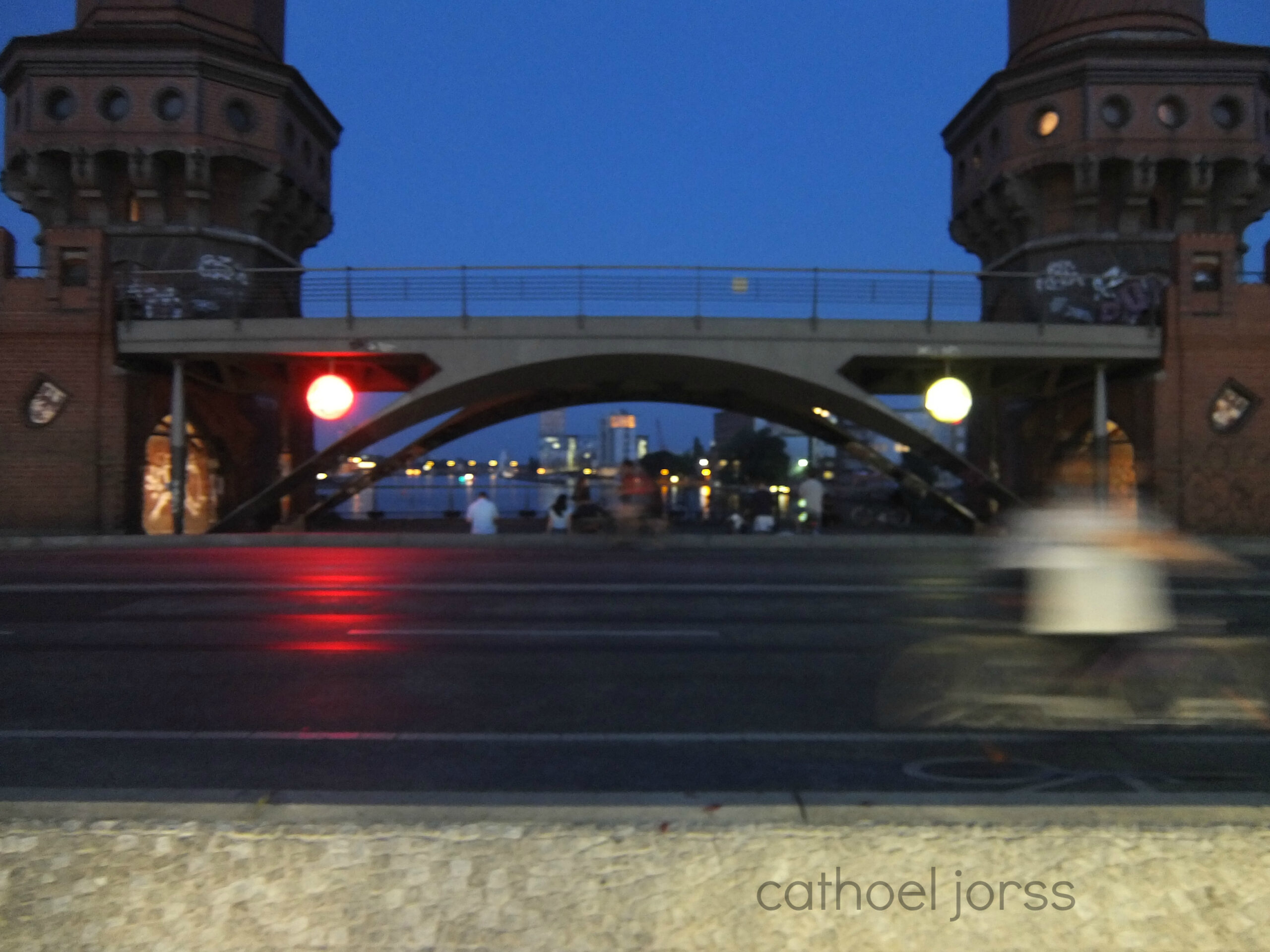
Berlin, Berlin, I cannot but love you. Unbelievable, unmistakeable. The contrast to Copenhagen is immediate. At the airport nothing works. Every toilet is barred with tape and the man in the kiosk is grumpy but funny. He raises his eyebrows and shrugs. We are laughing. The train smells faintly of old urine. When we get out to change trains at Ostkreuz, for a moment I’m wondering can we have stumbled into a party? A party on the train platform, doesn’t that seem unusual? But it’s just a bunch of Sunday night revellers, standing about talking loudly and all of them wearing various casual, scraped-together outfits, some in funky, messy costumes, a girl with her afro pared into a kind of wave and bleached orange is crouching earnestly over her bags, sorting methodically a magical melee of things from one gaping leather satchel to another. She has on a short pair of shorts and some kind of shearling vest cut high around the ears. The moon drifts high, high, high above the scene, it does look like a scene, grubby and fitted out like a film set built by many hands. The train fills with the noise of someone’s ghetto blaster and the smell of stale alcohol. People are drunk. By the smell of it, some have been drunk for several days: a smell not of spilled beer or Red Bull breath but of old booze leaking from people’s pores. Three ladies with their suitcases ask my friend directions, he answers confidently and then grows confused for a moment when pointing out the outermost stations on the map above the door. The boy opposite catches my eye over his girlfriend’s head and we both laugh, laugh for a while, one setting the other off with a glance when the other stops gasping. The three pretty girls with demure frocks and curly hair are smiling tolerantly. The newly-arrived ladies wave when we get off. “Have a great time in Berlin,” my friend says. The love. The moon. The insanity. The mess. The three drunken Polish guys who ask for money, shoving a filthy coffee cup under my nose and rattling it. “Für beer und weed?” The gasp that leaps out of me when we reach street level and a low tide of litter has buried, like old snow, the bottom of all the tyres on all the bicycles locked to the railway station railing.
-
blood of the camellia
Proud of a conversation I had, in German, with the guy in the corner shop just now. He met me just inside the door, and rolled his eyes vehemently. “I was just about to close!” With a sigh he swung his swag of chains – yes, chains, that’s how you shut up a shop in Berlin – over the back of a chair and came round the counter to serve me. I stayed courteous and curious and soon he was telling me about his day. The Ordnungsamt, sort of a local city police, came in and made him change his display. He can sell ice cream by the cone tomorrow, and beef jerky and foiled sausages, but no beer and no ice creams already packaged. “No ice?” I said, misunderstanding the word. “Only if it’s not already wrapped,” he said gloomily. “But, ah – because of… God?” I wondered (Gotteswegens?) Yes, he said. He started showing me one by one the items on his crowded counter that would have to be stowed away at the end of every week so as not to offend the Lord. I said, You know, whoever God may be… don’t you wonder… whether maybe this is not quite what he meant? “Ihr koennt das kaufen, und das und das, aber nicht das.” Yes, he said, I’m not convinced that God minds what I sell, either.
I used to sing in a tiny madrigal ensemble which performed in an old cathedral and we would have to sit through the services as they droned on in what, to me, might as well have been Latin. Choristers brought puzzle books and read poetry. Every Sunday after the service everyone would be invited to partake of the blood of the camellia bush and the bread of the fields, sponge cake and tea bags served with plastic plates and (mega groan) polystyrene disposable cups. I was almost thrown out of the choir for suggesting that if there is a God, and if you believe God has made this whole earth for our dominion and we are somehow or other in charge…. wouldn’t God want you to wash up your cups and use them again? Isn’t God, by God’s very nature, fundamentally opposed to polystyrene? I mentioned this to the choir at large and to the choir master and also, a couple of times, to the minister and his wife. Oh, they said vaguely, the washing up…. Later the choir master visited me at home, to tell me two of the sopranos had made a deputation to request I be thrown out, as a troublemaker. Aren’t the manufacturers and purchasers of polystyrene the real troublemakers? I feel like Charlton Heston brooding over his precious gun, or Scarlett O’Hara clutching her handful of carrots. This is my land, it’s our land, so help me I’ll never give up. Because ‘not til the last tree is felled and the last river dried up’ will we realize, it seems, that you cannot eat God.