A confluence of kindness in the Sunday cafe this morning. People were slouched about, eating their brunch. A series of wan songwriters entertained us from the speakers. When we first walked in a classical guitarist had just done playing, and when he walked around the tables with his cupped hand outstretched, everybody gave. Then a commotion at the doorway. A very very drunk lady sloshed her way in. She shouldered her way between two quite closely placed tables and sat down. Oof. Began talking to the woman on her right, who clearly didn’t know her. It was a long bench seat along the wall so now all three women, ladies who brunch with a lady who lurches tucked between, were sat shoulder to shoulder like pigeons under the framed oil paintings of Karl Marx. The place is called Cafe Marx, been there for years apparently. The drunken one pulled off her filthy beanie, revealing sparse tufts of grease-darkened hair. She was loud. And she looked smelly. The woman she’d spoken to rose to the occasion like the Queen. “I know,” I could hear her saying agreeably, “it’s freezing outside.” The drunk one said something inaudible, affable. “Ja,” said her invaded neighbour, “gemütlich.” Gemütlich is a word like the Danish word hyggelig: cosy, it means; warm, comfortable, comforting. The kind of word you invent when you live in a climate where a person consistently turned away from every door can die just by sleeping in the park overnight. The waiter came over to reason with her. Her voice rose, she waved her beanie at him. At first he said, Can you go, please, and You will have to leave, and Do you want me to call the Police? “I am the Police,” she said grandly, settling her beanie back over her ears. But the women either side of her and their companions were wonderful. Unworried. Well, worried but cool. They started suggesting to her, Perhaps you’d be more comfortable in the corner there, that looks so cosy, wouldn’t you like to have a table to yourself? Why shouldn’t you have your own table? “Yeah,” she said, in tones of worn aggrief, “yeah, why indeed.” And as she staggered to her feet and lurched towards another table (ours) the waiter once again stepped in, more respectfully, more kindly this time. His customers had taught him that – or rather, reminded him, as we do for one another. Gently he took her arm. “Could I ask you to sit outside?” he said, in such courteous tones that she was able to pretend she had been given a choice, to deliberate a moment and then decide, “Also dann.” Ok then. He escorted her to the door, more like a nephew than a bouncer suddenly. The people on the bench seat shifted and laughed quietly, restive with relief. You know how belligerent you get when you feel like your humanness has been ignored. She was aggro. But lost. In the wind outside she sat down with some difficulty. I went over to the counter and spoke to the waiter in a low tone. “Das haben Sie so schoen gemacht,” I said, “so freundlich.” You did that so beautifully: so friendly. “Aw,” he said, looking down. He was putting something on a plate behind the high counter. I said, I would love to buy a coffee for that lady, if… you don’t mind providing one for her. (Thinking of the risk to his china). But by the time he brought the coffee, hot and rich with crema in a takeaway cup, she had gone. The overturned table and smashed ashtray on the ground were all she’d left behind. I walked up and down the square for a while looking for her but she had moved on. And would continue to be moved on, I imagine, all the rest of the winter. And would perhaps be picked up by the Winter Bus that goes around collecting people who have fallen asleep in the snow. And whose fire in the belly, lit and swollen from the magic bottle, might not be enough to keep them alive til morning, in the dark cold lonely treesung night.
Tag: Berlin
-
a dog’s park life
Crossing the park I passed the usual gatherings of African men standing about under trees, whiling away the hours until someone comes to buy some drugs off them. Sometimes they sidle up and say, “Alles klar?” and occasionally a whisper of “Grass?” comes up or, once, from a bolder guy, “Cocaine?” I’ve worked out at long last that not all of them are dealers, some are just hanging out because this is where they hang out; because they come from a culture where instead of everybody sitting in their own bedroom facing their own screen, you spend the day with everyone, you hang out. A shower of sparks fell across the park: four guys huddled round a low homemade brazier and fanning its coals with the lid of something. The smell of meat roasting. The sound of whickering trees. The way these recent settlers have brought the ineffable mystery of life back up under Germans’ noses. Two men were sitting on a bench in the shadows and a large, round, comfortably built black woman slowly passed. She was pushing a trolley. One called out to her, “Hey! Mama Africa!” “Yes,” she said, kindly but wearily, pausing, and I thought perhaps she was just someone whom everyone turned to for help, communities yield such persons, I explained to my companion this theory and he said, No, it’s even more beautiful. Mama Africa sells hot food to the dealers on cold nights, she goes around with her trolley and if they are hungry, they flag her down.
A few hours earlier coming through the same park I came across three dog owners standing about warming their hands in their pockets, their four dogs channeling and chasing one another, noses to bottoms, noses to groins. Another dog raced in like a flash of black fur and then two more dogs arrived, a merry flurry, soon there were eight dogs weaving and circling and joining each other nose to tail like elephants or ants and the tallest dog owner, an old punk, said in his dark gravel or asphalt voice It’s a regular dogfest, “Es wird ein richtig Hunde-Party.”
-
little staves
I wonder at the charmingly gap-toothed Engrish on the front of the chopsticks packet. Wonder hardens to wryness when I turn the packet over and see the flawless instructions on the back which show diners how they should use them. The front says, Welcome to Chinese Restaurant. Please try your nice Chinese food with chopsticks, the traditional and typical of Chinese glorious history. And culture. PRODUCT OF THE PEOPLE’S REPUBLIC OF CHINA.
But the back says, Tuck under thumb and hold firmly. Add second chopstick, hold it as you hold a pencil. Hold first chopstick in original position, move the second one up and down. Now you can pick up anything. This is the brand of (oh joy) disposable Stäbchen (“little staves”) that are most commonly given away with even eat-in meals in Asian restaurants in Berlin, they must consume thousands of trees per annum and presumably are also designed to entrance hundreds of thousands of infatuated, patronising Western cultural tourists. Because by making use of people’s urge to condescend and correct, you can pick up anything.
-
never the swain
Two swains drifting like white roses on the dark canal. My Berliner swain calls them swains and I never correct him. Similarly I refrained for reasons of selfish enjoyment from pointing out to an earlier, South Australian swain, who though a native speaker was heartily dyslexic (he called our chimney ‘the chumley’), that the swans’ babies are commonly called ‘cygnets’. ‘Look Oel. A mummy and a daddy swan. And all the little swanlings.’
-
the narrow rainbow
So the skies are white, the rooves are grey, the buildings brown and cream… the either dreary or soothing winter pallet of Germany is restful to the imagination. In every cafe, candles flicker. Little pots of gold.
-
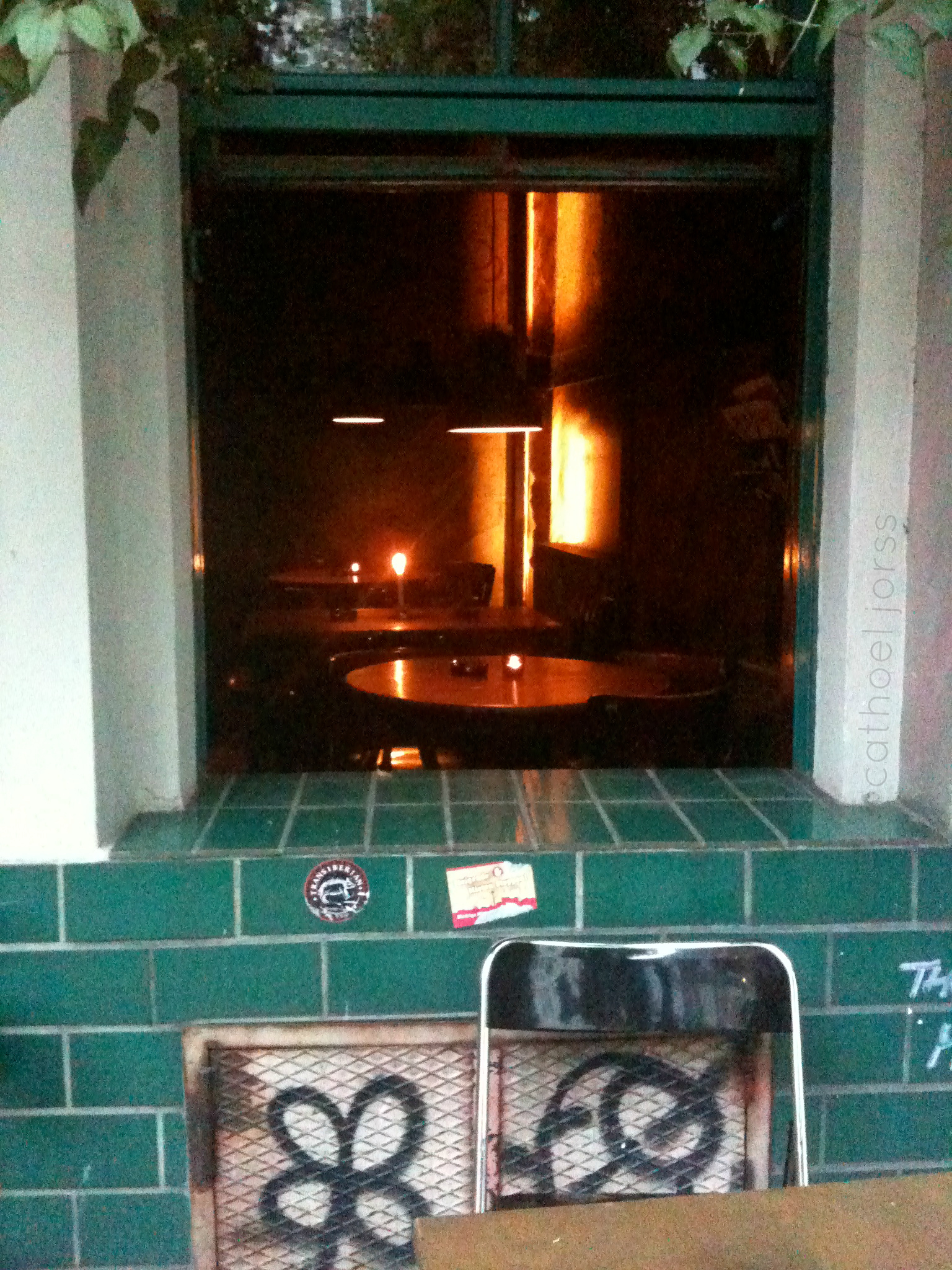
three dog night
A bar in Berlin. I am greeted by a dog. “Na hallöchen! (‘little hello’) Wer bist denn du?” He is wiry and rough-haired and nuzzles my bag, clearly scenting the traces of Another Dog on its old leather. Then said Other Dog bursts in. Writhes himself in an ecstasy into my lap. Now we are three. Dog owner joins us: four. A lanky dude with his lanky red-headed setter lopes into the bar just as the music changes. Red-headed setter slides under our table where all the dog action is at. Berlin, I love how you let dogs into your bars. How a person thirsty but inconclusive and confused can say, Was war denn das? Was du gerade gemacht hast? What was that you just made? And the barkeep will explain. “A very old-fashioned Old Fashioned.” It was so good I sucked all the sugar out of the orange peel. A wreath of contented dogs round my feet lying like drunks. A man who sells Motz (homelessness magazine) came in and made his pleading spiel. Along the bar a line of hipsters sweet and tilt-headed as birds.
-
replanting
“Aw!” ‘What?’ “Aw just… somebody’s torn this little plant out, and now it’s gunna die.” I could hear my surprised, injured tone of voice, high like a disappointed child. My friend stopped and I had already squatted in front of the dismal garden bed built round the trunk of a tree, in which someone had planted four or five tiny evergreens and a wilting marigold. It was two degrees this morning; I had on leather gloves. Ideal for scraping out a hole in the soil. Took up the tiny shrub, lying on its side in what seemed to me a foetal position, and stowed it in it new hole, tucking soil around its roots and talking to it as I pressed the dirt into place. “There you go, that’s better…” I stood up, brushing my gloves against one another, and turned back to my friend and our conversation. A woman on a bicycle had stopped to watch. She gave me this head-tilting, compassionate look with two very very slow blinks of her eyes, acknowledgment.
At home on my kitchen windowsill I have a shred of pelargonium stolen from someone else’s window box, a present for a friend who cannot keep sprigs of basil from the supermarket alive yet dreams of being a gardener. He only has a tiny, bricked-in, West-facing balcony that looks dismally over a supermarket car park. I’ve shown him photos of how, in an Australian climate at least, you can grow a lot of food in such a space. When I saw this still-flowering window box with not just red and pink but also the darker, sultrier, more sophisticated velvetty maroon flowers, I filched a bit, peeled from the undermost hem of the plant where the person caring for it would lose least enjoyment. A few paces further on I found an empty plastic cup. Scooped up a cupful of leaves for the bottom layer and then a handful of rich dark friable soil. Stowed the incipient plantmonster in there and will nurture it until it has begun to send out some roots, hopefully before I leave Berlin, so then it can be passed on to its new owner with hopefully some chance of surviving the grey winter.
As a child in the tropics I used to worry about the trees, who seemed to me buried to the neck in hot, foetid soil, unable to move, >trapped!!< It took me years to work out that this kind of simple projection is not really compassion, does not help anyone. Years, and some lambasting from a Tibetan Buddhist nun who yelled, “You have too much compassion & no wisdom! No wisdom!” In any case one imagines suffocating heat is less of a problem for a German tree.

-
the peace yard
Walking home down rainy streets my last night in this house. Tomorrow unnest, budge myself, nudge, shift. Winter has landed with its big wings. Now the warmth of the indoors folds us in, the subway’s roaring throat, we all descend, we bring our dogs and biscuits. I saw two small boys fighting in the subway train, one slammed his hand down on the other one’s shoulder their sister put back her head and roared. They were hipheight to everyone’s delicate glances, the mother looked estranged. In this city if they serve you tea it is a mess of hot water in a clear jar (hard, chalky water, that dries white) and with spoon and bag of leaves laid on the white milky ceramic… neatly. Effervescent neatness, the German delight: effortless neatless and high art and kitsch. German joy, Friede; German graveyard, Friedhof. I’m leaving I’m leaving. I’m coming I’m coming: Australia wait for me. Maybe forever as jet blurting travel grows inexcusably wrong. Standing stranded on the traffic island as the creamy lights pour in three strands down the hill like pearls and the crimson lights pour like Christmas up: I said something aloud to myself in German, I started to cry. Thank you for your hospitality, your kindness, your warmth to all the strangers, your strangeness, your calm. The leaves shaped like webbed hands that wave in the wind. The strings of lights under the lip of each awning. The Grüss dich, the Tschüssi in shops, the dogs. In 24 mornings more, I’ll be gone.
-
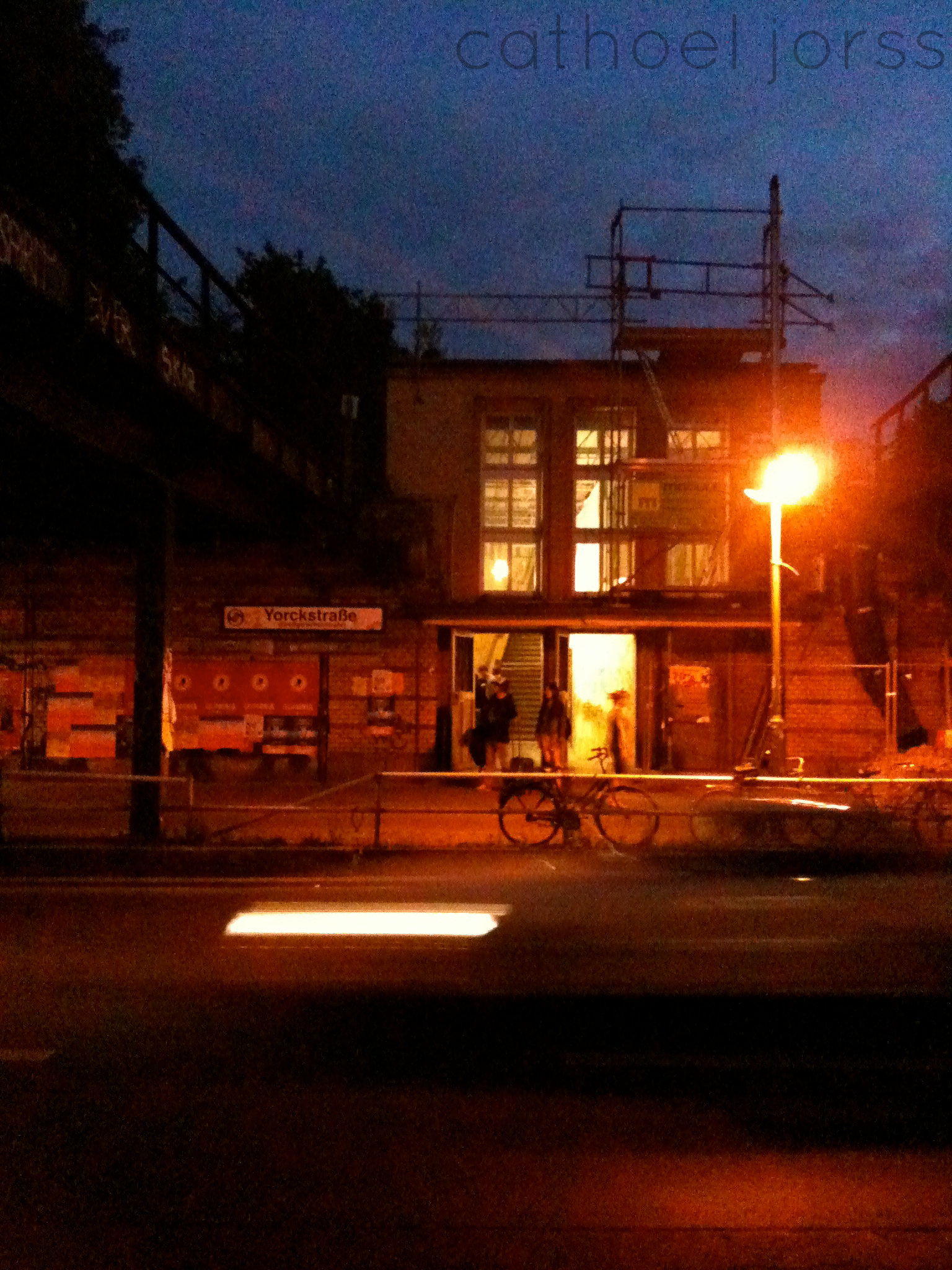
between the fingers of Fidel Castro
I know an eighty-year-old cafe where the day passes smooth and coiling as molasses poured out of a dented tin. I sit in the smokers’ room, not because I smoke but because of the candlelight and conversation. Today I stopped at an antiquarian bookshop that has trestle tables out front. A recent conversation reminded me I had never yet read Machiavelli’s The Prince. The bookseller had two copies, an Everyman and a Penguin; two different translators; a quick skim decided me I would buy both, and I carried them to my favourite table and curled up there, thinking if I read these two versions both at once, maybe I’ll be able to triangulate.
I read very slowly, laying each book face down at the end of a chapter and taking up its companion. Three tall, lanky, and very good-looking men came through in waterproof jackets, carrying boxes and boxes of lettuce and potatoes. Afterwards they sat down at a small table under the pastel portrait of Fidel Castro (cigar) and drank coffee and argued for over an hour. I tried something new off the menu: it’s German food, everything is new. Fidel Castro’s fingers resembled an abstract of a human hand carved from potato. Everything carved from potato. After the War Berliners relied on an American Rosinenbomber (the “raisin bomber”) dropping boxes of foodstuffs and dug up the forest called Tiergarten in order to sow vegetables. I thought of the various cafes I know in Brisbane and wondered how it will feel to adjust. The temperature has plummeted, and isn’t that a most marvellous word: like a fruit yet unripened on the branch, that finally gives in and plunges to the ground. Last night returning from a long forest hike it was perishing, four degrees. I ate my Weisswurst and Brezel and thought about the differences between reading in a cafe full of other people reading, and the dinner experience of last night, in an unreconstituted jazz and blues pub, where the cute barkeep turned down his infestation of immemorial blues and turned on a large white roped-up screen. Oh, God: Tatort. The awful detective show Germans watch as Sunday religion. Somehow the roomful of unstirring people watching a fourteen-year-old girl’s character get raped – the oldest man put his head into his hand, others watched unmoved – was so blinding and so effing awful, we got up and left. That household full of habitual viewers sharing the dirty hot tub of popular TV had somehow less in common than the people crouched in corners at my newly beloved red checked clothed cafe: reading newspapers or, in three cases, books, we were each of us turned away from our commonality but yet reminded me of swimmers foraging deep in the saltiest water, where the sunshine is sweet, where the strands of warmer and colder waters pass over one’s legs caressingly and there is always something further to be discovered. In only the one ocean, in always the one sea.