Tag: boy

  • hitting the child

    Today on the markets I saw a man hit his child. He and his wife were standing among the racks of a bright clothing stall, I did not see what the boy had done but I noticed a woman sitting at her sock & beanie stall knitting had stilled her two needles and taken up watch. He said to his son, We are sick of you today. You must stop this. Look: people are staring. The child looked unhappy. He was maybe 7 or 8. Maybe he had done something monstrous, we were bystanders. I exchanged glances with the sock lady and her mouth tightened. Walking towards the little family I saw that the boy had flung himself on his father, wrapping his body around the man’s leg, his arms tightly clasped round the thigh and his face buried in the fabric of his father’s jeans. The father was speaking to his wife about clothes. I went up close to him. I dropped my hand quietly on his shoulder. “Let him say sorry,” I coaxed.

    “Eh?” He looked up. I repeated, “He wants to say sorry. Let him say sorry.” My hand came up to cup the back of the boy’s small, silky head. “Yeah, yeah,” said the father, dismissively, “we will.” But his own hand crept up into the boy’s hair. Because I think, whether we are parent and child or two adults, by instinct we follow each other’s example. Later I wondered how had I got away with it. Why had the father not slapped me, as well. I think because I had no sense of righteousness, I didn’t feel entitled, I felt irresistibly moved. I felt back to my voice, my tone, and felt its gentleness. I felt the way my eyes were burning with love in my head. You know how you can feel them in their sockets, fires in the skull, your soul on fire inside them, like a pair of windows opening out instead of in.

  • berserker

    berserker

    Yesterday walking down a very Turkish street I saw four groups of boys, one after the other, carrying large, menacing, (plastic) bazookas. One held his fake sub-machine gun to his friend’s head as the friend squirmed and several times tried to bat it away. An eight-year old carrying the Ramadan bread tucked it under his arm and pulling a pistol from his pocket shot his five-year-old brother in the face. Then they both walked on, their pistols bulging in the pockets, carrying the bread of God and guns like it was nothing.

    H2O HoL gorlitzer park boys

  • eternity’s train

    eternity’s train

    Because I have lots of fears I am constantly setting for myself little and large tests of courage. Where I am staying backs onto a river and it’s out in the country and quiet. So tonight as it grew dark I set out for a walk along the bank.

    This might not sound very scary but the path is narrow and in places, eroded, and more importantly as it grew dark I had a nervousness of who might be lurking in the woods. I said to the trees as I stepped off the narrow footbridge onto a sandy, forested island, Protect me, trees. The water raced by at my side, gleaming and opaline, milky and green, crying out its river sounds. The bushes growing over the path are very often spiky; I think if I were a shrub growing around so many beavers’ nests I would be inclined to be spiky, too. I let my feet fall as quietly as I could. Rounding a bend in the path I saw firelight fluttering up ahead. I stayed quietly behind the screed of trees, knowing that while I could see them I would know that they couldn’t see me.

    Three men; young men; really, boys. One of them was building the fire. The other two got up and flung themselves into the fast-moving current, surfacing with howls of pleasurable dismay at the cold.

    I went round the path to where the boy stood, pulling leafy branches off a pile behind him and stacking them on the blaze. His fire of course was very smoky and looked like it wouldn’t flame so high for long. I was almost upon him. I said, in English, Hi, just loud enough that he would turn and see me before I got too close. As is usual with potential aggressors when you face them, they are a human who has worries of their own. Of course, I had seen that from many yards away, otherwise I would have taken a different path. He said, Gruezi, looking a little nervous, himself, and I said, Gruezi. When it was almost dark I crossed a railway bridge with the water piling and piling round its piers. It was foaming so loud I did not hear the train. It came rushing out of eternity into the moment where I lay, my belly exposed to the armies of darkness, lay in rigid smooth standing position, facing the train and with both my hands holding the narrow railing, there is only a meagre though adequate walkway built alongside the track, high above the river, and people’s faces and meals were passing in the dining car in shuttling fashion segmented by the fast windows, only an arm-length or two arm-lengths distant. Without meaning to I shrieked a long scream like a train’s eerie whistle. The train passed in seconds and I crossed over the high bridge, recovering, thankful.

  • hole in a glacier

    Climbed a mountain today in a steep mist. We had to cross a lake to get to it, this was from Lucerne, shared a table on board with a godfather and grandfather and their little charge, who had unbelievably long eyelashes. After his biscuit and orange juice he grew sleepy, the godfather pointed, showing me, “See? his pupils get smaller,” and when they handed him his favourite thing, a green handkerchief called Noushy, he made a point of the corner of it and prodded himself thoughtfully in the ear with that. Then he brought it to his opposite palm and touched himself gently, thoughtfully several times in the middle of his little pink palm with the handkerchief point; then back to the ear; to the hand.

    All four of us were laughing at him in the gentlest possible way. They said, he always does this: Handkerchief in the ear, handerchief in the hand. The little boy’s nickname was Noushy, too. What a solemn little fellow.

    At the far side of the long and complicated lake that covers it seems several counties, and incorporates a steep-sided volcanic-island-looking outcrop that appears as if it would house a villain from James Bond in an eyrie reached only by helicopter, we reached a tiny town like a picture. Having late lunch there after our descent we saw a freshly married couple get off the same boat and start up the hill towards the only hotel, wheeling one small suitcase. She was still carrying her bouquet but had changed into a chic red frock matched with hot pink spike-heeled shoes. The bell of her hair swung forward every time she looked down at her flowers. At the souvenier shop they paused to talk to an elderly lady and then the bride tucked her hand under the groom’s arm and they climbed upward again.

    Upward, upward; windward, snowward. Most of our climbing was done by train and part of it was done on foot. The train is scarlet and shiny, groaning and steep. A series of steel teeth run up the centre of the line to prevent the loaded car from sliding backwards. We got out and walked into a mist that raced down the sides of the mountain exactly as cold air snakes out of a fridge. In the mist we passed a large group of botanists standing with heads bowed as they listened to their group leader, who had crawled under the fence to grab a flower, describing something green and rare. Or something common and brown, I couldn’t tell which, to me Swiss German is an impenetrable dialect. Higher up we passed a woman in sturdy walking boots but dressed in immaculate white pants and a spotless white shirt. We passed many couples on alpenstocks, the cleated walking sticks you use on steep hills, wearing serious but also immaculate hiking gear. So many cows crowded round the dairy that was shaped like an after-ski chalet their bells clattered like a Tibetan or Bulgarian choir. My friend said, the farmer knows the sound, he can tell if one bell is not sounding. On our way back down from the sightless summit, where we had sat for an hour watching mist spurl round the base of the huge communications tower, one of those farmers left his house and picking up a sagging rucksack lying in the open doorway went striding down the hill, looking well-fed and cheerful. He lept the electric fence. We were both wishing we’d brought extra jumpers but this mountain man was dressed in surfer shorts and a dark blue t-shirt. In the tunnel into the summit that leads, mysteriously and lightedly, to a great double-doored lift that brings you up inside the giant restaurant and hotel, it was so cold I wanted to suck on my fingertips. I remembered touching the icy wet wall as we walked into a hole cut in a glacier when I was ten. It wasn’t so cold as that but the chill of forboding forbad me to wander any farther into the leaden heart of this mountain, I had to turn back towards the light.

    On the restaurant terrace I watched a woman who looked like Yootha Joyce smoke a cigarette after her meal. Her husband didn’t smoke and it was pretty evident from the way she took in the smoke that this was the love of her life. Her lips pursed on the orange cork-patterned filter sucked and fondled at it so slowly, so intently, I almost felt had she not had a hold of it with her long fingers the entire cigarette would have flown into her windpipe. It was like she was finally breathing. “Please fit your own mask before helping others.” The movement of her cheek muscles, langorous and strong, made me think of the little boy Noushy who had fallen asleep on the ferry.

    After the ride back down and our lunch we walked around the pretty foreshore. The Rigi, the mountain we had been on, is called by the Swiss “queen of mountains” and is where in 1903 I think the surveying process began. They built a marker there and from it measured to another mountaintop, and then a third, and then they triangulated. Now they have mapped out all of the surrounding peaks and beautiful etched steel landscapes showed what we would have seen had we been able to see anything. A sign cut into a steel plate fixed on the ground said, Sydney 16520km, with an arrow.

    The train down was filled with elderly people, many of them German. The town at the bottom is like a clam growing at the base of a mighty pier. Evidently people honeymoon there. The red and white striped awnings and terraced cafe feel so 1950s I kept fantasizing Sophia Loren was about to saunter around the corner, or maybe Frank Sinatra. It felt like Monaco. In the foreshore park a semi-circle of chairs faced a three-walled corrugated iron shed. A trio was playing, tiredly, dispiritedly, and on the concrete apron in front was an overdressed lady slowly spinning her plump son, chivvying in a sing-song voice, as though making a bear dance. The music was awful. Saccharine and slowed. As we walked past I said to my friend, It’s like the world’s dreariest private function. Writing that, now, I add in my head: I don’t mean all of Switzerland.


  • all police are souls

    all police are souls

    Entering the park at dusk we passed four very drunk men with maybe three full sets of teeth between them, squatting round a fire in a little glade of trees. Their enjoyment was loud and coarse and strong. We broke into the open and trudged up a slight hill, overtaken by a swoop of bicyclists. They were a family: mum, dad, teenage sister, and falling behind came the 9-year-old girl in her pink down jacket who wailed, Mamma, das geht nicht! (Mamma, this isn’t working). From the other side of the path came unexpected encouragement. A grizzled woman crouching over a joint called out in her throaty, smoky voice, “Du schafft es! Du kannst das!” You’ll make it! You can do it! The little girl put on a burst of speed, possibly out of terror or surprise, and the woman roared after her, “Yes! Yes! You’re doing it! You’re doing it! You’ve done it! YOU MADE IT!” It was such a beautiful, generous, Berliner thing to have witnessed. God love ‘er. With her scars and tattoos and her All Police Are Arseholes jacket.

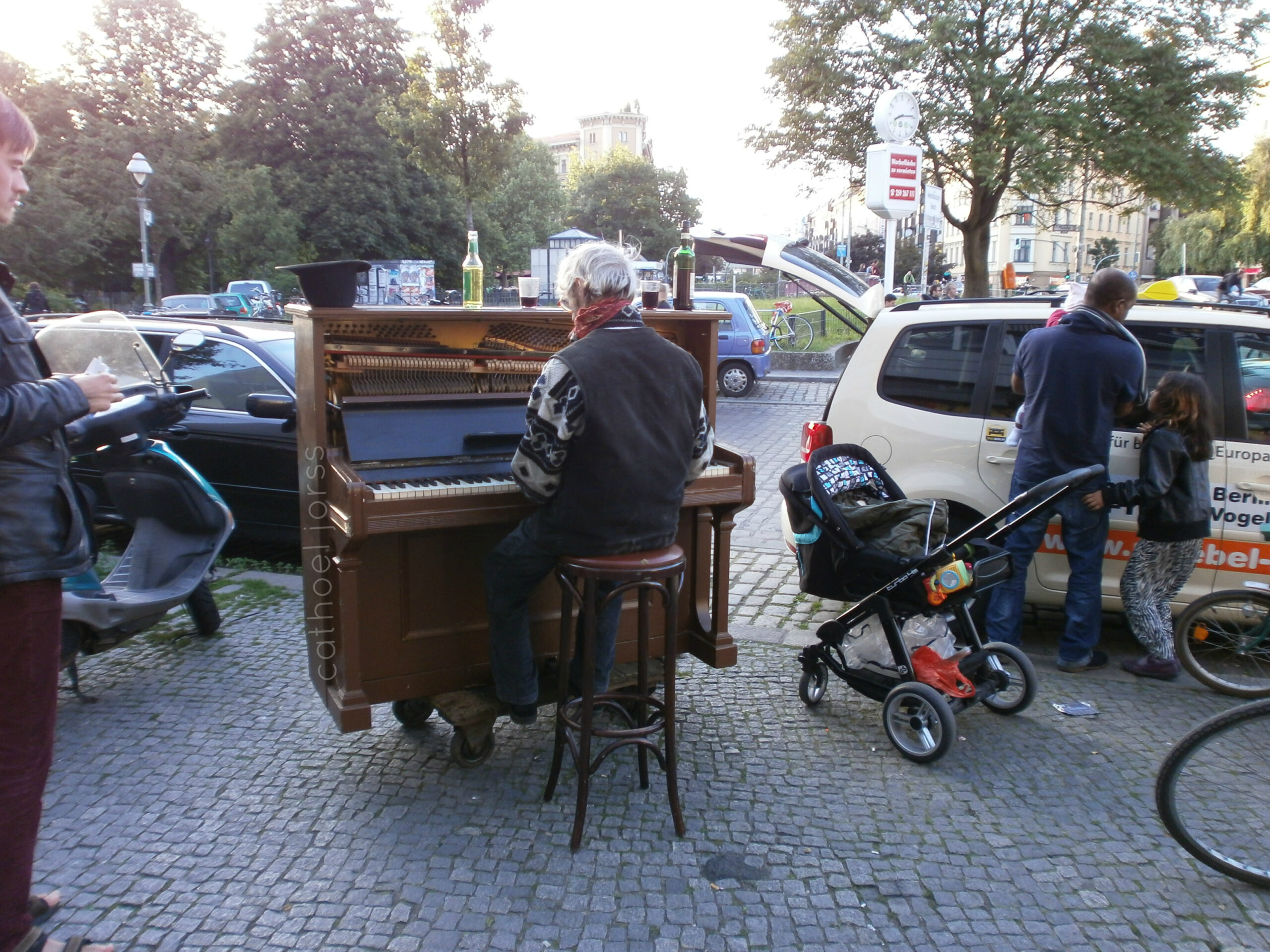
    H2O HoL browsing piano player

  • find your kind

    Heart-curdling rage in the city today. I was in a crowded shopping street when a man began to roar at his son. He was bantam-weight, wiry, blond, apoplectic: the boy looked six or seven at most. His little sister, used to keeping out of it, hung her head and looked away. Around them hundreds of people turned their heads – it was loud, roaring, full-bore, insanity’s volume. Shopping bags rustled, buskers busked. I stopped. A teenaged boy on a bicycle stopped too. I laid my hands flat on the air in front of my stomach, a placatory gesture. “Please,” I said. “Calm yourself. Your children are frightened.”

    He didn’t hear, didn’t answer, knew in that instant no one but themselves and his own swollen, massive entitlement to rage. He roared and roared, putting his face close to the child. The boy was bent double, both his arms rigid, pulling back and curving his body away from the danger as far as he could. The man held him by both hands in one large fist, the other hand making big threats in the air. I exchanged glances with the boy on the bicycle. I put one hand on each little dark head, smoothed and cupped them. Their soft hair, their stiff little faces. “There’s no need to shout like that. He can hear you. We can all hear you. You’re frightening him.”

    Giving me a vile look he dragged the child away. The girl followed willingly, willlessly I suppose. The man was blond and Nordic, red in the face; the little children looked to be Moroccan maybe or Egyptian. To my shame I was wondering how did this blond man get hold of these two small, dark children. Perhaps he was married to their mother. Perhaps they were his by blood, though none the more his to abuse and to frighten. Perhaps they were adopted. Maybe, stolen. I walked round the corner where they had gone, fretting and wondering, my heart a drum. The teenaged man on his bicycle came behind and I saw him swoop past the man and call out something. The man shouted back. My ears were filled with an army of blood. Making a determined effort I crossed the narrow laneway and caught up with them. “Sir,” I said, “sir, do you speak English? Please stop. Let me talk to you.”

    He turned and snarled, he raised his fist and planted it two feet from my face. “You’re not from here,” he sneered, “you know nothing.” I said, “Listen. You don’t need to frighten your children. Look at them: they’re terrified of you. Be gentle. Be kind. Find your kindness. Please!”

    He made a feint at me, not meaning it, just wanting to put me off. “Fuck you,” he shouted. “Fuck off!” I cupped my hand round the little boy’s nape. Probably he spoke no English at all. “Are you alright, little boy? Are you ok?”

    The poor darling. His father, the monster, dragged him away, gesturing curtly for the girl to follow. He was still detailing to the child in coarse roaring snorts how the boy was at fault, was faulty, would amount to nothing. I hope for the boy’s sake he saw that of those six hundred people who didn’t know what to do, there were two who could not accept he be treated that way. It’s not ok, you are someone, you exist and we can see you. Maybe that is a candle that keeps him alight until he can run away into the world. I did nothing, I made it worse, it’s not about me. Despairing I bellowed after the man, a last effort: “Be a real man and protect the children!”

    A girl came out of a shop, wondering. I showed her what had happened – the boy dragged around the corner, disappearing now, hanging back as hard as he could. She said, “Oh, my god. How could he.” We stared into each other’s gentle, sane eyes. “If he’s that loud, in public,” I said, slowly, “if he feels that entitled to shout and scream in the middle of a Saturday afternoon right here – imagine what he’s like at home.”
     

  • watching over you

    watching over you

    I saw a boy cross the road with his little sister. At the curb he made her stop and made her take his hand. I guess she was three; I guess he was four. He looked both ways. A car approaching slowly from two intersections north made him wait, and hold her back. His caution and sense of responsibility glimmered on him like sunlight. They waited and waited. The little girl sagged her head and dreamed, her brother stood alert and concentrating fiercely. The car went past, he lifted his foot, a second car poked its nose around from a side street. He waited again. I stood as casually as possible a few paces away, three times the size of the little steward, not wanting to injure his pride by letting him know I was waiting for them to be safe. I imagined the parent who had sent them on this errand perhaps watching from an upper window too. The corner shop stood up three stone steps on the opposite corner, its plastic flystrips beckoning. At last when the street was empty and still it was safe, according to the big brother’s judgement; they set out.


  • I am god.

    I am god.

    A friend of mine driving her nephew and niece said, they were arguing in the back. One of them had a goldfish that had died. Girl, 3, asked, But why do we die? She kept asking. And if we die, why do we live?

    Finally her brother (4) said, exasperated, Joanna don’t you geddit? We’re all just trying to become god. (There was a pause. Then my friend said he said): And I already am.

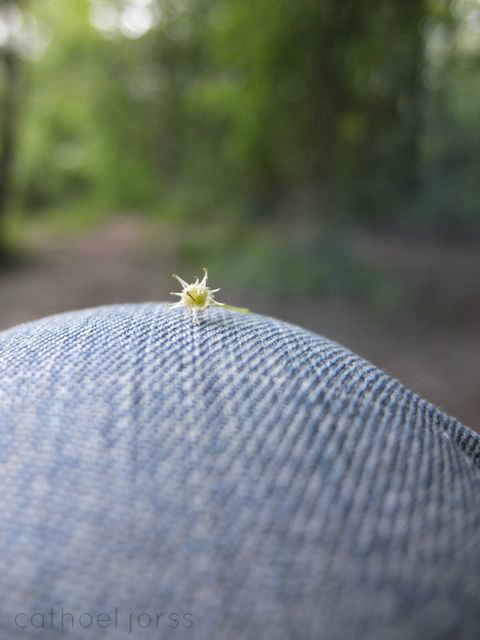
    H2O HoL knee with tiny fleur

  • you sneak up, & I’ll sneak

    you sneak up, & I’ll sneak

    Years before I had driven from Adelaide to Melbourne with my then partner. We towed behind us the tower of terror: all of our possessions lashed to a homemade trailer. His possessions were mostly tools and mine were mostly books.

    In a seaside town we stopped with his best friend and her husband. They had a four-year-old boy and he and I fell in love. The grown-ups strolled on ahead down the wickety dunes, talking and idly watching the seagulls wheel overhead, and the two of us scampered and bolted, climbed under and hid. We found things in the sand which have no name. We found soft glass and seagrapes, rusted and tasting salty.

    We burst back onto the roadside with its sparse traffic, three heads disappearing far out in front. In a rush of inspiration he turned to me: “I know! How about, you sneak up on your daddy, and I’ll sneak up on my daddy!”

    I remember the feeling of protective love that washed me in that weird warm moment. I was so frightened of seeing the hope and ambition, the trickery, fade from his eyes and their expression subdue and dim. I was frightened he might suddenly realize: Ach no! You’re one of Them! But we did it. He sneaked up on his daddy. And I sneaked up on mine. Ambush!