Tag: busker

  • a virgin busker

    On the subway a woman suddenly opened her mouth and began to sing. Her voice was tentative and good. She had a little loudspeaker rigged up through her mobile phone and had set herself to perform some songs in her own native Spanish. She was rugged up like the rest of us in a puffy blizzard jacket, was in her late middle age, and shy: and I would be willing to bet this was her first day out busking.

    She sang, Kiss me… kiss me all over, or as it renders in the Spanish, kiss me a lot. Her voice trembled with nerves but she kept going. She tried to set up a swing with her hips, stiffly, appealing to the stony crowd with outstretched hands. “Music?” her voice, her hands, her eyes seemed to be saying, “remember music?”

    I got up and went over to be nearer. She was standing in the doorway with her back turned to the glass doors. She smiled shyly at me and I smiled shyly back, nodding encouragingly, clinging to the yellow pole and hanging my head against it as though it were a mother.

    Shyness in public. It makes life so much more challenging. A little way into the song she switched up the tempo and the backing music began a familiar rumble. “Bamboleo,” she sang, wistfully but clear, “Bamboleah…” A moment later she was saying, thank you, danke schön, and pulling out of her jacket pocket a crumpled waxed-paper cup. It is easy to fall on hard times so rapidly. Well-dressed people are begging and collecting bottles for the deposit all over the city. I gave her two euros saying, Sie haben solch eine schöne Stimme, eine echt schöne Stimme. You have such a lovely voice, a really beautiful voice. This was perfectly true and she knew it. We thanked each other bashfully and she went off down the swaying carriage where to my surprise people pulled out their wallets and broke the fourth wall. I, too, am afraid to sing in public; I, too, have a voice. Her courage by this stage had moved me to tears and when the door at my station opened unexpectedly a second early, while the train was still moving, I stood back saying, “Whoa,” and smiling with surprise. German trains are seamless. The man waiting outside the doors stood facing me as the platform slowed. He smiled back. We smiled at one another. In the stairwell a man with his face turned to the wall was shooting up into his elbow, bared in the literally freezing grey cold.

  • it has sun

    In the cafe he showed me the pictures he had taken on his walk here, of a dog skateboarding in the park. “You should animate those into a thumb-book!” I said. Amy Winehouse was singing. “Or maybe a – gif.”

    We watched a couple walking past in their somehow sweet and somehow matching outfits. He had on a blend of waterfront worker and Clash renegade, a scarlet beanie; she was doused in a long, woollen coat with skirts, like she had stepped out of the moors to take the city air. I was struggling to put all of this into words and he said, “Their cute sort of karate look.”

    I pressed his hand. “Karate-karaoke-paparazzi.”

    We walked back past the housefront biliously painted with darker green highlights which says at arm height worst green ever. He had a conversation with the guy whose dog is wrapped in a torn army blanket, on the metal access ramp to the ATM foyer at the bank. This man is American and clearly made his life here years ago, but his German is poor. As is he. His devilish rock and roll grin greets bank customers and he swoops the door open, when they leave and when they enter, so courteously and with an infectious warmth.

    In the park, drug dealers and old ice: the frozen water kind. A girl cycles past, singing. The sun has been brief. “You should gig there,” he says, pointing over to a bar sunk underground with golden windows. “They host acoustic stuff.”

    “I’d love to,” I say, looking in at the knee-height windows shyly, as we pass. “If I ever start gigging again.”

  • autumbled

    Autumn in Berlin and the grimy guy begging outside our supermarket is absorbed in a book. When I come home he’s set it down to thank a woman who dropped some coins into his smashed paper cup. It is Sylvia Plath.

    I prefer him to the punker dude who spreads himself with a large dog either side right in front of the sliding doors, then leans far across the pavement to make elaborate drawings in chalk which people then have to step around. His begging seems to me a form of veiled aggression. It is a set-up that forces compliance on every passerby, lest we tread on his art.

    The two months I was away I compared the daily forecasts and found Brisbane, in its winter, was invariably a degree or two warmer than here. Summer has been short and late. Just last week on the canalside two boys in the late sun were playing chess. These are the last days, and it will be so cold til June next year we will see nothing of each other but our faces.

  • god bless the adult

    I met a man with shit-stained pants on the subway and we sang together. He had been swaying by his pile of plastic bags for half an hour, offering speeches to the cabin. People ignored him and looked away. Only the Hispanic man behind us covered his face with split fingers and laughed into his hand. When at last a voice spoke, mysteriously, smoothly, over some unseen PA – good afternoon folks, sorry to disturb, I am going to be making a little music for you this evening – it startled us, mildly, and the shit-stained man looked over, eagerly, and we all saw a younger man, also black, beautifully groomed with a high-maintenance beard, bending to the floor to switch on his little blaster which filled the train with some R & B groove.

    He began to sing, effortlessly, like a bird on a branch who is free. He sang about Her, She’s gonna leave me, I know it, I know my heart is hers. Bending to the instrument again he chose a Michael Jackson groove, Rock with You, with that lovely tripping flute that everybody recognises instantly.

    Oh, Michael Jackson. We love you and we were happy to be transported by your music. Your music and the MTA. The shit-stained man left his pole and his pile of bags and ventured up into the cabin, dancing, smoothing his shoulders across the air. He tapped the singer on the shoulder and passed him some coin, “his last dollar” said my friend. Then he instantly, uncrazily, turned away and sashayed back to his post, his literal post, making no demands on the singer and not importuning. The man singing was emboldened to dance around a little. “He’s good,” said the fellow next to me, and I said, “He is! And he’s dancing like that while the train is crazy swaying.” I got up, grabbing a pole, and swung my hips a little, in joy with the music. When the singer came past collecting “anything you have helps, and if you don’t have, I love a smile,” we all dug eagerly into our pockets, you have gave us joy.

    The shit-stained man hollered, “Baby! You’re great! You need to get yourself in the studio!” The singer answered, ruefully, “Man. I am in the studio.” “You need an agent.” The man behind me was laughing anew. Tears fell in splinters from behind his outstretched fingers, he gripped his face and wept with the mercy of it. “Oh yes!” he was saying, helplessly, to himself: “He needs you to be his agent, baby!” New Yorkers are aware, I think, of one another’s ludicrises.

    The singer returned to his portable blaster, the subway doors still open, and he picked it up and called out thank you and left I thought how he could lose all his profit if someone grabbed the music box and ran away with it. The doors slid shut and we began to move. Left alone to his audience the man in stained pants began to declaim in song. He sang, movingly, God Bless the Child, in a cadence and tune of his own. I joined in, a lovely melody we wove and we were glancing at each other, shyly. I said, “You have a lovely voice.” He said, “I’m 71 years old. I begin to sometimes wonder, what is God’s plan for me.” “Ah,” I said: “that I don’t know.” He said, “My mother always told me when I was little. Boy, God has a special plan in mind for you. But I begin to wonder sometimes, what it is.”

    He collected all the crumpled bags at his feet, laboriously, very often missing when he went to grab them by their outstretched necks. At the next station he was gone and another busker came on, young, Mexican, radiant, and silent, a stocky boy wearing a sandwich board with his two stumps of arms held out in front of him, like Jesus on a candle. His sign read, Hi, my name is Felix. I lost both arms in a work accident. God bless you and thank you for any help you can give. The cabin fell silent. All the joy fell away. We are lost in an industrial accident, this fractured world. Soberly people fished in their pockets, to help. Felix’s face was suffused with the grace of joyous living. He came past and I fished shame-faced in my emptied-out purse. “I’m so sorry this happened to you.” “Thank you.” His voice was soft and filled with humour. “I just gave all my money to the busker,” I said, uselessly. He smiled at me, and I smiled at him a smile that turned down at the corners and pressed my hand to my heart where it ached, and at the next station he got off and walked away, inside his sandwich board, a human pyramid only one head high. As I watched him disappearing into the mystery of his own devilishly difficult life and its challenges, his form flickered with metal stripes as the train took off, I realised my hand was still pressed to where my heart lives and that, unlike the man in stains, this younger man trapped in his sandwich board “for life, as it were,” as Washington Square has it, has made, is making decisions; he has formulated a plan; he is not waiting for some unseen God to evidence in his life. God, if you’re there, bless the child that gets his own. Make us less helpless (we say, helplessly). Give us this day each the daily breadth to see where we are in this life, where we can get to in this world, and how we can all help each other. Amen.
  • madre de dios

    Following a little family down the long walkways of Terminal One to reach Terminal Two and the mouth of the subway, I kept seeing how the little girl held tight to her mother’s hand and how the little boy held his father’s. She was scarved and wore a baby close against her chest. On the other side of the glass stood a queue of twenty-five-year-olds waiting to board our flight back to Berlin.

    The Metro ticketing machine offered little flags: press which language you want. I put “Spanish,” because I am stubborn. The trains are suffocatingly heated. People kept climbing on board to beg or to busk. The four men from the Andes with their squat amp and teensy guitars, held high on their chests the way you’d nurse a machine gun or maybe a baby; people looked annoyed at the racket but I gave them some money thinking, these guys are only here at all because Spain built ships, and crossed all the way the world and found their Country, and stole millions and killed millions. Now with their long obsidian hair and their colourful backpacks and their Pan flutes they are back bringing a little music into everyone’s commute: an unfair and gracious exchange.

    A man whose face has been eroded by what looks like an acid attack came holding out his two stumps of hands palm upwards, smiling and wheedling. A man whose right foot is crushed and slanted made his way painfully down the carriage, telling his story and asking… for bread, there was a young man beautifully upright in his wheelchair and begging and a Caribbean man playing joyous reggae and all of this happened in between airport and town.

    I dragged my suitcase and changed trains twice. The driver came out his side door when I climbed out at Manuel Becerra saying, something something something descapacitado… seeing my expression he gestured, unmistakeably, repeating himself very slowly: the disabled staircase (an emphatic sweep of one arm) is reached by dismounting on the other side of this train: and I looked, and sure enough the doors on both sides were open. “Gracias,” I told him, struggling with my suitcase and box of books back across the open carriage in which everybody stared, “Muchas gracias” – how amazing that he should care. In the next train a man gazed and gazed. Another man next to me was reading the National Geographic in Russian. I bought, very carefully, something to eat from the man running his glass-front stall, and he taught me a new word to add to my existing Spanish stock of two (“por” and “favore”). Something something some? “Non hablo espanol,” I hazarded, awkwardly. He said it again with gestures: “caliente?” Blowing on his pursed fingertips to show how it was hot. Oh, did I want it heated? “Por favore.” He went on, helpfully: “friore” (I think) means “cold.” “Muchas gracias.” It just amazes me how people living in an ancient city awash with lenses can be so welcoming and go out of their way to be kind to a person who clearly knows nothing of their country and speaks barely one word: god love them for that. So far Spanish people are wonderful. Though it also made me proud that I found my way using a photo I had taken off google maps in Berlin at 5am from the Metro stop to my hotel without asking help of anyone. It was raining and I arrived wet and splashy. At the corner across from some huge splendid palace a car swept past drenching me and another man in rainwater and we shrugged at each other, smiling, starting to laugh. The “caliente” man gave me a little receipt with my 2€ pastie and I picked up off his counter another receipt, left by another customer, which had been folded into a boat shape, or perhaps a hat; I slipped it into my pocket and will take it home – all the way home to Australia, if necessary.

  • to stars

    to stars

    In an unpretentious Italian restaurant where all the pasta had been made by hand, the chatting-family atmosphere fell into something much deeper and richer and darker. A cellist had walked in and in his overcoat sat down on a backless chair in front of the servery and began to play. Something, I don’t know what. He drove his fibres of unholy sound into the great grail of all of us, each of us, like an ochre long-blown off the palm of his hand. I saw the small boy with dark lozenges of eyes climb down from his chair at the corner table in the second room and go to stand, unconsciously in the waiter’s path, his head a jar for the tadpoles of surety this man was making for us. He stood and stood, listening and watching, lost to every other thing. Behind him his parents and their friend kept chatting and only the older, grizzled, quizzical looking man at another table let his gaze rest on the little music lover so fondly, brimming with acceptance, and I let my gaze rest on him in turn and the music rested on all of us, like snow, that spares no needle in the pine forest and lifts its shifting darkness turn to stars.

  • little flower

    little flower

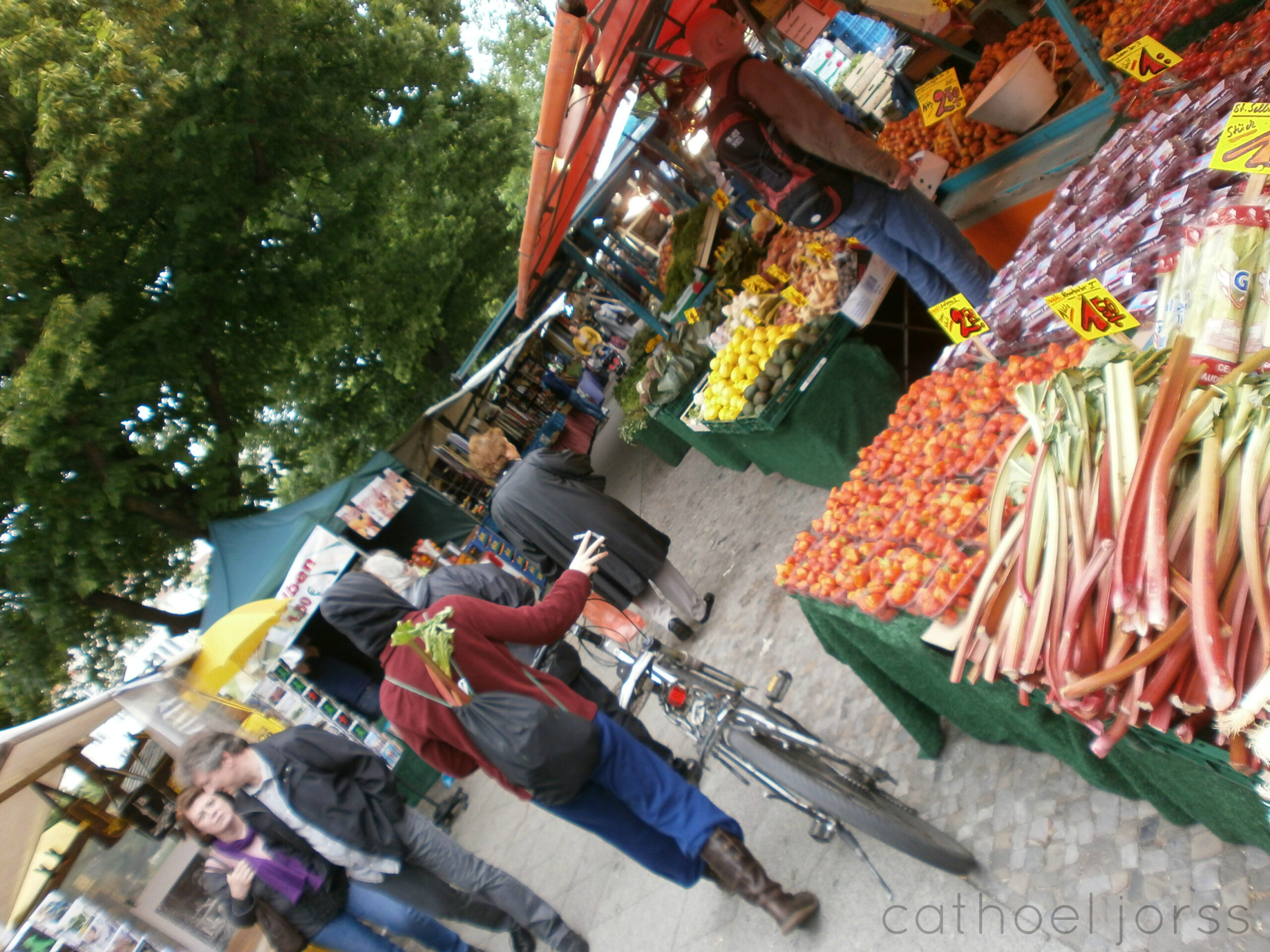
    Went onto the market, transformed now with its leafiness half on the ground, and half overhead; I wanted parsley, and something else leafy, maybe spinach, and potatoes. So many types of potato, each ugly in its own precious way, it would be nice to buy one of each and label them with toothpicks (i, ii, iii… xii, xiii, xiv) in order to find out once and for all how in flavour and texture they veer. The buying of parsley I always find a puzzle here: what is the German for a bit, or a bunch? I didn’t like to ask the grumpy lady in mittens who served me today smilelessly. At the smoked fish van in dappling shade I hesitated over the golden reams. A guy was playing steel drums in a kind of trance, which he had transmitted to the several small families swaying in front. I said to the fish seller when he came back in, I’d like a couple of those fillets please. I said, ein Paar: a pair, a married couple, a few. He picked one up in his long curving tongs, like a beak. How many is ein Paar? he asked. Well, I said; actually, two. Ah, he said, laughing: so an actual pair! He began wrapping the fish, chuckling softly to himself. Ego stung me and I wanted to find a cunning way of letting him know this is a second language for me, over just a few sentences people don’t always pick it up. You know, I said, artlessly, guileful: This everyday stuff is the part I find hardest, in German. How many is a few? How much parsley do I need? Is it a posy, a bouquet, a… well, ein Bisschen: a little bit?

    He knotted the paper bag and spun it with that deftness so stylish in stallholders. He was considering my question. Well, he said at last, you can’t go wrong with a little bit. Ein bisschen. It’s not a posy or a “little flower” (“Blümchen”, I had said). Ein Stück, a piece… yes…. you can always buy a piece of parsley.

    Peter Pepper. I took the parcel of fish and stowed it with the parsley in my bag. Thanks, I said. He handed over my change. “And now, you get ‘a little bit’ of money back, too,” he said, using the familiar form of “you”, which gave me a warm feeling as I stowed the piece of money in my pocket and wandered back past all the closing stalls with their shrieks and two for ones.

    H2O HoL markets colourful

  • someone else’s rage

    A girl with a most glorious voice started singing as the train took off, she was hidden by a mess of passengers who cleared, instinctively, to give her some room. Playing a tiny ukelele and letting the song free like a bird: her fond little scratchings on the instrument suited the sweet, round spiciness of her voice. She sang “Leaving on a Jet Plane” and somehow turned it into a kind of confident kvetch. “Don’t know when I’ll be back again ~” or if, babe, if you don’t shape up. Her hair sprang up out of her head like fireworks, fizzing in spiraling coils. She was relaxed, she was vivid. I searched all my pockets: not a single coin. But I could applaud, and the lady sitting opposite, huddled in the shoulder of her stolid-looking husband, sat up and clapped as well. I was about ready for some music, having had a close encounter this morning with somebody else’s pain and bewilderment, a massage therapist who had told me too much of her personal stuff and now retreated behind a wall of rage so sudden as to be rather terrifying. Why are you now so angry with me, I said, and she said, because we keep talking about my stuff. Now just lie down and let me treat you. I had said, when we found ourselves back on That Topic, you need to take action, and she snarled: I’m so sick of your opinions! How did we get ourselves into this? It was my fault, she told me, because on arriving I had asked “How are you.” So I was riding home sore from a non-massage and felt glad of the girl with her spunky round voice and her star-spangled stockings crossed over each other, comfortably loosely, as she leaned against the door. Glad of the blue sky when I came out of the train, its creamy little penguins of cloud. I stepped round nine Australians in the street who were saying to one another, patiently, “I want to do the museum and then the Wall,” “Well, I thought you wanted to do the club park”. I stepped into a bakery and said, “Haben Sie Brezel?” “Alle weg!” she told me, looking up from her scrubbing and then saying, ah, no, look – there’s one more left here. I took my pretzel into a corner store and bought it a beer. Because, fuck it. The girl at the counter was so divinely beautiful I had told her so before I realized I’d opened my mouth. “You! are beautiful as a picture!” Thanks, she said, laughing, perfectly familiar with her personal splendour. It was such a joy to look at her and laugh and to walk home along the slow, clogged, crowded street with bread in one hand and with beer in the other. If I could find the desert here and the beach, if I could find a way to make a living, I would live in Berlin for ever and ever and ever and never sleep.


  • unter den berlinden

    unter den berlinden

    When I leave I will miss the magical wildness of Berlin, that is already being built out for apartments and hotels; the overgrown factories with railway lines running through them; the fact that on every sunny spot, a railway bridge, a low brick wall over the river, people will bring out their paperbacks and their beers, arrange themselves quietly, spend an afternoon, publicly lolling. I’ll miss the laundromat round the corner from me which is also a pub and has a pool table and couches. Old punks, living in squalor in huge squats but running them as businesses now – showing open-air movies, collecting beer bottles for their glass deposit. “Was your father a glassmaker?” my dad used to say to me, when I was a kid and would sit hunched too close to the screen blocking his view of the TV. I set my TV out on the nature strip seven or eight years ago, I do not miss it, but in Berlin my whole of life is like a child’s, sitting too close up against the screen – everything in colour, everything sharp and growing and broken, everything wailing and wrecked. On the medieval bridge I pass five buskers, all with their CDs out. The bricks smell of piss. This besieged city, surrounded by untouched ancient villages which were, until a few years back, clammy East Germany. The Wall runs like a cold seasnake through the town, you can look down at your sneakers and gasp, it has grasped you, the double line of bricks that show us: here is where we once were two. Isn’t it strange how a city itself can hold our patience and attention, an affectionate contract – the unending tolerance one will bring to one’s surroundings: like Melbourne, like New York, though perishing of loneliness some afternoons I’m in love with the stinking vile city as a whole. I love its dogs, haunting and purposeful and striking out each alone on some adventure of perception, one by one, differently spotted and scarred and with or without a collar, muscled or fat. Berlin, its train rides, the foul breath of the underground, I love its filthy pavements and its skies, almost invisible now that it’s autumn but breaking out late in the day with a luscious deep Fabergé blue that brings cameras up from chests and phones out of back pockets. I specially love its bicycles, spindle traffic of a woven city. I know nothing I experience or say here or see can make sense, not ever ever, I could grow old here (oh! a year, give me a couple of years yet) but I still would never know the deep dark nature of our violence, the way we entertain each other like guests on the front porch, the beeriness, the weary wary tolerance and mighty longing that like an oily octopus deep in the works drives this city and all who sail on her: show me the way to the next itch to scratch. “Berlin”, the name has become a spell, to me. I’m bound, bonded, blinded. In Berlin a spell.

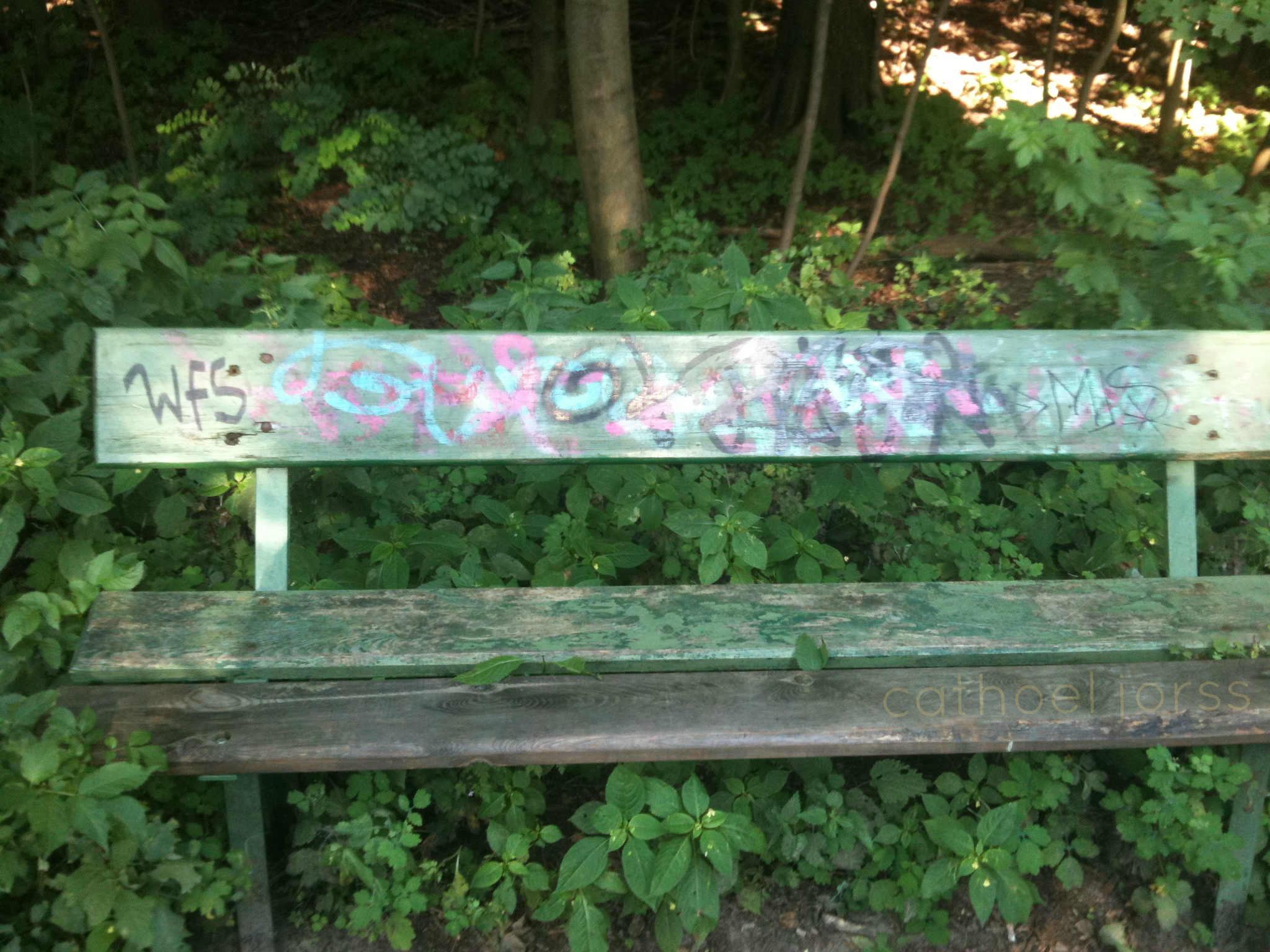
    H2O HoL greened bench

  • tower of rage

    tower of rage

    Yesterday morning I woke in that state known so satisfyingly as A Towering Rage. Must’ve had infuriating dreams. The sun came in my window and all the injustices of life lined up around me and stared like palings. It’s not a very usual experience for me and I wasn’t well equipped to deal with it. I didn’t stop to reason with or resolve my mood, just strapped some shoes around my feet and spilled out into the street. People were out. The sky was blue and clotty. The riot of graffiti seemed selfish and pointless. I travelled fast, towering and glowering. Took a sharp detour through the ruined industrial park where newer tourists than I stood about in shambolically worshipful groups, staring up at things with cameras in their eyes. Everyone was annoying. Before long the fury had burned off like a dew but for twenty or thirty minutes it was quite a lot of fun, in a yah, boo sucks kind of way. People got out of my way. The best and strangest, most irritating part was as I strode along not bothering to alter my misanthropic expression, men marvelled and turned and stared. A fellow in a schnitzel cafe craned round his wife’s back to gaze and blink. A tall man with a redheaded child on his shoulders met my eye with that slightly goofy, astonished, almost grateful look by which strangers compliment each other wordlessly. I was too angry to be gratified but I kept noticing. Each time I thought, like an incoherent teenager, As! If! The young, bearded, beautiful man who lies supine with his begging bowl annoyed me more than usual. The day before I had noticed his sweatshirt said, I laugh at you all because you’re all the same. He rattled his tin at me wistfully and I said, spreading my hands, Are you going to give *me* something? Sure! he said, digging into his coins with a big smile. I laughed, which annoyed me the more. As ever the sky and the water were beautiful, the sneer in my mind, more than love, seemed to distill every atom of the day into a burning clarity.

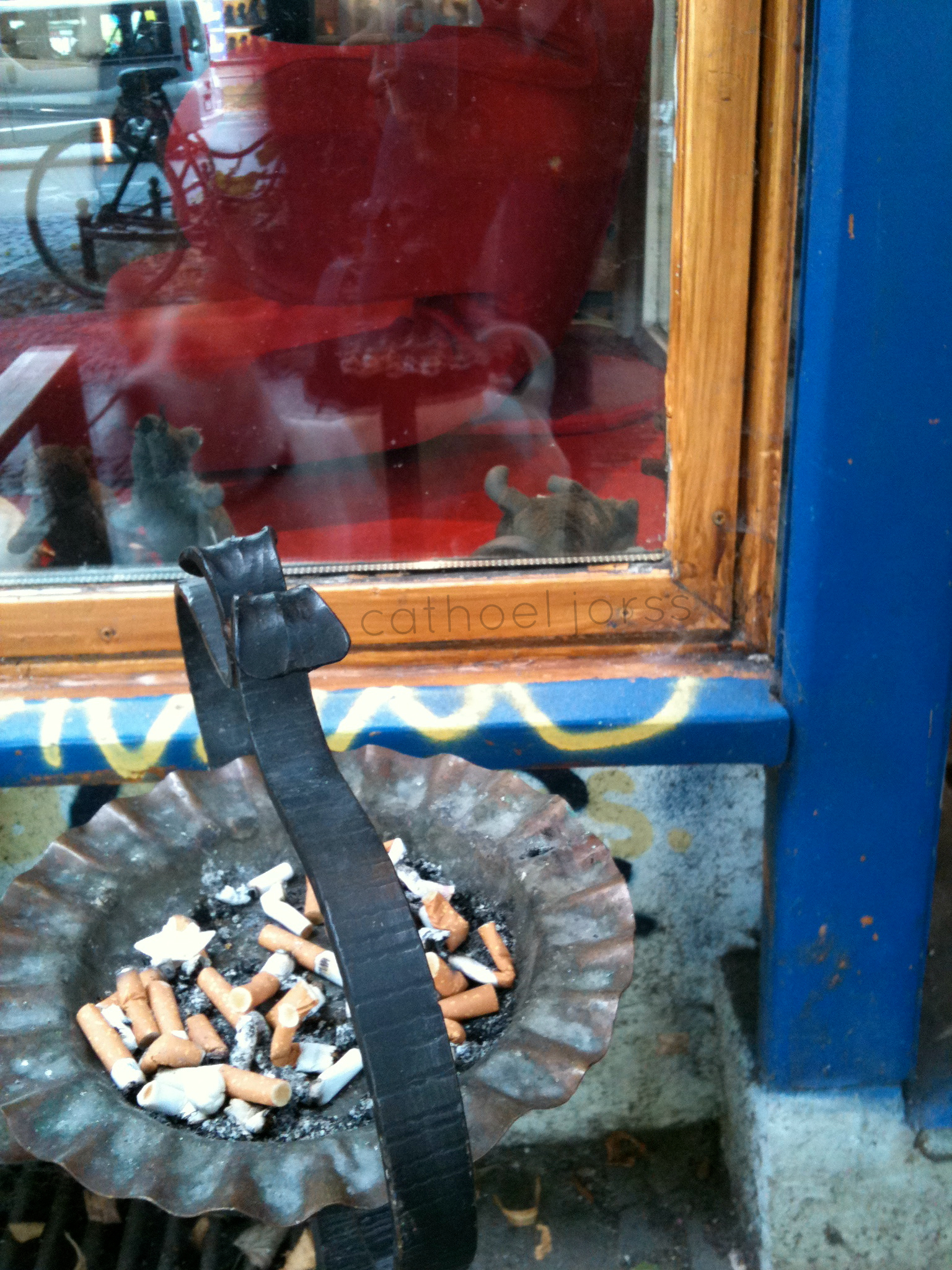
    H2O HoL ashtray hearth