Tag: cat

  • possessive hand

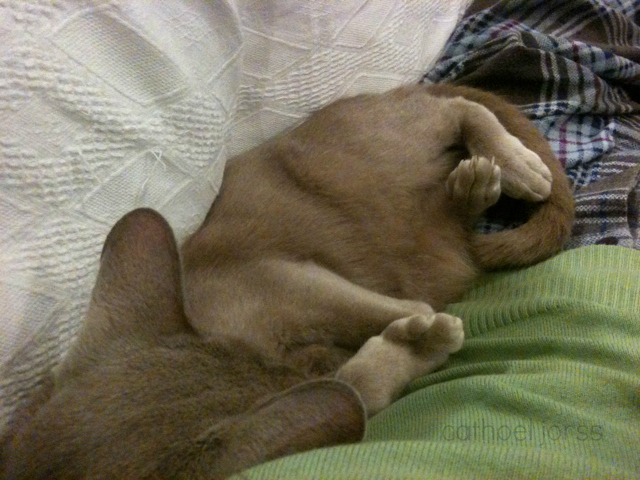
    The little cat puts her hand possessively on my arm. After a moment’s thought her other hand creeps up to join it and I remember the day I finally found her again, after she had been lost for a lifetime, five months at large in the laneways of inner Melbourne, and a man rang in response to one of my incessant posters saying, I think your cat is living in our backyard, and I went there and she came out warily from among the ferns, panting with thirst and telling me all about it, Mwowl, wowl, wowow, and she wrapped her forearms around my thigh and pressed her length along the length of me, ferocious with love.

    Today I am going away again forever and she knows something is up. She doesn’t like it. She has slept in the private cave between my knees, purring. She comes along after her night walks and nudges the blankets with her little nose, so that I half-wake and raise the covers up for her, and she slides in. Our physical intimacy has always been a most remarkable element, to me. When I found her it was through a cattery out at St Kilda, the other St Kilda, a coastal hamlet miles out of Adelaide. The lady who ran it was dotty about cats and had simply bred too many. The local council told her, you have to get rid of some, or cull. She’d put a notice up in the papers saying, free purebred kittens. I went out to her farm and there were four large sheds brimming with yowls. In the middle one a concrete floor writhed with kittens. I sat down to watch and find the cutest one, the prettiest. I liked the golden baby with caramel points. I liked the dark brown. I looked down and a skinny, ugly, funny-looking teenage cat with a smudge on its nose had crept up onto the table silently and crouched in against my hip. She laid her sharp pointed head in the hinge of my thigh and closed her eyes.

    I didn’t want her. I wanted the pretty ones, ones who still had all their growing to do. The next week I visited again and the same thing happened. It was summer and my bare toes in their sandals were rimmed with little kittens who chewed softly at the salt. Oh, they were all adorable. But this freakish, peculiar, not particularly attractive animal stretched to the length of her growth had chosen me. With ill grace I packed her in a banana box and stowed her on the seat of my ute. She had never been away from her extended family before, never been alone or in a car. She gave out rhythmic little bleats. I was driving and could only fit the crook of one knuckle in the narrow slot by which banana packers lift bananas. I felt her soft face come up against the tip of the knuckle and she sat down right away and stopped crying.

    It is twenty past seven and everyone is sleeping. I leave Brisbane in a few hours. I was sitting up in bed writing with my early morning cup of tea and I glanced up and met the eye of a big muscular Maori man I had never seen before. He was creeping round the side of the house, wearing a hi viz vest. When I went to open the door he boomed, Hello! But when he heard me answer far more quietly, he glanced up at the house quickly, and said far more softly, “Aw sorry, don’t want to wake everyone up.”

    This was Robbie, lifting all my precious things into a truck to drive them out to the ship. He took especial care of my guitars. These guitars have been in storage in Melbourne for three years and my cat has been in storage here. My mother calls her the grey nurse. When Dad is sleeping, which he mostly does, she curls in him and sleeps too. He’s her perfect companion: warm and available and never standing upright so he always has a lap. When the constantly changing rota of Blue Care nurses visits she sits on the side of his bed and keeps guard mistrustfully. I would so love to take her to Berlin with me but it would be cruel to all of them. My father would be bereft. And Tisch is a little wild animal with her afternoon frolics in the bamboo, her insouciant saunters under the old house next door to taunt their verandah-caged dog and to leave her scat. During the day I hear my father talking to her. She is his grave, watchful, lazy companion.

    There was another cat here who was dying when Tisch first arrived, four years ago when I went to Berlin, for a week, and ended by staying for three months. I met a man and stayed on and now our future is uncertain – just in the last 24 hours. I had parked Tisch in a cat hotel in Richmond and when I went in to pick her up the girl on the desk said, in a bored tone, “Name?”

    I said, “Tisch. T, I, S, C – ”

    “Oh!” she cried. “Tisch! Oh, does she have to go? Can’t she stay?”

    She brought me my cat and I couldn’t help noticing Tisch had grown substantially rounder. “We take her out whenever it’s quiet,” the girl confessed. “We play with her round the desk and give her biscuits.”

    The year before, Tisch had been lost for so long that my friends were telling me, You’ve got to give her up. She is dead, or she’s found another family. I walked the streets calling and calling. I collected sightings. I rang a cat retrieval specialist who suggested a poster saying, This Cat Has a Serious Illness. “But she’s healthy!” I protested. “She’s a sweet little healthy girl.”

    The retrieval specialist said darkly, “You’ve got to appeal to people’s lowest common denominator.” I said, “No. I’m going to appeal to the love.”

    My poster had photographs of Tisch curled in my lap and on the rug and it said, This is Tisch. She is lost. I miss her like sleep. A flood of text messages followed. Can I put up your poster at our school, I have copied your posters for our office, don’t lose hope, “this is our dog Wendy. She is watching tv. I thought a picture of her might cheer you.” A neighbour wrote, “I know how you feel. I lost my little while dog eight years ago and I still stop every little white dog in the street, just in case it might be him.”

    So now my guitars are on their way to the sea and will be freighted like so many piles of t shirts. I have only a temporary home in Berlin and the reason I couldn’t come to visit Dad sooner was my offensive landlord had taken me to court. We have a contract but he seems to think he can bully me into leaving, for his friends to use the apartment, by dint of phoning and shouting at me, screaming at the door. The loving relationship I was going back to, the person who has kept me sane in our whispered late-night conversations, has turned his back and folded his arms. It’s all hard. I leave my father and my cat wrapped in each other’s skinny arms. I salute death, the enchantress who makes life possible, as ably and courteously as I can. I remember my uncle’s cat Putschen, after the uncle had died in a scurf of urine stained cushions and skittering letters to the government about his fears of his various neighbours; Putschen was big and wild and I had to coax him into the car. Years later after Tisch had also moved in, Putschen had cancer. The cancer ate him away from inside and I was visiting and for some reason the spot he wanted to curl in all day and all night was the wardrobe in my room. He had become transcendent with pain and was skinny and hollow and purring so loudly all night that I finally had to move him, into the next room, through whose wall I could still hear him. The other cat, Tisch, would come in of an evening and the two of them touched noses, “Still the cancer?” “Yup, it’s ok.” I began to call him the Dalai Putschen. My father has not reached this state and the death which seemed imminent now perhaps may be more uncertain. We can’t know. My father says to me every day, Can’t you stay one or two more weeks? and I have. But now it is time and I am heading out into the wilderness, a country whose language I don’t speak, a blessed breather of solitude that now with my relationship on ice seems more like a lonely sojourn in foreign parts. I will get to Berlin in eleven days and don’t know if he will be there to meet me, or not. I leave my cat behind and she is the worst possible correspondent. She doesn’t phone, she never writes – not a postcard – but my mother has said, when I telephone and she hears my voice, sometimes she comes and writhes around the implement. A hollow love long distance. A house of bamboo grief. I don’t even know what I am saying any longer and the plane is waiting, opening up its maw.
  • house mousse

    This week I’m going home to Berlin to find an apartment of my own, via a writing sabbatical in Thailand which I suspect I will sleep through. What was supposed to be two weeks has turned into a six week endeavour. I have worked from dawn til night, busted my finger, worn myself to a shred, and these are my small victories: Dad sat up and asked if he could have a cup of tea with lemon and honey. Dad wanted to sit out on the verandah and watch the sunset. Dad went on his first outing since the hospital and scoffed fish and chips and a giant fresh iced coffee laced with cream. Mum had someone to cry to. Mum went to a really good physio to whom I practically drove her with a stick and in a single visit was able to raise her damaged arm upright, from months of being stuck at a horizontal maximum. They learned how to use their iPad. The living room looks warm and congenial and less like a hospital. The garage has been cleared out and has one of Mum’s paintings hung to greet her when she gets in, as she starts now very cautiously to drive herself about now and again. The garden is healthy and the verandah brimming with fresh plants. The cat has been taught not to wash herself when she’s on the bed, which she was raised (by me) not to do but had forgotten in the local recent spoiling. In between I have packed up 11 cartons of painstakingly sorted and delicately couched feathers, crumples of fabric and shell, shards of perfectly worn wood, and partially assembled assemblages for shipping to Berlin. I feel replete.

    This afternoon I made this for Dad, and he ate two teaspoons of it – victory! It’s velvety and rich. You can replace the honey with maple syrup if you are vegan.

    FREAKY CHOCOLATE AVOCADO MOUSSE

    1 frozen banana
    3 tbsp cacao powder
    1 refrigerated avocado
    3 tsbp cocoa powder
    2 tbsp honey, or maple syrup if you’re vegan
    1 tsp lemon juice
    1 tsp vanilla extract
    2 tbsp iced water
    A tiny pinch of salt

    INSTRUCTIONS

    Blend.

  • possum off

    Pissed on by a possum as I was lying in the hammock. Cat sprang out and stalked off, tail in air. Possum continued climbing the branch, tail in air. This was after I had already been bitten by a sharp mosquito that turned out to be claw of cat perched on nearby kitchen chair on the lawn to tell me, let me in, I want hammock, you gotta lift me up. Now the three of us who momentarily were linked are sundered: life goes on.

  • meat time

    I love how the cat comes and sits, not next to the fridge, just sort of within range… letting me know with infinite courtesy that, you know, no hurry or anything, but some people might say it’s high time for Meat Time. “Meat Time!” I say, finally noticing her where she folds like a furred god, immaculately footed. Her tail is wrapped around her legs, she is not getting in anybody else’s way, she doesn’t say a word – and not only because she has no words and little use for words, it’s because she is being polite. If I walk between her and the magic fridge, where, for all I know she knows, the meat actually grows, ready carved into fresh nibble-sized bleeding chunks, she almost falls over herself skipping to reach me – she does a little hop, like a twist, her backside and haunches still sitting on the ground while her eager front feet have set off in the opposite direction. She reminds me of comics in old movies who say, “They went… thaddaway!” pointing two fingers in two directions. I let the chunks of flesh fall into her bowl. I’ve given up moving the old hair elastic that is her beloved and her prey, which every day ends up dropped into her empty dish. I hadn’t given up wondering why she would drag it over there once she’s done chasing and torturing the poor thing, then one day it dawned on me: oh. This is her eating place, where she would drag the corpse of her intended supper if she weren’t a soft little domestic possum-murderer. That worn elastic is her prey.

  • this cat the sun

    I think this cat’s favourite person is the sun. She believes everything he tells her and is willing to let him whisper into her belly and long ears for hours. I don’t think she realises he is distant, to her he is close. And I don’t believe she cares that he sprawls his favours indiscriminately. He is her sun and that’s all that matters here.

  • living in the garden

    living in the garden

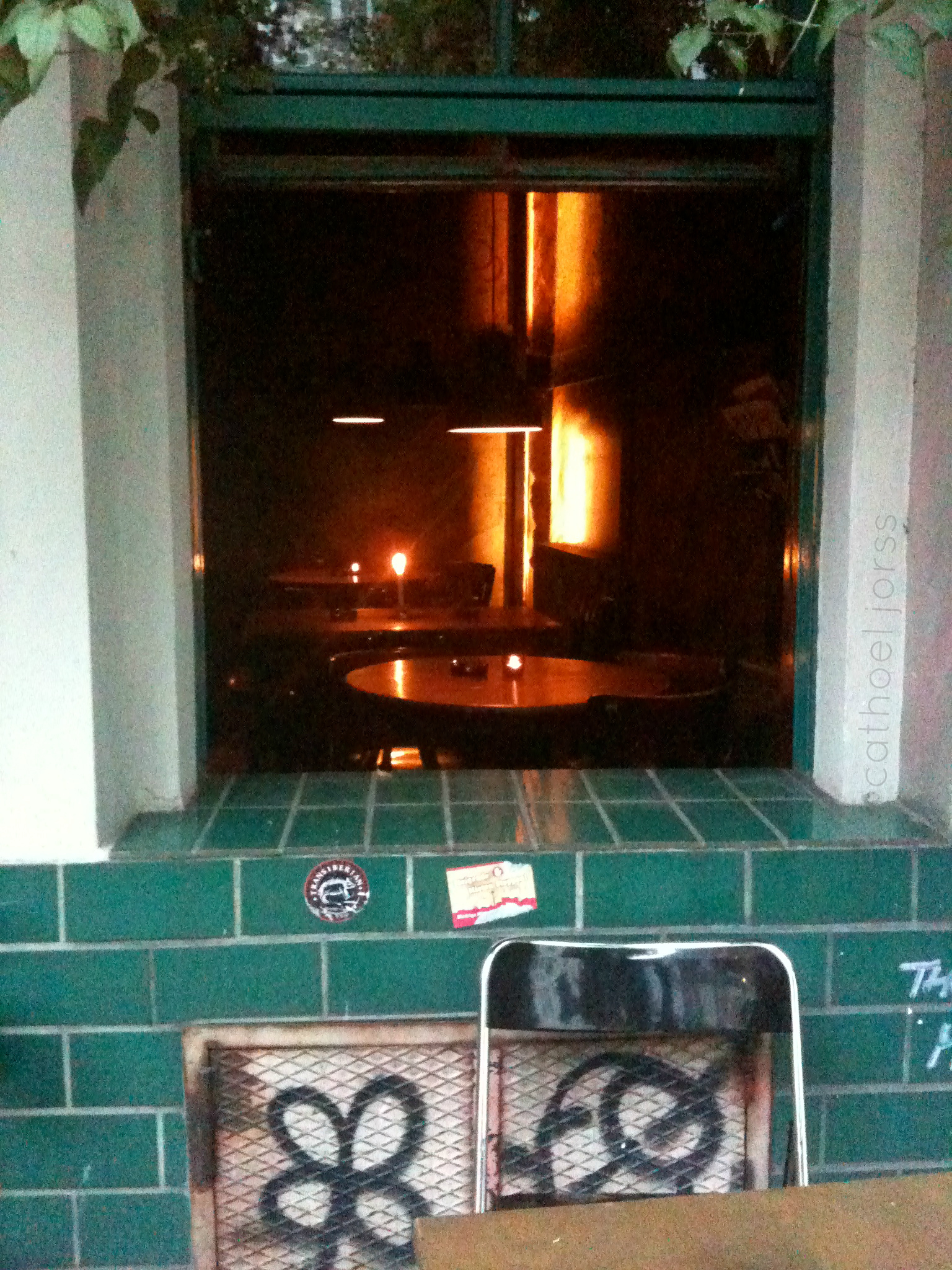
    Last night I slept under my own roof for the first time in four months. So to speak. It’s a beautiful sublet in a groovier part of town, bristling with bars, but very quiet behind the city wall of our foremost apartment building. I’m in the back, windows facing the trees, in a place with high ceilings and old DDR coal stoves clad in green and corn-coloured ceramic tiles. Downstairs is a baby with lusty lungs. A black and white cat sleeps in the courtyard. The owner of the flat spends her summers living ‘in the garden’ just outside town, which sounds idyllic, and has rented me her keys, her crockery, her weird hot water system, her dreamy curtains. Turning off the reading light I felt momentarily assailed by ghosts and spirits, a movement in the darkness, a sense of swarming: all the people who have lived in this old building in the past; and it occurred to me this was my first night sleeping out, beyond the palings, in the saddening wilderness of old-time East Berlin.

    H2O HoL windowglimpse

  • mouth bandit

    mouth bandit

    Some days I really miss my cat. She is grey & downy and is a right little snuggleupagus. She’s also a kind of miracle cat because she got lost one night, this was in inner Melbourne, and stayed lost for five months until one day someone rang in response to one of my posters, saying, I think your cat is living in our backyard. She had survived as a street cat and was thin but unharmed. Whilst not living in alleyways she likes to harvest unattended hair elastics from the desks of working poets and will carry them about in her mouth for hours, tirelessly playing fetch…. like a little dog. I love her but we always had two separate piles: mine (to hold my hair back) and hers (a bit manky from being scuffled and chewed).

    One thing I love about cats is their ambition. I would see her crouched at the foot of a wall, every fibre bristling with concentration as she sighted up a browsing mosquito or a shadow under the ceiling. “I can take that, I can totally take it!” And yet they seem to have no other desire than to laze. Most important of all is: be comfortable. Always be comfortable.

    H2O HoL tisch green jumper

  • shaped like a fish

    Pouring out dry biscuits for the cat I wonder: why are they fish-shaped?  It can’t be for her sake.  She’s not thinking, Hey, this reminds me of a fish!  Cats don’t abstract.  So though she is attached to me, and will follow when I move to another room waiting to climb back onto my lap, what she feels for me is not actually love.  If I were tiny enough, she would eat me.

    On the first day of life-drawing class the teacher said, the mistake you all keep making is, you are trying to draw the outline.  ‘The outline is an abstraction,’ he pointed out: ‘it doesn’t exist.’  If you glance down at the page & look up again with your head on a different angle, the outline you have started to draw no longer makes sense.  As the model tires and her hand begins to droop, everything looks different.  Now the lines you have made are unhelpful; are, in fact, an obstacle.  Abstraction becomes an obstruction.

    One of the challenges in learning to draw for the first time, as an adult, is to see past your own expectation of what ‘a face’ looks like.  Two eyes, and they lie parallel.  What ‘a body’ looks like: breasts are round.  Deftly the drawing teacher made sketches as the model stood patiently naked.  ‘Abstraction,’ he said, ‘actually interrupts us from learning to really see what we are seeing – and draw from that.’

    A 14-month-old child visited this week, the day he had just said his first word.  ‘Dog,’ he said.  Now the cat, crunching her fish-shaped biscuits, was ‘dog’, the birds in the flowering gum were ‘dog’ – he had learned that there exists a class of creatures who are warm and independently mobile, but are not humans.  His first steps into the abstract: now he can invent and worship gods, make art, fall in love.  There were three little stuffed toys in a row on the windowsill which we gave him to play with.

    They are three pigs, collected from op shops, each one different entirely to the others.  One is of pink plush and sits upright, with long puppet arms and a curling tail made of felt. Another is stout, almost legless, and looks more like a piggy-bank.  As sketches they appear almost unrelated, yet the mysterious principle of pigliness unmistakably joins them.  The cat will never be hungry for biscuits just because they resemble fish.  But in a few more years little Harlo will look at this array of furry inanimates and say, ‘three pigs.’