I want to wish everyone a beautiful festivities, in whatever shape you find them, the end of the year is coming and a new round of seasons upon us like a fresh page with the old year in invisible ink. In this difficult life on this ruined earth let us do the best we can to be gentle and fierce and active and happy. Merry Christmas. Happy New Year. Be awake and true and well.
Tag: Christmas
-
the boast of Christmas past
Last year and the year before that and four years ago too we went down on the train to West Germany, to a tiny village lying under the skirts of the old woods. This is where my sweetheart was born. His father was born in the same house and to me the village, the house, the family symbolised most of what I’ve longed for all my life – the continuity and cosiness of grandmother living upstairs and now sleeping in the graveyard, the grooming visits, where we trimmed her candles and scattered flowers for her; the dog racing joyously through unbroken snow; the stacks of firewood and the window dense with flickering lights.
I felt so welcomed the very first year, when he and I had known each other only six months; his mother was kind and his father jovial yet somehow forbidding and she had saved for me the tree to decorate, “because you are an artist.” I persuaded him to go down there early in the season so we could hang out in his family, since mine is so fraught; and on December 9, 2012, four years ago today, we woke up at the other end of our long train ride and opened the door on a perfect world. Here is what I wrote:
Waking up in a tiny German village. It has snowed and the snow extends away across the fields. The woods stand shoulder to shoulder up the hill. Opening the door I can hear church bells howling like dogs, everything is beautiful because everything is covered in snow, a white democracy. The phrase forms in my mind and a series of sour images ensues: what is white about a democracy? Everything in Germany is tinctured with its history, the way everything in Australia cries out black stories. Nonetheless this fairytale landscape has a hold of my mind, I feel relaxed and browsing, last night by the candleglow Christmas market I found a bookshop displaying eleven different editions of the tales of the Brothers Grimm in its front window. Tiny sparrows dart at the small wooden house outside pecking at seeds. A fierce wind has sprung up from, apparently, the Arctic Circle and I close the door thankfully. Good morning, winter world.
Then last year, a huge family shindig. I should put ‘family’ in inverted commas because part of the substance of the fight – the potatoes perhaps, if not the meat – was that I was not part of the family, being a newcomer; therefore he had no right to bring me into important family discussions.
This important family discussion was about money, aren’t they all. Previous family visits had been laidback, shambolic, tilted round long evening board games and wine. Now something was brewing, but I couldn’t work out what. All week we’d been trying to work out why everybody seemed so tense. Then January second I stumbled out of bed and down the dark hallway to find my honey and his father locked in fiery argument.
I sat down and took my partner’s hand. To be locked inside a fire is grievous indeed. I had never heard this family shouting before, though the father’s a bit of a bully: our very first visit I had called him out on his treatment of his son, when the man whistled for him to bring something; He’s not a dog, I said, and the old man said: Doch. (“Au contraire.”) This visit he had been mocking us for our failure to produce a child; the sister, a thistly blonde, was swollen with her third and we had lost our baby and been unable, thus far, to bring forth a living sibling. The proud grandfather sat with his injured foot up on an ottoman, making my partner’s dog beg for walnuts; his son said, please don’t spoil my dog, it is I who will have to live with him, and the father said: “Well. If I had a grandchild, I would be spoiling the child. But as there is no grandchild…”
These coarse country people occur in my family as well. Ours also drink too much and hoard things and are suspicious of fresh food. All week we had been walking in on whispered conferences which urgently suspended and then remained hanging in the air, swinging like baubles. Now the underwater fire had burst forth. It was a question of inheritance. They had cooked up an arrangement which seemed to me bitterly unfair as well as financially unwise, and I said so.
My own family finds me outspoken, too. It inconveniences them to the point of injury. When I flew home for my father’s funeral and suggested, in sentences very tentative and clothed in sticky tact, a less sentimental poem for the ceremony, my brother said flatly, “That’s not open for discussion, Cathoel.” I said, “But – ” and he ranted, “See! this is why I was saying it would be better if you didn’t come back – you’re just this person who comes in and changes everything.”
“You don’t belong in this family,” he had also said, on another occasion, and when I retailed this story after Dad’s funeral to my friend she said, bracingly, “This is perfectly true, of course. The only difference is, he doesn’t realise that it’s a compliment.”
“She doesn’t belong in this discussion,” the father said now: “because you two are not properly married.” Well, I told him, wounded and enraged. When your daughter got married – it was on two days’ notice and in the town hall, because they’d worked out at the last minute they would save eight thousand euros in tax by becoming officially a couple – I had to borrow a set of unwashed clothes from the bride, else I’d have had to go along in my overalls. It wasn’t exactly love’s young dream.
Well, but you have no children, he blustered, so you don’t really belong. And thus silenced me with pain.
I told him some home truths and he told me to shut up. We had never spoken to each other like this before. I got louder. So did the dad, but I suspect everyone is so used to his roaring and his barked commands that they barely noticed. Afterwards I was accused of having said things that were beyond the reach of my imperfect German vocabulary. I reminded the father that he had told me several times to halt den Schnabel, hold your muzzle. They were so outraged at my insurrection “under my roof, to me, as host! in my Own Home!” that they had no room left over to contemplate what might be due to a guest, a vulnerable guest trying to celebrate their daughter’s umpteenth glowing pregnancy, a person separated from her own family and far from home. When I first saw the daughter, clomping on her sore ankles and complaining about the weight, I had followed her outside and asked that we could hug each other. “I’m so happy for you. It’s just painful for me, kind of, because we tried so hard – but I’m happy for you. I just wanted to give you a hug, you and your belly, and try to get myself used to it.” She embraced me with tears in her eyes. Now all of that was forgotten. I had called the messy patriarch of this outlander tribe a bully, to his face. I had said, inspired by rage and a kind of foaming disgust at his harassment and meanness, Your son – is a real man. He has manhood. I have seen him do terrible things and then hold himself to account. I’ve seen him struggling to learn and to make changes in himself. You should respect him. You should treat him with respect.
I think we can’t bear when a woman speaks out. When a woman questions things. How dare she, how could she, and who does she think she is. The day after the fight we caught the train home to Berlin. I went up to the father, sitting at the table with his arms folded, and put out my hand. After a moment, he took it. I said, thank you for your hospitality and for having us in your home. The next morning a phone call. And the word, Hausverbot. This means, I forbid you my house. It is kind of a ‘don’t ever darken my door.’ In German, my partner said, very serious. You would give Hausverbot to a repeatedly violent pub guest who started a knife fight and stabbed somebody. Or to someone who’d been stealing in your store.
The son, of course (they assured him) was welcome. But do not bring that woman under our roof. I spent January dissolved in tears, before distaste began to displace the other pain. You don’t belong in this family. All year long the wound festered. My father died and I went home. I confided how I was dreading this Christmas, worse than all the Christmases before. Afterwards my mother, in a bout of generosity, offered to send us both to Morocco for a holiday to replace the painful season. In an ancient Islamic city we could forget about the festivities we’d not share. We could put aside the sore points like the pregnant sister who didn’t bother giving either of us a gift, and whose kangaroo skin rug we had lingered over for an hour in the ugg boots store, wanting to bring her something luscious and Australian and Scandinavian for her comfy home, stroking every skin to find which was the softest. They are soft like the tender belly fur of a little cat. A day later, when all the piles of gifts had been opened and I was putting mine away, I asked her: hey what did you give me? I can’t seem to find it. Oh, she said – I just never thought of it. This hurt, and I told her so; not that she has to give a gift, but that she didn’t think. Now somehow this long-ago frisson of discomfort has been revived and painted glossy and put in the front window. We, who brought an extravagant gift we could ill afford, are designated materialistic, and grasping. My outspokenness is insufferable. My partner is greedy, because he feels sad and hurt at being all but cut out of his parents’ will. Last week the father, tricked past his pride by the wife who pretended his son had called first, finally rang. “I lift the Hausverbot,” he said, grandly. “You are very welcome and I hope you’ll come to us. But please don’t come to Christmas – your sister and her husband wouldn’t like it.”
-
walnut hound
We are travelling with a medium-sized hound named Felix and tonight I learned something uncanny about him. There is a bowl of walnuts on the low coffee table by the horde of tealight candles, santa-shaped geegaws, and slinky Christmas lights. The adult son of the house picked up a walnut. “Now watch,” he instructed, and gave it to the dog. Felix stretched himself under grandma’s chair and propped his two paws out in front of him. Delicately he turned his head first left then right, cracking the walnut shell from either end with his long white teeth. The turns of his head on the floor looked so adoring, he held the nut between his two hairy paws. Having dispersed the shell he spent a few juicy-sounding minutes extracting for himself the slivers of meat and scarfing them down ecstatically. I’ve never seen a dog behave like that. When I cracked a walnut for myself – with a nutcracker – he came and sat beside me and gazed with reproachful intensity at every movement. They told me how Felix climbs on the couch and puts one paw up on the coffee table so he can reach the bowl.
The other discovery I made this evening is that if you crack a walnut open cleanly enough, the halved nut with its blade of faintly gleaming wood still attached down the centre can be made to flutter through the air and resembles a tiny butterfly.
-
frauenpower
Tiny revolutions in other people’s lives, I just can’t stop making them. When we got here and had eaten our first meal together I said to our hostess, No, I’ll wash up. Because as everybody knows, it’s not on for the person who cooks to wash up as well. I made sure to say it loudly and clearly in front of her husband and all her grown children, but got mere glassy looks in exchange. “Cathoel is very industrious,” she noted, approvingly, later, to her son. Christmas morning I made the only grandchild thank her after she’d been brought a cup of cocoa when everyone else was drinking coffee. She decided she’d like some once her grandmother had already sat down, and without hesitation the grandmother left her own breakfast untouched and got up again.
I couldn’t bear to see how everybody sat down at the long, laden table and started saying, “Some jam would be nice,” and then when she had already returned from fetching it, “Oh, you know what? Let’s have some dark bread as well.” Tonight my partner cooked and I washed up. Afterwards we played cards, just him and his mum and his dad and me. The father got up and got beers. As I got up to go to the kettle I announced, “And I’ll take a cup of tea… does anybody else want a cup of tea?” With slight embarrassment my partner corrected my German: “No, Cathoel, in this case you say ‘I’m going to make a cup of tea.’ ‘I’ll take a cup of tea’ is for when you’re expecting a waitress to bring it to you.” “Yes,” I said, primly, “I was making a joke. Because I’ve noticed in this household people just sit there and say, I’ll take a cup of tea, and then your mother instantly gets up and goes into the kitchen.” His mother began to laugh. I’ve never seen her laugh so heartily. She slapped herself across the knees. “Thank you! Thank you!” Her cards spilled and she picked them up and began tucking them back into a handful, wiping away tears. We played on and I drank my tea and they drank their giant beers, and in the end it turned out the two men had trailed behind and the winners, bringing home exactly the same number of points each, were the two of us. “Sieg der Frauen!” I said, victory of the women. “Frauenpower,” she said, and we shook hands diagonally across the table.
-
what Jesus did
Christmas edition of the local paper, West Germany. Four pages of articles welcoming the first couple of hundred asylum seekers into the area. Photos of Syrian and Pakistani families lugging their suitcases off the bus and of all the local dignitaries who turned out to smilingly shake their hands and welcome them; photos of the Christmas feast that was put on to welcome the new arrivals: a little Afghan boy says gleefully, “We are famous!” Editorial reminding everybody of the story of pregnant Mary and her husband Joseph searching for a shelter in which their baby, Jesus, could be born, and how this is no different to our communal obligation to offer shelter and a welcome to people currently seeking asylum. I’d like to send a copy to Canberra.
-
dinner party from the sofa
I was at a dinner party and came over all poorly. In fact I thought I might throw up and had to kind of bolt from the room. Must’ve been the Tramadol, an opiate fed to me by my beloved who had acquired it from his father, who suffers from extreme chronic pain. “They’re not really all that strong,” his father said airily. The headache that has been a companion for days now, for almost a week, had sharpened so if I turned my head it brought spasms of nausea. A small disagreement over breakfast had unexpectedly ballooned into a stand-up shouting match in this house where I am a new guest, pain in my belly from the sorrow of it all day. So I succumbed. “Take the other half, too,” he said when the pain did not ebb. Twenty minutes later we were at this party on the other side of the little winding road where the family live scattered in houses like little farms and I started to feel most peculiar. You know that dizzy sweating pressure that comes with acute nausea. Anyway I sat it out and everyone was kind and generous, including the two people who’d yelled at me. What I wanted to say was that the feeling of lying under a soft scarlet blanket on the long sofa in the living room, with a paper Christmas star beaming down on me and a row of red candles in the casement unlit, was so cosy and comforting I felt a whole mess of worries and griefs slowly melt and slide away. The heating was not on in this other room and the chill in the air felt to me healthy and fresh, deeply deeply invigorating. The sounds of communion and chatter from next door were so soothing and a delight. Over the adult voices and faint music I could hear the joyous prinkling of the little girl who was drifting in her seabed of uterine privacy when we were last here, who is thoughtful and nachdenklich, reflective, and has hair the colour of threshed wheat. They brought me a heat pack for my neck, they saved me some dessert. When we came out after our hugs the stars were so clear and so high and the sky had opened itself to the night, the heavens upon us, the peaked white houses standing about like sleeping horses, the night seemed to me sacred and blessed and the row of long needling trees threading the sky along the winding road into the distance led, one could tell, into all good, mysterious things. The white dog made a flickering song of joy along the slick black road as we wound our way home, breathing visibly.
-
the little lost letter-dove
One of the world’s sweetest men has been reading me snippets from the local paper. There is a photo of an activist dressed as Santa Claus holding up a sign towards unmoved Israeli soldiers at the checkpoint Bethlehem which says, “Jesus brought us one message: peace, freedom, and justice.” In the section International News comes a distressing story “Brieftaube Geklaut.” He tries to translate literally: someone has stolen a letter-dove. This letter-dove is worth 150,000 Euros. He is under the impression that ‘dove’ is pronounced in birds as it is in entering water. “Despite its value this male bird had still only the name AS-969.” I imagine perhaps we can all agree that ‘letter-dove’ is a far better name for such a male animal than the drear and faintly contaminated sounding ‘carrier pigeon.’
-
a small town in West Germany
We came today to a small town in West Germany to stay with family, my out-laws, who are champion collectors. Outside the door stands the Christmas tree, an actual tree cut at the throat and still wrapped in its net bedding, because as mother-out-law promised, “We left it for you both to decorate the tree.” Two years ago we were here for the first time, my first time, and she broke the ice – that winter, actual literal ice – by leaving it to me to coordinate decorating of the tree. The old spun and woven and blown decorations came out in their plentiful boxes. These people live in a house that’s been theirs for generations, something hard for me to imagine, and they have filled it with stuff. I asked the son of the house, my beloved, what the name of their strange street meant. It is the last road before the fields and we saw a pheasant bent forward and clucking to himself crossing worriedly from one shorn side to the other, as though pursued by tax collectors. “Ah,” he said. “Well it means an old execution place of the Germanic peoples; in the forest.” “Gosh, well I am so glad I asked about that. What a bummer it would have been if I had Forgotten to Ask.”
A couple of hours into our visit after plates of breads and cheeses (three kinds of bread, two of cheese, and five kinds of preserved meat) I began to nudge him and wheedle with my toes until he finally realised, “Oh! Wir gehen gerne auf den Weihnachtsmarkt, we’d love to go onto the Christmas market, might just run in there on their second-last night, ok with you? Mamma can I take your car?”
The Weihnachtsmarkt for me is the entire point of our trip. It’s the reason I am in Germany. This is what my partner used to twist my arm into the winter again, when we could have been lying in our hammock in the sweet greasy green southern hemisphere, feasting on mangoes as they fell off the tree overhead. We drove in, on the wrong side of the road, round errant curves each festooned with the needle trees dark and sore which never lose their leaves despite the cold. Several times I asked, “Where are we going?” just to have him answer, patiently, humouring me, “I think we’re going onto the Weihnachtsmarkt.” We walked onto an old town so medievally beautiful that the first time I was brought here through the old arch I burst into tears. As we explored the golden stone lit by street lanterns I forgot the crowded family house where in manoeuvring my suitcase through the door I joggled an unevenly-built shelf and three different hair dryers and four hairbrushes fell to the floor. I forgot all family obligation. I forgot all junk everywhere. We were in the beauty, in the ages, in the kings. Once more. People, mainly couples, drifted dark as feathers down the narrow winding streets, arm in arm. Golden lights, bottle-end window fixtures, deep restful casements and star-bright lanterns. Windows lit with all kinds of crafts and art. Rounding a final corner we came into the burst of flame that is the yearly Christkindlmarkt, market of the little Christ child: people gathered, people standing, people laughing and drinking and stamping their feet. This year it’s not all that cold, I think I must have imagined that last bit. The stalls hung with lanterns wound all round the little cobbled streets where no cars go and people ordered salmon smoked over the flame, white forcemeat sausages and star-shaped bread rolls, gingerbread hearts, eggnog “mit Schuss” (with a shot – of rum, or amaretto); Glühwein. Everyone was jolly and, this not being Berlin, they couldn’t care how cool or uncool they seemed, they were just having a simply uproarious time on the close-packed stones, throwing their heads back, wearing their Santa hats. So much conversation, all in German, some few leafless trees bestowing their shadows underneath the venerable church.
“That one was built in 800 AD,” he said, as I lit into the dream and did not come back. Anyway where is there to come back to? only the eternal present, whereas old Germany presents a time immemorial, something I had forgotten and feel now coming alive along my veins as though fishing lights dipped into me and brought the life swimming to the surface, every Christmas I have had “in which” (I told him) “we ate salad” now fell away and the stars we cut out of quartered paper made sense, the blobs of snow we’d stickytaped on strings hanging from the ceiling in the tropics – cotton-wool snow – all of a sudden had a purpose, everything fell clear. A quintet of young men with brass in their mouths were playing and it was a song I recognised, “no,” I thought, still in my trance, “that is not a song, that is a hymn.” My partner asked, what is the difference, and I sang it to him then could not stop: O come let us adore him, O come let us adore him, O come let us adore him… it’s not so easy to write a melody that good. “I’m going to be singing that all the way home, I warn you, it is so beautiful like an old wine in the throat, so if you’ve any complaints let us hear them now and then you’ll hold your peace.” “No complaints at all,” he said, bending tenderly round me as though I had been a bell.
I noticed on every unfolding gold-lighted stall that the Germans love kitsch, they just love it! “Don’t you have kitsch in Australia?” “We have junk. Plenty of junk, and trash. But your trash has a kind of sentimentality to it that is all your own.” He laughed low in his throat. We jounced home slowly, gently, through the medieval town under the tall pink facade of the building that more resembles a cake, past the outer streets where cars travel on the cobblestones as rippingly as though they had, or so it sounds, each four flat tyres. I remembered the word and reefed it out, “Reifenpanne,” a flat tyre, and the resurrection of this long-ago-acquired German word touched me and blessed me, as though there were endless space in my mind, as though life stretched on eternally.
-
brandy barter
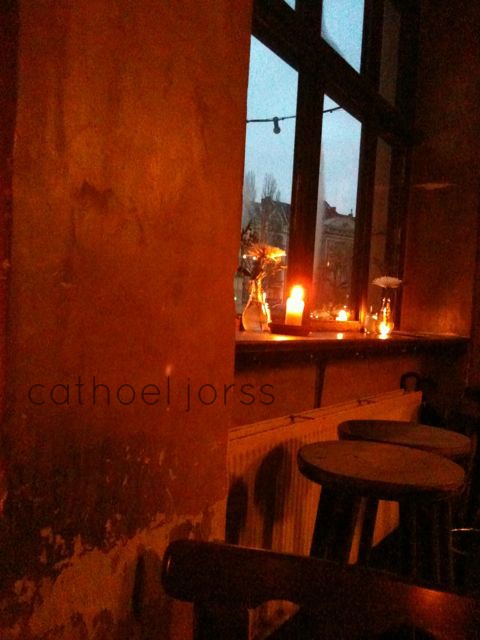
I must have lived in Berlin too long because it’s screeching hot on a Sunday afternoon, I am exhausted, and somehow the idea has crept into my head that I would like to drink a martini. It won’t dislodge. Opening my parents’ liquor cabinet is a dispiriting experience. It is a small, oval, glass-panelled thing on turned legs and inside, it resembles a brown mouth half-filled with decayed molars. An uneven semi-circle of discoloured flasks: these are the bottles of something your old workmates gave you for Christmas and that no one enjoys enough to actually drink. Plus a bottle of cheap brandy from which I made the pudding butter five days ago. Outside, Brisbane sprawls on all sides, as far as the sea and the hills, suburban and stupefied by shimmering heat. I cannot accept that there isn’t some strange punk bar or pirate bar within a block’s walk, opening late and staying open even later, candles on the tables, dogs under them, where a charmingly incompetent twenty-five-year-old bartender will make me a martini that begins with him holding up a Cinzano bottle that is actually labelled ‘Martini’ and showing me, “It’s empty.” After that I will explain that you don’t need a bottle marked ‘Martini,’ you need gin. I wish I could buy a vile martini for three euros, or a sublime martini for four, and have the bartender bring his black leather wallet to my table afterwards and have to remember that when you pay, it is customary to tip, but advisable not to say “Danke” when you hand over a twenty-euro note: this means, in the German sense, “Nein, danke,” which means “keep the change,” and it took me almost all of an eighteen-month stint there to learn this.
On Christmas Day I met for the first time in three years my uncle, with whom I had been having a feud. He lives across the road and is stubborn, a unhelpful family trait shared by us all. Our feud arose because three years ago I was staying with my folks a few months before moving to Melbourne. During that time I had set up a writing room in their dining room and pinned out the manuscript for my poetry book along the tongue and groove walls. It was a quiet, dim, and sacred space. The first song in my album was recorded there, on a single microphone propped by the couch. But for now it was just me in there every day, working, working. The walls were lined with shelves and high up above the rows of books lay three ugly old clocks, stained wood, with various pieces missing. I made a joke, apparently: we should sell these on Ebay. My uncle, who spent his childhood immersed in the story of these clocks, one of which had belonged to a great-uncle who died in the Great War, took me seriously. It had not occurred to me that such hideous objects might be of value to anyone. I was at my desk one afternoon when the door opened without a knock and my uncle strode in. He is a train driver. He was wearing hubcap shorts and a huge pair of dusty boots. Without a word he climbed onto my desk and started reaching down the clocks. I was milling at his feet, wringing my hands, saying Please get off my desk! Don’t stand on my stuff! That’s my work! If you want the clocks I will get them for you! My uncle took all three clocks in his arms and climbed down, grunting. He set off down the hall with the clocks anchored under his chin and me beside him being flicked aside like a fly. He confiscated the clocks and later told Mum it was in order to protect family heirlooms from being sold online. The idea that I could live in my parents’ house whilst secretly selling family treasures online was disgusting to me. I marched over to his house to demand he apologize. I could not accept that anyone could know me all my life and believe me capable of such selfishness. We had been mates since I was three or four – how could he not know that hey, she’s a royal pain but at least she is painfully, irritatingly honest? The feud simmered slowly for all the years I was away. No one had been sure whether to invite this lonely uncle to Christmas lunch or whether to leave well enough alone. Christmas morning everybody cooked. My sister-out-law made a magnificent salmon and wrapped it in foil, my brother cut up foothills of potatoes, we worked out that we had almost one whole joint of meat or fish for every adult at the table. I made a pavlova and a Christmas pudding and followed the most labour-intensive recipe for custard I had ever seen. It required the milk to be slowly heated to a simmer and then allowed to cool. Halfway through it said, “Now transfer custard to a clean saucepan.” I made the brandy butter. Then I went to the phone. I rang my uncle. “It’s Cathoel. Are you coming over soon? Because I have a problem and I need your help.
“My problem is that I made the brandy butter and it’s got so much brandy in it that it literally won’t absorb any more. There’s actually a puddle of brandy sitting in the top of the butter. Everyone’s telling me I’ve wrecked it and I need you because you are the only person in the world who can come over and tell me ‘this needs more brandy.’” My uncle said, “You need back-up.” “Exactly,” I said. “I’ll need to make myself beautiful,” he said. “I’ll need to have a bath.” I said, “Don’t get too beautiful. The rest of us have settled for only moderately attractive, so don’t be too long.” When he came in the door half an hour later he handed me a drinking straw. “Is this for slurping up the excess brandy off the top?” I asked. “Yes,” he said. Then he took a spoonful of my brandy butter and said, wonderfully, “It’s perfect.”
-
feast of increments
Christmas can be excruciating. All this talk of love and family throws heartache, loss and loneliness into relief. A woman I used to know killed herself this week, from sheer isolation it seems. In German it’s called self-murder.
It happens sometimes that the people we love are not within reach, or they have died, or we are separated by sheer human awfulness. Sometimes you just haven’t met them yet and can’t be sure they are real. This year I feel bloody lucky to be living in a brimming household, spending the holiday with people I love and where trust is rebuilding. Other times I’ve been separated from my family for geographical and also more graphic reasons and there was one Christmas I spent alone entirely, in a deep sharp almost unendurable pain. You know that special holiday feeling: that you are shut out from some cosy universal nesting time all framed in glowing windows, everyone else has a family to come home to, a loved one to choose for, trusted friends to cook for and visit and call. I wish there was a sure way of dispelling this treacherous fantasy. I wish I had a way of reaching those who suffer this season, including my former self, to ask them to hold on, to try to let the joy emerge again.
Because it will. I remember seasons in my life when I asked myself, can you die of loneliness, and heard the answer in my heart: yes – yes, you can. I’m so grateful I survived the unsurvivable times. I feel exhausted but I want to embrace life, its torment and its sweet. The perpetual leisure and the frenzy of modernity, these new tools that can take us further into life or distance us from each other. Maybe as a race we are learning in tiny, clunking, incremental steps to please stop injuring each other, to stop neglecting and ignoring, to welcome one another to the day and to embrace the golden joys of solitude. I hope we all keep on quietly learning one another’s languages. Like shade on a hot day I long for peace. In myself, and the quivering peace of many hearts. All of our hearts have struggled and been tormented. Yet here we all are. Merry Christmas to all our strange golden stained souls. And I wish for a wonderful year. A turning point. A gateway to a liveable, lovable future. A freshness that learns from old wisdoms, particularly the still-most-human communities in remnant rainforests and on deserts who have most to teach. Between the future and the past: a door.