
An Abbott and two Bishops. Are we actually being governed by some weird splinter faction of the Catholic Church?
Tag: church
-

blood of the camellia
Proud of a conversation I had, in German, with the guy in the corner shop just now. He met me just inside the door, and rolled his eyes vehemently. “I was just about to close!” With a sigh he swung his swag of chains – yes, chains, that’s how you shut up a shop in Berlin – over the back of a chair and came round the counter to serve me. I stayed courteous and curious and soon he was telling me about his day. The Ordnungsamt, sort of a local city police, came in and made him change his display. He can sell ice cream by the cone tomorrow, and beef jerky and foiled sausages, but no beer and no ice creams already packaged. “No ice?” I said, misunderstanding the word. “Only if it’s not already wrapped,” he said gloomily. “But, ah – because of… God?” I wondered (Gotteswegens?) Yes, he said. He started showing me one by one the items on his crowded counter that would have to be stowed away at the end of every week so as not to offend the Lord. I said, You know, whoever God may be… don’t you wonder… whether maybe this is not quite what he meant? “Ihr koennt das kaufen, und das und das, aber nicht das.” Yes, he said, I’m not convinced that God minds what I sell, either.
I used to sing in a tiny madrigal ensemble which performed in an old cathedral and we would have to sit through the services as they droned on in what, to me, might as well have been Latin. Choristers brought puzzle books and read poetry. Every Sunday after the service everyone would be invited to partake of the blood of the camellia bush and the bread of the fields, sponge cake and tea bags served with plastic plates and (mega groan) polystyrene disposable cups. I was almost thrown out of the choir for suggesting that if there is a God, and if you believe God has made this whole earth for our dominion and we are somehow or other in charge…. wouldn’t God want you to wash up your cups and use them again? Isn’t God, by God’s very nature, fundamentally opposed to polystyrene? I mentioned this to the choir at large and to the choir master and also, a couple of times, to the minister and his wife. Oh, they said vaguely, the washing up…. Later the choir master visited me at home, to tell me two of the sopranos had made a deputation to request I be thrown out, as a troublemaker. Aren’t the manufacturers and purchasers of polystyrene the real troublemakers? I feel like Charlton Heston brooding over his precious gun, or Scarlett O’Hara clutching her handful of carrots. This is my land, it’s our land, so help me I’ll never give up. Because ‘not til the last tree is felled and the last river dried up’ will we realize, it seems, that you cannot eat God.

-
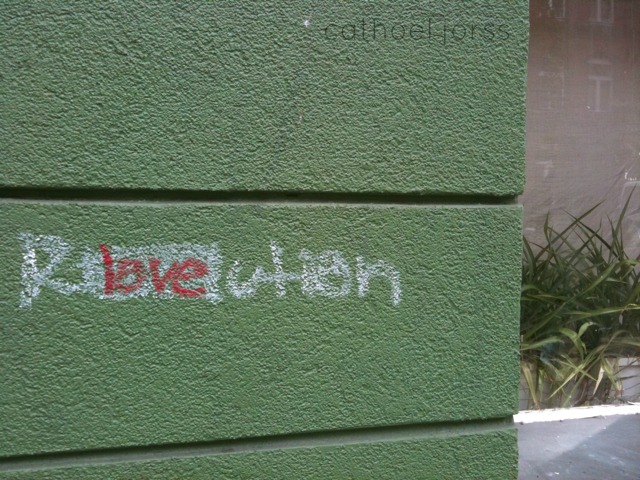
relovelution
It seems to me the central stupidity of the revolutionary mindset is, it says: You can’t use the same kind of thinking to build the future as you used to build the past. So we need to destroy McDonalds, overthrow the government, raze the Catholic church, etc. But what is this doing? It’s using the same kind of tools as were used to build the problem. Destroy and rebuild, some people are good and other people are bad, et cetera. I say there is good in everybody and we need all of it.
-

the human scenery
On my last day in Berlin I visited at last the Museuminsel, Island of Museums. It feels strange to ride an arched bridge onto an island on your bike. The island being castled with stately buildings filled with treasures only makes it the stranger. My favourite was the first, which holds treasures rescued or stolen from ancient cultures around the world, many of them excavated and painstakingly reconstructed by Berlin historians. Bits are still missing. You walk into a temple rebuilt under a soaring roof and begin to feature on a hundred fellow tourists’ documentary records. So few people were examining the faulted relief work with their eyes. They carried screens, like bashful eighteenth-century ladies shading their virtue with fans.
I was wearing a comical and very old beanie bought in a bead shop in Copenhagen. The lady who sold it to me bought it in Cameroon: she wanted a good price, saying, I am too old now to go back there and find more of them. “Kings wear them,” she told me, and showed me a photo of several kings standing about splendidly wearing hats like mine – it is woven out of navy and soiled cream yarn, and has all over little inch-long prongs sticking out like a fully occupied pincushion, a sea anemone. I went back to the shop three times and every time I put it on my head I felt a warmth and powerful groundedness rise down in me. In the third chamber of the museum a vast and mighty gate became the most beautiful thing I’d ever seen. It was clad in tiles in marine blue, sea green, round white daisies plopped one by one along the base of each wall. So beautiful, so moving, when my companion who had been reading the signs sidled up to me and whispered, Babylon, all at once I understood and my eyes filled with hot tears. I stood in front of the giant gate with my head tilted back, lost in that world, feeling some shard or fragment of how it might feel to live in a city of Babylon. I could feel the song in my blood, you know the song you have as a child and that revisits at odd occasions. Like lying face down in the hot sun watching the insects burrow among grass-stalk forests. Like half-waking, half-sleeping. Like sliding into a lake. When I turned there was a scampering behind me as a small tableau dissolved. Three Japanese ladies, elbow-height to me, were posed less than two feet from me as their friend, holding a camera and shooing them together like school children, took their picture using me, the giant with sprouting head, as colourful blue background.
Sure, we all do it. At least, I do. But I try not to hurt or molest or offend people. I either ask permission with a lift of the brows or if discovered, make a laughing confession out of it and offer to show the picture. Sometimes if I happen to take a beautiful photo that has someone in it, a stranger, I’ll go up to them with it and ask if they’d like me to send them a copy. These women’s refusal to meet my eye was irritating and unnerving. I spoke to them, gently enough: Excuse me. It’s not very comfortable for you to use me as human scenery. They put their heads down and scurried away, whispering to each other as though an animal had spoken. I wanted to be heard, to be human. I went over to the lady who was packing up her camera. “Excuse me, do you speak any English? I really wish you wouldn’t use me for your pictures without acknowledgement. It’s unkind.” She too ducked her head and backed, holding up both hands and waving them flat to ward me off, an invisible windshield. I could imagine the stories accompanying this picture in the slide show: And then ~ she attacked us~! I saw a security guard look up and went over to him, feeling assailed and dismissed, wanting to talk to someone. “I just had a kind of upsetting experience,” I told him, in German, “those ladies used me as human scenery in their photos and then when I spoke to them, they wouldn’t answer me.”
The expression on his face changed minimally. “Lord,” I said, “this must happen to you, like, 57 times a minute!” He said, “I hide in the corner there sometimes to get away from it. They look past me like I’m not even there.” “How awful!” I said. We were smiled by now, we kind of loved each other. “And don’t you feel… it’s as if, if I photograph everything instead of seeing it directly… am I really actually here?”
Leaving the museum hours later I waved to the guard and he waved back. “Danke!” On the way in his colleague who’d collected our tickets had said, pointing at my head, “Tolle Mütze!” “Danke!” I said. The old man who snatched a photograph when he thought I couldn’t see him I followed around the corner til he stopped, then raised my own camera and took his picture, expressionless. That felt better. But mostly my bones and my blood were immersed in the sacred, cool atmosphere of the place, a whiff of many places, the ‘first megacity’ Uruk which was one of the seats of writing. They had small clay tablets like gingerbreads propped on clear plastic feet and telling how many fish had been provided for the workers, how to repel the evil left behind by an expected eclipse of the moon. Afterwards we walked to the Bodenmuseum where people had carved marble into lace. Many many Marys and many small Christs, the repetition struck me as humidity does when you return home to a tropical climate. “I finally get it!” I whispered to my friend, on tiptoe (he is 6’8″). “The Mary worship – it’s about motherhood!” “Yes,” he said, shrugging, raised on the stories. “Mother and son. And the son becomes king. And is murdered for love.” I think that’s what he said, I was in a daze with the old, perfect works, the high wooden ceilings, the light lapping over them when you tilt your head back reflected from the green canal lying outside the Museum’s windows. At the top of the Bodenmuseum is a tea rooms with lovely long windows and not, when we visited, a single customer to absorb and be blessed by its splendid, gently-urging, lace-stitching music.
-

jazz, godliness…
I’ve cycled past this jazz club in town maybe half a dozen times & never had the nerve to go in. Today in the afternoon sunlight both the doors were standing open and, oddly, two tables with bottles of soft drink stood at the entrance guarded by ribbed plastic cups. A handsome-looking man was pouring. I got off my bike. “Is this – open? I mean,” looking at the people in coats milling around inside, “are you… rehearsing?”
He flashed me with his blinding Amway grin. “It’s a church. You’re very welcome.” I stepped back. Looked up at the sign. “It’s not a… jazz club?” “It is a jazz club, just not today. But we have lots of music!!”
Who could put their faith in a church that’s willing to use disopsable cups? Looking back, I could have given him many better responses, the least of which might have been, “My only religion is jazz” (a lie). Instead I had that protective feeling one has around people who seem to look out wistfully from inside their own club and wonder why more don’t join. “Jazz,” I said, “godliness…. they’re related.” And we waved each other off, a pair of heathens, neither one willing to convert.