Tag: communication

  • of wheels & wings

    Today a day of wheels and wings. On the high street I set myself an errand, which failed, as the Turkish woman who repairs garments has locked her shop and flown south for the summer, into a tide of incoming birds. Her storefront was locked like a little dark cage. On the street out front two big bikes sputtered and racked, their owners shouting conversation back and forth as they waited for the light to change.

    Who among us is not waiting on a change in the light? A small boy, not too small, maybe eight or nine, was making his way down the pavement. He stopped and gazed at these beasts, two big throbbing machines, the riders almost supine in that cock-cocking slouch. Spine relaxed to a slump, pelvis tilt: this was manhood. These were Harleys, or whatever other bike there is that renders that cocooned helplessness. Hands up curved like a child riding papa’s back and peering over. The boy made a thumbs-up and grinned. They didn’t see him. I was walking behind and swept up my own arm to jab downwards. Look, I showed them, swooping the air above his head like a homie. This boy here, needing your manhood. The nearer one saw him and smiled, cracking a face almost paisleyed in swirling tattoos. The boy called out something. Made a fresh thumbs-up and offered it. “Was?” the biker yelled: whut? I left them talking – masculine, back and forth across a several arms-length’s distance, in roars, through the machinery of their own engine noise – I was grinning. They seemed to me all somehow boyish, and sweet.

    Very late alone I had lunch under the trees. The water beckoned with deceitful gleams, fish-whiffy at close-up. Every passing car was loud on the cobbles, which make tyres sound flabby as though hopelessly flat. On the pavement a woman passed wheeling a bicycle, sailing under steam, under her own steam. Her long brown hair tangling behind her. A small, queenly child perched on the bicycle seat. The child had clots of molasses-coloured dreads in a long ponytail; she rode her mother’s bicycle as though it were a steed, her beauty an admonition on us all. The sister came pedalling behind, dreaming atop her own bike as her little feet propelled it forward slowly. The slow, stately pace and their undisplaying femininity gave the family a processional quality.

    Overhead, the summer trees flickered. In three months all these trees will be bare, I suppose. Late at night I’ve been out walking and heard the trees start up the breezes as though it were old spirits of the place who pass. The breeze travels high off the ground, in the canopy. The branches rustle and are silent again, shifting the dark. In the old world, I have heard, people knew how to make news travel from tree to tree. We have forgotten our every enchantment. I think we seem to long for that. The flickering fireside of a computer or gather-round television. The mercury of incessant palm-warming phones, that promised to free us and have enslaved. As I was frowning across the road into this thought, a fellow rode past on his ridiculous bicycle, wearing a tiny porkpie hat. His bike had tiny wheels and a tiny frame. Pedalling like a clown, his knees under his chin, he too stared ferociously ahead. But he looked up and caught my eye and slowly, piercingly sweetly smiled, and I smiled back and thought: this changes everything.

    On the tabletop a glossy orange ladybird made its way trundlingly by. Ladybird, here: let me give you a lift, I thought, deceitfully, meaning here ladybird… give me a lift. I put out my finger flat to her, hoping she would launch herself off me and fly away so I could launch on her a wish. She climbed me and kept climbing, clear along my finger and up onto the back of the hand. Scaling the knobbly writer bones on my wrist she came up softly through the hairs on my speckled forearm. Softly, softly, all the way to the shoulder she came. I put up my hand, patting: Where have you gone. She fell out of my hair, locked in the jaws of a ferocious millipede. He was black, glossy, and writhing, he had her pegged by the petticoat of her wings. As I said aloud, Oh, no! and began to try and separate them I was aware of a prejudiced loyalty, stemming not just from the delicate, brief intimacy shared with the beetle but also her cute, round prettiness, from a human-projecting point of view. He was hungry too but I had no thought for him: even the pronouns I assigned seemed to me a kind of self-adoration disguised as compassion. It seemed like he was consuming her in front of my eyes. I put my thumbnail in between them. That’s how he died, because I accidentally separated his head from his body, a much larger brute, crude and intrusive. His body curled and stilled. The bird hobbled away, her skirts awry. The glossy orange wing case folded neatly and defensively whole but one sheer inner wing trailed long and ruffled behind her. I suppose this creature now will starve and will die a painful death, where she might have been eaten at once. I got up and walked home through the jolting stream of pedestrian-sized traffic, the bike trailers towing kids home from kindergarten, children loose and relaxed in their own inner worlds, gazing, musing, one little boy holding a flapping cut-out drawing in front of his face and singing sleepily as in a dream. I craved their size and their sense of safety. I envied their wheels and their wings.
  • suicide: it’s the silence

    Every time somebody private or prominent dies by their hand, there is a rush of resentment, frustration and grief. Responses like this one begin to appear, many of them driven by the feeling I remember… People who care about people point out that those among us who are most sensitive, empathic, engaged, and gifted, who do the most good to humanity, are exactly the ones who most suffer from sadness and grief at the cruel state of things, from informed fear about our future, sometimes from the tendencies to depression and psychological disorders that can make self-murder seem like a life-saving relief. I know these feelings from my own history. I remember the frigid isolation of knowing there was no one I could make myself known to, who would listen and not judge, not dismiss or undermine or cover over or muscle in on my fears. When is our tipping point? How many bears on the ice? How many island nations with intricate shell currencies and hand-carved feathered cultures nowhere replaceable? How many languages, how many artists? How many species of feathered companions improbable, exquisite, helpless and lost? How many species of humans do we hand over to this convention of closedness, given that we each represent a wild, fresh, unknown, exotic, unprecedented breed, a new world of thought and invention and insight, a whole world of humanity written in one daft pinhead. How much diversity are we prepared to throw under the wheels of industrialised life before we wake up and embrace each other? I look into the heart of me, my beloved, my closest friends. Any one of us could have been lost to our own isolated sadness and guttered hope. In my mind these thoughts gather, forming a single phrase: the silence is killing me. How much more vivid bold planet do we junk before we really wonder where we are going to live? How many more sweating, cursing, loving, ridiculous and delicate people do we sacrifice to depression, anxiety, exhaustion, loneliness and plain sadness before we are willing to talk about one another’s pain?

  • horsegrass

    horsegrass

    I met a horse. This horse had several large brown friends, in white socks, a kind of uniform they wore with insouciance, all of them living apparently in a big barn with straw trodden into its stained concrete. Horse life is boring, I suppose, when it’s under a roof. The horse fixed me with his eye as I was rambling by the river and compelled me by a kind of horsenosis to climb the hill and face him. We stood and stared at one another. I thought of the apple core I had thrown away in the brush. I told him, I haven’t brought you anything because… I didn’t know you were here. Somehow the horse or the grass itself put in my mind the idea that there was fresh green grass spurting everywhere plentifully out of the ground, only – he demonstrated with his head, ducking under the rails, and he had to do it twice before I got it – in a ring around the fenced enclosure all the grass was eaten to the nub. Poor horse. I said, “Would you like some grass? You can have some,” and bent to rip it. Laid my hand flat and offered it to his big lips and teeth. He showed me by knocking the stalks on the rail it is preferable to tear off the woody stems and clots of dirt. I should have thought of that. Next clump I harvested, I tore the stems across so he could eat the whole bundle, which he did. The other horses pawed impatiently at the rails. What stops them from jumping the fence? Only politeness, I imagine. I’m home now, hearing people moving about upstairs and the surprising bleat of sheep and throaty clong of sheep’s bells from a garden with no house in it, two houses away. I can see an Ikea stool belonging to the next-door children and the blooming wild plums on the far side of the river that grow in clumps and look like smoke. It’s growing dark now and the Indonesian lamps inside the house make yellow splashes on the scenery.

  • like lamps

    like lamps

    Just now walking down the street the most miraculous small experience. It’s growing dark and the shop windows glow like lamps. I came out of a side street full of bars and cafes onto a shopping strip thronged with parcels. Among the clots and clumps of other people approaching from the opposite direction I met eyes with 10, 12, fifteen, twenty strangers: we each of us looked into each other seriously, momentarily: and it felt like we exchanged between us something palpable. Sometimes the early dark and gloomy days here crush me unbearably. Other times it feels like the civilisation that has built itself here and endured and spawned so many writers, so much beauty, so much music and art, says: we have woven something here. We light our lanterns as the cold closes in. We endure and turn our endurance into a survival and our survival into a flourishing life. We defy you, winter! We defy you, death! We defy you, lack of meaning!

    Even as I think this I am wondering, too: is it not in fact death, and decay, and winter, that give meaning to life, and evolution, and spring? Seems like it is and I am only too frightened within my own mortal mind to see it.

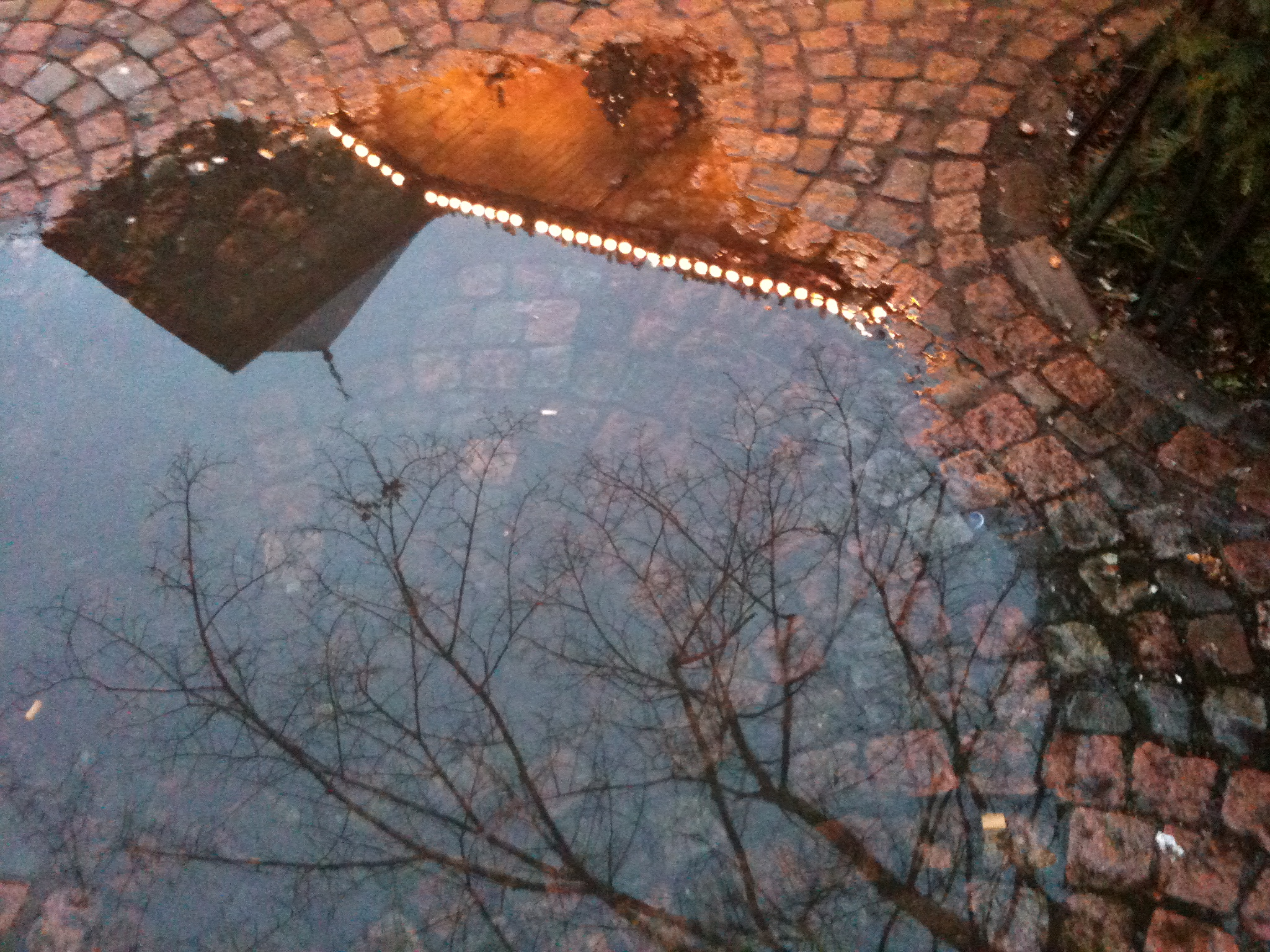
    h20 HoL cobbles puddle copper

  • cafe dating

    First date in a cafe. “They always play such excellent jazz here,” he is saying. “Try the cakes, they’re always good.”

    “Right,” the girl says lightly. He has over-ordered, wanting to induct her into his routines. “I think heaven must be an eternal breakfast,” he says. The girl is drinking coffee as though it were ice cream, with a spoon. Elbow on the table she slumps onto her hand. “May I?” She tears the best bit off his croissant, the fresh, unbroken, creamy end of the horn. I watch him watching it all the way into her mouth, his resentment almost audible.

    Now the waitress brings his fruit salad, poignant with yoghurt. The yoghurt shimmers fat and glossy and unbroken. “Go ahead,” he says, “try.” She shakes her head. The third dish arrives, two soft-boiled eggs in a glass, with pretty salad arranged all around it in a tide. “I’ll just try a bit of your egg,” says the girl to her date, having presumably told him she is not hungry, that she never eats breakfast. “Or maybe I can just take half, some salad, a little of your bread?” She draws the saucer from underneath her coffee cup and holds it out.

    “I usually don’t ruin it,” he says. “They always arrange it so nicely here. But – yes! Please! Of course you can! Please: help yourself.” They are neither of them native speakers but both speak in English. I think she is Spanish and I think he is German. His voice is soft and seducing but I think the relationship is off to a stony start. Now they are talking about her work. “It’s an animal. No, it’s a fung, a fungus, right?” “Ja,” she says, “a fungus.” “Have you ever given a name to a bacteria?” he asks her. “There must be some good bacteria out there.” Maybe tonight this girl will call one of her closest friends. “There must be some good men out there,” they will say. Maybe the man will ask himself how come a woman can be so resistant to being induced into the world he has already arranged so perfectly for her. It just has this one hole to be filled, a her-shaped vacancy. Why won’t she fill it? Don’t women want love?