Tag: cyclist

  • a birthday story

    It is my birthday and I had kind of a depressing morning because (various reasons). But I reckoned I could make a go of the afternoon, and I was right. Riding out into the day aboard my trusty, failsafe, foolproof bicycle I zoomed around town for an hour or two looking for the restaurant, cosy but decent, in which my friend arriving from Copenhagen this evening will treat me to dinner. He says I’ve got to choose. So I chose, and had lunch outdoors in the shade and a large German beer. Needing shade is such a luxury in grey chilly Berlin.

    The bowl of noodles was delicious and the beer made me feel better. I sauntered home on my wheels, spinning down the quiet side of an overgrown local park and only gradually noticing that the man crouched forward on his bench was speaking to me. You are traveling much too fast, he was saying, and then his forbidding German conformity dissolved into a slow salty smile when I smiled at him, raising my eyebrows without meaning to, a smile that turned flirty when he flirted back.

    “Sicher?” I said, slow and low – are you sure? “Absolut sicher,” he said, and his tone had evolved from censorious to self-mockery and enjoyment.

    The African men at the bottom of the park looked me over and I looked at them. I miss Africa. Noodling along the pavement on my way home, which you shouldn’t, but people do, I was warmed when three men in identical backpacks like Mormons stepped aside to let my bicycle pass. “Das ist lieb,” I told them, that is lovely. The tallest one said, gravely, “I come from Stuttgart.”

    “Oh,” I said over my shoulder as I zoomed past, “that is also lovely.”

    The little German birds are high in their voices like tree bells. When I was in Ghana all those months I kept thinking: the birds fly away to Africa for the winter. So here they are! I kept expecting I might meet one and we would recognise each other. Hey, I know you. I’ve seen you in Berlin.

  • pedalling home

    Pedalling home along a tree-lined street which is set aside for bicycles, I heard a crash. A man reaching up to put his brown wine bottle in the brown glass bin had tipped forward and toppled like a tree – at first I thought he must be drunk. There was nobody about, just him and me. I had jammed on my brakes.

    He actually flung his legs up in the fall and took a few tips to settle, like a rocking horse set rocking. “Alles okay?” I leaned my bike and ran over. He was getting up painfully slowly and had that embarrassed expression that usually indicates want of serious injury. “Die Kante…” he explained as I reached him, the curbside had a camber…

    Falls, as we know, can be deadly in the elderly and I remember that Leonard Cohen had a serious fall, as so many older people do, in the days before his death. I remember locking myself in a wardrobe to cover my face and howl, when I heard that he had died, two weeks after Dad’s funeral. Our St Leonard of Koans.

    Shakily restored to his own feet, the man immediately turned to pick up his empty bottle and popped it in the open mouth of the brown bottle sorting station. They have three colours and beer bottles commonly have worn whited shoulders from rubbing companionably up against each other on all those trips back to the brewery and then the store. Och, Germany: you slay me. It’s like a magical land in which everyone behaves the way I’ve always done: we’re all in this together. I had just passed a crossing where another crash heralded a tipping bicycle, whose basket was filled with neatly sorted bottles, possibly heading for this same recycle station. They started to bounce and break all over the cobblestones. Before I could react a dozen people had swooped in to help, propping their own bikes and stooping like long-legged birds.

    I asked the elderly man, “Sind Sie verletzt?” Are you hurt? He passed a hand uncertainly over the crown of his head, showing me where there might be an injury, and in response to this mute plea for mothering I passed my own hand very softly over the tender scalp, as downy as a baby’s but for the sparse, short, grey, bristling old hairs. “How are you getting home?” I asked him, “you’re not driving, are you?” We stood there assuring each other. I told him the skin on his head was not broken. He told me he would be sure to be careful getting home. “Just be tender with yourself,” I told him, as I should rather more often tell myself.

    Nearer home I chatted on the phone for a long while with my dear friend, on a park bench under a stand of trees which were shedding their golden leaves as I watched. The light was just so. I found a stinking dog shit smear on the back of my hand, and made a face and started wiping it off on the grass, still talking. On the far side of the square a street dweller pulled from his breast pocket a little packet of paper handkerchiefs and drew out a fresh one and offered it to me. He bowed. I crossed over there and took it, still talking, thanking him.

    During the phone call I watched two dog owners whose dogs – one large, one small – had woven an enthusiastic wreath running counter-clockwise, passing the leashes over one another’s hands. They kept trying to untangle the beasts but the dogs running clockwise sniffing one another’s butts had passed into a blur. I saw a toddler pitched forward and running on the balls of his feet as he approached the road. There were no cars coming and his mother looked on unworried from a few paces behind but nonetheless a young girl stepping onto the pavement with her friend stopped her body in front of him, forming a kindly barrier. She stood mashing her feet and chatting to him, distracting him and making it a game, then stepped aside without a word when his mother had caught up with him and he was safe.

    This communal parenting moves me to tears. I told my friend and we both laughed with joy. I described to him the two dogs blurring themselves into a wreath on the cobbles, their owners doe-sie-doeing from above. It was dark when I put my phone back in my bag and walked uphill past the man who was still standing by his bench, with his beer, gazing up into the trees. He had on a leather hat with a feather to its brim and standing by him was a trussed wheelbarrow loaded with his things. I had gathered all my groceries in two hands and clutched them to my chest to stop them falling. “Thanks again,” I said, “for the handkerchief,” and the man said, ascending to the familiar or affectionate you, “You’re very welcome,” and I said, matching his informality, “That was love of you,” das war lieb von dir, and he bowed and pressed his hand upon his heart, and I pressed my crowded with bottles hand over my heart which was cluttered with a jar of honey, a bottle of biodegradable cleaning spray and a heavy bottle of milk; the other, free hand was splayed to keep hold of a second jar and a second bottle and I pressed the glass into my heart and we smiled at each other, at the end of an autumn day so beautiful it would make you want to resurrect belief of some kind in some kind of deity.

  • we call it Berlin snout

    In a second hand shop I tried on the superlong pair of creamy trousers that had had to be hung twice over the pavement rack. They were pearl coloured Thai silk and so long in the calf you could ruche them up tight, and then the bloomer shaped waistband region ballooned like a flower in water.

    For a while I stood considering myself in the old gilt mirror. Old guilt is a standard fitting in most of Germany. I took them off and hung them up and carried them back outside to where the shop owner, studded with piercings, was lounging in the sunshine with his two hairy mates.

    “Leider nicht,” I said, sadly, no, and handed the pants back to him. Berliners pride themselves on their snouty grouchiness and he pretended that he didn’t know why I was handing them over. “Was soll ich mit den?” What am I supposed to do with these?

    Oh, I said, I can easily hang them back on the rack myself, if you prefer.

    He gave a gusty sigh. No, no, he would do it. “But what’s wrong with them?”

    I plucked at the fabric to show him. “They’re beautiful. They would make a great performance outfit, I was thinking.”

    His mate reached past us to take hold of the nearer silken leg and stroked the sheer fabric, thoughtfully.

    “Totally transparent of course,” I pointed out. “It’s just one of those garments you would have to spend the whole evening organising. I’m too lazy.”

    “It takes a special kind of person to wear these,” the owner said, and I laughed.

    “All of my specialness is used up in other areas,” I said, spreading my hands. A crooked smile crept into the hang of his long mouth. “Oh, well,” he said, consolingly, stroking the pants as he hung them back up and draped the extra length over the rail. “Next time, we’ll have something for you, for sure.”

    These old punks with their 1980s businesses. Berlin brims with rebels who pierced their noses in 1976 and have held fast to their philosophy of DIY and punk ever since. Some of them collect bottles for a living. Some run resourceful squats. Some of these host outdoor cinema and restaurant venues in the summer and some are barred to visitors and spend all their energy, so I hear from my few resident friends, holding endless rounds of meetings to adjust the way the household is run. I got on my bike and swooped across the deep tram lines where a bicycle wheel can very easily get lodged. I live alone and have no piercings, not even in my earlobes. I have left the man who adorably called these his ‘earlimbs’ and now I make my way into the world again alone, greeting you, Berlin, willing to be shown what’s up, willing to cycle across town and see what’s going down, willing to stay home for days on end concentrating hard and then suddenly spring outdoors into the unexpected sunshine, willing to be across it all and to put up with all your crossness and snooty snoutiness. I know the smile that lies behind the sneer. The pink within punk.

  • of wheels & wings

    Today a day of wheels and wings. On the high street I set myself an errand, which failed, as the Turkish woman who repairs garments has locked her shop and flown south for the summer, into a tide of incoming birds. Her storefront was locked like a little dark cage. On the street out front two big bikes sputtered and racked, their owners shouting conversation back and forth as they waited for the light to change.

    Who among us is not waiting on a change in the light? A small boy, not too small, maybe eight or nine, was making his way down the pavement. He stopped and gazed at these beasts, two big throbbing machines, the riders almost supine in that cock-cocking slouch. Spine relaxed to a slump, pelvis tilt: this was manhood. These were Harleys, or whatever other bike there is that renders that cocooned helplessness. Hands up curved like a child riding papa’s back and peering over. The boy made a thumbs-up and grinned. They didn’t see him. I was walking behind and swept up my own arm to jab downwards. Look, I showed them, swooping the air above his head like a homie. This boy here, needing your manhood. The nearer one saw him and smiled, cracking a face almost paisleyed in swirling tattoos. The boy called out something. Made a fresh thumbs-up and offered it. “Was?” the biker yelled: whut? I left them talking – masculine, back and forth across a several arms-length’s distance, in roars, through the machinery of their own engine noise – I was grinning. They seemed to me all somehow boyish, and sweet.

    Very late alone I had lunch under the trees. The water beckoned with deceitful gleams, fish-whiffy at close-up. Every passing car was loud on the cobbles, which make tyres sound flabby as though hopelessly flat. On the pavement a woman passed wheeling a bicycle, sailing under steam, under her own steam. Her long brown hair tangling behind her. A small, queenly child perched on the bicycle seat. The child had clots of molasses-coloured dreads in a long ponytail; she rode her mother’s bicycle as though it were a steed, her beauty an admonition on us all. The sister came pedalling behind, dreaming atop her own bike as her little feet propelled it forward slowly. The slow, stately pace and their undisplaying femininity gave the family a processional quality.

    Overhead, the summer trees flickered. In three months all these trees will be bare, I suppose. Late at night I’ve been out walking and heard the trees start up the breezes as though it were old spirits of the place who pass. The breeze travels high off the ground, in the canopy. The branches rustle and are silent again, shifting the dark. In the old world, I have heard, people knew how to make news travel from tree to tree. We have forgotten our every enchantment. I think we seem to long for that. The flickering fireside of a computer or gather-round television. The mercury of incessant palm-warming phones, that promised to free us and have enslaved. As I was frowning across the road into this thought, a fellow rode past on his ridiculous bicycle, wearing a tiny porkpie hat. His bike had tiny wheels and a tiny frame. Pedalling like a clown, his knees under his chin, he too stared ferociously ahead. But he looked up and caught my eye and slowly, piercingly sweetly smiled, and I smiled back and thought: this changes everything.

    On the tabletop a glossy orange ladybird made its way trundlingly by. Ladybird, here: let me give you a lift, I thought, deceitfully, meaning here ladybird… give me a lift. I put out my finger flat to her, hoping she would launch herself off me and fly away so I could launch on her a wish. She climbed me and kept climbing, clear along my finger and up onto the back of the hand. Scaling the knobbly writer bones on my wrist she came up softly through the hairs on my speckled forearm. Softly, softly, all the way to the shoulder she came. I put up my hand, patting: Where have you gone. She fell out of my hair, locked in the jaws of a ferocious millipede. He was black, glossy, and writhing, he had her pegged by the petticoat of her wings. As I said aloud, Oh, no! and began to try and separate them I was aware of a prejudiced loyalty, stemming not just from the delicate, brief intimacy shared with the beetle but also her cute, round prettiness, from a human-projecting point of view. He was hungry too but I had no thought for him: even the pronouns I assigned seemed to me a kind of self-adoration disguised as compassion. It seemed like he was consuming her in front of my eyes. I put my thumbnail in between them. That’s how he died, because I accidentally separated his head from his body, a much larger brute, crude and intrusive. His body curled and stilled. The bird hobbled away, her skirts awry. The glossy orange wing case folded neatly and defensively whole but one sheer inner wing trailed long and ruffled behind her. I suppose this creature now will starve and will die a painful death, where she might have been eaten at once. I got up and walked home through the jolting stream of pedestrian-sized traffic, the bike trailers towing kids home from kindergarten, children loose and relaxed in their own inner worlds, gazing, musing, one little boy holding a flapping cut-out drawing in front of his face and singing sleepily as in a dream. I craved their size and their sense of safety. I envied their wheels and their wings.

  • the pickling palace

    The people across the road are drunk and two of them are planning to have sex together tonight for the first time. That’s at this stage, it’s not even dark yet, we’ve still got the Fight that Blows Up Out of Nowhere and Falling Asleep in the Pizza up our sleeves. Their voices carry and then the Friday afternoon traffic will surge up the hill again to carry them away. He says something and she says, “You are fucking kidding me.” “No,” he says, something something. “You’re just making that up!” Her incredulity is a dare. Climb this tree for me and bring that fruit. He says, “No, I’m deadset serious. Anything you like.” One of the other blokes says something and then the girl begins to sing, or chant, like she was at a football game: “Je-sus, Je-sus, Je-sus, Je-sus.” The positive guy sings something over the top of her, harmonizing. He’s making it up. He’s fucking-kidding her. Their verandah falls apart in a seething heap of laughs just as a truck roars down the road. When the noise clears he is saying, aggrieved, “…been doing it all my life.” I know that feeling, I have too. I have just got home from a delicate day of negotiations in my unconscious and as we swept over the bridge with its hanging-lantern streetlights and banners I felt a song unbrew in me. I sang it out the window in handfuls of confetti and as we pulled away from under the biggest fig tree, that the road goes around (the greatest kind of road), I said, to my long-legged companion who was driving, “Did you see that girl on the corner, the beautiful girl, with the guy who’s just so in love with her?” “Yes,” he said, his voice warm as if fond of them. “How she was just standing there in her little purple dress,” I said, “holding the orange flowers he brought her. He’s looking at her so carefully, he’s in love with her every little gesture. She’s not even noticing, telling him something, he’s in love with the way that she says it.” “So is she in love?” he wanted to know. I said, “Could be. But she’s not thinking about it, she is remembering something that happened and telling him. So it was hard to tell.”

    We drove round a sweeping corner prickly with pedestrians. We had watched a giant ibis as it took off from a street sign and flew the length of Charlotte Street, its white wings insignia. The prosperous tropical colonialism and sandstone and big bunches of trees made me feel at home. I wound my seat back and propped my foot out the side window. I said, sentimentally, “Both of them standing there with their bicycles.”

  • replanting

    “Aw!” ‘What?’ “Aw just… somebody’s torn this little plant out, and now it’s gunna die.” I could hear my surprised, injured tone of voice, high like a disappointed child. My friend stopped and I had already squatted in front of the dismal garden bed built round the trunk of a tree, in which someone had planted four or five tiny evergreens and a wilting marigold. It was two degrees this morning; I had on leather gloves. Ideal for scraping out a hole in the soil. Took up the tiny shrub, lying on its side in what seemed to me a foetal position, and stowed it in it new hole, tucking soil around its roots and talking to it as I pressed the dirt into place. “There you go, that’s better…” I stood up, brushing my gloves against one another, and turned back to my friend and our conversation. A woman on a bicycle had stopped to watch. She gave me this head-tilting, compassionate look with two very very slow blinks of her eyes, acknowledgment.

    At home on my kitchen windowsill I have a shred of pelargonium stolen from someone else’s window box, a present for a friend who cannot keep sprigs of basil from the supermarket alive yet dreams of being a gardener. He only has a tiny, bricked-in, West-facing balcony that looks dismally over a supermarket car park. I’ve shown him photos of how, in an Australian climate at least, you can grow a lot of food in such a space. When I saw this still-flowering window box with not just red and pink but also the darker, sultrier, more sophisticated velvetty maroon flowers, I filched a bit, peeled from the undermost hem of the plant where the person caring for it would lose least enjoyment. A few paces further on I found an empty plastic cup. Scooped up a cupful of leaves for the bottom layer and then a handful of rich dark friable soil. Stowed the incipient plantmonster in there and will nurture it until it has begun to send out some roots, hopefully before I leave Berlin, so then it can be passed on to its new owner with hopefully some chance of surviving the grey winter.

    As a child in the tropics I used to worry about the trees, who seemed to me buried to the neck in hot, foetid soil, unable to move, >trapped!!< It took me years to work out that this kind of simple projection is not really compassion, does not help anyone. Years, and some lambasting from a Tibetan Buddhist nun who yelled, “You have too much compassion & no wisdom! No wisdom!” In any case one imagines suffocating heat is less of a problem for a German tree.

    H2O HoL white river flowers

  • lord snowdon’s bicycle

    lord snowdon’s bicycle

    Rounding the corner on my bike just now I accidentally took part in a mass demonstration. I don’t know what it was about, maybe just a celebration of biking. People seemed easy and relaxed, it is a sweet sunny day with high white cloud, a blue sky, the pack of people travelling at jogging pace over the bridge, guarded by police on massive motorbikes, reminded me of Laura Ingalls Wilder’s description of her father’s experience of riding up out of the river bluffs with a big wolf pack travelling on all sides, they must have just killed and eaten, he told her, they showed no interest in me whatsoever. This was a quiet deed: shared, fruity, holy; some cyclists had dressed up, about a third were wearing helmets, but most of us travelled incognito, as our regular selves, quiet chat here and there like flowers in the grass or fishes occasionally leaping from the water. At my street corner I peeled off and passed the flower stall that has suddenly appeared since the weather turned autumnal, the strands of cut purple grasses stirring their flimmish pretty seedheads in the breeze like a prairie. America once was all prairie. A body of buffalo roamed it from end to end, turning each time they eventually reached the coast, nosing each other, “it’s not here! go back!” like the sparkling water in a snowdome slapping from end to end slowly. This may not be the exact scientific truth.

  • tufty

    tufty

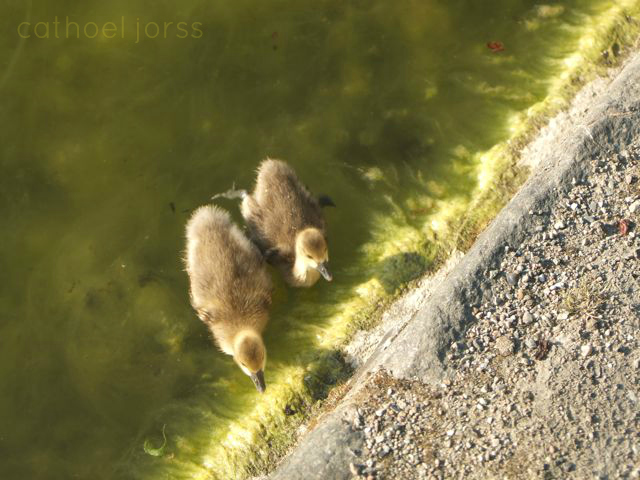
    Under the trees I saw two people riding side by side, holding hands between the bicycles. Not far away a duck plunged earnestly beak-first into the water, its tufted tail and downy bum held upright by the twin prongs of its feet on the scummy surface.

    H2O HoL ducklings

  • find your kind

    Heart-curdling rage in the city today. I was in a crowded shopping street when a man began to roar at his son. He was bantam-weight, wiry, blond, apoplectic: the boy looked six or seven at most. His little sister, used to keeping out of it, hung her head and looked away. Around them hundreds of people turned their heads – it was loud, roaring, full-bore, insanity’s volume. Shopping bags rustled, buskers busked. I stopped. A teenaged boy on a bicycle stopped too. I laid my hands flat on the air in front of my stomach, a placatory gesture. “Please,” I said. “Calm yourself. Your children are frightened.”

    He didn’t hear, didn’t answer, knew in that instant no one but themselves and his own swollen, massive entitlement to rage. He roared and roared, putting his face close to the child. The boy was bent double, both his arms rigid, pulling back and curving his body away from the danger as far as he could. The man held him by both hands in one large fist, the other hand making big threats in the air. I exchanged glances with the boy on the bicycle. I put one hand on each little dark head, smoothed and cupped them. Their soft hair, their stiff little faces. “There’s no need to shout like that. He can hear you. We can all hear you. You’re frightening him.”

    Giving me a vile look he dragged the child away. The girl followed willingly, willlessly I suppose. The man was blond and Nordic, red in the face; the little children looked to be Moroccan maybe or Egyptian. To my shame I was wondering how did this blond man get hold of these two small, dark children. Perhaps he was married to their mother. Perhaps they were his by blood, though none the more his to abuse and to frighten. Perhaps they were adopted. Maybe, stolen. I walked round the corner where they had gone, fretting and wondering, my heart a drum. The teenaged man on his bicycle came behind and I saw him swoop past the man and call out something. The man shouted back. My ears were filled with an army of blood. Making a determined effort I crossed the narrow laneway and caught up with them. “Sir,” I said, “sir, do you speak English? Please stop. Let me talk to you.”

    He turned and snarled, he raised his fist and planted it two feet from my face. “You’re not from here,” he sneered, “you know nothing.” I said, “Listen. You don’t need to frighten your children. Look at them: they’re terrified of you. Be gentle. Be kind. Find your kindness. Please!”

    He made a feint at me, not meaning it, just wanting to put me off. “Fuck you,” he shouted. “Fuck off!” I cupped my hand round the little boy’s nape. Probably he spoke no English at all. “Are you alright, little boy? Are you ok?”

    The poor darling. His father, the monster, dragged him away, gesturing curtly for the girl to follow. He was still detailing to the child in coarse roaring snorts how the boy was at fault, was faulty, would amount to nothing. I hope for the boy’s sake he saw that of those six hundred people who didn’t know what to do, there were two who could not accept he be treated that way. It’s not ok, you are someone, you exist and we can see you. Maybe that is a candle that keeps him alight until he can run away into the world. I did nothing, I made it worse, it’s not about me. Despairing I bellowed after the man, a last effort: “Be a real man and protect the children!”

    A girl came out of a shop, wondering. I showed her what had happened – the boy dragged around the corner, disappearing now, hanging back as hard as he could. She said, “Oh, my god. How could he.” We stared into each other’s gentle, sane eyes. “If he’s that loud, in public,” I said, slowly, “if he feels that entitled to shout and scream in the middle of a Saturday afternoon right here – imagine what he’s like at home.”


  • by the nape

    by the nape

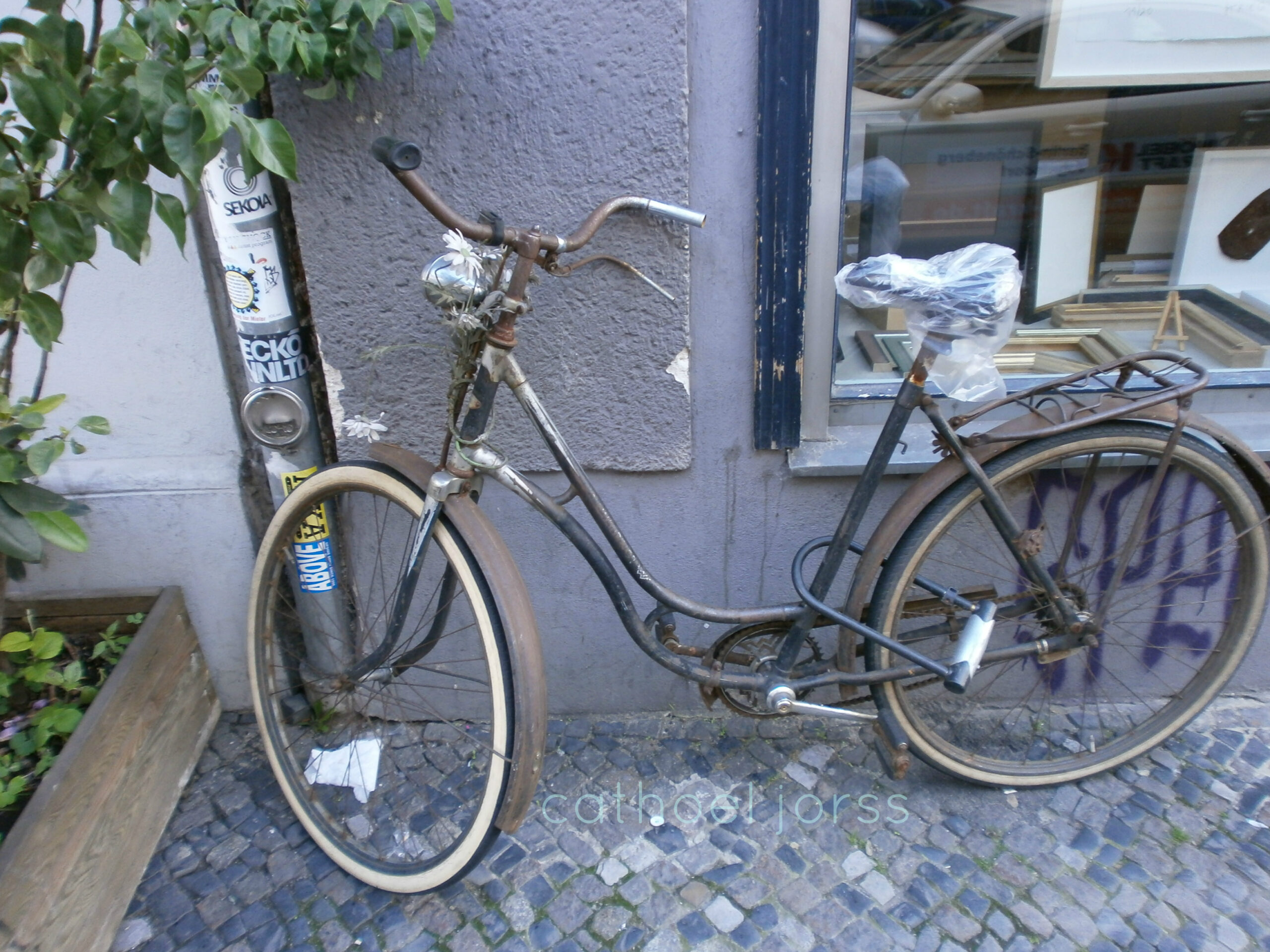
    A man just jogged down the stairs holding his bicycle, by the nape of its seat, with one hand. In his other hand casually he carried a satchel spilling books. Its wheels are spinning helplessly: in the fluttering pit of my stomach I know the feeling.

    H2O HoL grey bicycle