Tag: dog’s life

  • while he sleeps

    Today I am sitting beside my father while he sleeps. It is the last time, probably ever. We are outdoors in the sunny Queensland day and I can hear all the birds. These birds are what I miss. I miss the little endearing coy breezes, the big leaves that rattle like jewels. My father has woken up several times and when he does I smile at him and he smiles at me back.

    The last time he opened his eyes I was leaning forward looking at him and when our eyes met I started to cry. “I’m leaving tomorrow,” I said, and he said, “You’re leaving tomorrow?”

    “Yes,” I said, nodding helplessly, “I’m pretty sad about it.”

    “That’s no good, pet,” he said, closing his eyes and drifting peacefully down into the sleep that is the love of his late life while I curled in the creaking cane chair and wept copiously. It’s not just Dad. It’s not just the exhausting and dispiritingly servile position I occupy in this household which I now choose consciously, for it is all the last times, that has worn me out. Why I’m crying is, the relationship I have been in through all its vicissitudes for the past four years has dissolved this morning, seemingly finally. We have reached this point before. There are certain intractable obstacles and our dear and passionate love and longing for each other keeps sweeping them aside and then they just rise up again. This man, this dear and loving, sweet and nonchalant, cool and long-legged tender and painstaking golden-eyed man has a dog, and the dog belongs to him and to his ex partner. She lives in the United States but still sees Felix as her dog. She once introduced my beloved, after she had moved to the US and was visiting Berlin for the summer, to an acquaintance as “the guy who’s babysitting my dog.”

    It is like being unwilling stepmother to a ferociously dysfunctional, sometimes aggressive and sometimes sweet overgrown child who is never going to grow up and leave home, is never going to go out and get a job, is always at the end of the bed wanting to take part in all our exchanges. The dog when I first took my place in this man’s bed shimmied on his belly all the way up my legs and hips and onto my chest and put his face in my face, drew back his lip like Elvis, and growled at me. “I’m just letting you know,” he growled, “that this is my bed and you have no place in it.”

    Just talking about him exhausts me. The little cat is crying at the glass verandah doors and I go and open them and lift her into my embrace. She is purring. She slept all night in the crook of my elbow, purring and opening her sleepy eyes from time to time to gaze at me. Dogs only live ten or fifteen years, I have pointed out. I’ve argued. I’ve told him, your ex can’t just move away – to another continent – for half the dog’s lifetime and still expect to share in his keeping. When I first came on the scene they were meeting up every fortnight in the park to swap the animal back and forth as though he were a child.

    He has sprung stiff-legged from a standing position onto our legs as we fell asleep and had to be dragged screaming and threatening behind the only internal door in that tiny apartment, into the bathroom. He has threatened to rip our throats out whenever he feels cornered or defensive or scared. When my sweetheart wants to come stay the night with me he has to wait til the dog has been taken for his last late-night walk, then rush home before breakfast to walk him again, so that we can never spend an evening together unless he goes home at the end of it. The alternative is I allow the dog to visit too and this means an evening of perpetual negotiations as he tries to creep closer and closer and puts his paw suggestively up on the couch. I could handle all of this, I could handle the fortress we have to build on my couch before bedtime to keep the dog off it, I could handle the needy pleading pellmell greeting extraordinary in dogs which makes each morning such a big production, but I can’t and won’t handle the dog’s recurring aggression in my home, I need to have a home where I feel safe.

    This house is not such a place. It took me courage to return. I was to stay only two weeks and a half and now six weeks have passed and the whole thing has worn me to the nerve. Things fell apart many years ago and since then my family are what I miss. All day I look after my parents and after they’ve gone to bed I have packed all my effects. I have so been looking forward to the night I would step off the airplane in Berlin and into the arms of the man I still love. He loves me too. Despite this love our story is wasteful and sad. I know that if we had been blessed with a child of our own or even if we had kept living in our little rented cottage in Brisbane where we were so happy this animal would have loosened his hold on that strong and intricate heart. I have begged him to make more room for our closeness. Even our physical closeness has been tyrannised to an extent by the presence of this needy animal, who clamours to climb into the bed and if banished to the bathroom emits rhythmic yearning pants that disgust me to the marrow. It’s too much and I cannot cope with it. I am tired of coping with the way the sanity and sweet nature of my man turns into defensive insobriety round this animal, this four-legged reason we are not living together. I have been away from Berlin a month longer than we planned and his closeness is what I have missed. I am gazing at the little grey cat with her ludicrous big ears who has curled on my father’s lap and fallen asleep. I love her dearly, passionately, she is my boon companion. But were she to growl and hiss and spit when people carried out ordinary transactions, had she bitten me so fiercely on both hands that I was left with nerve damage, if I found it difficult to find a place for her to stay when I was travelling because so few of my friends could trust her or enjoy her – I know what I’d choose. I would choose you. I’d choose you and love you. I’d fuck them all off my loyal loving long-legged superdarling and just love you.
  • nation of dog lovers

    You know you’re in Germany when you can saunter into a department store carrying your dog on a leash. The dog accompanies you up the escalator, looking longingly across at the fluffy bunnies quivering in their mesh cages down in the pet department. When the dog starts barking and kicks up a fuss in the queue to pay for haberdashery findings, and everyone turns with expressions of indulgent affection, that’s when you know you’re in Germany. When the woman staffing the cash register leans in to ask confidingly, Darf er eine Leckerli haben? Is he allowed to have a little treat? She has drawn open her cash drawer and pulled out a little bag of crackling dog treats. She gazes over the counter at the dog with a doting expression. She says, Mäuschen? my little mousie-mouse? wouldn’t you like a little yummy treat? The people at the next register have stopped their transaction to watch. Everybody is smiling fondly. The dog takes the treat politely, then drops it to the floor. His owner, known in German as the Herrchen, the little husband of the dog, bends to pick it up and then the dog takes it and gulps it down. An elderly lady in the queue says, That’s right. He takes it only from his Herrchen.

  • the dark lit me home

    I rode home after writing in a large dim room in silence with four other people. The evening blue was ripening to black, like a terrible bruise. In the dark other, unlighted bicycles hurtled past, people were strolling. The cars make way for bicycles and the cyclists make way for pedestrians and dogs. It is warm still and all the bars spill into the street. At a local bar the owner has a shaggy Alsation who was lounging out front, his paws sprawling forward, his orange ball lying some distance away. People walked around him without question. His head was tilted and he gazed into the sky abstractedly, as if he was looking at the moon.

    Today a boat went by under a bridge I was crossing on foot, just a little motor boat. Maybe the length of two bath tubs. Three people were sat in it, two wearing hats and two with dogs on their laps. They made a wide round and turned to the old rusted pontoon which may perhaps be where the bridge was once footed. The pontoon protrudes into the stream and is painted bright yellow, like an inflatable dinghy, for safety. The man with the doggie on his lap cut the engine and the three of them floated, inspecting the guerrilla garden of bright flowers someone has planted in the rusted out hollows.

    To carry the soil there and fill the rusted holes with fertility, to scramble down the bank every couple of days to water the plants: this seemed to me a beautiful enterprise. I showed the photos I made to a friend who said, Yes: I heard the guy who made that garden painted the outer rims black, because it was lovelier. Then he was fined because it was unsafe; and now all the old metal is yellow again. After our conversation I came out again onto the tree-lined street and rode home, following the moon all the way, more white than yellow, and hiding ineffectually in a tangle of treetops, in obscuring golden street lights, and behind partial cloud.

  • a beauty

    When I woke up I remembered the beautiful girl who was sitting outside a coffee booth by the river yesterday. She got out her phone and scrolled, she was luminous like a black pearl. When we were leaving I went up to her and said, Excuse me. Do you speak English. Yes, she said, in American. I always prefer to give compliments on the way out, to avoid creating half an hour of shared embarrassment where they have to keep smiling at you for thank you, or avoid looking your way. “You’re so beautiful,” I told her, “it makes me happy to see you. Beautiful, classy face. Bless you.”

    She looked shy and pleased and said Thanks, very soft. All along the river path people were pushing their bicycles, sitting in the sun on benches, tramping with their large and small dogs. I guess everyone is beautiful when you look closely but some people wear it like a treasure they are trapped inside of, which casts its light on everyone they pass.

  • don’t you feel like reading books any more?

    I was in a bookshop yesterday with my friend just arrived from Copenhagen. It is around the corner from the bookshop where he and I first met. We met because he was standing gazing at the books in the English-speaking section when I visited to see how the ones I’d left were doing, and I went up to him and said, You should buy this one! I wrote it! And he did and then later I visited him at his own bookshop near the cold Danish lakes which has one wall of records and two walls of books and a tiny espresso machine.

    The bookshop yesterday has a cafe attached, it’s built under a railway line in a series of old-fashioned orange brick arches and you can hear trains screaming overhead while you drink your coffee. Adjacent to the cafe part are the shelves of books in two rooms, and the two sections of literature reach each other by means of a narrow passage, all too brief, papered entirely with the titles published by a German house which uses bold whole colours. So you walk into a rainbow of literature: I catch my breath. On the other side I peeled off to go visit poetry and my friend went visiting novels. The man who staffs the back section (English and French, philosophy, poetry) came sailing through from the just-closed cafe holding a small plate high on one hand. A fork stuck out of it, upright like a sail. Hard on his heels were two sad-eyed beagle-like dogs who weren’t beagles, who gathered themselves at his feet as he reached the stool and gazed imploringly at the underside of his plate. “Two very firm friends!” I remarked. “With clearly no agenda whatsoever.” “Tcha,” he said, spearing a wedge of cake. “Or maybe two very firm friends of the strawberry cake.”

    I began turning over the hardcover books, looking to see how people had solved the design problem I am wrestling with: how do you answer, on the back cover, the one powerful almost abstract image on the front? Do you just have a plain colour? If you put another photo, does it end up looking 90s, like a boulevard magazine? The combination, I find, of ambitious ideas of beauty with design inexperience makes independent publishing hard. My friend showed me a novel marked The greatest book you’ve never read. Neither of us had read it, either. He was looking for WG Sebald. “Have you read Proust?” “Oh, yes. But I can’t remember any of it. It took me months.”

    As he turned away I remembered what my novelist friend had said, at the time: You should put that on your gravestone. “She read Proust.” The man on the stool dropped two chunks of cake for his patient friends. I thought how the poetry section was in the dimmest corner but a good slice of strawberry cake brings dogs to your heels. I turned back to the hardcovers, none the wiser, nonetheless. Another book lover walked in, an older man in a beautiful wool coat. One of the dogs had climbed into the leather armchair at the entrance to my rainbow and was sitting there looking rather tired and sad. “Na?” he said, stooping to greet her. ‘Na’ is hard to translate but means, I think, approximately: so? how are you, person whom I feel attached to and fond of, or whom I like on sight. The dog gazed back at him plaintively. Clearly he had brought no strawberry cake. He tickled her under her chin. “Und?” he asked her. “Hast du keine Lust mehr, Bücher zu lesen?” Don’t you feel like reading books anymore? How Germans speak to dogs – courteously, seriously, with familiarity – makes me truly love them.

    You’ll see some raddled punker and some lady in expensive trainers, their two dogs tangle in a sniffing wreath along the river path and they both stand there smiling tolerantly, as if to say: Tcha…. That’s just the way dogs are. I had seen this that same morning, in a seamier part of town. In other news, we saw an otter swimming along the canal, and followed it for half a mile under the trees. Periodically it dived, making a ring of bright water and then emerging further along up the bank. Turns out otters swim at about a walking pace. In all my life I’ve never seen one before, I’d have taken it for a beaver except that I asked a man standing with his arms folded and he told me, doubtlessly, “That – is an otter.” Another man in his blue kayak was sorting things on the bank, readying himself for a sunny day’s rowing. On the other side two trumpeters stood side by side and played some mournful tune into the quiet water’s ears.

  • a dog’s park life

    Crossing the park I passed the usual gatherings of African men standing about under trees, whiling away the hours until someone comes to buy some drugs off them. Sometimes they sidle up and say, “Alles klar?” and occasionally a whisper of “Grass?” comes up or, once, from a bolder guy, “Cocaine?” I’ve worked out at long last that not all of them are dealers, some are just hanging out because this is where they hang out; because they come from a culture where instead of everybody sitting in their own bedroom facing their own screen, you spend the day with everyone, you hang out. A shower of sparks fell across the park: four guys huddled round a low homemade brazier and fanning its coals with the lid of something. The smell of meat roasting. The sound of whickering trees. The way these recent settlers have brought the ineffable mystery of life back up under Germans’ noses. Two men were sitting on a bench in the shadows and a large, round, comfortably built black woman slowly passed. She was pushing a trolley. One called out to her, “Hey! Mama Africa!” “Yes,” she said, kindly but wearily, pausing, and I thought perhaps she was just someone whom everyone turned to for help, communities yield such persons, I explained to my companion this theory and he said, No, it’s even more beautiful. Mama Africa sells hot food to the dealers on cold nights, she goes around with her trolley and if they are hungry, they flag her down.

    A few hours earlier coming through the same park I came across three dog owners standing about warming their hands in their pockets, their four dogs channeling and chasing one another, noses to bottoms, noses to groins. Another dog raced in like a flash of black fur and then two more dogs arrived, a merry flurry, soon there were eight dogs weaving and circling and joining each other nose to tail like elephants or ants and the tallest dog owner, an old punk, said in his dark gravel or asphalt voice It’s a regular dogfest, “Es wird ein richtig Hunde-Party.”


  • three dog night

    three dog night

    A bar in Berlin. I am greeted by a dog. “Na hallöchen! (‘little hello’) Wer bist denn du?” He is wiry and rough-haired and nuzzles my bag, clearly scenting the traces of Another Dog on its old leather. Then said Other Dog bursts in. Writhes himself in an ecstasy into my lap. Now we are three. Dog owner joins us: four. A lanky dude with his lanky red-headed setter lopes into the bar just as the music changes. Red-headed setter slides under our table where all the dog action is at. Berlin, I love how you let dogs into your bars. How a person thirsty but inconclusive and confused can say, Was war denn das? Was du gerade gemacht hast? What was that you just made? And the barkeep will explain. “A very old-fashioned Old Fashioned.” It was so good I sucked all the sugar out of the orange peel. A wreath of contented dogs round my feet lying like drunks. A man who sells Motz (homelessness magazine) came in and made his pleading spiel. Along the bar a line of hipsters sweet and tilt-headed as birds.

  • reeky dog

    Such a pretty day. When I came out of the Underground station the sky had filled with these tiny white, flat-bottomed clouds, as though they were puffs of steam that had popped up from the chimney of some hidden machinery. It was a pleasure to reach the outdoors. Jumping onto the train I caught the eye of a raddled punk, crouched over his big brown dog. He was petting and soothing the animal, lovingly. I smiled and he smiled. The doors slid shut. But what was that… awful smell? Oh, god, it’s the hound. A guy in workout gear looked over and made an expression of disgust. I looked about me. People were wrinkling their noses. The smell filled the cabin and was unendurable.

    I got up and slid down the far end of the train carriage. Within seconds that end of the carriage was full, as though the track had tilted: the punk and his dog sat up on a vinyl bench by themselves, unsurrounded on all sides. The dog was emitting these edgy, whining noises. Everyone looked strenuously away, in a body, as though they could dissolve him by pretending he wasn’t there.

    The punk guy shrugged at me, the only person making eye contact. “Der reitet nicht gerne,” he said. He doesn’t like to ride. I said, “Tcha…” I was revolving in my mind the most inoffensive way to mention it to him, trying to translate: dude, your dog really reeks.

    The smell was unbearable, a creature rotting alive, I was breathing in little shallow gasps. We pulled in at the next station and the carriage emptied within seconds. Seven people ran pelting down the platform and leaped into the carriage behind. There they stood doused with disapproval, that righteous German indignation people can excite by basic inconformity. Even in a punk city, even in Berlin. I followed, laughing helplessly. Och, the poor old punk with his mangy, stinking, poor terrified animal. The long-term neglect, the isolation. You know that kind of released and loose laughter that feels like crying, feels almost like sex. It was kind of sad but wonderful and could only happen here. All the way home I was remembering him and the confederacy of perfumed people locking him out of their secret, hidden glances. I remembered and kept glancing out the window and smiling to myself. The poor smelly dog and his misery, the poor old drug-fucked oblivious punk who maybe thinks people reject him because he’s rejected society, thirty years ago, with his haircut and his piercings. Making up his stories to himself of why people can’t bear him and will not come near. An almost unbearable ecstasy of shame pierced me, that I had not spoken, that my German is laborious when it counts, that I couldn’t find the words. Berlin, decorous and louche at once. You big old mess of freaks.

  • beware of the god

    I passed a Turkish döner shop where they carve shreds of meat from a large, limb-shaped conglomeration that’s turning very slowly dripping grease into the grill. In front of the low window sat a patient Alsatian. His nose was lifted towards the man sunning himself on his elbows, dreamily staring along the street while the meat crisped up behind him. I said, indicating the dog, “Er hat Hoffnung.” “Is he yours?” the man said. “Oh no, he’s not mine, but I think he has hopes.” He was already dipping his curled fingers into the tray of meat shards, peeling off a long strip and lifting it over the sill. He threw the meat and the dog caught it. Gulp. Gone. I said, “Wow, aren’t you nice.” As I got back on my bike the man was delving back into the gleaming pile of flesh and the dog was gazing at him as at a temple statue that has moved and revealed itself a god.

  • cafe calm

    cafe calm

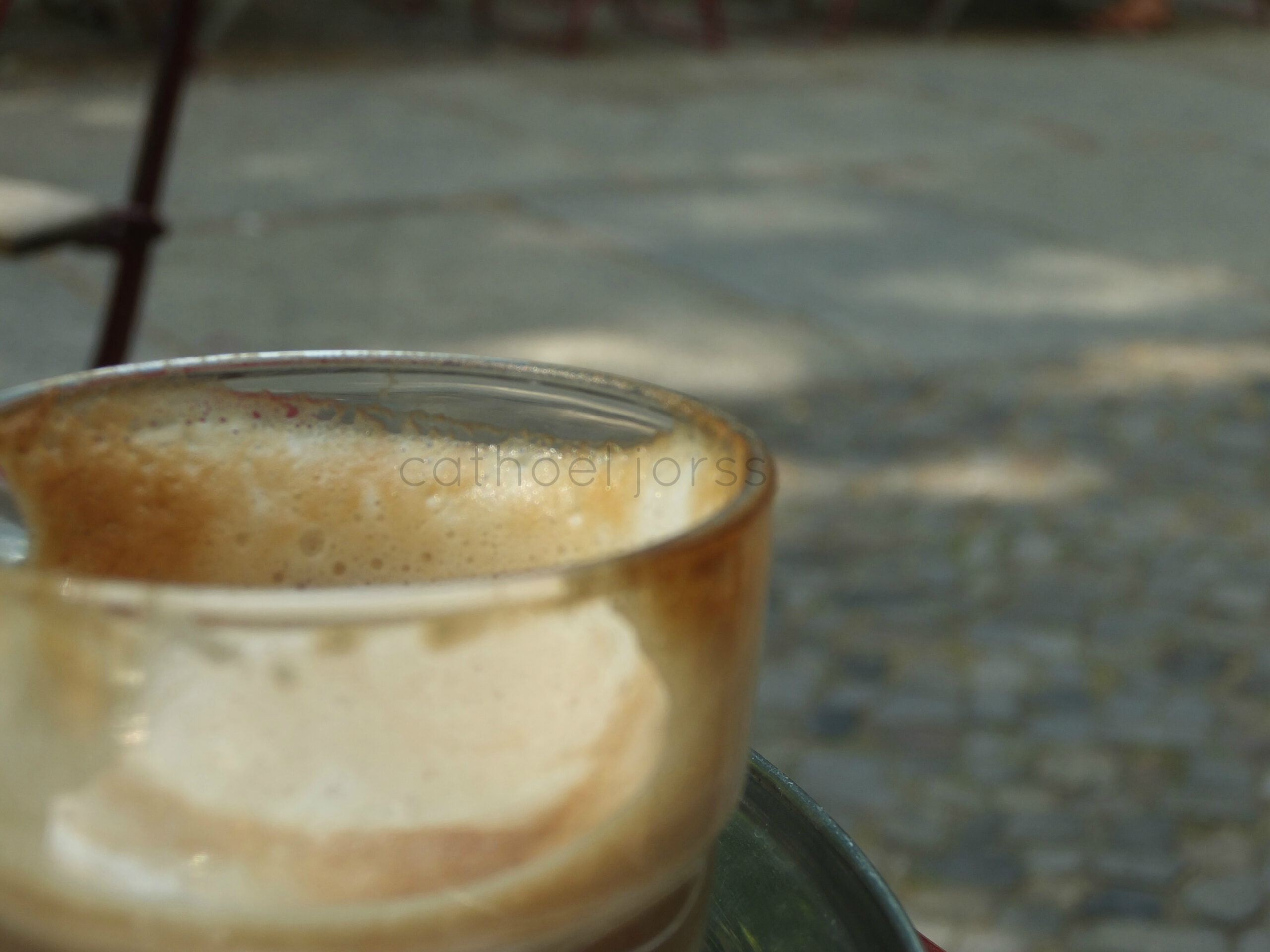
    It was breathlessly hot. Almost every inch of Berlin seems to be paved. I went out with a friend who has a dog. The cafe we found has three guardian trees, sentinels of sensibility on a long glaring featureless street. The dog flung himself onto the shaded pavement. The cafe owner brought him a basin of water. He brought us menus written on little lined notebooks, with pictures of writers pasted inside. They made perfect coffee and perfect eggs. The owner, a motherly, middle-aged gay man in a blue gingham shirt, came over and said, holding up two biscuits between his thumb and forefinger, “And is my little friend allowed to have something to eat?” He crouched by the dog and stroked his head, offering the crunchy treats coaxingly. The awning over our heads was caramel-coloured and had strings of golden lights looped underneath. The tables had little sprouting pots of flowers on them and those glass sugar dispensers with a tilted steel nipple like round fat ducklings. We gazed up and down the street, falling into silence, stunned by this unusual heat. I told my companion, cafes save my life every week. What would this street be without this oasis? A bleak, suburban hopelessness. Cafes give the feeling that human civilization has been for something. They collect up the beauties of what we have made. This lantern, this music, this length of printed cloth, this sturdy tumbler just right for the grasp. From a cafe vantage point one can sit and look out. One gazes on the world passing ceaselessly, in starts and spurts, and says, Aye. So it is. Such is life. This is us. Here we are. It’s a funny old world. And so it goes.

    H2O HoL coffee closeup