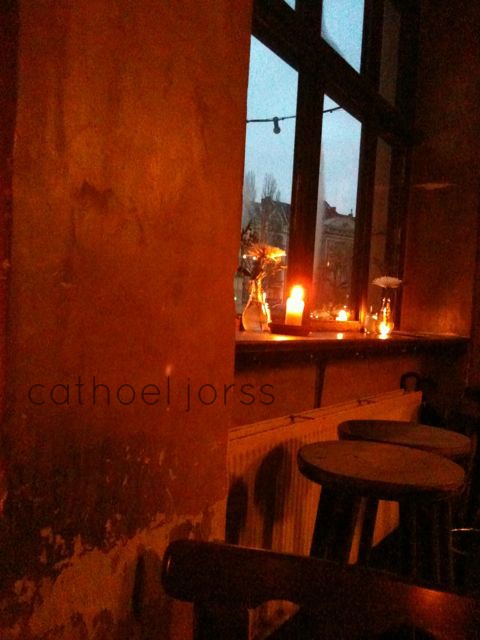
Last year and the year before that and four years ago too we went down on the train to West Germany, to a tiny village lying under the skirts of the old woods. This is where my sweetheart was born. His father was born in the same house and to me the village, the house, the family symbolised most of what I’ve longed for all my life – the continuity and cosiness of grandmother living upstairs and now sleeping in the graveyard, the grooming visits, where we trimmed her candles and scattered flowers for her; the dog racing joyously through unbroken snow; the stacks of firewood and the window dense with flickering lights.
I felt so welcomed the very first year, when he and I had known each other only six months; his mother was kind and his father jovial yet somehow forbidding and she had saved for me the tree to decorate, “because you are an artist.” I persuaded him to go down there early in the season so we could hang out in his family, since mine is so fraught; and on December 9, 2012, four years ago today, we woke up at the other end of our long train ride and opened the door on a perfect world. Here is what I wrote:
Waking up in a tiny German village. It has snowed and the snow extends away across the fields. The woods stand shoulder to shoulder up the hill. Opening the door I can hear church bells howling like dogs, everything is beautiful because everything is covered in snow, a white democracy. The phrase forms in my mind and a series of sour images ensues: what is white about a democracy? Everything in Germany is tinctured with its history, the way everything in Australia cries out black stories. Nonetheless this fairytale landscape has a hold of my mind, I feel relaxed and browsing, last night by the candleglow Christmas market I found a bookshop displaying eleven different editions of the tales of the Brothers Grimm in its front window. Tiny sparrows dart at the small wooden house outside pecking at seeds. A fierce wind has sprung up from, apparently, the Arctic Circle and I close the door thankfully. Good morning, winter world.
Then last year, a huge family shindig. I should put ‘family’ in inverted commas because part of the substance of the fight – the potatoes perhaps, if not the meat – was that I was not part of the family, being a newcomer; therefore he had no right to bring me into important family discussions.
This important family discussion was about money, aren’t they all. Previous family visits had been laidback, shambolic, tilted round long evening board games and wine. Now something was brewing, but I couldn’t work out what. All week we’d been trying to work out why everybody seemed so tense. Then January second I stumbled out of bed and down the dark hallway to find my honey and his father locked in fiery argument.
I sat down and took my partner’s hand. To be locked inside a fire is grievous indeed. I had never heard this family shouting before, though the father’s a bit of a bully: our very first visit I had called him out on his treatment of his son, when the man whistled for him to bring something; He’s not a dog, I said, and the old man said: Doch. (“Au contraire.”) This visit he had been mocking us for our failure to produce a child; the sister, a thistly blonde, was swollen with her third and we had lost our baby and been unable, thus far, to bring forth a living sibling. The proud grandfather sat with his injured foot up on an ottoman, making my partner’s dog beg for walnuts; his son said, please don’t spoil my dog, it is I who will have to live with him, and the father said: “Well. If I had a grandchild, I would be spoiling the child. But as there is no grandchild…”
These coarse country people occur in my family as well. Ours also drink too much and hoard things and are suspicious of fresh food. All week we had been walking in on whispered conferences which urgently suspended and then remained hanging in the air, swinging like baubles. Now the underwater fire had burst forth. It was a question of inheritance. They had cooked up an arrangement which seemed to me bitterly unfair as well as financially unwise, and I said so.
My own family finds me outspoken, too. It inconveniences them to the point of injury. When I flew home for my father’s funeral and suggested, in sentences very tentative and clothed in sticky tact, a less sentimental poem for the ceremony, my brother said flatly, “That’s not open for discussion, Cathoel.” I said, “But – ” and he ranted, “See! this is why I was saying it would be better if you didn’t come back – you’re just this person who comes in and changes everything.”
“You don’t belong in this family,” he had also said, on another occasion, and when I retailed this story after Dad’s funeral to my friend she said, bracingly, “This is perfectly true, of course. The only difference is, he doesn’t realise that it’s a compliment.”
“She doesn’t belong in this discussion,” the father said now: “because you two are not properly married.” Well, I told him, wounded and enraged. When your daughter got married – it was on two days’ notice and in the town hall, because they’d worked out at the last minute they would save eight thousand euros in tax by becoming officially a couple – I had to borrow a set of unwashed clothes from the bride, else I’d have had to go along in my overalls. It wasn’t exactly love’s young dream.
Well, but you have no children, he blustered, so you don’t really belong. And thus silenced me with pain.
I told him some home truths and he told me to shut up. We had never spoken to each other like this before. I got louder. So did the dad, but I suspect everyone is so used to his roaring and his barked commands that they barely noticed. Afterwards I was accused of having said things that were beyond the reach of my imperfect German vocabulary. I reminded the father that he had told me several times to halt den Schnabel, hold your muzzle. They were so outraged at my insurrection “under my roof, to me, as host! in my Own Home!” that they had no room left over to contemplate what might be due to a guest, a vulnerable guest trying to celebrate their daughter’s umpteenth glowing pregnancy, a person separated from her own family and far from home. When I first saw the daughter, clomping on her sore ankles and complaining about the weight, I had followed her outside and asked that we could hug each other. “I’m so happy for you. It’s just painful for me, kind of, because we tried so hard – but I’m happy for you. I just wanted to give you a hug, you and your belly, and try to get myself used to it.” She embraced me with tears in her eyes. Now all of that was forgotten. I had called the messy patriarch of this outlander tribe a bully, to his face. I had said, inspired by rage and a kind of foaming disgust at his harassment and meanness, Your son – is a real man. He has manhood. I have seen him do terrible things and then hold himself to account. I’ve seen him struggling to learn and to make changes in himself. You should respect him. You should treat him with respect.
I think we can’t bear when a woman speaks out. When a woman questions things. How dare she, how could she, and who does she think she is. The day after the fight we caught the train home to Berlin. I went up to the father, sitting at the table with his arms folded, and put out my hand. After a moment, he took it. I said, thank you for your hospitality and for having us in your home. The next morning a phone call. And the word, Hausverbot. This means, I forbid you my house. It is kind of a ‘don’t ever darken my door.’ In German, my partner said, very serious. You would give Hausverbot to a repeatedly violent pub guest who started a knife fight and stabbed somebody. Or to someone who’d been stealing in your store.
The son, of course (they assured him) was welcome. But do not bring that woman under our roof. I spent January dissolved in tears, before distaste began to displace the other pain. You don’t belong in this family. All year long the wound festered. My father died and I went home. I confided how I was dreading this Christmas, worse than all the Christmases before. Afterwards my mother, in a bout of generosity, offered to send us both to Morocco for a holiday to replace the painful season. In an ancient Islamic city we could forget about the festivities we’d not share. We could put aside the sore points like the pregnant sister who didn’t bother giving either of us a gift, and whose kangaroo skin rug we had lingered over for an hour in the ugg boots store, wanting to bring her something luscious and Australian and Scandinavian for her comfy home, stroking every skin to find which was the softest. They are soft like the tender belly fur of a little cat. A day later, when all the piles of gifts had been opened and I was putting mine away, I asked her: hey what did you give me? I can’t seem to find it. Oh, she said – I just never thought of it. This hurt, and I told her so; not that she has to give a gift, but that she didn’t think. Now somehow this long-ago frisson of discomfort has been revived and painted glossy and put in the front window. We, who brought an extravagant gift we could ill afford, are designated materialistic, and grasping. My outspokenness is insufferable. My partner is greedy, because he feels sad and hurt at being all but cut out of his parents’ will. Last week the father, tricked past his pride by the wife who pretended his son had called first, finally rang. “I lift the Hausverbot,” he said, grandly. “You are very welcome and I hope you’ll come to us. But please don’t come to Christmas – your sister and her husband wouldn’t like it.”