Tag: family gathering

  • grappapa

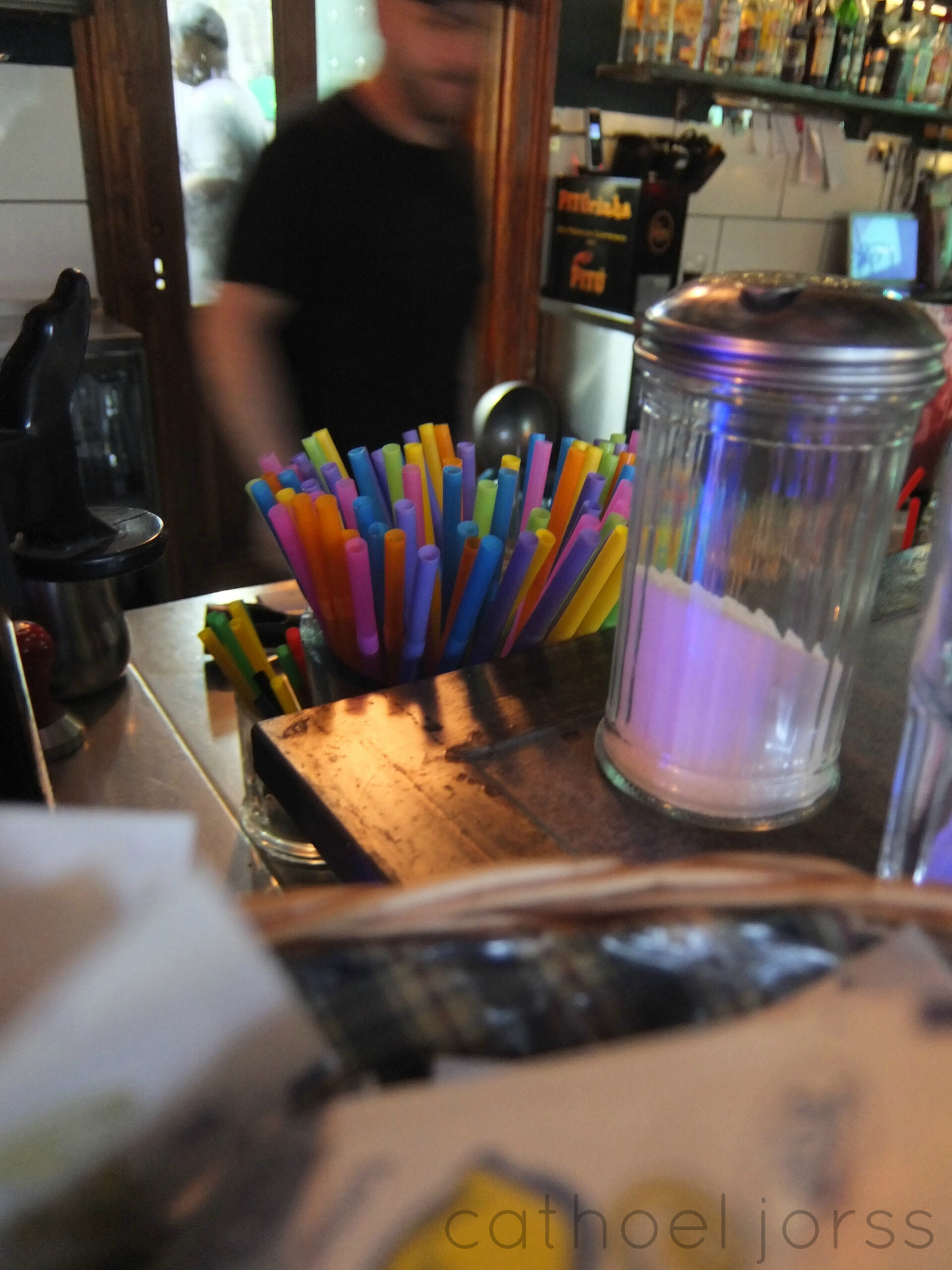
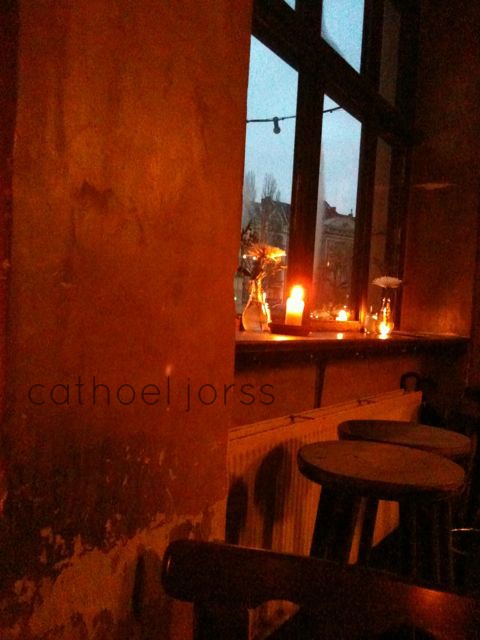
    I found a bar lit solely by candles. To get there I had to pass twenty-five Christmas trees, laid out to die on the stones. A wax-stick notice scribbled in the window of a nearby cafe said, Be at least epic. I found a bar I liked and it took me two passes to work up the courage to go in. The barman was Spanish and wearing a beautiful waistcoat. He brought me a clean glass of water, a fresh white napkin, a glass bowl of pretzels, and an ashtray. He folded his hands and said, Was darf’s sein?

    I said, I’ve had a fight with my boyfriend and we’re living in one room, I’ve got nowhere to go so I came here. No, actually, I said: have you got some kind of grappa, or something? Sure, he said, and poured me a large measure. He swung the bottle between his middlemost fingers, to show me it now rung empty. “That would be it,” he said. Some more Spanish guys came in and the world was lost in embracing. I saw them pull out their tobacco pouches and grabbed my drink and took it right up the back. Couches. Little spindly tables. Candles.

    There was a note written on a napkin framed on the wall. I translated it for myself. Dear Sebastian. Once again we have to find ourselves another bar. This sucks. This is the 85th time! Please let us know when you are opening once more. Next to it a sampler stitched in cursive said, Liquor. I got out my notebook and started to analyse. Last night was his fault, and he’s apologized. This one was probably more to do with me. I guess I overreacted. We neither of us do well with sharing the one room: us and the dog. Two individualists sharing four walls. Baby, I was born to run.

    Last night a quarrel blew up over dinner, a civilized affair involving a bottle of red wine from Spain I’d fetched and some luscious spaghetti he had made. I couldn’t stand it, simply just couldn’t stand it. “What is the matter with you?” I asked him. He went out to drink a beer with his friend, a darling man whose snarling cat has just died. I mean, just in the last week. “Tell him from me I’m sorry, very sorry about the little one. Don’t let anyone tell him it’s only a cat, or he should get another one. Love hurts.” “Ok, I’ll tell him.” When he got back I had just finished my book – Robinson Crusoe – and was disposed to complain. “It starts out so adventuresome then it ends in a ten-page account of his tax debts and financial affairs. Ducat by ducat.” He said, “Didn’t anything exciting happen?” “O yes,” I said, shrugging, “I suppose – he and 12 other people got set upon by 300 wolves in the Pyrenees. But it somehow made dry reading.” He sat down beside me and stroked my hair. I said, “I can’t believe he went into all that detail about his monetary decisions and didn’t mention one word about how it felt when he left his island, where he had lived alone for almost 28 years!” He swung his long legs up beside me and opened his own book with one elegant finger. “I wish I could read you some of this,” he said. “But I think you’ve already read it.” I lay my book on his chest so that it slid into his lap. “Read me some of this,” I said, wheedlingly. I felt so baffled by Berlin. I felt homesick but hardly knew for where. The point of the city began only gradually to seep back into me as I strolled this late evening, my fury settling, looking in the windows of bars. I felt transplanted, my roots snapped and shrivelled. That tiny village of a few hundred souls where we had made our home – unexpectedly, unplanned, sleepily – since just before Christmas was gone. I needed to be held.

    So he took up the book I had offered, a novel from Mills and Boon. Gravely he read me the title and author and all of the details on the inside sleeve page. “Towards the Dawn, by Jane Arbor. First published 1956. This edition 1969.” I curled into his belly and listened there to the secondary rumble of his voice. The soft hesitancy of his European accent that executes perfectly the French towns and train stations and hesitates over words like “battleaxe” (pronounced “battle eggs”). A few pages in the girl alights at an unknown French provincial station. It is late and dark, the station sign almost seems to swing overhead. We had ourselves just recently alighted from a long European rail journey, all the way back to Berlin through the night from his family to our tiny apartment. As she looks blankly round the empty platform, a shadow looms. “‘Mademoiselle finds herself in difficulties?’ he asked.” He stopped reading and we both indulged a romantic shiver. “He….!” he said, just as I said, “He!” I confided, “I can tell you how to tell if this is the hero. If he’s charming and frank with her, he is just an obstacle the hero will remove. But if he is grumpy and has no patience with her, if they strike sparks off one another… that means he’s definitely the one.” “I see,” he said, nodding as if wisely, taking up the little book and slicking back its page. I coiled into the doona and listened and he picked his way over the words written long, long, long before my parents were courting. Another world. Reminder of the true world we’re in. The book has yellowed stiff pages and its cover is printed dark pink. I took up one of my heavy bedtime plaits and dropped it over my eye so that the bed light wouldn’t disturb me. I started falling asleep. As I fell I remembered another gentle man I had loved in the past who once when I could not sleep at all drew barely a sigh when I woke him for the dozenth time, saying patiently, “Alright listen. I’ll roll over and you cling onto me and off we’ll go into sleep together. You ready? Hold on tight! You hangin’ on?”
  • making everything diamond

    making everything diamond

    Two boys scribbling either end of the dinner table. “What are you drawing?” 6yo: “It’s a diamond. With a rainbow inside it.” 4yo: “This is a machine for making everything dead.”

    Their mother, breastfeeding, laughs telling us how the 6yo asked her could they play “jumping over Amelia on the couch.” Amelia is three weeks old. She was wrapped and asleep and her brother said earnestly, “It’s okay Mummy. We’re not going to jump on top of her.”


  • beekeeper

    @…………..

    Sister-in-law: “Yeah that was my uncle who used to be a beekeeper. But then he lost all his bees.” Brother (mournfully): “Yeah. ‘I used to be a beekeeper but now I’m just… a keeper.’” Mum: “But he didn’t keep them, he didn’t keep them at all!” Brother: “‘I used to be a beekeeper, but now I’m just… a bloke.’” Nephew: “We have four chooks. Salty, Fairytales, Slippers, Goldie, and Superchook.” Second brother: “Only Salty turned out to be a rooster so we sent him out to a farm. He’s died now.” Me: “Really?” Brother: “Yeah. And the neighbours have two chooks that turned into roosters. The neighbours closer to town.” Nephew: “We could play chess. But there’s too many of us.”

  • brandy barter

    brandy barter

    I must have lived in Berlin too long because it’s screeching hot on a Sunday afternoon, I am exhausted, and somehow the idea has crept into my head that I would like to drink a martini. It won’t dislodge. Opening my parents’ liquor cabinet is a dispiriting experience. It is a small, oval, glass-panelled thing on turned legs and inside, it resembles a brown mouth half-filled with decayed molars. An uneven semi-circle of discoloured flasks: these are the bottles of something your old workmates gave you for Christmas and that no one enjoys enough to actually drink. Plus a bottle of cheap brandy from which I made the pudding butter five days ago. Outside, Brisbane sprawls on all sides, as far as the sea and the hills, suburban and stupefied by shimmering heat. I cannot accept that there isn’t some strange punk bar or pirate bar within a block’s walk, opening late and staying open even later, candles on the tables, dogs under them, where a charmingly incompetent twenty-five-year-old bartender will make me a martini that begins with him holding up a Cinzano bottle that is actually labelled ‘Martini’ and showing me, “It’s empty.” After that I will explain that you don’t need a bottle marked ‘Martini,’ you need gin. I wish I could buy a vile martini for three euros, or a sublime martini for four, and have the bartender bring his black leather wallet to my table afterwards and have to remember that when you pay, it is customary to tip, but advisable not to say “Danke” when you hand over a twenty-euro note: this means, in the German sense, “Nein, danke,” which means “keep the change,” and it took me almost all of an eighteen-month stint there to learn this.

    On Christmas Day I met for the first time in three years my uncle, with whom I had been having a feud. He lives across the road and is stubborn, a unhelpful family trait shared by us all. Our feud arose because three years ago I was staying with my folks a few months before moving to Melbourne. During that time I had set up a writing room in their dining room and pinned out the manuscript for my poetry book along the tongue and groove walls. It was a quiet, dim, and sacred space. The first song in my album was recorded there, on a single microphone propped by the couch. But for now it was just me in there every day, working, working. The walls were lined with shelves and high up above the rows of books lay three ugly old clocks, stained wood, with various pieces missing. I made a joke, apparently: we should sell these on Ebay. My uncle, who spent his childhood immersed in the story of these clocks, one of which had belonged to a great-uncle who died in the Great War, took me seriously. It had not occurred to me that such hideous objects might be of value to anyone. I was at my desk one afternoon when the door opened without a knock and my uncle strode in. He is a train driver. He was wearing hubcap shorts and a huge pair of dusty boots. Without a word he climbed onto my desk and started reaching down the clocks. I was milling at his feet, wringing my hands, saying Please get off my desk! Don’t stand on my stuff! That’s my work! If you want the clocks I will get them for you! My uncle took all three clocks in his arms and climbed down, grunting. He set off down the hall with the clocks anchored under his chin and me beside him being flicked aside like a fly. He confiscated the clocks and later told Mum it was in order to protect family heirlooms from being sold online. The idea that I could live in my parents’ house whilst secretly selling family treasures online was disgusting to me. I marched over to his house to demand he apologize. I could not accept that anyone could know me all my life and believe me capable of such selfishness. We had been mates since I was three or four – how could he not know that hey, she’s a royal pain but at least she is painfully, irritatingly honest? The feud simmered slowly for all the years I was away. No one had been sure whether to invite this lonely uncle to Christmas lunch or whether to leave well enough alone. Christmas morning everybody cooked. My sister-out-law made a magnificent salmon and wrapped it in foil, my brother cut up foothills of potatoes, we worked out that we had almost one whole joint of meat or fish for every adult at the table. I made a pavlova and a Christmas pudding and followed the most labour-intensive recipe for custard I had ever seen. It required the milk to be slowly heated to a simmer and then allowed to cool. Halfway through it said, “Now transfer custard to a clean saucepan.” I made the brandy butter. Then I went to the phone. I rang my uncle. “It’s Cathoel. Are you coming over soon? Because I have a problem and I need your help.

    “My problem is that I made the brandy butter and it’s got so much brandy in it that it literally won’t absorb any more. There’s actually a puddle of brandy sitting in the top of the butter. Everyone’s telling me I’ve wrecked it and I need you because you are the only person in the world who can come over and tell me ‘this needs more brandy.’” My uncle said, “You need back-up.” “Exactly,” I said. “I’ll need to make myself beautiful,” he said. “I’ll need to have a bath.” I said, “Don’t get too beautiful. The rest of us have settled for only moderately attractive, so don’t be too long.” When he came in the door half an hour later he handed me a drinking straw. “Is this for slurping up the excess brandy off the top?” I asked. “Yes,” he said. Then he took a spoonful of my brandy butter and said, wonderfully, “It’s perfect.”


  • feast of increments

    Christmas can be excruciating. All this talk of love and family throws heartache, loss and loneliness into relief. A woman I used to know killed herself this week, from sheer isolation it seems. In German it’s called self-murder.

    It happens sometimes that the people we love are not within reach, or they have died, or we are separated by sheer human awfulness. Sometimes you just haven’t met them yet and can’t be sure they are real. This year I feel bloody lucky to be living in a brimming household, spending the holiday with people I love and where trust is rebuilding. Other times I’ve been separated from my family for geographical and also more graphic reasons and there was one Christmas I spent alone entirely, in a deep sharp almost unendurable pain. You know that special holiday feeling: that you are shut out from some cosy universal nesting time all framed in glowing windows, everyone else has a family to come home to, a loved one to choose for, trusted friends to cook for and visit and call. I wish there was a sure way of dispelling this treacherous fantasy. I wish I had a way of reaching those who suffer this season, including my former self, to ask them to hold on, to try to let the joy emerge again.

    Because it will. I remember seasons in my life when I asked myself, can you die of loneliness, and heard the answer in my heart: yes – yes, you can. I’m so grateful I survived the unsurvivable times. I feel exhausted but I want to embrace life, its torment and its sweet. The perpetual leisure and the frenzy of modernity, these new tools that can take us further into life or distance us from each other. Maybe as a race we are learning in tiny, clunking, incremental steps to please stop injuring each other, to stop neglecting and ignoring, to welcome one another to the day and to embrace the golden joys of solitude. I hope we all keep on quietly learning one another’s languages. Like shade on a hot day I long for peace. In myself, and the quivering peace of many hearts. All of our hearts have struggled and been tormented. Yet here we all are. Merry Christmas to all our strange golden stained souls. And I wish for a wonderful year. A turning point. A gateway to a liveable, lovable future. A freshness that learns from old wisdoms, particularly the still-most-human communities in remnant rainforests and on deserts who have most to teach. Between the future and the past: a door.