Tag: festivities

  • peeling back the years as trees

    Oh, I love my little desk in my little borrowed room. At night the night is all around and silent, absolutely silent unless you hear the unending majestic progress as if across tundra after tundra of the wind. This desk is surrounded on all sides by literal towers of the possessions of the host who’s put up with us for three weeks now but in its centre in the circle of the lamplight I find peace. Television quacking in German from the far end of the house. The book I am reading face down with its spine open to the pool of gold. Robinson Crusoe. Incredibly racially presumptive. He saves the savage from himself. I wish that I could do that for me. Tonight I took my bowl of “Eierschnee”, that is, meringue mix or as they call it “egg snow” across to the family household three doors away closer to the mouth of the woods. I stowed it in their lovely oven; ours was blooming with pizza. “See you soon!” she said, and an hour or two later stashed with pizza we were back, for a round-table game of Risk. The man next to me said, That’s not in the rules, and I stuck out my hand. “Wanna bet a million, billion, squazillion dollars?” I said in English. “I’ve been playing this game since I was ten.” We somehow were laughing all night. Presumably because nobody actually cared about winning the world – or, as it is calling in the German language rules (snicker), “freeing” the world country by country. I acted out the illustration I had seen in an article on the US today: photo of a bold swollen warcrafty flying boat, which dipping through the clouds was labelled: “This is a Freedom Machine. It seeks out people who have no freedom and gives them some.” So there we were five of us around the table, giving each other some freedom.

    I had a long bath this afternoon and as I let out the water and stood up a name, or idea, came to me. How profoundly refreshing it feels to think none of such ideas or insights for three hours while we visit and a sixth person comes home, no, I don’t want to play, I just don’t want to talk, been talking all day and now I will just sit here and give advice. I understood what he said and what everyone said and thought, how proud I am to play a whole game, whole evening, in German, hooray for me. I am a guest. It is such sweet and cloudy relief, I have almost no thoughts, it seems. So long as I cook, sometimes, and wash up a lot, and let out my bath water and bring in wood; so long as the dog gets walked and there is someone to photograph the forest and to notice the seams and quiet crickles in the water of the old winding river as wide as a small moat; so long as I stop at the crooked gate to talk to the brown family of fuzzy goats who all crowd curious yet abashed on their hillside in case you have brought them anything sweet; then I have no other job while I’m here, and that’s why we have stayed so long, sleeping 13 hours a day and eating like a caterpillar, book after book, salad after greens, and one vista on another of the quiet level countryside where so many long generations of tall Germans have settled back into themselves after the various empires including their own. Shame is sodden in the ground here as almost everywhere. Pride and shame. The candles flickering all night in the little cemetery, the tap hung with half a dozen green watering cans. The wreaths on doors. The fact that among Germans, a game of mock war brings these stinging and pungent jokes quoting the Führer and certain words, “Tomorrow from 8.45 we fight back” for example, can reduce them all to weeping and slapping themselves on the thigh with mirth.

    Laughter is the only weapon of sanity that insanity cannot corrupt. So I will keep mine high. We walked round the block, which is a brown mown long field, and passed no more than a half-dozen houses with their scratchings in chalk year after year where the Sternsinger, the star singers, dressed in robes and following a star to Bethlehem have passed; he pulled out his harmonica and the medium dog ran his own way among the rivets, and I told him our story: We are just a minstrel couple decamped from our last home, passing under moonlight and the two large mother-trees. These trees are merely a bunch of sticks, like witches’ ravelled hands. We’ve nothing but our little dog, our mouth organ, our magic bag of words. We pass under the windows of the village, they hear us in their sleep. The land is settling, for winter, folding itself under into its ice. I will be gone by then and the land won’t remember because this is not any of my ancestral home.
  • dinner party from the sofa

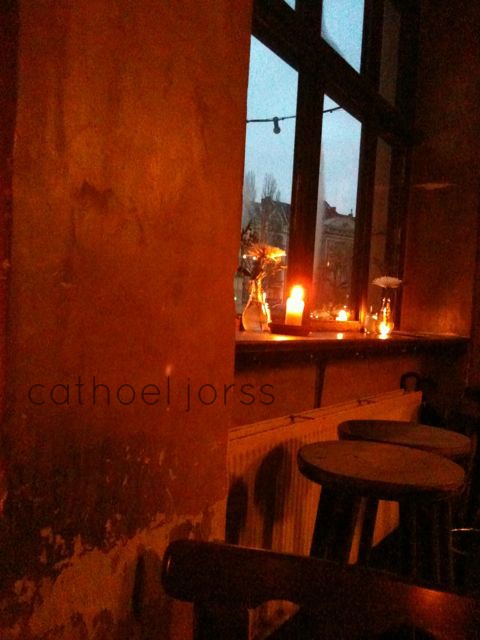
    I was at a dinner party and came over all poorly. In fact I thought I might throw up and had to kind of bolt from the room. Must’ve been the Tramadol, an opiate fed to me by my beloved who had acquired it from his father, who suffers from extreme chronic pain. “They’re not really all that strong,” his father said airily. The headache that has been a companion for days now, for almost a week, had sharpened so if I turned my head it brought spasms of nausea. A small disagreement over breakfast had unexpectedly ballooned into a stand-up shouting match in this house where I am a new guest, pain in my belly from the sorrow of it all day. So I succumbed. “Take the other half, too,” he said when the pain did not ebb. Twenty minutes later we were at this party on the other side of the little winding road where the family live scattered in houses like little farms and I started to feel most peculiar. You know that dizzy sweating pressure that comes with acute nausea. Anyway I sat it out and everyone was kind and generous, including the two people who’d yelled at me. What I wanted to say was that the feeling of lying under a soft scarlet blanket on the long sofa in the living room, with a paper Christmas star beaming down on me and a row of red candles in the casement unlit, was so cosy and comforting I felt a whole mess of worries and griefs slowly melt and slide away. The heating was not on in this other room and the chill in the air felt to me healthy and fresh, deeply deeply invigorating. The sounds of communion and chatter from next door were so soothing and a delight. Over the adult voices and faint music I could hear the joyous prinkling of the little girl who was drifting in her seabed of uterine privacy when we were last here, who is thoughtful and nachdenklich, reflective, and has hair the colour of threshed wheat. They brought me a heat pack for my neck, they saved me some dessert. When we came out after our hugs the stars were so clear and so high and the sky had opened itself to the night, the heavens upon us, the peaked white houses standing about like sleeping horses, the night seemed to me sacred and blessed and the row of long needling trees threading the sky along the winding road into the distance led, one could tell, into all good, mysterious things. The white dog made a flickering song of joy along the slick black road as we wound our way home, breathing visibly.

  • a doll, soused

    In my pajamas at 6pm: pajamas are my favourite clothes. The phone rings. It’s a woman I spent a recent evening immersed in, such kinship, a friend who’s an acquaintance, we hadn’t seen each other for fifteen years. We used once to live in the same tiny village, an island in the centre of town. “I’ve just scored free tickets for A Doll’s House, it starts at 6.30, I can pick you up on my way.” “I’m in my pajamas.” “Or you could meet me there.” So I dive through the shower and go.

    La Boite is in a playground of festival furniture, large swings built from slabs of ply painted black, projections onto a huge white screen, an outdoors bar. Under the stars. Too late arriving to be let in for the first act I take my ticket and wander. “Go up the back and read the secrets people have posted,” the lovely usher tells me in a whisper, “you can write your own secrets on a typewriter, get your nails done, get your palm read.” My friend has disappeared and gone inside. I buy a glass of wine in the pallet bar and carry it over to the palm-reading shed and read the wall. Some of the secrets are so lurid surely they must have been confected for the occasion – I can’t believe such a dark confluence of dramas has wandered past this tent, during the week of this festival. It’s my turn to get my palm read. I hold my hand out. “My name,” says the beautiful man in a top hat, “is Tawdry Heartburn.”

    The greatest drag name in all the world. He flexes his fingers round mine and asks questions. Strong, long thumb: do you like standing alone? Emotion line is deep in your palm – Oh, I know, I say – and it runs straight up this finger, the seam of intuition. Broad-handed people are across lots of areas of life. “It may be hard to finesse so many skills.” He drops his voice and confides something of his own. All the stars pricking their way across the roof of this white vinyl tent stand to attention like satellite dishes, I imagine, flowers in the dark sea of night. Salt sea polyps.

    Afterwards he draws out of his holster round the forearm, black leather, a brand-new fresh emery board. On the back is stamped his website name: this is his card. I go over to the theatre and go in. The stage is made from pallets and the second act is starting. My friend and I take seats right in front, where we can see, and be shouted over by the five actors who have each dyed their hair some lambent colour, as Ibsen insisted.

    Did Ibsen really write this way, a string of almost uninterrupted, seamlessly joined cliche? “They’ve rewritten it a bit,” my friend confides, in a whisper, and I whisper back, “Lord, I hate the theatre.” But the game comes down darkly upon us and snatches us away. At the high point where the spare actors rush out of the wings and turn the stage round like a carousel, breath is caught, time is hung. Then in the interval, climbing our way out of the palace of dark attention, I look back and see the immediate blue glow of a dozen screens. Something has happened on facebook, on twitter, on email while I’ve been gone. I’ll stand and suck my thumb, smallest and dearest of my own limbs. I will, I do.

    The music at the end is dense and scoring. It has a three/four beat behind four/four that drives it like a wagon. I stand up with everybody, groping our way back to our feet. Behind me is a face I’ve not seen since New York, a pianist who played on my album. We stand exclaiming, his date is impatient, I turn away and go over to the swing. My friend has gone to have her palm read, she says: I must go meet Tawdry. You will love her, I predict, fearlessly psychic now my palm is read. I lie full-length on the biggest swing under the scaffolding and let my heart hum its own earworm melody, unable to predict the night, sweet and buoyant waiting for the drive home, ready to greet myself, itching for paper, for a typewriter, a studio, for all New York. And Brisbane shines at night, that’s when it’s best and beautiful. Thanks Ibsen for the enduring ideas. Thanks West End for the villagers. I am tired and I drive carefully, the lion on my steering wheel yawns at me all the way home.


  • brandy barter

    brandy barter

    I must have lived in Berlin too long because it’s screeching hot on a Sunday afternoon, I am exhausted, and somehow the idea has crept into my head that I would like to drink a martini. It won’t dislodge. Opening my parents’ liquor cabinet is a dispiriting experience. It is a small, oval, glass-panelled thing on turned legs and inside, it resembles a brown mouth half-filled with decayed molars. An uneven semi-circle of discoloured flasks: these are the bottles of something your old workmates gave you for Christmas and that no one enjoys enough to actually drink. Plus a bottle of cheap brandy from which I made the pudding butter five days ago. Outside, Brisbane sprawls on all sides, as far as the sea and the hills, suburban and stupefied by shimmering heat. I cannot accept that there isn’t some strange punk bar or pirate bar within a block’s walk, opening late and staying open even later, candles on the tables, dogs under them, where a charmingly incompetent twenty-five-year-old bartender will make me a martini that begins with him holding up a Cinzano bottle that is actually labelled ‘Martini’ and showing me, “It’s empty.” After that I will explain that you don’t need a bottle marked ‘Martini,’ you need gin. I wish I could buy a vile martini for three euros, or a sublime martini for four, and have the bartender bring his black leather wallet to my table afterwards and have to remember that when you pay, it is customary to tip, but advisable not to say “Danke” when you hand over a twenty-euro note: this means, in the German sense, “Nein, danke,” which means “keep the change,” and it took me almost all of an eighteen-month stint there to learn this.

    On Christmas Day I met for the first time in three years my uncle, with whom I had been having a feud. He lives across the road and is stubborn, a unhelpful family trait shared by us all. Our feud arose because three years ago I was staying with my folks a few months before moving to Melbourne. During that time I had set up a writing room in their dining room and pinned out the manuscript for my poetry book along the tongue and groove walls. It was a quiet, dim, and sacred space. The first song in my album was recorded there, on a single microphone propped by the couch. But for now it was just me in there every day, working, working. The walls were lined with shelves and high up above the rows of books lay three ugly old clocks, stained wood, with various pieces missing. I made a joke, apparently: we should sell these on Ebay. My uncle, who spent his childhood immersed in the story of these clocks, one of which had belonged to a great-uncle who died in the Great War, took me seriously. It had not occurred to me that such hideous objects might be of value to anyone. I was at my desk one afternoon when the door opened without a knock and my uncle strode in. He is a train driver. He was wearing hubcap shorts and a huge pair of dusty boots. Without a word he climbed onto my desk and started reaching down the clocks. I was milling at his feet, wringing my hands, saying Please get off my desk! Don’t stand on my stuff! That’s my work! If you want the clocks I will get them for you! My uncle took all three clocks in his arms and climbed down, grunting. He set off down the hall with the clocks anchored under his chin and me beside him being flicked aside like a fly. He confiscated the clocks and later told Mum it was in order to protect family heirlooms from being sold online. The idea that I could live in my parents’ house whilst secretly selling family treasures online was disgusting to me. I marched over to his house to demand he apologize. I could not accept that anyone could know me all my life and believe me capable of such selfishness. We had been mates since I was three or four – how could he not know that hey, she’s a royal pain but at least she is painfully, irritatingly honest? The feud simmered slowly for all the years I was away. No one had been sure whether to invite this lonely uncle to Christmas lunch or whether to leave well enough alone. Christmas morning everybody cooked. My sister-out-law made a magnificent salmon and wrapped it in foil, my brother cut up foothills of potatoes, we worked out that we had almost one whole joint of meat or fish for every adult at the table. I made a pavlova and a Christmas pudding and followed the most labour-intensive recipe for custard I had ever seen. It required the milk to be slowly heated to a simmer and then allowed to cool. Halfway through it said, “Now transfer custard to a clean saucepan.” I made the brandy butter. Then I went to the phone. I rang my uncle. “It’s Cathoel. Are you coming over soon? Because I have a problem and I need your help.

    “My problem is that I made the brandy butter and it’s got so much brandy in it that it literally won’t absorb any more. There’s actually a puddle of brandy sitting in the top of the butter. Everyone’s telling me I’ve wrecked it and I need you because you are the only person in the world who can come over and tell me ‘this needs more brandy.’” My uncle said, “You need back-up.” “Exactly,” I said. “I’ll need to make myself beautiful,” he said. “I’ll need to have a bath.” I said, “Don’t get too beautiful. The rest of us have settled for only moderately attractive, so don’t be too long.” When he came in the door half an hour later he handed me a drinking straw. “Is this for slurping up the excess brandy off the top?” I asked. “Yes,” he said. Then he took a spoonful of my brandy butter and said, wonderfully, “It’s perfect.”


  • feast of increments

    Christmas can be excruciating. All this talk of love and family throws heartache, loss and loneliness into relief. A woman I used to know killed herself this week, from sheer isolation it seems. In German it’s called self-murder.

    It happens sometimes that the people we love are not within reach, or they have died, or we are separated by sheer human awfulness. Sometimes you just haven’t met them yet and can’t be sure they are real. This year I feel bloody lucky to be living in a brimming household, spending the holiday with people I love and where trust is rebuilding. Other times I’ve been separated from my family for geographical and also more graphic reasons and there was one Christmas I spent alone entirely, in a deep sharp almost unendurable pain. You know that special holiday feeling: that you are shut out from some cosy universal nesting time all framed in glowing windows, everyone else has a family to come home to, a loved one to choose for, trusted friends to cook for and visit and call. I wish there was a sure way of dispelling this treacherous fantasy. I wish I had a way of reaching those who suffer this season, including my former self, to ask them to hold on, to try to let the joy emerge again.

    Because it will. I remember seasons in my life when I asked myself, can you die of loneliness, and heard the answer in my heart: yes – yes, you can. I’m so grateful I survived the unsurvivable times. I feel exhausted but I want to embrace life, its torment and its sweet. The perpetual leisure and the frenzy of modernity, these new tools that can take us further into life or distance us from each other. Maybe as a race we are learning in tiny, clunking, incremental steps to please stop injuring each other, to stop neglecting and ignoring, to welcome one another to the day and to embrace the golden joys of solitude. I hope we all keep on quietly learning one another’s languages. Like shade on a hot day I long for peace. In myself, and the quivering peace of many hearts. All of our hearts have struggled and been tormented. Yet here we all are. Merry Christmas to all our strange golden stained souls. And I wish for a wonderful year. A turning point. A gateway to a liveable, lovable future. A freshness that learns from old wisdoms, particularly the still-most-human communities in remnant rainforests and on deserts who have most to teach. Between the future and the past: a door.