Tag: forest walk

  • the ride home was the best party

    Imagine a lake. It is vast and extends, if you swim out to the middle and gaze round, at either end as far as the horizon. We set off very early in the morning from town and have cycled for hours, climbing endless sandy paths. It’s ferociously hot, nearly forty degrees, we have left the last village and are deep in the pines. With my narrow city tyres I have to climb off and push, slaloming again and again in the hot sand that grabs my wheels like bulldust in the outback and I sink aside and slew. The closest railway station is by now a long way back. Even where the path is harder, juddering pine cones tumble over the ruts. They are numerous and tiny, an infestation of bronze, authoritative and resplendent against the dense matting of their own gold blonde needles that lie in great drifts on the banquets of deep green moss.

    Occasionally the trees stir and everything smells of lemon pepper from the pines.

    We have reached the water and taken off our clothes, a duck floats past out on the artificial waves serene and glowing-eyed. A butterfly feeds for butterfly hours at the prongs of cow parsley nearest the edge. The underside of the bank is eroded and when a boat passes I see why. The slopping of the waves against the bank’s underside, a chain of caves under the roots, resumes a slurping, dragging slow ruction like the sound of sex. Two white swans sail under the sloping belly of a white boat, its glossy wood striped by the green tree stems lying along the water like city lights. On the back of the white boat a golden man is balancing naked, poised to jump.

    This was a month back, one of the last hot days. We would catch the train as far out of town as it goes, then cycle on to the garden house where our friends spend their summer weekends at the edge of the forest by a lake. We cycled all day, stopped and swam, took photographs, arrived late and everyone had eaten. A cluster of a dozen bicycles stood inside the gate at the end of the road. A winding path engrossed the grass under tall dark trees to the little handmade house. We passed a kind of treehouse built up high above the sweet old-fashioned bathroom which had a tiny verandah, and later I took my drink up there and climbed the narrow steps and sat looking out at the night. I could feel the forest all around, its siftings and shiftings; its damp.

    All day long travelling through green tunnels, further and further, deeper and deeper. A party in a forest, now settling to drowsy hums. The candles and lamps lit long after dark, the trellis glowing golden in the flickering green with a row of tiny lanterns in the vine. The little boy, maybe four years old, who wanted juice when all the juice was gone. He stood between our host’s knees in the open doorway of the fridge and gazed in. The large poodle thrust her head eagerly over his shoulder and all three faces were lit as the man showed him, patiently, what each bottle contained. A speckled rope of tiny bronze lights wound up the trunk of the tallest tree all the way to its distant canopy. The boy must be put to bed, slowly and peacefully, by both his parents at once. His father carried him into the magic tipi and his mother laid him down. He was so little. They knelt over him and it seemed they were talking to him. The little boy at the centre of the universe. I could not hear their soft voices but I watched from the candlelit table, fascinated, filled with terrible soft yearning. His mother had taken him on her knee and sat cheerfully on the luggage rack of someone’s bike, when we went down to the lake that afternoon and lazily swam. Now she lay down and curled herself around him, and the father sat back on his heels and they all three waited for sleep to come.

    Late in the night the German voices began to blend into a fairytale nonsense tongue and I grew sleepy. I got up and went quietly up the back of the garden to the tipi where the little boy lay. Next to the softly sleeping boy I lay on my back, with my ankles crossed, in Kinderparadies, my eyes open and all the trees leading me up into the dark glinting complexities and simplicities of night. “Who’s that,” the mother asked her husband quietly, “in the tipi with Thomas?” “It’s me,” I said. “Ah…” And I lay there close to sleep myself, not just his but my own, until at length I heard people standing up and getting wakeful and we gathered all our things and took our bikes from the flock of bikes inside the gate, and we all mounted and swooped off down the hill towards the water.

    It was nearly midnight, all the houses’ lights were dark. Freewheeling down the hill and making swoops of joy I realised: I was the only woman setting off to swim. My swimsuit in the bottom of my bag, damp and uninviting. At the little meadow by the lake I let my clothes drop in the dark and walked into the water unadorned and very slowly; and a soft furry nudging at my hip was Fleur, the lovely large piebald poodle, pressing herself to me as we went in together. “Oh!” I said, “You’re coming in with me, are you, lovely girl? And it’s just us girls.”

    The water was silent and reeds stood quietly at either side of the shallow beach, only a few metres wide, where we stepped in. The men were joking and teasing behind us and joined the water gradually. The lake lay black as pitch to the horizon around us. The sandy bottom is soft and forgiving, as though filled with salt. Nothing dangerous lives here: I kept telling myself.

    I turned my face up and could see the stream of stars, a river of frozen timelessness of which the dark clotting trees low on the ground were banks. Afterwards for the joy of silence I left my bike lights switched off. At the crossroads we set out to the left and our companions set out right, Goodbye! Thank you! Goodbye! Through the little village we were joined by another couple on their bikes, who came out of a side road silently, she had lights on and he hadn’t, as though we were their ghosts, or they ours.

    We entered the forest, at the edge where it envelopes the road. The little train station lay the other end of this swarm of long-limbed trees, other side of the dark. It was so late at night and so quiet. The wheels. I left my light switched off and plunged in, following the leader bike whose own light swooped graciously, five bike lengths ahead. Everything was invisible around me but the sense of the tall trees, running for miles on either side. Riding fast I was enveloped in a blackness absolute and reaching, the forest spirits catching after me. I must trust that between his passage and mine, nothing will have changed, no dark animal jumped into the path with its big arms out to block and to swallow me, without a trace or sound.

    When we arrive at the station the train is there, silent like all German trains. A dishevelled man standing with his dirty backpack on the platform is accosted by two blonde girls who climb out to say, Excuse me is there a late-night shop nearby? “Here? I doubt it. What do you need?” “Oh. We only wanted to buy some water.” “But this is great – look!” Opening his pack. “I have gallons of water. I made a bet with my friend that I couldn’t sell all this water before dawn. One euro per bottle. And would you like this free magazine?”

    We lean our bikes up against each other and fumble at the ticket machine. We also buy water. We also decline the free magazine. It is one in the morning: yet again the first morning of the world. I slump down in a corner seat and with tiredness and satiety am almost swooning. I am thinking of the tall trees high above the tipi, whispering night sounds to themselves, the voices of the party adult and dark, the eyrie on its grassy rise, the sleeping child lost in no doubt the safest, nicest feeling in all the world tonight. Under my seat the pulsation of the train’s workings begins to climb, all doors are wide open still, and the glass breeze fills the cabin with freshness as if it were light, again and again, and then again and again.
  • the wind was rising

    “The wind was rising, so I went to the wood. It lies south of the city, a mile from my home: a narrow, nameless fragment of beechwood, topping a shallow hill. I walked there, following streets to the city’s fringe, and then field-edge paths through hedgerows of hawthorn and hazel.

    “Rooks haggled in the air above the trees. The sky was a bright cold blue, fading to milk at its edges. From a quarter of a mile away, I could hear the noise of the wood in the wind: a soft marine roar. It was the immense compound noise of friction – of leaf fretting on leaf, and branch rubbing on branch.

    “[…] Anyone who lives in a city will know the feeling of having been there too long. The gorge-vision that streets imprint on us, the sense of blockage, the longing for surfaces other than glass, brick, concrete and tarmac. […] I felt a sharp need to leave Cambridge, to reach somewhere remote, where starlight fell clearly, where the wind could blow upon me from its thirty-six directions, and where the evidence of human presence was minimal or absent. Far north or far west; for to my mind this was where wildness survived, if it survived anywhere at all.

    “[In 1990] the American author William Least-Heat Moon described Britain as ‘a tidy garden of a toy realm where there’s almost no real wilderness left and absolutely no memory of it. Where the woods are denatured plantings. The English, the Europeans, are too far from the wild. That’s the difference between them and us.’”

    ~ Robert Macfarlane, opening The Wild Places

  • the black hamburger of weddingworld

    On the bus coming home from our forest walk we passed a billboard for Hochzeitswelt: Wedding World. My partner says it’s a giant sales emporium but I am convinced it is some kind of fun park. At the market hall we got out and walked. I was noticing the graffiti – hereabouts is my own minute but weirdly lasting contribution to Berlin’s conversation, in chalk, a grammatical correction: I added an apostrophe two years ago to someone’s vehement caps-lock scrawl WONT DIE IN SILENCE. On a windowsill stood a half-eaten hamburger, which at first glance seemed to have molded over. I started think of the experiments people do with processed food where you stand a burger under a glass shade and months later it has not rotted. I remembered the droll jazz lover I befriended in an Ethiopian jazz cafe in Melbourne who rather lucidly summarized this result: If microbes won’t eat it – neither should you. Whilst putting all this together in my mind I realized there was something strange about this burger’s black mold. It was paint. Trailing up the pebblecrete wall to the sill was a long swab of black spray paint, part of the grafitti. A man in his sixties, splendidly dressed in a mohair overcoat and Russian fur hat, stopped to see what we were looking at. I showed him. He rocked back on his heels to laugh. As we came round the next corner my partner, formerly a product designer, said, looking up at a sign he had made for a local late-night kiosk, “Really I think I did a good job on that one. It’s so eye-plopping.” “It is,” I said, with difficulty, “really it is eye-plopping.”

  • now I don’t want you to get too excited

    All my life people have been telling me not to get too excited about things. They say, “I don’t want you to be disappointed.” And the truth is the thing I have so vehemently looked forward to almost never resembles the picture I have built in my mind. It’s often disappointing. But it feels like I experience the same thing twice: in glorious living freshnicolour in my own imagination, and then the worldly version, frangible in a different way, that arises through weather, and temperament, coincidence and sheer human effort.

    This afternoon we went out of the house and walked into the forest. There is ice on the ground. It’s all two colours: the listless copper of dead leaves and the warping green of moss. My favourite plant, each mound of it a tiny city. Tramping in silence we passed several small clumps of people with their dogs. My tramping companion who by now knows me rather well asked casually, “What would you have preferred this afternoon? Walk in the forest? Or a nice coffee shop.” “Oh!” I said, “I would love to go to a nice coffee shop.” These while plentiful in Berlin are thin on the ground in the outback towns. “What if I told you there was a coffee shop in the forest? Would you like to visit there, on our walk?” “A coffee shop? In the forest?” This has been a dream of mine for a long while, I always complain there is no coffee shop when we are out walking. I began to imagine what it would be like. “Maybe it’ll be like a little ski chalet, with an open fireplace where you can toast marshmallows on long sticks.” I was hopping with excitement. “Actual sticks, and then when the marshmallow’s toasted you dunk it in your hot chocolate. The hot chocolate comes in steins.” My partner gave me an old-fashioned look. I said, “Maybe there’ll be Swedish girls with white-blonde hair, wearing ugg boots and onesies. Maybe they serve Glühwein!” I grabbed his arm. “I’m so excited about the coffee shop I can hardly breathe.” “Do you want to see some old ruins, an old castle?” he said. “It would mean putting off the coffee shop a while longer. About a half an hour.” We cut across the main path and took a winding way uphill. As we rose up from road level we could see a couple of triangular German houses built under a clump of willows, with a little brook running past in front. “That’s where the hobbit-folk live,” I told him, “and in the warmer months they put up a maypole and dance around it by moonlight. Those fields are where they grow their magic beans.” “How can you tell?” “Oh,” I said, “you can see it just by the look of the houses.”

    The castle is actually an eighth-century farmhouse built within an acre of fields, the whole pasturage surrounded by high stone walls on a hilltop, with round look-out posts on all its corners. The dry stone walls have worn away and remain in only three or four places, but a large sign on the path up the hill shows how it once would have been. It was so cold on the hilltop, with a view of the green countryside all around. The ground was slushy. The wind was icy. The path downhill was treacherous. Not far now to the coffee shop, I thought. “Maybe they’ll serve tankards of ale, warmed by a red hot poker.” “A poker?” We were speaking in English. “It’s kind of a stick made of metal. You heat up the poker in the fire til it’s glowing hot, and then you just plunge it into your mug, to heat the ale.” “Really?” “Yes, in medieval times. Because otherwise, it was so miserable, living in these drafty stone houses. No heating. Dressed in stinking animal furs.” He stopped, grabbing a tree branch to prevent himself careening down the hill. “Look: try not to get too excited about it. I doubt they serve tankards of ale. And they might not even be open.” Indeed the buildings looked medievally dingy and unlit. There is a very deep stream that rushes by in front, with an old earthern bridge trampled over an arch of stone; the mill wheel stands motionless and the water pours past fast and loud. A granary or old barn built on the other side displays its mullioned windows. We went round the side of the third building, which had a series of unlit lamps stationed in its tiny ground-level windows. It looked like an old wayside inn. The side door had thick panes of glass let into it and from inside a faint light was beckoning.

    An overweight nun was taking coffee with her family. Our dog growled at their dog. A few growling Germans were seated outside in a kind of glass atrium that had been thrown out of the stone wall and clad, inside, with green plastic astroturf. They were smoking with gusto and beers. There was no one else about, but from the kitchen out the back a sound of clashing pans and shouting came through the green-painted door. It all seemed to have been redecorated with great enthusiasm in the mid-90s. We sat down at a long table made from fake wood and after a leisurely interval one of the men smoking out in the gardenhouse came and asked us, “Was darf’s sein?” He had filter coffee, teabag tea, and apple strudel, served with a distinctly canned custard. There was a real fire burning, in one of those glass-fronted cast iron stoves. I guess it should have been rather disappointing; I guess if I learned to rein in my imagination I would have only the stolid reality to endure, and never the wraithlike phantasy. On the other hand many’s the time the world in its unreachable immediacy has blown my own thought-pictures aside like so many dull orange leaves. I watched the dogs on our way home to the car park sniffing and prancing at each other; the little dozing houses; the burbling stream. I couldn’t work out if it was reasonable to expect myself to apply the control of imagination that I use, say, when someone’s describing a painful operation over dinner and I need to keep eating, to random coffee houses in the German woods. Castles collapse in forests, you know, as well as in the air. All I know is that that chalet with its steaming mugfuls of cocoa is mine and nothing short of Alzheimers can ever take it away from me.

  • führer, shine

    führer, shine

    Yesterday a German friend asked me, could you ever imagine to live in Germany permanently. I guess my laugh was unflattering. Why not, he said. I’m sorry, but… the way you guys run your country – it’s like a bunch of very well-behaved eldest children looking after the place while their mummy and daddy are away. Now it was his turn to laugh. “Until the Führer gets back,” he said, slapping himself with mirth. Pretty much, yes.

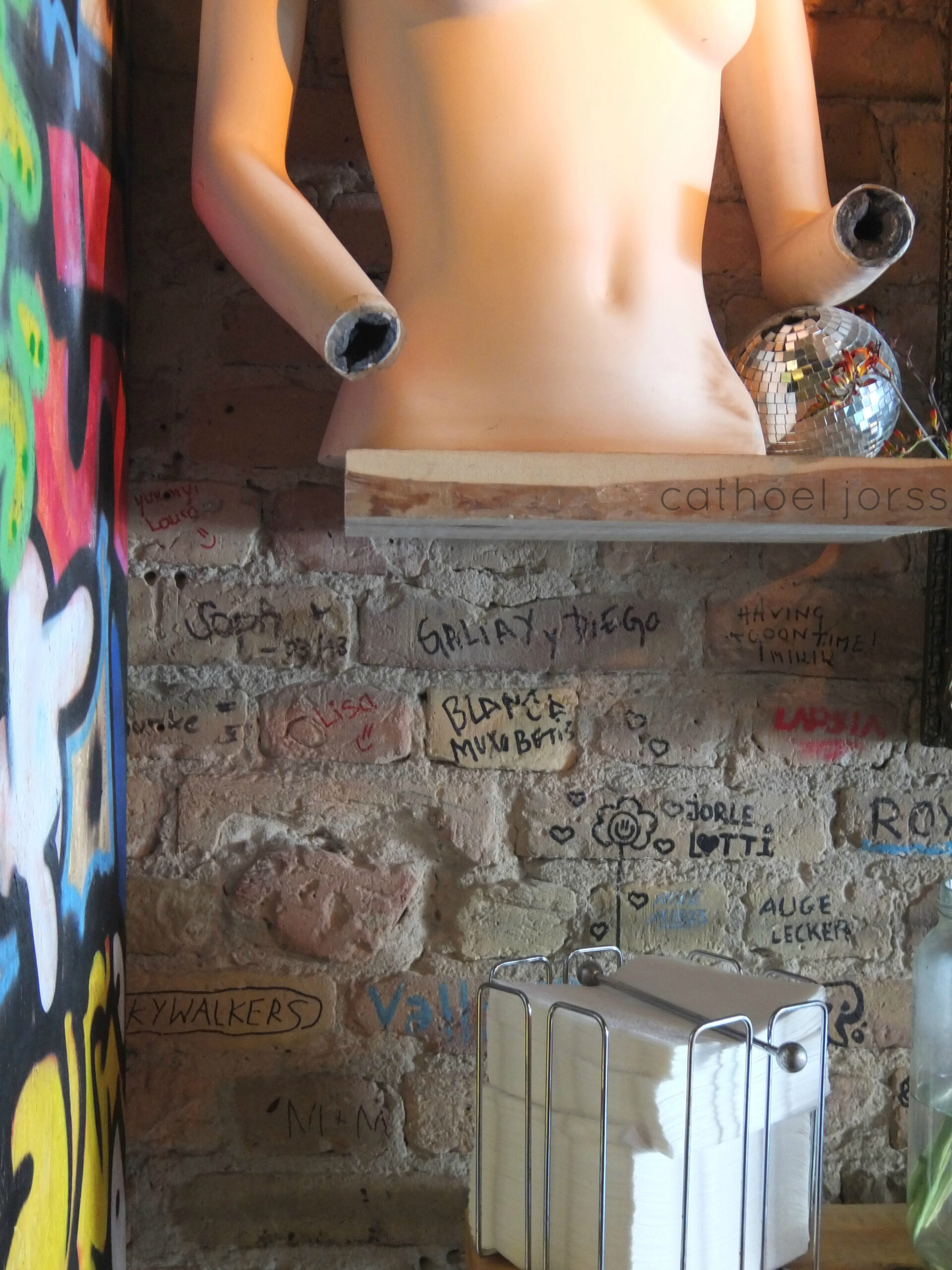
    H2O HoL manekin burger bar

  • eternity’s train

    eternity’s train

    Because I have lots of fears I am constantly setting for myself little and large tests of courage. Where I am staying backs onto a river and it’s out in the country and quiet. So tonight as it grew dark I set out for a walk along the bank.

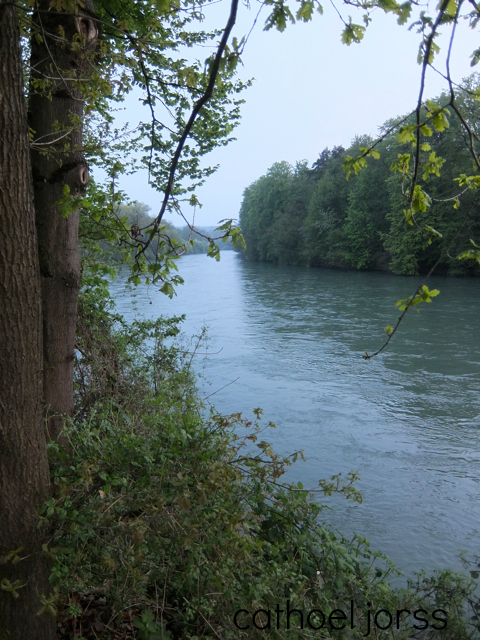
    This might not sound very scary but the path is narrow and in places, eroded, and more importantly as it grew dark I had a nervousness of who might be lurking in the woods. I said to the trees as I stepped off the narrow footbridge onto a sandy, forested island, Protect me, trees. The water raced by at my side, gleaming and opaline, milky and green, crying out its river sounds. The bushes growing over the path are very often spiky; I think if I were a shrub growing around so many beavers’ nests I would be inclined to be spiky, too. I let my feet fall as quietly as I could. Rounding a bend in the path I saw firelight fluttering up ahead. I stayed quietly behind the screed of trees, knowing that while I could see them I would know that they couldn’t see me.

    Three men; young men; really, boys. One of them was building the fire. The other two got up and flung themselves into the fast-moving current, surfacing with howls of pleasurable dismay at the cold.

    I went round the path to where the boy stood, pulling leafy branches off a pile behind him and stacking them on the blaze. His fire of course was very smoky and looked like it wouldn’t flame so high for long. I was almost upon him. I said, in English, Hi, just loud enough that he would turn and see me before I got too close. As is usual with potential aggressors when you face them, they are a human who has worries of their own. Of course, I had seen that from many yards away, otherwise I would have taken a different path. He said, Gruezi, looking a little nervous, himself, and I said, Gruezi. When it was almost dark I crossed a railway bridge with the water piling and piling round its piers. It was foaming so loud I did not hear the train. It came rushing out of eternity into the moment where I lay, my belly exposed to the armies of darkness, lay in rigid smooth standing position, facing the train and with both my hands holding the narrow railing, there is only a meagre though adequate walkway built alongside the track, high above the river, and people’s faces and meals were passing in the dining car in shuttling fashion segmented by the fast windows, only an arm-length or two arm-lengths distant. Without meaning to I shrieked a long scream like a train’s eerie whistle. The train passed in seconds and I crossed over the high bridge, recovering, thankful.

  • duck surfer

    duck surfer

    Watching an adolescent duck flying upstream and surfing down, flying up and surfing down, over and over on the fast-moving river. Finally he hauls himself out on a low-hanging branch and sits there, drying in the sun, quacking with satisfaction.

    H2O HoL stream indonesien

  • heart of stones

    heart of stones

    I walked downstream to the picnic place where someone had made a heart of stones and filled it with pads of moss. The stones have gone now but the moss remains and some of it has taken root. A wet Spring. It makes not a green heart shape exactly, but something like. Heart like a blob. Heart like jelly, like a cloud.

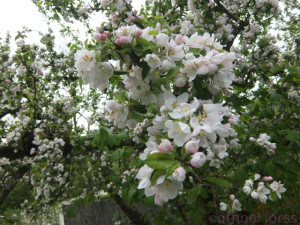
    H2O HoL apple blossom

  • sailor way

    sailor way

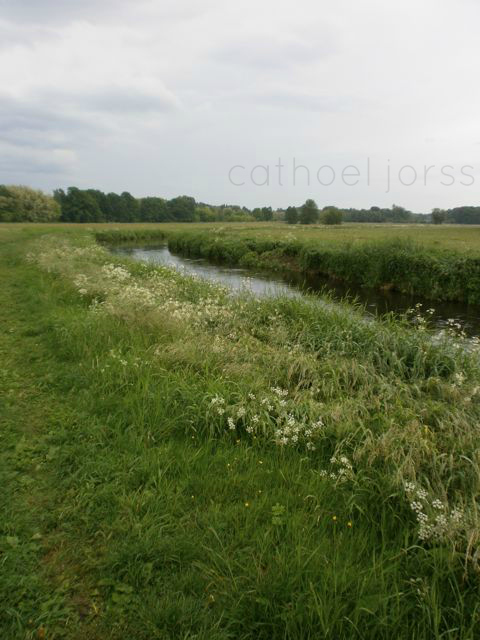
    By the river new wildflowers are now growing, the seasons progress with colour and line. Some of them are upright prongs of dark pink clovers and some, I suspect from the shape, might be buttercups. Buttercups are famous! I’ve read about them since I was a little girl, in English novels. But I think I’ve never seen one. Let alone the swards of white spear-flowers populating the nearby woods, which travel in a carpet as far as the eye can discern under trees…. On the river a lady duck surfs as lady ducks did on the swift green current with their husbands, three weeks ago. This one has babies aboard. They clutter her back, five dark brown bobbing heads, and she carries them smoothly and the water carries all of them, as time carries all of us, long may it be so if our enterprises and selfishness have not too deeply uncluttered the lifeless oceans and cluttered up the air and clogged with metals the water. Sail away, duck mum, smooth like a promise and find a better, greener place.

    H2O HoL sacred river

  • golden lion

    golden lion

    I went upriver two nights ago with a box of matches in my pocket. It was overcast and just beginning to get dark. Went down a green gladed path that I know and found the place I’d found before. I’ve never seen anybody there but once there was a girl playing her guitar on the next promontory, sitting on a fallen tree with her hair falling over her face.

    As I went I collected twigs and dried stalks and small fallen branches. I made a bristling bundle with each hand, I stretched my palm to carry more. At the place I built a fire. Last week someone had played a game there: twelve squares deep and ten squares wide, etched into the dirt, it had three teams: one playing with smooth stones, one with dandelion flowers, one with short sticks each piercing a leaf.

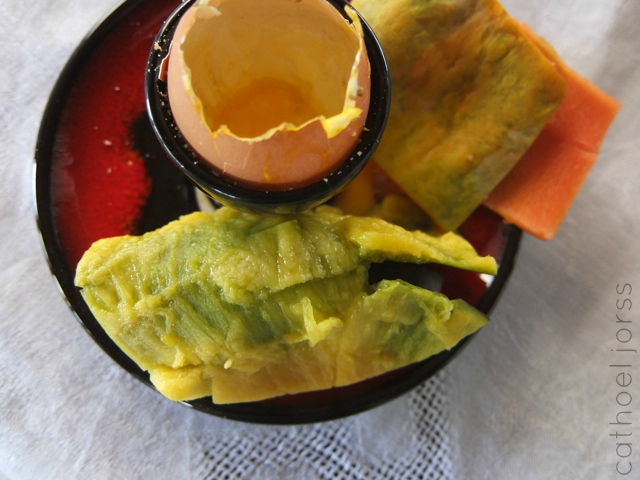
    In front of the fire I sat down to rest my back against a tree. The water rushed behind me, rushing rushing. It had begun to rain, not too heavily, I put on my coat and let the tree shelter me. A blue egg had fallen from the nest, egg-blue and speckled. On the inside its broken shell was white as teeth. Last night I took a different way and when I came to the clearing downstream where a bench and firepit have been built, in front of the bench someone had made a heart with stones. The stones said: “I <3 ..." The inner body of the stone heart had been filled with clumps of moss, and every few inches the green dense moss was punctuated by a golden dandelion flower. Again it grew dark, and again it rained, and I sat and watched by the water. H2O HoL red egg breakfast