Tag: German food

  • the lovely man

    You know how sometimes two souls collide in a fleeting way, like two bells chiming in different trees, and you never forget that person even if you never again see them or think of them. Well, that happened to me today. A most beautiful man. I went out to buy eggs and to finally drop in and see my friend who runs an exquisite New Berlin gift shop – it is filled with lovely things – he sells liquors and vodkas brewed locally. He sells handmade cards on creamy laid paper which have perfect arrangements of tiny dried flowers on them. Each card is initialed by the lady who makes it and inside is a little sheet of paper with her wavering handwriting – she is quite old, he says, and lives in Bavaria – explaining which wildflowers she used for this card. After much hesitation among the meadows I chose one with violets and something called in German “geese flowerlings.” The lady’s name is Rotraud – that’s her first name. I imagine her an elderly maiden, Germanic, pure-hearted, fieldly.

    While we were standing chatting a woman walked in whom I had passed on my way into the snooty health food store, she has a seamed and brown face round like a nut and he showed me the cards he also sells with her photographs on them. I was still reeling. Ahead of me browsing in the health food store opposite I had seen this lovely man, baby straps wrapped around his chest, long wrinkled pants and comfy shoes and somehow the back of his head attracted me. At the egg shelves we ran against each other and looked into one another’s eyes and smiled. I like you! I like you, too. As I was walking home feeling so filled with ardour and friendship he cycled past, slow and leisurely, making faces at his baby who lay smiling in the little wooden cart pushed in front of the bicycle. Hey, I said. Hey, he said. I came home to the man whose loveliness is known to me in more compelling detail and the sound of whose voice from outside the door lifts my heart. He took a photo of me in my crowded overalls, every pocket bulging with spinach, bananas, nectarines, tea. I put some water on to boil the eggs whilst telling him all about it. We gloated over the four different kinds of amazing German breadrolls I had chosen and their funny names. My favourite breadroll name is ‘Schrippen,’ a kind of ordinary light white bun. I bought potato rolls, farmer’s rolls, dinkel rolls and poppy and sesame fruit rolls, lifting each one out of its hutch with the long-handled scissor provided there for just that purpose.

  • meatbags

    meatbags

    It’s Monday afternoon and we are eating meatbags for lunch. This is because we are in Brisbane and have a German visitor. This German visitor has only been in Australia once before, in Melbourne for two weeks last year, during which visit I made him eat a meat pie from the local 7-11. Bad move. He got their name mixed up and months later, when I was marveling at the disgustingness of a German breakfast staple known as ‘builders’ marmelade’ (raw mince and chopped onions eaten on a bread roll), he burst out, “But what about those disgusting Australian meatbags?” Today it was time to reconstitute our culinary reputation, much as oranges will be reconstituted to make what we call fresh orange juice. We went to the local bakery. Standing in front was a line of people who amply illustrated what a lifetime of bakery products will do to your body. They were all having long, yarning conversations with the girls behind the counter, it was evident they all queue there every week. We got our pies and sat down to eat them in the shady courtyard. Afterwards my German visitor said, I feel like drinking a cacao. I said, a chocolate milk? Excellent notion, it will degrease our gullets. We took our chocolate milks across the parking lot and started towards home. Then my mother and father turned up. They too had decided it was time for a meatbag lunch for everyone and in addition they were hunting down a copy of the Sydney Morning Herald so that their sensitive liberal visitors would not have to suffer through The Australian every morning. For some reason the German visitor could not be persuaded to eat a second meatbag. “Maybe he’s full,” said Mum.


  • unforgiveably gone

    Today my hair kept tangling in the buttons at the back of my coat. I spent a long time standing in doorways or under trees, thoughtfully fishing there with my fingers, dreamily, gingerly unwinding. I’ve been spending time in a cafe that was opened “ca. 1930” by the stout pretty dark-haired woman whose blurred photograph on the front page of the menu (hand-written) may have been one of the last ever taken of her. Berlin’s dark, sour, staining history runs alongside every step, like the raised seam of bricks which traces where the much more recent Wall has been carted off and destroyed: maybe she was torn down, maybe deprived of her life and livelihood, maybe dispatched, grossly outraged, starved, murdered, ruined, unforgivably gone.

    The brass plaques, size of a cigarette packet, that here and there replace one or two cobblestones with a name or a family of gone names are, I found out, the work of one artist.

    I spent much of the day in her cafe, writing and writing, had a bowl of broth with pancakes rolled and thinly sliced into it, lingered, in the air spiked with smoke, over a menu of dishes I couldn’t understand. Because even where I can translate, the concepts are unfamiliar and dim: Leberknoedel, Schupfnudeln, alles mit Kartoffelecken.

    When I came out the blue hour had struck and everything felt festive. I went into a hat shop and wound my way along the walls right to the back. I picked up and fingered things, stroking and probing. I stood in front of their long polished mirror wearing a crimson top hat that was too big and came down over my brows.

    My new Kiez is studded with turreted buildings, an old tollhouse, an old gatekeep. Many of them now are restaurants and the golden interiors, the white clothed tables, the solicitous bending of waiters in the windows – the shimmering, old-glazed, inviting windows – were so irresistible. I resisted. I went into the supermarket which bursting like fruit from a basket was so much more vivid, more lively than the dreamily acquiescent twilighttime street, and filled with families. Stubbornly determined to cook in my two-room palace of hired minimalism which has no pepper grinder, no chopping block, and no knives, I snatched up a small sack of potatoes, some garlic and onions, a roll of butter. I have powdered stock and a Swiss army knife and I reckon it’s enough to make soup.

    It’s so cold. The insides of the windows are cold. Not too cold. Not just yet. Deliciously so. My landlady hovers like a ghost in the hollow of her white apartment, her beauty, her wide frightened blue eyes with their large pupils staring like bullets. I found our bed last night to be beautifully cosy and soft, woke to a window of tree. Once I’d had a bath there seemed little else to do and I felt so happy about that.

    In the evening after I’d moved in, before the bath, I went out exploring, feeling hollow and hungry inside. A restaurant golden and beckoning softened the corner of my new street. I stood shivering in the dark for ten minutes and walked up and down and up and down again before I found the courage to walk in the door and thus enter its enchanted, entire, intact civil world. It was disconcerting, after all this long travel, how hard it felt just to walk in. Intruding on the community of this new district, unknown to me like a new city, by this decision to eat out took far more courage than I’d expected. I so often eat alone and I like that. But I guess my adventurousness is exhausted.

    In Melbourne I used to notice this, every morning even when I’d been writing over my breakfast in the same cafe every day for months: the forcefield that people establish or emit when they form an unconscious community, shiftingly, by being all in the premises, by forming a varied, large party, strikes me like shyness buzzing electric across the doorway of every new cafe, and always has; this felt far harder.

    Now, this evening, everything feels different. I can feel I have found my way. The new part of town is becoming my Kiez. Its dark streets of houses feel now already less intimidating and austere, more quietly homey and interesting and wan. My sublet in its dank courtyard is divided from the welcoming bustle of shops by a river of rushing lights pouring the hill, like sand, from one glass to another. My sight clears and I start to see. Not everyone here has money. Between the lifestyle shops are the lifeline shops, where hungry people find what they eat. I am hungry. I’m always so hungry. At the supermarket checkout a man in front of me said to the cashier, Holst du mir mal vierzig Cent? Ich habe keine Brille mit. Can you grab me the forty cents? I don’t have my glasses. Obligingly the guy sorted through the coins, patiently, turning them and showing them til he found the right ones. The guy behind me made a friendly remark and I turned it to advantage – a politician! Laying a finger on his bright yellow toilet rolls I asked, Have you ever thought of trying out the recycled kind? No, he said, in a tone that showed it’s never crossed his mind. It’s just that the trees take such a long time to grow, I said. And it takes a long time to replace the ones we chop. He gave me his twinkling smile. Next time, he promised, I’m going to remember that. I piled the stuff into my knapsack and took up the mesh bag of potatoes by its uppermost root. The corner of the sack yielded a perfect potato, an archetype, shaped and sized exactly like an egg. I closed my fingers and palm right round it and used that to carry them home, internally a handle. The high blue wintery sky and red lights were so absorbing that I accidentally walked right past my street and found a brand new park. The grass was still dimly green but the trees already blackened by night. Little children darted round the path, excited, calling out. As I turned back for home I saw a little family, with very young children, slowly climbing the damp stone steps carrying candle lanterns. The parents’ lamps genteelly leap-frogged each step, one by one, the candles swinging three feet up from the stone. But the littlest child, to whom walking is still a labour of concentration, held his lantern outstretched and swung it right forward with the effort of each step’s climb. I came home and put the potatoes on and put on all her lamps. The window above the bare desk is a square of black in this white soft room and I can hear as I’m typing the dark-throated toll of some old church’s beautiful, wild, German bells.
  • little flower

    little flower

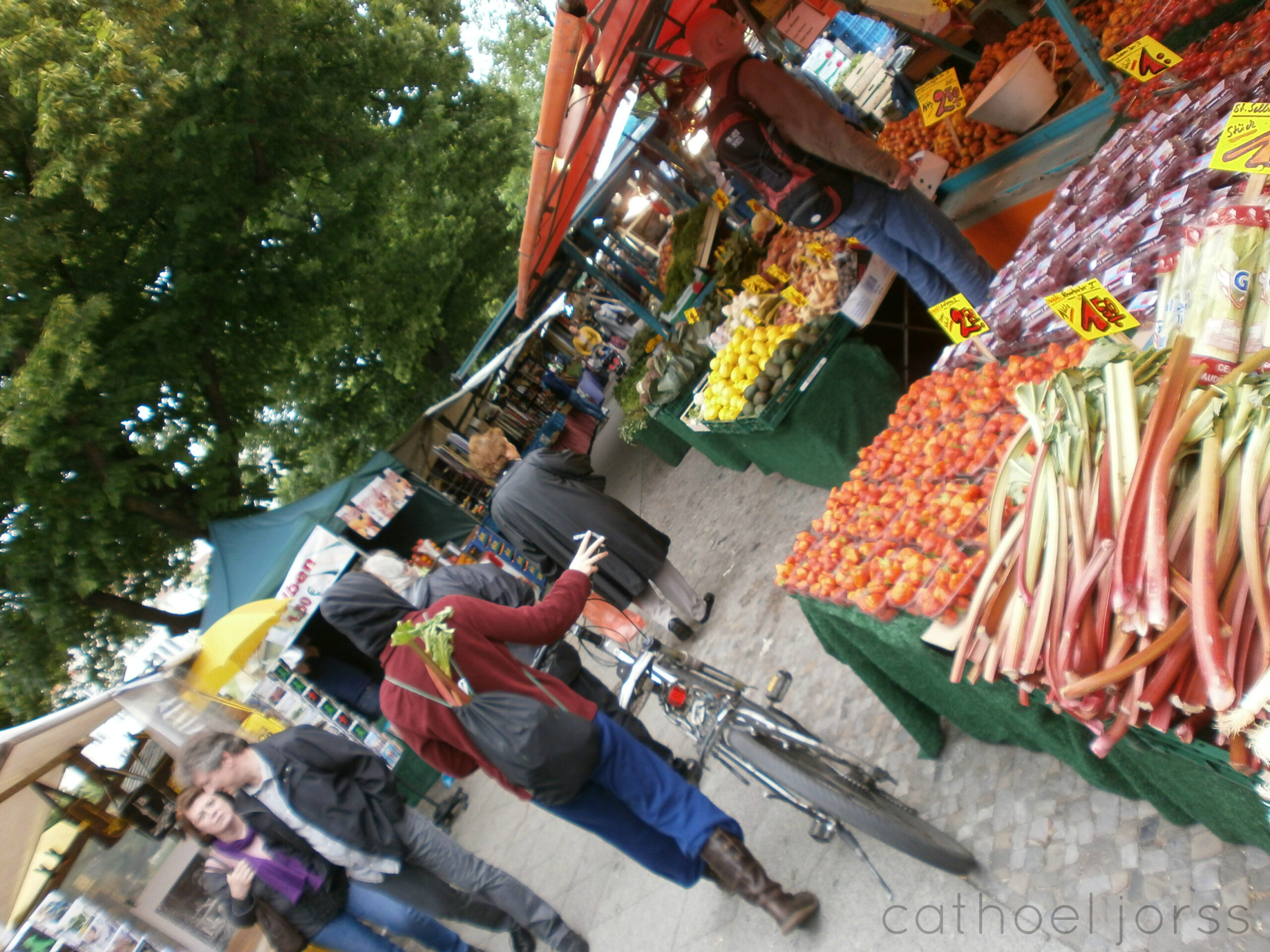
    Went onto the market, transformed now with its leafiness half on the ground, and half overhead; I wanted parsley, and something else leafy, maybe spinach, and potatoes. So many types of potato, each ugly in its own precious way, it would be nice to buy one of each and label them with toothpicks (i, ii, iii… xii, xiii, xiv) in order to find out once and for all how in flavour and texture they veer. The buying of parsley I always find a puzzle here: what is the German for a bit, or a bunch? I didn’t like to ask the grumpy lady in mittens who served me today smilelessly. At the smoked fish van in dappling shade I hesitated over the golden reams. A guy was playing steel drums in a kind of trance, which he had transmitted to the several small families swaying in front. I said to the fish seller when he came back in, I’d like a couple of those fillets please. I said, ein Paar: a pair, a married couple, a few. He picked one up in his long curving tongs, like a beak. How many is ein Paar? he asked. Well, I said; actually, two. Ah, he said, laughing: so an actual pair! He began wrapping the fish, chuckling softly to himself. Ego stung me and I wanted to find a cunning way of letting him know this is a second language for me, over just a few sentences people don’t always pick it up. You know, I said, artlessly, guileful: This everyday stuff is the part I find hardest, in German. How many is a few? How much parsley do I need? Is it a posy, a bouquet, a… well, ein Bisschen: a little bit?

    He knotted the paper bag and spun it with that deftness so stylish in stallholders. He was considering my question. Well, he said at last, you can’t go wrong with a little bit. Ein bisschen. It’s not a posy or a “little flower” (“Blümchen”, I had said). Ein Stück, a piece… yes…. you can always buy a piece of parsley.

    Peter Pepper. I took the parcel of fish and stowed it with the parsley in my bag. Thanks, I said. He handed over my change. “And now, you get ‘a little bit’ of money back, too,” he said, using the familiar form of “you”, which gave me a warm feeling as I stowed the piece of money in my pocket and wandered back past all the closing stalls with their shrieks and two for ones.

    H2O HoL markets colourful

  • beware of the god

    I passed a Turkish döner shop where they carve shreds of meat from a large, limb-shaped conglomeration that’s turning very slowly dripping grease into the grill. In front of the low window sat a patient Alsatian. His nose was lifted towards the man sunning himself on his elbows, dreamily staring along the street while the meat crisped up behind him. I said, indicating the dog, “Er hat Hoffnung.” “Is he yours?” the man said. “Oh no, he’s not mine, but I think he has hopes.” He was already dipping his curled fingers into the tray of meat shards, peeling off a long strip and lifting it over the sill. He threw the meat and the dog caught it. Gulp. Gone. I said, “Wow, aren’t you nice.” As I got back on my bike the man was delving back into the gleaming pile of flesh and the dog was gazing at him as at a temple statue that has moved and revealed itself a god.

  • Blurlin

    Blurlin

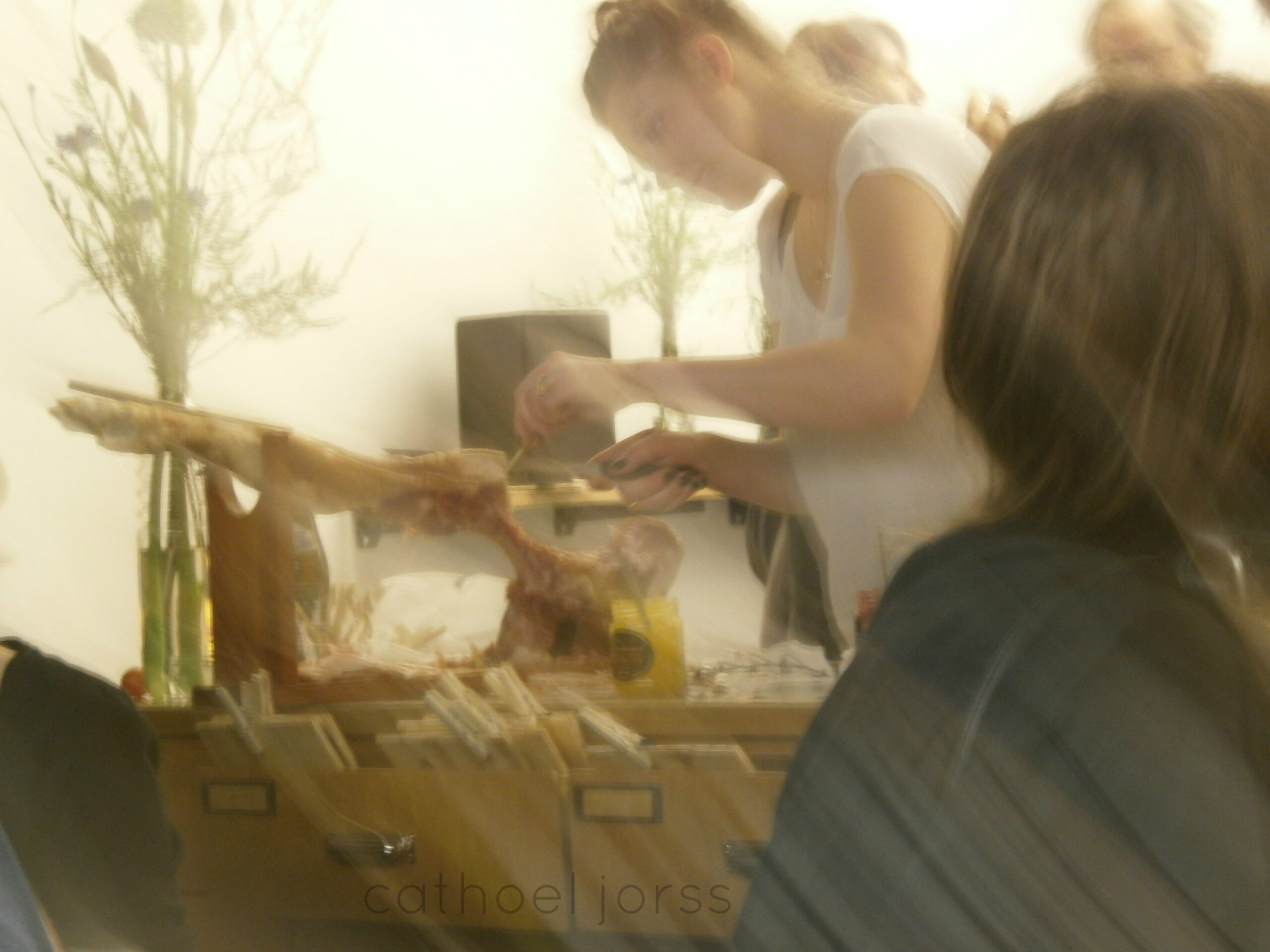
    Last night was an event called The Long Night of the Design Studios in which studios threw their doors open and invited people to come look. Cheeses were carved on raw plywood platters and I saw a girl in a filmy white dress carving chunks off an entire pig’s leg. The night before, DMY design festival opened in an old hangar at the abandoned airport Tempelhof. Tonight is the opening of the Poesie Festival. Ordinarily I stay home for weeks on end, writing in pajamas in cafes, undisturbed by anything beyond the books and the birds. I’m proposing a name change: Blurlin.


  • while it lasts

    One thing I love about Germany is that you can find local bakeries who’ll treat you like diners in a restaurant. You can choose a bread roll filled with lettuce and cheese, or raw mince and onion (“builders’ marmalade”), or some kind of iridescent preserved meat with cucumber, and order a cup of tea and have it all brought to your table outdoors with knives and forks and napkins and not pay until you leave. You can sit under the bower of greenery and watch a skinny mother with a pram and a cigarette flirt with the shaven-headed dude who just leveled a trigger finger at a passing flock of teenagers. One of the teenagers says to her friend, “Do we look like school students?” Yes, you do. Enjoy it while it lasts!