At rehearsal with a Ghanaian band for whom it is imperative to have two different drummers side by side. There are three brass horn players and I have counted four different patterns of stenciled colour on the walls. The room is filled with people speaking Ga and Twi and pidgin and the carpet is striped. The hand drummer is unable to play as he keeps having to get up from his seat to dance. The kit drummer gives out commanding shrieks of joy. Brass section is tight. I didn’t want to sing Redemption Song but the bass player said, Tell our story. On the way home, I rewrote it on the back of the bike, saying Oh pirates, yes we rob you. Sell you to the merchant ships.
But your hand was made strong/by the hand of the almighty. We had ridden two hours on a motorbike in catastrophic traffic to get here, scattering streetlight vendors selling popcorn and plantain chips and iced water in plump bags and millet milk from zinc pails on top of their heads, finally spinning onto a long rutted red dirt road consumed with dust. Gig is Friday night and it is going to be wonderful.
~ 1st December 2021, a different world
Tag: Ghana
-
long-legged rock god
-
wait what
When I got there the doctor said, “You know when we call you in at seven in the morning it’s not good.” She had called me in at 7.15am on Friday to give this news. I have cancer. She used words like ‘chemo’ and ‘metastasize’. She emphasised that these are words I may not need to learn. In my head there was only room for three words, the same three words recurring all weekend.
She gave me the name of a surgeon I’m to meet today, Monday, who will try to cut all the cancer out. She said, “You’ll be reassured to know that everyone’s going to be treating this as the utmost urgent priority.” I sort of half-laughed. “That is not reassuring,” I told her, wryly, and she made a comical face. I am proud of that wryness and that half laugh. Those are my courage.
She said she thought what they first found might have been inside me maybe a year. She said, best case scenario is I go into surgery this week and the new doctor, a man, cuts all of it out, he gets the lot, and after that I keep getting scanned and checked and tested for the next five years then for the rest of my life I will have to keep an eye on it and keep meeting from time to time with these doctors (“you’ll get sick of the sight of us, I promise you.”) Then there’s some spreadage and there is no cure so we irradiate it or poison it with chemo which doesn’t poison just the cancer but the host as well — me, in my body — and then at the far end is, the scans reveal it’s in your blood or lymph glands or your organs are riddled with it, we are sorry, there is nothing we can do, you have a few months, set your affairs in order.
Until the first tests come back there is no way of knowing how much cancer is in my body at this stage nor how far it may have spread.
The call from this doctor’s receptionist came as I walked out of the hospital from seeing Mum. That morning, Thursday four days back, I woke to texts from Mum at 4.30am saying hello I am very very sick and then from my brother at dawn, we are at the hospital with Mum, pneumonia and it’s not looking good. I went straight in to see her and I’ve never seen anyone so sick. She was shivering with fever and delirious and vomiting up coiling tubes of bright yellow foam like a pool noodle, like those batts you put into ceilings for insulation. We thought she was going to die. The doctors seemed to think so, too, and they told us, the family should come. When I came out of my own appointment next morning Mum had turned a sharp corner and by some miracle of resilience was sitting up in bed eating a sandwich. I was thinking what if she dies, what if she really does, what if she is dead already and she is gone and she’ll never know I have this. Instead, Mum seemed so much calmer and stronger and I visited again and made her comfortable in the too-short bed and listened to the doctors and my mother told me a story about her aunt, my great aunt, who died only two months back at 96. This great aunt had cancer, and I never knew. She had it cut out, and recovered to live this long life. Since returning from Africa at the end of 2022 I had been asking when could we drive up to see her. Instead, she died, and the day of her funeral I happened to phone and Mum said, Can’t talk now darling, we’re all in the car on the way to Warwick, and I said, Why, what’s happening in Warwick, and she said, “Auntie Berta’s funeral.” I said why — but why — how come I, and she said, smoothly, your brother put his foot down. He told us, if she goes, I’m not coming. And he’s a pallbearer.
I don’t know the source of this estrangement and no one can explain it to me. Soon it may be immortal, as far as anything human. I don’t know why my mother’s 84th birthday in November was held at this powerful brother’s house and I was not invited. I had been lured back from Ghana on the promise of the long-overdue reconciliation I had been asking for and working towards for more than a decade. That she let one of her last birthdays be celebrated without me, the whole family gathered just down the road, when I had been gone some twelve years and was actually living under her roof at that stage — I cried for days. And, in an aching gap in the crying I went to my first decent painting class and worked round the fire in my throat on my first decent painting. The boy’s name is Atta Bonye and his wry, thoughtful, sweet and spiced expression speaks to my heart. All I know is we are humans here together and life is turbulent and short. All Ghanaians know we cannot heal nor even address these painful things if the other party does not want them resolved. All we can do is cling to those things which bring life and give health, and try to distance ourselves from toxins, from cruelty in others and the impulse to cruelty if it should surface in ourselves, try to balance painful honesty with life giving kindness, try to be as real and as present as we possibly can, though it cost us everything, as they say in Accra, you have to “happy yourself.” -
pizzagram
Woman at the next table films her third slow sweep of the entire restaurant. I am stuffing long reins of mozzarella in my mouth. I wipe my face and go over.
‘Hi. So sorry to intrude. I just really don’t like being background scenery in your panoramic videos, I just want to eat my messy pizza without ending up on your Instagram. Could you please not do that?’ I have broken the fourth wall. She looks stunned. The couple at the next table roll their eyes and purse their mouths.
Everyone else in the room including half the waiters is staring down into their phones, apart from one man seated at a large table who has met my gaze and grinned sadly, as though we are the only two left awake. Suspending conversation in favour of objects is objectionable. Objecting to being rendered an object is human. It seems to me as we turn this corner we are normalising all the wrong things.
-
Ghana get it
Today in Ghana I ran into my friend Kwame, who sells jewellery from his lap in a wheelchair in Osu and thus supports a family of five. Kwame’s dream is to be a lawyer. We shook hands seven times. We were so happy to see each other we were nearly in tears. I told him my visa trouble in Berlin: I cannot sell the lovely recycled glass beads I brought back which should include an opportunity for sponsorship or reparations to somebody like Kwame, because I got turned down for a business visa, they are worried I would not be earning enough money (true) and thus not paying enough taxes in Germany (also true). I told him I will keep trying. I rode home by trotro and jumped off when I passed a heaving Spot where hundreds of groovy people all dressed in black were dancing and drinking and ceaselessly embracing. They looked so cool and helpless. ‘Excuse me. Is this a funeral? I don’t want to intrude.’ ‘Welcome, welcome! Our friend died, he was a dancer. Only thirty years old.’ The bar man agreed he would stand me a drink even though I had no money. We both touched our hearts, I will come back tomorrow, thank you for trusting me. Funeral goers in matching black t shirts lifted their glasses and bumped fists as we all began dancing in the crowded road. ‘We all wish white people would dance like that. You are a Ghanaian now.’ I wish. What I wish is if I had my way, some combination of eco conscious Berliners and forthright outrageously excellent Ghanaians and thoughtful land respectful Indigenous Australians would be ruling this world. ‘Why can’t you tell Trump he is not allowed to do this thing?’ ‘I’m trying! I tweeted him. He doesn’t mind me.‘ In Ghanaian English this means, he takes no notice of me. ‘Why does he treat Iran this way?’ asked Pious, who had taken my number to send a selfie we all made. ‘I don’t know,’ I said. His friend chinked his glass against my glass. ‘Is it because he’s a mother fucker.’ Yes, I said. That’s why.
-
Ghana get it
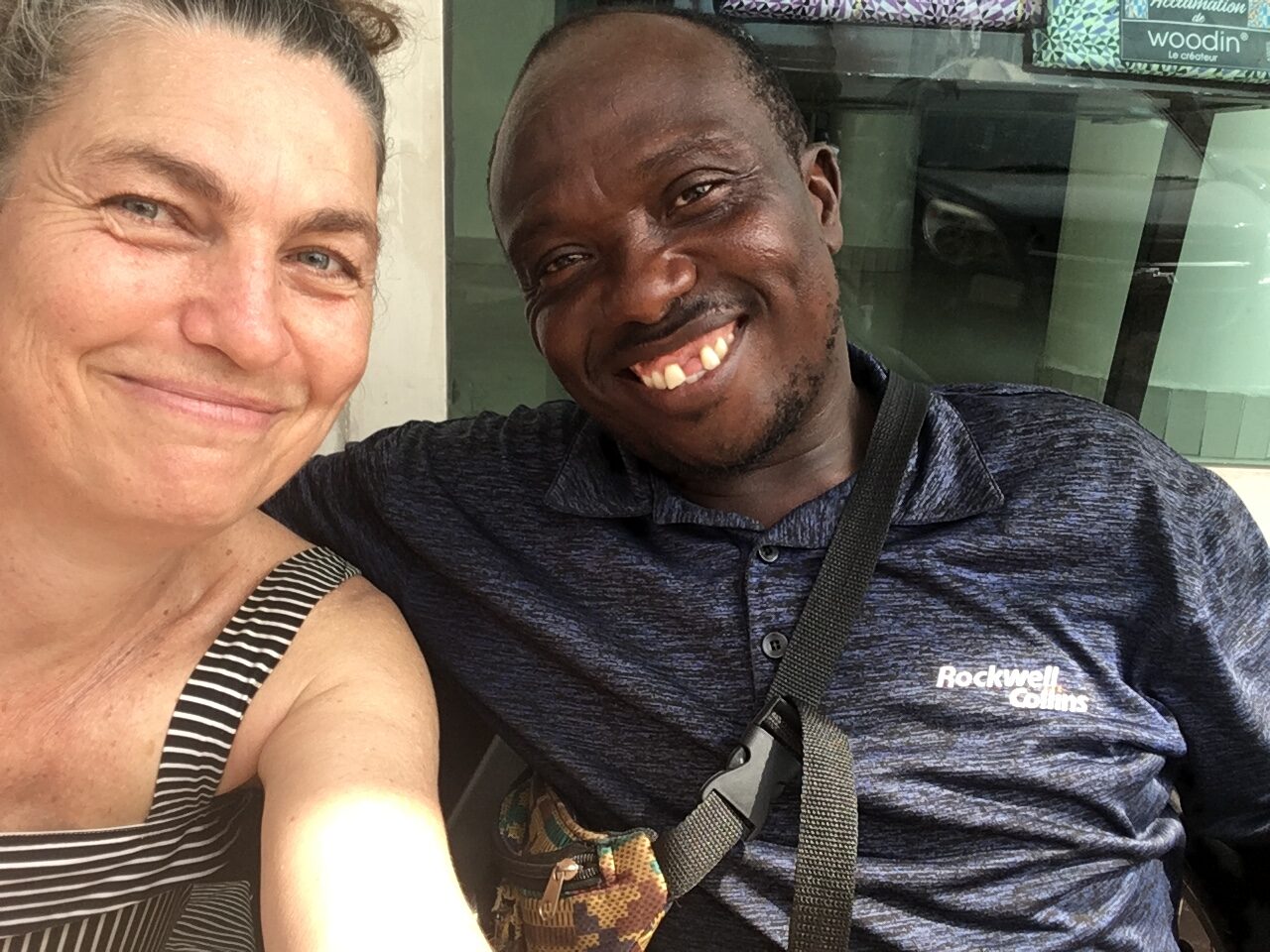
Today in Ghana I ran into my friend Kwame, who sells jewellery from his lap in a wheelchair in Osu and thus supports a family of five. Kwame‘s dream is to be a lawyer. We were so happy to see each other we were nearly I years. We shook hands seven times. I told him my visa trouble in Berlin: I cannot sell the lovely recycled glass beads I brought back which should include an opportunity for sponsorship or reparations to somebody like Kwame, because I got turned down for a business visa, they are worried I would not be earning enough money (true) and thus not paying enough taxes in Germany (also true). I told him I will keep trying. I rode home by trotro and jumped off when I passed a heaving Spot where hundreds of groovy people all dressed in black were dancing and drinking and ceaselessly embracing. They looked so cool and helpless. ‘Excuse me. Is this a funeral? I don’t want to intrude.’ ‘Welcome, welcome! Our friend died, he was a dancer. Only thirty years old.’ The bar man agreed he would stand me a drink even though I had no money. We both touched our hearts, I will come back tomorrow, thank you for trusting me. Funeral goers in matching black t shirts lifted their glasses and bumped fists as we all began dancing in the crowded road, ‘We all wish white people would dance like that. You are a Ghanaian now.’ I wish. What I wish is if I had my way, some combination of eco conscious Berliners and forthright outrageously excellent Ghanaians and thoughtful land respectful Indigenous Australians would be ruling this world. ‘Why can’t you tell Trump he is not allowed to do this thing?’ ‘I’m trying! I tweeted him. He doesn’t mind me.‘ In Ghanaian English this means, he takes no notice of me. ‘Why does he treat Iran this way?’ asked Pious, who had taken my number to send a selfie we all made. ‘I don’t know,’ I said. His friend chinked his glass against my glass. ‘Is it because he’s a mother fucker.’ Yes, I said. That’s why.
-
Make Africa Great Again
We went out to the white people’s restaurant, as he calls it, which is a street stall on a dirt laneway behind the supermarket. There’s no street lighting, no cutlery. Collapsible plastic tables are set up between the parked cars. Vivid local tunes blast from the tiny bar across the road, which brings icy beers in brands no one drinks in Europe. We sit there for hours eating chicken and fish with our fingers. Last week a white girl got up and went over to the bar, carrying her phone. She persuaded the barkeep, who is a rapper, to link up her tunes to his speaker. Within seconds this wholly fresh and salty sound bathed the scene, and at their work and in their seats everyone was dancing.
Tonight a man sitting against the wall behind us had on a MAGA hat. A black man. I looked closer. MAKE AFRICA GREAT AGAIN. I got up and went over. Close up his red baseball cap read MAKE AFRICA HOME AGAIN.
I crouched beside his table to say hi as I do occasionally when a table of visitors have stiffed the boy dancers. “We can’t afford to give money every day,” they say, reasonably, demonstrating they can afford to eat out every day and I spread my hands, “I know, me too,” and persuade them that it’s ok not to give, it’s not ok to turn your stiffened faces away and keep eating while someone is standing there, sweating with performance, holding out an upturned cap. He is standing there. Treat him like a human. You are not greater nor less. Make whiteness great again.
Since so much of our cruelty comes from diffidence, I offer scripts. “I say, I’m so sorry, I cannot help you this time.”
“But then they don’t go away!”
“Just be direct. It’s courteous. ‘I’ve said no three times, you have to leave now. Bye.’” I tell them the dancer who stuffed fire down his pants but was yet to bloom in puberty “came to our table after you, and he just looked so wounded.”
Poverty is all around us like jackrabbits in the grass. Poverty, hard work, resourcefulness and struggle. We are like big birds of prayer gliding like clouds across the sun, idle on the air and wondering which one next we will swoop on to assist or exploit. Building our bullshit churches, insulting sufferers with thoughts & prayers in place of action, rendering free men into slaves, free woman into sex slaves. Calling the children they raise from rape ‘half caste’, as though only that portion of their humanity fell into any class we recognised.
Next morning four boys came to the low wall around our house which keeps the goats out. Their upturned faces were lower than the wall and I had to go and peer over, to hear. “Please, we want you go buy us four bicycles.”
Oho! I said. Well I would love to buy you four bicycles. I wish I could. I explained that I would love to have a bicycle, myself. But of course, I meant a second bicycle, here in my second home at which I arrive by jet plane.
The spokesboy suggested, “Or maybe a ball.”
My heart flooded with regret and shame, yearning and heat. Why shouldn’t these smiling, reasonable, kindly, and well spoken courteous boys have a ball? A ball to play with. A boy standing behind him said, “Bicycles!” and got cuffed for spoiling the deal. I asked, “Ee gon be how much?”
They reasoned. “Well, ee cost 25 cedis.” Five dollars. The spokesboy explained, you can get them for 18 cedis, but… “They get spoilt?” I suggested, using a word that in the wealth world we use to describe unhappy children but which here means, I had a phone once, second hand from the markets, and now it doesn’t work.
I tried to respond to this adventurous, eminently reasonable, and brave request the best way. I didn’t want them to feel that if this ball got spoilt they could just come ask the white lady for another, that a ball was nothing to me. I didn’t want them to feel I gave something which was nothing, it seemed insulting. I explained I had little money right now. All Africans know little money. It’s the most usual form of money. “But I will try. I’m going to try to find some money for you so we can buy a ball. I can’t promise you,” I said. “But I will do my best. Do you get me?”
Of course I’m going to buy them a ball. I just want them to have a week of looking forward to it. I see school children carrying their homework under the awning of a shop which has a light. I see people eating yam for breakfast, just boiled yam. If you have a sauce on your rice, the sauce is a couple of spoonfuls of garnish; in Europe garnish is the main dish. The man in the MAKE AFRICA HOME AGAIN cap made me at home at his table and we spoke for some few minutes. Neither of us mentioned Trump. We exchanged our numbers, as Europe and Africa should do. We are so few and have so much. They are many, and have little. We, they. We spoke about the music. The rapper who brings beers played his own song again. Coming back to our table I was dancing, a little. In Ghana I always want to give everyone everything and as I build my tiny business I am finding out a way we might be able to do that, one transaction at a time. It’s not giving everything: it’s not giving at all. It’s giving up what we can afford of what we stole. It’s giving part of everything back.
-
mud road
We are walking down the road in the middle of the night. The road is made of mud. Our new home is in a village and it has no address. An urban village, lapped on all sides with villages that make up to capitol, one storey high and crowded with tiny chickens and little soon to be eaten goats as far as I can see.
Should I look nicer, I said, tonight on our way out, rumpled in my unironed skirt. Oh no, he said, Cathoel you are a white lady – you always look dressed up automatically.
Every time he remarks, casually at the door when I have loaded him with parcels, “My loads are plenty,” or, when after a cross cross-cultural fight we start really finally hearing each other, or when he pronounces ‘automatically’ with its six distinct syllables as indeed it deserves, or when I say ‘hippopotamus’ and reduce him to peels of crying laughter — each time I fall a little bit deeper into love as though it were a big bowl of soup.
Here is a church. Already they are moaning and they’re wringing their hands. One lady paces foot to foot, waiting for transportation to start and eulogy to have set in. The whole road will have to listen to their dismal rejoicing. Further along, a few shops are still open. One is called Reggae Spot, selling tins of condensed milk and mosquito coils, though Ghanaians laugh at malaria.
On the weekend we rode nearly ten hours north on bad roads festooned with craters in a tiny bus leaking dust from its frayed with rust underside. Under my mother in law’s mango tree I asked her when she offered tea, do you have any condensed milk? No, she said, I only have normal milk – producing a tiny costly can of condensed Carnation milk, as normal as canned be.
In our village house the water is piped in from a truck to a large polytank on a concrete stand. A chicken is roosting on her nine eggs in one of the pots I have planted and I greet her every morning, “Good morning, Lady Chicken, still working hard I see.” I am reading Elizabeth Gilbert, another white lady dressed up in her handknit white life who took an entire year away from work and spent it in Italy (eating), in India (praying), and on Bali (falling in love). Her book Eat, Pray, Love became such a sensation and attracted so many privileged rich seekers to the island that Balinese took to wearing t shirts which said Eat, Pray, Leave.
In her ashram Gilbert riffs through two pages of the startling innocence that characterises unearnt privilege. Americans don’t know how the rest of the world sees them; men don’t know that women understand them all too well. When she writes of her friendship with her fellow floor scrubber Tulsi, she describes the girl as ‘cute.’ Tulsi is far cuter now that her glasses have smashed, and due to poverty she cannot afford to replace them. “Tulsi is just about the cutest little bookworm of an Indian girl you ever saw,” Gilbert writes, calling up one of a wardrobe of Indian tropes she has prepared earlier, “even cuter since one lens of her ‘specs’ (as she calls her eyeglasses) broke last week in a cartoonish spiderweb design, which hasn’t stopped her from wearing them.”
It doesn’t seem to occur to the author who is scrubbing floors voluntarily as part of her search into herself that looking out from inside that webbed lens might not be pleasant. That being unable to do without the glasses now smashed and damaged is not the same as a cute, manga-kid stubbornness refusing to give up a favourite garment which has torn.
Tulsi describes her prospects: she will turn eighteen soon and will be married off to some boy she dislikes, or is indifferent to. A “teenager, a tomboy, an Indian girl, a rebel in her family,” she loves hiphop and lists for her oblivious interlocuter, oh, so interlocutely, the flaws which can prevent a girl from marrying. Her skin is too dark. She is old, 28 for example. Her horoscope is wrong. Not one of these flaws is anything a girl can do anything about, except that she must not be too educated, or have had an affair with someone.
We’re left wondering if in the conversation itself Gilbert found the time to commiserate with her feisty, spirited, trapped companion or whether she just floated directly from this listing of someone else’s sufferings – so many someones – into fresh contemplation of her own inner self. “I quickly ran through the list, trying to see how marriageable I would appear in Indian society… At least my skin is fair,” she concludes, innocently. “I have only this in my favour.”
Meanwhile in this village house, which we intend to rent out as a kind of guesthouse so that other privileged oblivious whites can come here with their cameras and render all our neighbours objects in the background of their own selfies, I am scouring and cleaning too. When I bought this broom the woman who had made it asked, “But do you know how to use it, though?” By turning it upside down and stabbing the dirt I made her laugh. “Like this, right?” I am too shy some days to leave the house. I feel like an intruder. Daughter and grand daughter of intruders. We have stolen so much. Africa produces 75% of the cocoa that fuels the world’s $75 billion chocolate industry, and earns 2% of the profits. Like an American in her ashram I am doing what I can, so lazily, so slowly, to clear away the cobwebs and look out on this bold world more plainly. I am trying to become aware of the crazy-making stain of sharp edges that my Ghanaian boyfriend has to see past every time he tries to achieve anything at all. I am perceived as being well dressed without putting in any effort. I am addicted to my own comfort. And as I weigh my prospects I try to imagine how that effort spared in grooming and combing can best be spent.
-
hanging weekend
Ahhh, weekend in a hammock, swinging softly from side to side and hearing the waves crashing, the moon imperceptibly rising with its bald and honest glare, yes, you can hear it, you know it, we know it. A nearby little restaurant – the only one in this seaside town – was kind enough to deliver meals and beers, one of their staff members lives across the road. Behind us, Africa. Ahead of us, the poisoned sea riddled with plastics and emptied of all piscine life by hulking ships like the ghost ship tethered to the beach. This sea from which English, slaving ships, and gold miners came.
I read a most wonderful book and read parts of things I’d written, to my beloved. We sat tail to tail in our hammock two days over, or my head on his chest, or his head in my arms, or in our little high netted boat of bed. A simply stone-flagged bathroom with a tap that hangs from the whitewashed stone ceiling; that’s our shower. Nothing could be nicer, nothing was. And then the quiet drive back to town chasing racing red taillights, the crowd of people at intersections selling chocolate made from Ghanaian cocoa, children’s books, necklaces of steering wheel covers, brooches of soft packs of cotton buds or giant crowns of watermelon on a tray, like Carmen Miranda.
-
waking up in Africa
It is my birthday tomorrow and I’ve woken up in Africa! Beautiful Ghana of the glorious peoples. At the spanking new immaculate airport a man was bobbing at his keyboard and singing, in the arrivals hall, “And you’ve all arrived safely on this Wednesday night, hope you’ve had a great flight, welcome, welcome.” My flight was grumpy cos we got stuck on the runway for an hour (in, you know, air-conditioned comfort with personalised movies to watch) and I reminded the guy rolling his eyes next to me and complaining, you are in Africa. You arrived here on a million-dollar machine. A fast-disappearing luxury neither our planet nor most people working late at this airport can afford. We were fed and offered tiny bottles of wine and scented towels to wipe our hands and no one fell out of the sky on long wings of flame *just enjoy it!* Singing and bobbing in the passport queue, overjoyed to see my sweetest honey the kindest most gorgeous man in the world, whom I adore, who waited patiently outside in the crowd an hour for me and carried all my cases. I travel heavy, mostly books.
He had brought me a malaria tablet and fed it to me in a swallow of boiled drinking water in the car park. Then we got as close to each other as we can on the back seat and drove away into Ghana. What a blessing and privilege to be here, to be with him, even to know him when we have spent our lives on separate continents, to be running a tiny business with big eyes that wants to construct a way for Europeans to offer ‘personal, partial’ reparations to Africa.
-
parcel in cloth
One thing I love in Ghana is people seem so good and kind. Not all of them, I guess, but daily life seems to me founded in a beautiful mutual respect and helpfulness. I watched the ‘mate’ in a grinding and crowded trotro (a tiny bus) jump down and help the man who was slowly climbing out, he lifted the man’s parcel wrapped in stained cloth – perhaps his stall – from the front passenger seat and set it down on the pavement. Then the two of them lifted it without a word, one side each, and settled it on the man’s head so he could carry it home.
I saw a little boy tapping my Ghanaian boyfriend on the hip, offering a coin. “Boss – you dropped this.”
Sometimes I think about Australian cities where these days people barely say hello. I think about New York, where I first visited in 2011 and New Yorkers were always saying to me, “You Australians are so friendly. In New York we hate each other.” Then I wonder how much of my experience of being in Ghana is filtered through the privilege of being a relatively well-off visitor, a white woman, someone from whom everybody can potentially benefit.