I showed up at the supermarket checkout at closing time with a tub of ice cream. She said, “How are we this evening,” and I said, “Well, I can’t speak for you, but I’m fine!” I gave her such a big smile she took a blink and stepped backwards. But she was game, we’re human, they could put big windows up high in those places to let the trapped staff gaze out. Rewards card? Nope. Bag? I opened my little folding one with a whoosh. “I’m in the supermarket, in my pyjamas, buying ice cream,” I rejoiced. “This is a beautiful night in my life.” She laughed. She folded up my receipt over and over into a very neat square then pushed it inside the bag. We wished each other a great evening. All the way home I was peering up through the windscreen following the shrouded moon. Brisbane, you have so very many trees. So many friendly young women who are competent and under employed. So many tubs of fine ice cream.
Tag: grocery shopping
-
summer treat
The woman behind me at the supermarket checkout had a little pile of five caramel bars, two gossip magazines of the trashiest kind, the ones with really flimsy rattling paper, and a tub of flavoured yoghurt. She saw me looking and her brow contracted. When I said, “I’m so happy for you,” which in German is said, I rejoice myself for you, “that looks so delightful,” her whole face relaxed.
“Ja,” she said, and picked up the stack of caramel bars and hugged them. “It looks really great, doesn’t it.”
“It really, really does,” I said. When I reached my bike in the row of bikes out front someone had dropped a leaflet in its basket to advertise a yoga retreat on Corfu. It is colder today and the summer, only two days old, feels already threatened.
-
follow milk
I learned a poetic new German word just now at the little health food shop. The man behind me had put just one item on the counter, a carton of Folgemilch. I asked him, “What is… follow milk?”
“Well,” he began, and something about his tired, slightly harassed, but ever willing to be helpful expression and messy hair struck me with insight.
“Is it… what you eat when you are done with drinking only milk?”
I didn’t know how to say ‘breast milk’ let alone ‘solid food’ so I just said, only milk.
“Exactly!” he said, and then used that pricelessly dear word Germans have for breastfeeding infants. “It’s for sucklings.”
We both shifted our stuff along the counter as the person in front moved on.
“So can you use it for other things, in general, like… I’m just having a beer as a followlunch?” I asked, hopefully.
His brow clotted. “No. No, that is not right.”
Learning German. It’s one-third flights of folk poetry, two-thirds ‘that is not right’ and ‘we simply don’t do it that way.’
-
don’t stand so far from me
Och, my heart’s pounding! I just queued in the supermarket next to a man taller than me (rare) with whom I conceived one of those fleeting yet it stains your day – your weekend! – mutual desire curves founded in, apparently, mutual liking as well as pheromonal drift. Oh, I stood next to him and he stood next to me. He came up behind me and I cleared my stuff out of the way, as Berliners often do for one another, so that he could lay his heavy armfuls of groceries on the band. “Danke schön,” he said, in just this irresistible voice, and I glanced up and met the most beautiful eyes and a shock went through me and my face lit up and I said, “Bitte!” A pleasure!
After that we both crowded up close to one another and he was humming and after a little while started singing so that I would see what a gorgeous voice he had. I was immersed in the glowing feeling running up and down my nearer, left side and in parsing his collection of groceries (single!) and in searching round the vault of my brain for some plausible, yet open-ended, conversational gambit. The woman ahead of me had already greeted the cashier and her goods were being rung up. We hadn’t long.
I picked up the plastic divider between his stuff and mine, only later realising what a perfect psychological expression of my wishes this really was. “Ich habe gehört,” I remarked, holding it out to offer to him, “daß diese manchmal ,Kassentoblerone’ gennant werden.” Ya know, I’ve heard these are sometimes called Cashier Toblerones.
“Stimmt!” he said, yeah that’s right! He took the thing from me and lifted it up. Pretended to stuff the end in his mouth and tear off a hearty chunk. We laughed and then there was nothing else to do but grow shy, so we both turned back to the belt and gazed at the groceries. He checked out my stuff and I checked out his. I was buying the ingredients for a carrot and ginger soup and he likes decent cheeses. My side was humming. Oh, I was just so happy and contented to be standing just that little bit too close to him, and to be in each other’s aura. There was nothing more to say, apart from, “When will you be here next, you’re so goddamned cute,” so when my goods were rung up I sang out, “Tschüss!” and he said, “Tschüss!” and I ran laughing out of the supermarket, saying to the giant punk out front who holds out his little army cap for donations of spare change, “Du siehst ja so total schön aus, heute!” You’re looking so beautiful today! It wasn’t just the punk in his Saturday outfit of fishnet stockings and a zebra print mini, it was the light, the few trees left in the corner of the car park, the little boy zooming on his scooter with a great determination, the dad who stood and watched with his arms grimly folded – I ran home and said to my companion, who was sitting up in bed holding his stomach and had requested, when I said what might make you feel better, carrot soup, “I just met this man in the supermarket and we liked each other so much! Oh, it was such a joy just standing next to each other.”
Ordinarily these kinds of stories are just part of the ongoing conversation between us but today, stricken with stomach flu and hungry for his first solid meal in three days, the poor guy went, “Don’t, I’m gunna vomit!” He was clutching his stomach. I has pushed open the window and was peering out in case the cute guy and his cheeses might have decided to walk home down our end of the street, in case I might see him. Bye, love.
-
zwiebelchen?
On the markets I passed a tourist with an American accent who was saying to his companion, “Jeez. So much amazing stuff to eat and drink!” Inexplicably he managed this in a tone of complaint. Jet lag? For how, I wondered, can you possibly turn that into a sense of personal injury. Woe is you. I bought a jar of honey; local honey is relatively flavourless because the Linden trees in Berlin have a very mild scent. I bought sweet potato at the potato stall where you can spend half an hour reading her scribbled handmade signs. She extols the nutritional benefits of orange vs purple sweet potatoes and sells fourteen kinds of spud. When I buy a bag of root vegetables she always pops a tiny round golden onion in the top, saying sweetly, “Zwiebelchen?” which means more or less ‘And may I offer you a tiny baby onion… an onionette?’ She’s so cute with it. What’s particularly cute is that she has clearly trained her husband to do this and he clearly doesn’t get it: when I buy from him he’s all blokey and dismal, ticking off the requirements almost visibly in his head: paper bag, turn down the top like a lunch pail, “Oh yes, the onion! Sorry – here, have an onion.” Muttering to himself that he almost forgot to throw that in. My eyes meet hers over the back of his head and we share a moment of feminine protectiveness and love.
The potato lady is an old punk and always has some raddled spud which has started to send out its purplish tendrils, turned upside down for hair and with eye holes nicked in its face with a toothpick. Generally these guys will be carrying a flag or dressed in a scrap of fabric, propped up in front of middlemost bucket. I skirted the Turkish stall holders who sing their wares and scold their customers and fronted up at the endmost cheese stall, where some of the cheeses are eight years old. She also has butter, far younger, in fact churned yesterday. The woman in front of me was buying a slab of butter and as I sometimes do I composed the German sentence in my head while I was waiting. “Auch so ein Stück Butter, bitte.” Ie ‘I’ll have another such slice of butter, please.’ One of my greatest difficulties on the market is I don’t know the words for piece, slice, bunch, punnet – the collective nouns. When I came home with my basket over my arm, my friend was stretching up over her bicycle’s rump to pull my doorbell again. I told her of my triumph and we hugged each other gleefully. We are veterans of Germany’s indefatigably formal and prolonged migration processes, where ordinary German seems to acquire a top hat and a moustache. You see, I told her as we mounted the stairs to eat the Dutch pepper cake I baked this morning: I performed three distinct linguistic somersaults in a row, to get out that sentence intact. First there’s the two different Ks: auch, and Stück. The two different Us, ü and u. Then the two different but similar words, Butter which ends in a dry R, and bitte which ends in the kind of disdainful e we rarely use in Australian English. Out it came flawless. I somersaulted home.
-
colourful, gleaming, a fresh crate of stairwell
I walked home at last through the markets and by the time I got to the street door of my new home I was struggling with parcels, camera because things kept flinging themselves at me in their peculiar beauty and a heavy bag of books from the discount box outside a wonderful bookshop I’ve wanted to step into for ages, and I had. At the door I met this man who was one of those so beautifully made, sculpted, just beautiful men built like manhood, his arms bare and brown and his black hair well cut but not obsessively groomed and his shoulders taut as he held at chest height a wooden crate of market vegetables, colourful, gleaming. You know how your breath kind of stops. He reached over me as I leaned my bicycle and fumbled the key and just – pushed – the heavy Haustür open for me, slid past, stood at ease with his lovely boot blocking the door from slamming on me. I said thank you and cambumbled myself and bike and packages inside. At the stairwell we bottlenecked and he was behind me as I hoisted up the bike and looped my book bag over one arm and climbed the wide stairs, measuring the treads with his comfortable, go for miles fit and perfect pace. I knew that he had seen my awkwardness and would be used to it and would take it as his tribute. As we both turned at the landing, me and my bicycle with him and his fruit behind me, he said, “Schönes Rad!” Lovely bicycle. Mine is on the first floor and by the time I’d worked out what he’d said (“He spoke to me!”) we were at my door. The suggestiveness of doorways flickered through my mind as rapidly as a fish and I fumbled my key and said, “Ja. Stimmt.” Yes: true. And he smiled and I smiled and he went on up the stairs and knocked at my upstairs neighbours and beauty is an accursed gift, I remember the luminous days of my own moon when people would stop me or cross the street to tell me what they had noticed about my body, my face. Your hair, your feet, the way your hand pushes back the door: inside this world of collapsed longings which fan out into every promenade and every boulevard you enter and entice and somehow enlist people, the whole world, in your sharedness, even when you are not thinking of it and when you are mournful or hurrying or bored: that is the fanfare beauty gives to our everyday, like a flag streaming across the peerless sky that gives weight to its innocent unmeaning blue and makes it for a moment everything and perfect.
-
buying the cow
The guy before me loaded five litre bottles of milk onto the counter at the BioMarkt, the organic store. I said, You know, it might be cheaper to buy a cow. He said, Well, we thought about that, and the two of us smiled at one another. The girl who was serving has prominent front teeth and a mousey, rather shy face. She started laughing and couldn’t stop. She was still laughing about the cow when I packed up my groceries and bad her goodbye and the guy with the milk had let the door swing behind him. I guess because of the link with the dairy products this reminded me of an incident when I was working on the cheese stall on an outdoor market in Britain. I was 23 and my boyfriend had that day turned 32. He was a bit of a drama queen and spent the day sagging and sighing. Two tiny old ladies who used to visit every week to buy “a quarter of a pound of mild white” cheddar asked him kindly, “What’s the matter with you, love?” He looked downcast. “I’m… *thirty-two* today.”
I will never forget their reaction so long as I live. Unless Alzheimers. Well, they laughed. They cackled. They slapped each other. One of them fell against the butcher’s glass opposite and banged herself on the thigh repeatedly, crying tears of laughter. It was the funniest thing they’d heard in months. My boyfriend looked foolish and I began, or so I hope, to look at him differently, more narrowly; in between bouts of mirth the ladies were gasping, “Thirty-two! You’re a child! You just wait! You know nothing!”
-
unforgiveably gone
Today my hair kept tangling in the buttons at the back of my coat. I spent a long time standing in doorways or under trees, thoughtfully fishing there with my fingers, dreamily, gingerly unwinding. I’ve been spending time in a cafe that was opened “ca. 1930” by the stout pretty dark-haired woman whose blurred photograph on the front page of the menu (hand-written) may have been one of the last ever taken of her. Berlin’s dark, sour, staining history runs alongside every step, like the raised seam of bricks which traces where the much more recent Wall has been carted off and destroyed: maybe she was torn down, maybe deprived of her life and livelihood, maybe dispatched, grossly outraged, starved, murdered, ruined, unforgivably gone.
The brass plaques, size of a cigarette packet, that here and there replace one or two cobblestones with a name or a family of gone names are, I found out, the work of one artist.
I spent much of the day in her cafe, writing and writing, had a bowl of broth with pancakes rolled and thinly sliced into it, lingered, in the air spiked with smoke, over a menu of dishes I couldn’t understand. Because even where I can translate, the concepts are unfamiliar and dim: Leberknoedel, Schupfnudeln, alles mit Kartoffelecken.
When I came out the blue hour had struck and everything felt festive. I went into a hat shop and wound my way along the walls right to the back. I picked up and fingered things, stroking and probing. I stood in front of their long polished mirror wearing a crimson top hat that was too big and came down over my brows.
My new Kiez is studded with turreted buildings, an old tollhouse, an old gatekeep. Many of them now are restaurants and the golden interiors, the white clothed tables, the solicitous bending of waiters in the windows – the shimmering, old-glazed, inviting windows – were so irresistible. I resisted. I went into the supermarket which bursting like fruit from a basket was so much more vivid, more lively than the dreamily acquiescent twilighttime street, and filled with families. Stubbornly determined to cook in my two-room palace of hired minimalism which has no pepper grinder, no chopping block, and no knives, I snatched up a small sack of potatoes, some garlic and onions, a roll of butter. I have powdered stock and a Swiss army knife and I reckon it’s enough to make soup.
It’s so cold. The insides of the windows are cold. Not too cold. Not just yet. Deliciously so. My landlady hovers like a ghost in the hollow of her white apartment, her beauty, her wide frightened blue eyes with their large pupils staring like bullets. I found our bed last night to be beautifully cosy and soft, woke to a window of tree. Once I’d had a bath there seemed little else to do and I felt so happy about that.
In the evening after I’d moved in, before the bath, I went out exploring, feeling hollow and hungry inside. A restaurant golden and beckoning softened the corner of my new street. I stood shivering in the dark for ten minutes and walked up and down and up and down again before I found the courage to walk in the door and thus enter its enchanted, entire, intact civil world. It was disconcerting, after all this long travel, how hard it felt just to walk in. Intruding on the community of this new district, unknown to me like a new city, by this decision to eat out took far more courage than I’d expected. I so often eat alone and I like that. But I guess my adventurousness is exhausted.
In Melbourne I used to notice this, every morning even when I’d been writing over my breakfast in the same cafe every day for months: the forcefield that people establish or emit when they form an unconscious community, shiftingly, by being all in the premises, by forming a varied, large party, strikes me like shyness buzzing electric across the doorway of every new cafe, and always has; this felt far harder.
Now, this evening, everything feels different. I can feel I have found my way. The new part of town is becoming my Kiez. Its dark streets of houses feel now already less intimidating and austere, more quietly homey and interesting and wan. My sublet in its dank courtyard is divided from the welcoming bustle of shops by a river of rushing lights pouring the hill, like sand, from one glass to another. My sight clears and I start to see. Not everyone here has money. Between the lifestyle shops are the lifeline shops, where hungry people find what they eat. I am hungry. I’m always so hungry. At the supermarket checkout a man in front of me said to the cashier, Holst du mir mal vierzig Cent? Ich habe keine Brille mit. Can you grab me the forty cents? I don’t have my glasses. Obligingly the guy sorted through the coins, patiently, turning them and showing them til he found the right ones. The guy behind me made a friendly remark and I turned it to advantage – a politician! Laying a finger on his bright yellow toilet rolls I asked, Have you ever thought of trying out the recycled kind? No, he said, in a tone that showed it’s never crossed his mind. It’s just that the trees take such a long time to grow, I said. And it takes a long time to replace the ones we chop. He gave me his twinkling smile. Next time, he promised, I’m going to remember that. I piled the stuff into my knapsack and took up the mesh bag of potatoes by its uppermost root. The corner of the sack yielded a perfect potato, an archetype, shaped and sized exactly like an egg. I closed my fingers and palm right round it and used that to carry them home, internally a handle. The high blue wintery sky and red lights were so absorbing that I accidentally walked right past my street and found a brand new park. The grass was still dimly green but the trees already blackened by night. Little children darted round the path, excited, calling out. As I turned back for home I saw a little family, with very young children, slowly climbing the damp stone steps carrying candle lanterns. The parents’ lamps genteelly leap-frogged each step, one by one, the candles swinging three feet up from the stone. But the littlest child, to whom walking is still a labour of concentration, held his lantern outstretched and swung it right forward with the effort of each step’s climb. I came home and put the potatoes on and put on all her lamps. The window above the bare desk is a square of black in this white soft room and I can hear as I’m typing the dark-throated toll of some old church’s beautiful, wild, German bells.
-
little flower
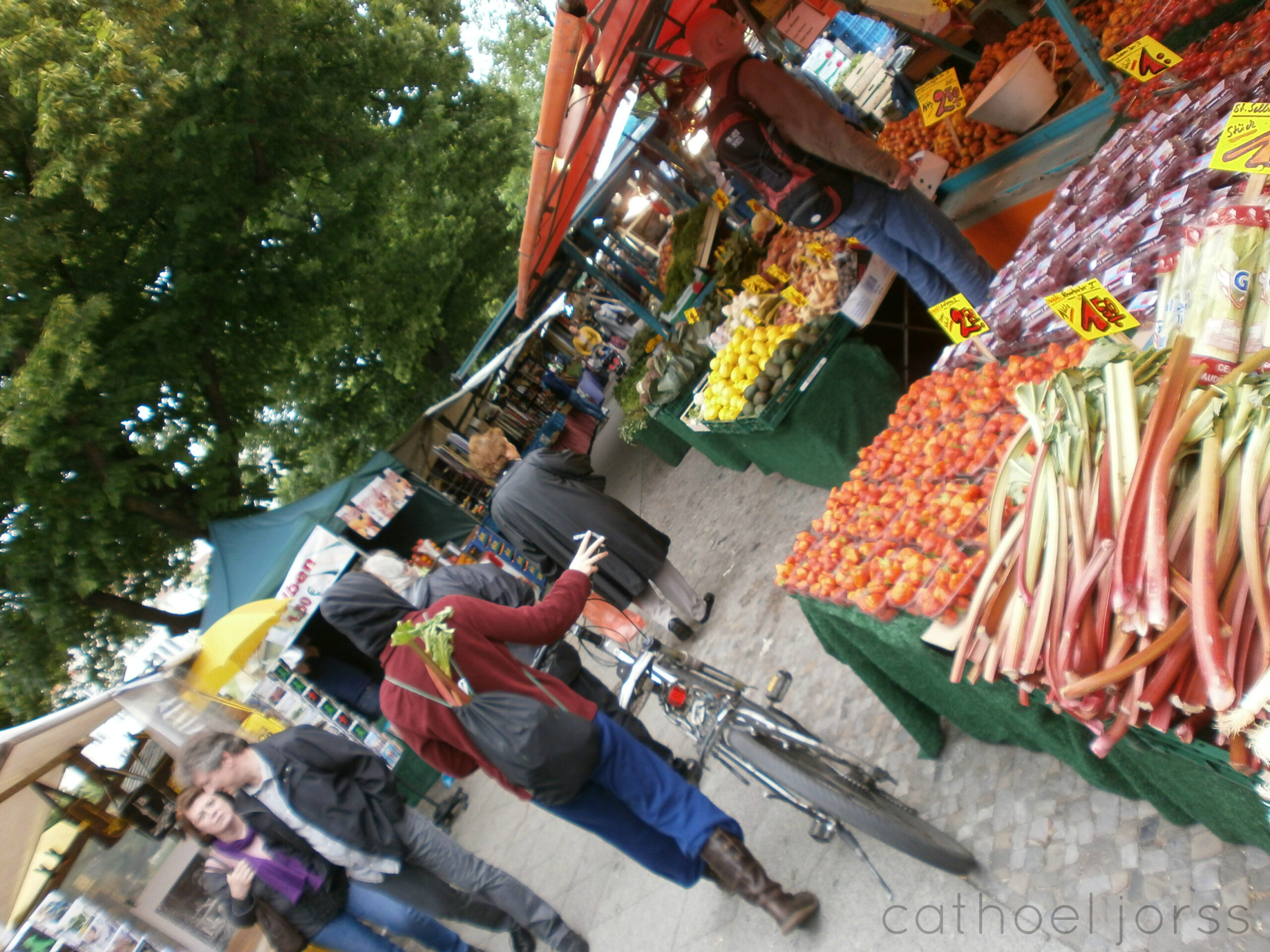
Went onto the market, transformed now with its leafiness half on the ground, and half overhead; I wanted parsley, and something else leafy, maybe spinach, and potatoes. So many types of potato, each ugly in its own precious way, it would be nice to buy one of each and label them with toothpicks (i, ii, iii… xii, xiii, xiv) in order to find out once and for all how in flavour and texture they veer. The buying of parsley I always find a puzzle here: what is the German for a bit, or a bunch? I didn’t like to ask the grumpy lady in mittens who served me today smilelessly. At the smoked fish van in dappling shade I hesitated over the golden reams. A guy was playing steel drums in a kind of trance, which he had transmitted to the several small families swaying in front. I said to the fish seller when he came back in, I’d like a couple of those fillets please. I said, ein Paar: a pair, a married couple, a few. He picked one up in his long curving tongs, like a beak. How many is ein Paar? he asked. Well, I said; actually, two. Ah, he said, laughing: so an actual pair! He began wrapping the fish, chuckling softly to himself. Ego stung me and I wanted to find a cunning way of letting him know this is a second language for me, over just a few sentences people don’t always pick it up. You know, I said, artlessly, guileful: This everyday stuff is the part I find hardest, in German. How many is a few? How much parsley do I need? Is it a posy, a bouquet, a… well, ein Bisschen: a little bit?
He knotted the paper bag and spun it with that deftness so stylish in stallholders. He was considering my question. Well, he said at last, you can’t go wrong with a little bit. Ein bisschen. It’s not a posy or a “little flower” (“Blümchen”, I had said). Ein Stück, a piece… yes…. you can always buy a piece of parsley.
Peter Pepper. I took the parcel of fish and stowed it with the parsley in my bag. Thanks, I said. He handed over my change. “And now, you get ‘a little bit’ of money back, too,” he said, using the familiar form of “you”, which gave me a warm feeling as I stowed the piece of money in my pocket and wandered back past all the closing stalls with their shrieks and two for ones.

-
they don’t speak
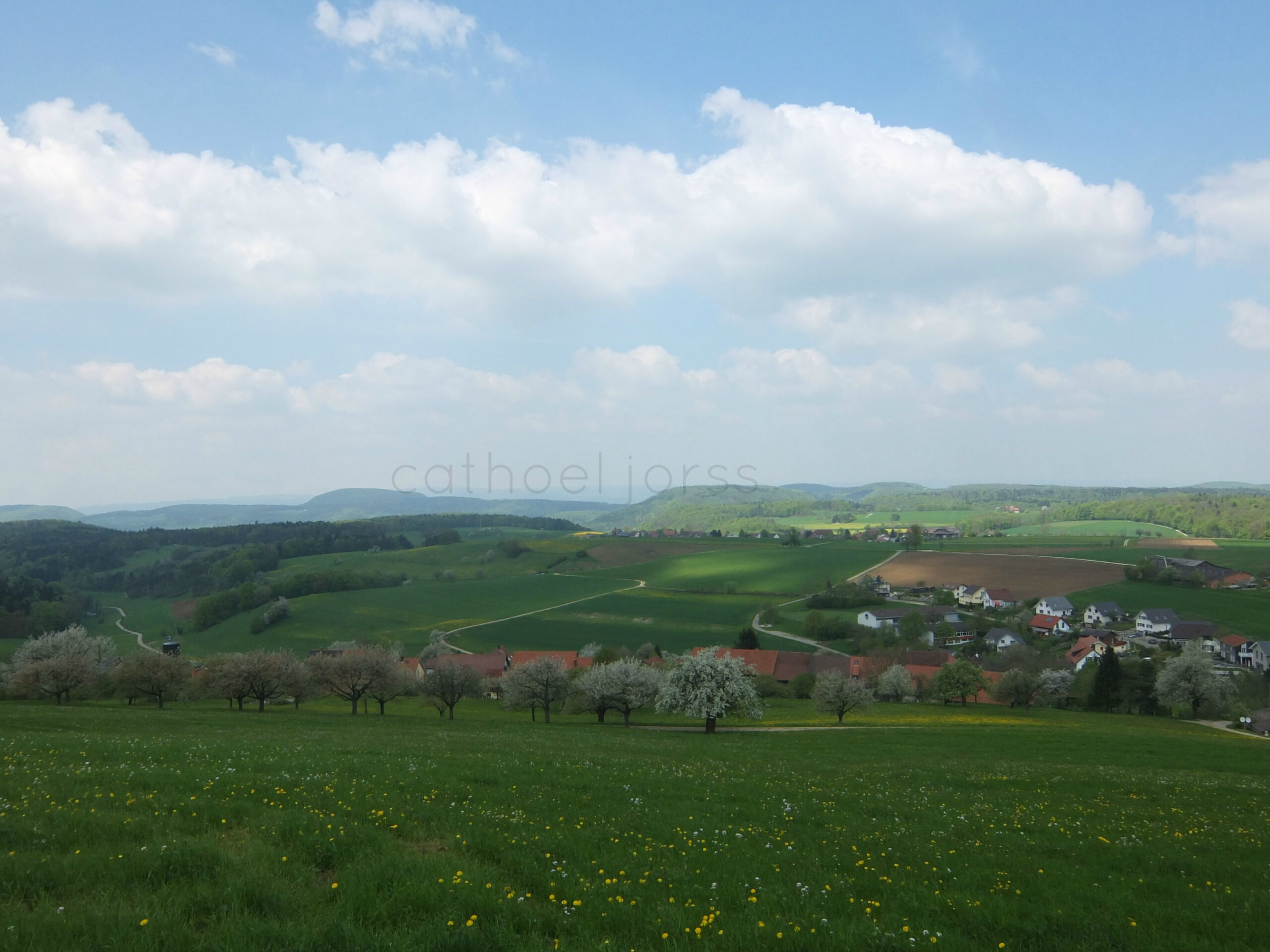
Switzerland: land of milk can honey. I am back and the milk from the Bioladen is fresh and sweet and creamy. Honey-coloured cattle browse along the path flicking fat mosquitoes with paint-brush tails. It’s all pretty: even the oversized Lego industrial landscapes. Life is orderly and a little prim. A church on every hillside: Catholic and Protestant (they don’t speak). The building of minarets on mosques is now forbidden here, it contravenes the Constitution. The snarling sprawl of Berlin overgrown between upright German houses, climate chaos and poverty seem very far from shore.