Tag: homecoming

  • crepuscular

    crepuscular

    As the evening creeps across the land/groping its way towards us like the bleeding protagonist stabbed who refuses to die/darkness is a promise/like cousin cool/do you promise? I have sweatered so much this day I can jumper no further.

    As coolth lays its stealth in a beam lowly under the trees/we stagger out/of the shopping mall carrying strawberries and tomatoes in my hat/swung by its string, a bonnet punnet/and all the trees/little and large and oblivious to cars one hopes/lay their shadows down/long on the green evening grass like ballgowns’ trains/everything wonderful cool beneath the branches/one by one the skateboarders pluck their boards out of the water and go home.


  • bristanbul

    bristanbul

    Brisbane always was like this…. for me. Suburban and shrill in the day; shadowed and sultry by night.


  • poor freedom

    Queenslanders! If you want to feel good about everything, get yourself a European recently arrived from their winter and take him to the beach. Mine had never seen waves above hip-height before, but he charged into the surf like a snuffling dog. Every time I wiped the salt from my eyes there he was, plunging and lounging, spearing under curly-headed wavelets like a cormorant, trying to catch already broken arriving waves (“This one’s mine!”), surfacing with a massive smile across his face. I lay in the water, it’s been so long, and the line of buildings tilted on one end of the sea and the mountaintops tilted at the other. Plumped up Australians dragged their bellies and boards. When I was a child only ladies who’d had children were jiggly, and old men might have a beer belly: now it seems the whole nation’s jiggling, even muscular men in their 20s. Sugar, sugar. The water accepted us all. The ocean too is thicker and slower than it used to be and off the coast of California, apparently, carpeted with deceased sea creatures. But on the surface between the flags we were quite happy, one of us ecstatic. He plunged past me spluttering in sheer joy, legs flailing. “It’s… like…. pure freedom!” he shouted.


  • sun crema

    Sunday. Drive down to the beach. Past all the worlds. Seaworld, Dreamworld, Movieworld. This tiny horseshoe strand was a favourite of mine. Now to get to it you have to round a dozen roundabouts: long miles of wilderness which now are smooth resorts. At the mouth of the bay a smooth cafe stands. It is full with people in smooth shoes and clothes. The irons have entered their souls. Only a few dozen are on the beach itself, or in the ocean, the water and sand rough on their skin. Years before, the beach would be full, the cafe empty. As we come down the hard-trod beach bridge with our feet scritching the yowling hot dry soft sand a girl comes up past us, body folded round her swimsuit the way a skin forms on sour yoghurt, smooth youth creased and jiggling like old age, her eyes down, her thumb ardently scrolling the smooth glassy surface of the palm-sized computer which gives her a mirror, I suppose, of who she is on this wildly sunny day on this hidden beach between the shaggy headlands and behind the smooth cafe. She has bought a lifetime season ticket to Phoneworld. She is never alone, but she’s always alone. Oblivious and knowing behind her the surf brings in its trays of crema.


  • ice cream man

    ice cream man

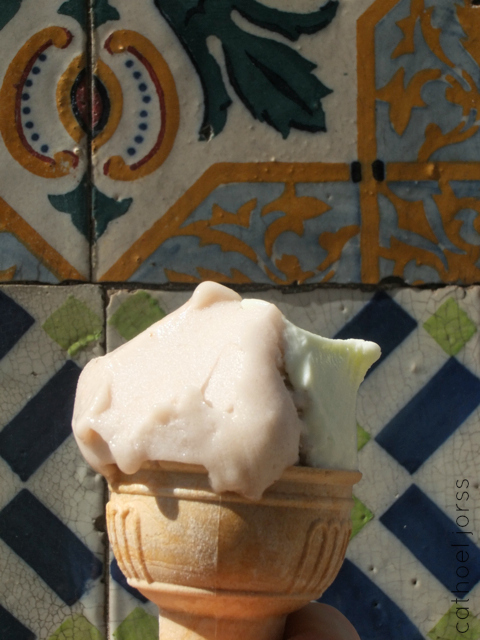
    Something I dig about the guy I’m travelling with. We are staying with my folks and Mum, fielding a houseful of hungry guests, sent us down to the supermarket with her credit card, and her pin number written on my wrist. We did the shopping and then looked at one another. I said, “Hey! We’ve got Mum and Dad’s credit card! And access to everything they own! Mwahahah!” I was just about to make a joke like, “Wanna go buy a car?” when my Berlin companion opened his mouth. He said, “Wanna buy an ice cream?”


  • peeling

    I’m peeling. Last time this happened I was about 14. Went for a long long walk and it was early in the morning and I just forgot about the sun. ‘Hey there, zombie girl,’ says my favourite person. He doesn’t, to his credit, reach out to tug shreds of skin off my nose. The lozenge of bright red skin at the base of my neck resembles the neckline of some elegant 1940s bathing costume. I’m just sure it does.

  • the peace yard

    Walking home down rainy streets my last night in this house. Tomorrow unnest, budge myself, nudge, shift. Winter has landed with its big wings. Now the warmth of the indoors folds us in, the subway’s roaring throat, we all descend, we bring our dogs and biscuits. I saw two small boys fighting in the subway train, one slammed his hand down on the other one’s shoulder their sister put back her head and roared. They were hipheight to everyone’s delicate glances, the mother looked estranged. In this city if they serve you tea it is a mess of hot water in a clear jar (hard, chalky water, that dries white) and with spoon and bag of leaves laid on the white milky ceramic… neatly. Effervescent neatness, the German delight: effortless neatless and high art and kitsch. German joy, Friede; German graveyard, Friedhof. I’m leaving I’m leaving. I’m coming I’m coming: Australia wait for me. Maybe forever as jet blurting travel grows inexcusably wrong. Standing stranded on the traffic island as the creamy lights pour in three strands down the hill like pearls and the crimson lights pour like Christmas up: I said something aloud to myself in German, I started to cry. Thank you for your hospitality, your kindness, your warmth to all the strangers, your strangeness, your calm. The leaves shaped like webbed hands that wave in the wind. The strings of lights under the lip of each awning. The Grüss dich, the Tschüssi in shops, the dogs. In 24 mornings more, I’ll be gone.


  • between the fingers of Fidel Castro

    between the fingers of Fidel Castro

    I know an eighty-year-old cafe where the day passes smooth and coiling as molasses poured out of a dented tin. I sit in the smokers’ room, not because I smoke but because of the candlelight and conversation. Today I stopped at an antiquarian bookshop that has trestle tables out front. A recent conversation reminded me I had never yet read Machiavelli’s The Prince. The bookseller had two copies, an Everyman and a Penguin; two different translators; a quick skim decided me I would buy both, and I carried them to my favourite table and curled up there, thinking if I read these two versions both at once, maybe I’ll be able to triangulate.

    I read very slowly, laying each book face down at the end of a chapter and taking up its companion. Three tall, lanky, and very good-looking men came through in waterproof jackets, carrying boxes and boxes of lettuce and potatoes. Afterwards they sat down at a small table under the pastel portrait of Fidel Castro (cigar) and drank coffee and argued for over an hour. I tried something new off the menu: it’s German food, everything is new. Fidel Castro’s fingers resembled an abstract of a human hand carved from potato. Everything carved from potato. After the War Berliners relied on an American Rosinenbomber (the “raisin bomber”) dropping boxes of foodstuffs and dug up the forest called Tiergarten in order to sow vegetables. I thought of the various cafes I know in Brisbane and wondered how it will feel to adjust. The temperature has plummeted, and isn’t that a most marvellous word: like a fruit yet unripened on the branch, that finally gives in and plunges to the ground. Last night returning from a long forest hike it was perishing, four degrees. I ate my Weisswurst and Brezel and thought about the differences between reading in a cafe full of other people reading, and the dinner experience of last night, in an unreconstituted jazz and blues pub, where the cute barkeep turned down his infestation of immemorial blues and turned on a large white roped-up screen. Oh, God: Tatort. The awful detective show Germans watch as Sunday religion. Somehow the roomful of unstirring people watching a fourteen-year-old girl’s character get raped – the oldest man put his head into his hand, others watched unmoved – was so blinding and so effing awful, we got up and left. That household full of habitual viewers sharing the dirty hot tub of popular TV had somehow less in common than the people crouched in corners at my newly beloved red checked clothed cafe: reading newspapers or, in three cases, books, we were each of us turned away from our commonality but yet reminded me of swimmers foraging deep in the saltiest water, where the sunshine is sweet, where the strands of warmer and colder waters pass over one’s legs caressingly and there is always something further to be discovered. In only the one ocean, in always the one sea.


  • unforgiveably gone

    Today my hair kept tangling in the buttons at the back of my coat. I spent a long time standing in doorways or under trees, thoughtfully fishing there with my fingers, dreamily, gingerly unwinding. I’ve been spending time in a cafe that was opened “ca. 1930” by the stout pretty dark-haired woman whose blurred photograph on the front page of the menu (hand-written) may have been one of the last ever taken of her. Berlin’s dark, sour, staining history runs alongside every step, like the raised seam of bricks which traces where the much more recent Wall has been carted off and destroyed: maybe she was torn down, maybe deprived of her life and livelihood, maybe dispatched, grossly outraged, starved, murdered, ruined, unforgivably gone.

    The brass plaques, size of a cigarette packet, that here and there replace one or two cobblestones with a name or a family of gone names are, I found out, the work of one artist.

    I spent much of the day in her cafe, writing and writing, had a bowl of broth with pancakes rolled and thinly sliced into it, lingered, in the air spiked with smoke, over a menu of dishes I couldn’t understand. Because even where I can translate, the concepts are unfamiliar and dim: Leberknoedel, Schupfnudeln, alles mit Kartoffelecken.

    When I came out the blue hour had struck and everything felt festive. I went into a hat shop and wound my way along the walls right to the back. I picked up and fingered things, stroking and probing. I stood in front of their long polished mirror wearing a crimson top hat that was too big and came down over my brows.

    My new Kiez is studded with turreted buildings, an old tollhouse, an old gatekeep. Many of them now are restaurants and the golden interiors, the white clothed tables, the solicitous bending of waiters in the windows – the shimmering, old-glazed, inviting windows – were so irresistible. I resisted. I went into the supermarket which bursting like fruit from a basket was so much more vivid, more lively than the dreamily acquiescent twilighttime street, and filled with families. Stubbornly determined to cook in my two-room palace of hired minimalism which has no pepper grinder, no chopping block, and no knives, I snatched up a small sack of potatoes, some garlic and onions, a roll of butter. I have powdered stock and a Swiss army knife and I reckon it’s enough to make soup.

    It’s so cold. The insides of the windows are cold. Not too cold. Not just yet. Deliciously so. My landlady hovers like a ghost in the hollow of her white apartment, her beauty, her wide frightened blue eyes with their large pupils staring like bullets. I found our bed last night to be beautifully cosy and soft, woke to a window of tree. Once I’d had a bath there seemed little else to do and I felt so happy about that.

    In the evening after I’d moved in, before the bath, I went out exploring, feeling hollow and hungry inside. A restaurant golden and beckoning softened the corner of my new street. I stood shivering in the dark for ten minutes and walked up and down and up and down again before I found the courage to walk in the door and thus enter its enchanted, entire, intact civil world. It was disconcerting, after all this long travel, how hard it felt just to walk in. Intruding on the community of this new district, unknown to me like a new city, by this decision to eat out took far more courage than I’d expected. I so often eat alone and I like that. But I guess my adventurousness is exhausted.

    In Melbourne I used to notice this, every morning even when I’d been writing over my breakfast in the same cafe every day for months: the forcefield that people establish or emit when they form an unconscious community, shiftingly, by being all in the premises, by forming a varied, large party, strikes me like shyness buzzing electric across the doorway of every new cafe, and always has; this felt far harder.

    Now, this evening, everything feels different. I can feel I have found my way. The new part of town is becoming my Kiez. Its dark streets of houses feel now already less intimidating and austere, more quietly homey and interesting and wan. My sublet in its dank courtyard is divided from the welcoming bustle of shops by a river of rushing lights pouring the hill, like sand, from one glass to another. My sight clears and I start to see. Not everyone here has money. Between the lifestyle shops are the lifeline shops, where hungry people find what they eat. I am hungry. I’m always so hungry. At the supermarket checkout a man in front of me said to the cashier, Holst du mir mal vierzig Cent? Ich habe keine Brille mit. Can you grab me the forty cents? I don’t have my glasses. Obligingly the guy sorted through the coins, patiently, turning them and showing them til he found the right ones. The guy behind me made a friendly remark and I turned it to advantage – a politician! Laying a finger on his bright yellow toilet rolls I asked, Have you ever thought of trying out the recycled kind? No, he said, in a tone that showed it’s never crossed his mind. It’s just that the trees take such a long time to grow, I said. And it takes a long time to replace the ones we chop. He gave me his twinkling smile. Next time, he promised, I’m going to remember that. I piled the stuff into my knapsack and took up the mesh bag of potatoes by its uppermost root. The corner of the sack yielded a perfect potato, an archetype, shaped and sized exactly like an egg. I closed my fingers and palm right round it and used that to carry them home, internally a handle. The high blue wintery sky and red lights were so absorbing that I accidentally walked right past my street and found a brand new park. The grass was still dimly green but the trees already blackened by night. Little children darted round the path, excited, calling out. As I turned back for home I saw a little family, with very young children, slowly climbing the damp stone steps carrying candle lanterns. The parents’ lamps genteelly leap-frogged each step, one by one, the candles swinging three feet up from the stone. But the littlest child, to whom walking is still a labour of concentration, held his lantern outstretched and swung it right forward with the effort of each step’s climb. I came home and put the potatoes on and put on all her lamps. The window above the bare desk is a square of black in this white soft room and I can hear as I’m typing the dark-throated toll of some old church’s beautiful, wild, German bells.
  • eggshellac

    Like a little eggshell in the sky. I have moved into my final Berlin sublet, just 3 weeks, and barely dare breathe. Everything is white down to the phone, painted roughly with house paint but still black on the inside when you pick up the receiver. In the little white bathroom a toilet with no lid and no seat. A tiny wooden vegetable brush perches primly across the back of the… mouth of the sewer. I said to my landlady, who is off to India for three weeks to translate Arabic manuscripts, “No toilet seat?” “Oh, did you notice that? Does it bother you?” “Well…”

    She said, “I guess it’s a bit cold, and kind of uncomfortable, but it broke and I just realized, I don’t really need this.” I foresee that within a few years she will be living cross-legged on the head of a pin. The place is quiet and curtainless and resembles a tiny Buddhist monastery. Floorboards painted white. White rugs which, she showed me, she cleans with a little brush. She pulled out a rush cushion from under the low white bed to show me: “This makes a great table, for eating.” Then she set off in the November rain through streets full of sticky wet leaves to fly south, with one little blue bag, wearing a pair of socks inside white sandals. Mysteriously there is no mat at the front door, yet everything within is pristine. My landlady had also painted her little computer white, including all the keys, but then had to scrub most of them back to the original black so that she could see what they were. Her patchy keyboard in the chalky white room was startling, a giant crossword. We exchanged money and keys this morning and she showed me around. “I have these two spoons.” Four plates, two bowls, and a couple cups, no pepper, oils, pans, forks, knives. “Poor little flower,” said the friend who helped me carry my suitcases. “You get the feeling that a gust of wind would blow her away.” I on the other hand will not be having that problem. In just 18 months my pile of cases and boxes has swollen like paper in water to twice their original dimensions. I think of the old cartoon of a bag lady pleading not guilty on a charge of shoplifting “by reason of static cling.” To get home I will have to divest myself of a rowboat full of leaves, intricately rusted bottlecaps, brochures and books that I picked up and brought home because they seemed beautiful or interesting. This might be the perfect place to do it. In between, I will loll in the tub and read, an egg in an eggcup in a large eggshell in the grey, minimalist skies over Germany.