In the late afternoon I walked down to the square. I’ve been indoors now every day of eight weeks. People were sitting round the edge of the grass as though it were a swimming pool they were dangling their legs into. The trees overhead are finally thickening with green.
A man who doesn’t have much had his tiny barrel-shaped speaker out and was blaring the blues. A bystander, so drunk he had lost his consonants, pitched forward and then arced backwards from the hips, hollering the blues. We have all been indoors since winter finally ended. We know the urge to holler. We know the blues.
Here the blues come marching back again, pouring from the settled sky, finally at rest and displaying all its sunny virtuosity which is kept from us in this dark city eight months of the year by thickset cloud.
The sky — the gorgeous preposterously cloudlit heaven of the springday sky. I sit down among the crumpled cherry blossoms, almost grey now in the grass. The sixth floor balcony where two weeks back a man had serenaded us with his saxophone is empty and the windows all dark. I sit watching two stout men drinking their beers, asking myself how is it I would know anywhere in the world they are Germans. Someone across the square sets up a rival speaker blurring AC/DC. Highway to Hell! screams the drunken singer, able to enjoy everything at once. A Turkish man who cannot afford to quarantine is collecting beer bottles, asking everyone first, may I have this. His face has patience and great sweetness. He stows each new bottle in his clanking bag. The pizza shop is open again but only for takeaway, ‘every one of our pizzas is nearly round’, their blackboard boasts. Last year at the end of the summer they had a drinks special chalked there: Soup of the Day — Gin Tonic. A man in a black Volkswagen sleek as a Beemer edges right in to the kerb and leaps out. He is prematurely casual in pink linens with a knotted sweater, it’s not really all that warm but he seems insouciant, he plugs in his car, a rental car, an electric car, and locks the keys inside the glovebox and goes strolling perfectly pinkly away. Like all of us, he is in rehearsal for summer, which is the future: summer 2021 perhaps, we’ll be able to travel, we’ll all be lightly and attractively attired, we will be slim and competent in public places, we’ll be free.
Tag: homeless
-
core grimey
Today I am going down to my favourite Berlin cafe to write. Last time I was there was four months back and I did not plan to be away so long. It was winter then and a homeless man came along the rows of customers to beg. He stood for some time reading over my shoulder, and when I looked round, he was nodding and smiling with glorious approval. He put his hand around me to scroll down so that he could keep reading. He put his index finger, seamed with grime in its peeling fingerless glove, up to my glowing little screen and almost touched it. He kept pushing his finger under the lines he liked, making little grunts to let me know he thought my writing was grand. I was so chuffed by him. The screaming espresso machine and the scraping of the stools and people chatting in German as they unwrap their croissants and unfold the thoughtful, liberal, kindly and independent German newspapers stacked in the corner are all sounds I have missed.
-
pedalling home
Pedalling home along a tree-lined street which is set aside for bicycles, I heard a crash. A man reaching up to put his brown wine bottle in the brown glass bin had tipped forward and toppled like a tree – at first I thought he must be drunk. There was nobody about, just him and me. I had jammed on my brakes.
He actually flung his legs up in the fall and took a few tips to settle, like a rocking horse set rocking. “Alles okay?” I leaned my bike and ran over. He was getting up painfully slowly and had that embarrassed expression that usually indicates want of serious injury. “Die Kante…” he explained as I reached him, the curbside had a camber…
Falls, as we know, can be deadly in the elderly and I remember that Leonard Cohen had a serious fall, as so many older people do, in the days before his death. I remember locking myself in a wardrobe to cover my face and howl, when I heard that he had died, two weeks after Dad’s funeral. Our St Leonard of Koans.
Shakily restored to his own feet, the man immediately turned to pick up his empty bottle and popped it in the open mouth of the brown bottle sorting station. They have three colours and beer bottles commonly have worn whited shoulders from rubbing companionably up against each other on all those trips back to the brewery and then the store. Och, Germany: you slay me. It’s like a magical land in which everyone behaves the way I’ve always done: we’re all in this together. I had just passed a crossing where another crash heralded a tipping bicycle, whose basket was filled with neatly sorted bottles, possibly heading for this same recycle station. They started to bounce and break all over the cobblestones. Before I could react a dozen people had swooped in to help, propping their own bikes and stooping like long-legged birds.
I asked the elderly man, “Sind Sie verletzt?” Are you hurt? He passed a hand uncertainly over the crown of his head, showing me where there might be an injury, and in response to this mute plea for mothering I passed my own hand very softly over the tender scalp, as downy as a baby’s but for the sparse, short, grey, bristling old hairs. “How are you getting home?” I asked him, “you’re not driving, are you?” We stood there assuring each other. I told him the skin on his head was not broken. He told me he would be sure to be careful getting home. “Just be tender with yourself,” I told him, as I should rather more often tell myself.
Nearer home I chatted on the phone for a long while with my dear friend, on a park bench under a stand of trees which were shedding their golden leaves as I watched. The light was just so. I found a stinking dog shit smear on the back of my hand, and made a face and started wiping it off on the grass, still talking. On the far side of the square a street dweller pulled from his breast pocket a little packet of paper handkerchiefs and drew out a fresh one and offered it to me. He bowed. I crossed over there and took it, still talking, thanking him.
During the phone call I watched two dog owners whose dogs – one large, one small – had woven an enthusiastic wreath running counter-clockwise, passing the leashes over one another’s hands. They kept trying to untangle the beasts but the dogs running clockwise sniffing one another’s butts had passed into a blur. I saw a toddler pitched forward and running on the balls of his feet as he approached the road. There were no cars coming and his mother looked on unworried from a few paces behind but nonetheless a young girl stepping onto the pavement with her friend stopped her body in front of him, forming a kindly barrier. She stood mashing her feet and chatting to him, distracting him and making it a game, then stepped aside without a word when his mother had caught up with him and he was safe.
This communal parenting moves me to tears. I told my friend and we both laughed with joy. I described to him the two dogs blurring themselves into a wreath on the cobbles, their owners doe-sie-doeing from above. It was dark when I put my phone back in my bag and walked uphill past the man who was still standing by his bench, with his beer, gazing up into the trees. He had on a leather hat with a feather to its brim and standing by him was a trussed wheelbarrow loaded with his things. I had gathered all my groceries in two hands and clutched them to my chest to stop them falling. “Thanks again,” I said, “for the handkerchief,” and the man said, ascending to the familiar or affectionate you, “You’re very welcome,” and I said, matching his informality, “That was love of you,” das war lieb von dir, and he bowed and pressed his hand upon his heart, and I pressed my crowded with bottles hand over my heart which was cluttered with a jar of honey, a bottle of biodegradable cleaning spray and a heavy bottle of milk; the other, free hand was splayed to keep hold of a second jar and a second bottle and I pressed the glass into my heart and we smiled at each other, at the end of an autumn day so beautiful it would make you want to resurrect belief of some kind in some kind of deity.
-
late summerhaft
Across town today I had the impulse to come through an overgrown island of trees that surrounds a church, and went wheeling my bike along its narrow, littered path where, if I tuned out the traffic, I could feel as though I were walking through a tiny woods. Someone is living there and had stacked their possessions under a low, clotty pine and strung their meagre collection of spare garments on a bush to dry. There’s still sun. Stringy and mean but sun nevertheless. We have had perhaps fourteen inconsecutive days of heat and sunshine this summer and already in August it is growing autumnal. As I was pushing my bike a man appeared beside me carrying a green plastic watering can. Berliners are busy when the sun comes out with their wild, colourful, shared public gardens. I’ve seen a woman dunking her can into the canal on a long rope so that she could tend the sunflowers she or someone else had planted and marked off with red and white striped tape. “What,” he said, cheerfully, “a man’s bicycle for a lady? Come now.”
“It’s true,” I said: stimmt. And we both looked down at my voluminous skirts, two prints in varying shades of indigo laid one over the top of the other. I passed a tiny preschool or as they call them, children’s shop, with nine little bicycles locked together out front and two double-barrelled prams parked side by side. As I came round the corner I started to laugh. A teenage boy was standing outside his ground-floor window, holding the end of a huge scarlet canoe which his friend fed from inside. He looked at me and I could see in his eyes the enjoyment of his instant recollection of the picture they must have made. They started laughing, too. It’s not the weather which keeps me here.
-
is still a man
A homeless man was sleeping in the stairwell when I came home. Or, to put it in the terms which my instinctive body understood, a stranger, appearing unexpectedly, had barricaded my door; his body was coiled and his face hidden; I had to step round him to get in.
Raised in Australia with its pleasant acres of ground receding from each family’s door to the nearby street, and in Indonesia where we lived in a compound, surrounded by high fences topped with broken glass, I struggle to ignore the constant stampede of human traffic that passes within a few feet of me where I sit at my desk or curl on the couch. That is mostly families who live here, plus the thundering party animals upstairs. Occasionally delivery men, wrong numbers, post. This was new: the street door downstairs stood propped open, because dusty workmen were clambering in and out all day long with their lengths of wood; a man had slipped in, with all his belongings in two filthy rucksacks, and curled on our stair.
It was hard for me to be compassionate. My first instinct was fear. I felt afraid of him because I couldn’t see his face. I unlocked my own door as quickly as I could and tried to shut it soundlessly behind me. Then I tried to think what to do. There was only one thing to do and that was, make him a cup of tea. It is so cold. A man without a roof is still a man. I boiled some water and hesitated in front of the stock pot of chai masala I brew every few days on my stove. Perhaps it would be too weird, too spicy for him. Germans don’t like tea; if you order it in a cafe you will get a tall glass of hot water with a tiny plate on top, a tea bag resting on it. I didn’t like to offer him coffee as he was clearly about to try to sleep.
I made the cup of tea in a clean honey jar, not liking to risk one of my landlord’s mugs. It was hot and I had to cut a strip off my old pyjamas, washed and stashed under the sink, to wrap round the glass with a rubber band so he could hold it. I added milk and honey. Then I went cautiously out onto the landing.
He was still there. I came towards him, keeping at arm’s length, fearful of alcoholic rage, resentment, violence. “Entschuldigung.” He turned away, gathering the hood of his jacket more closely around him. “Ich habe Ihnen eine Tasse Tee gemacht. Es ist Milch und Honig da drin, und Kardamom. Für die Wärme.”
When I get nervous my German deteriorates. What I tried to say was, Excuse me. I have made you a cup of tea. There is milk and honey in it, and cardamom – for the warmth.
He sat up. Pushed back his hood. I knew him – a man who often begs in the cafe where I write. This was not reassuring as he carries with him a sort of leashed impatience or suffering which made me yearn to be not recognised by him, lest he learn where I live. “Was ist drin?” he asked. So I repeated, Milk and honey. For the warmth. “Just leave this standing here when you are done.”
“Danke schön,” he said, taking the warm jar in its undignified skirt.
“Bitte schön.” I ran away. Locked myself into my house and roamed for an hour from one room to another, unable to concentrate. Why have I three rooms and he has none? Why have I not listed my living room as a shelter for some person recently arrived from devastated Aleppo? I picked up a book on mindfulness and laid it down again. There are days when I cannot even leave my house, when the thought of facing anybody undoes my heart. This is a luxury.
I sat on my bed with my head in my hands. It seems to me life is filled with suffering. It seems to me every one of us, before we went down this path that has brought us into our limited, anguished adulthood, was somebody’s baby, somebody’s child, and brimming with almost infinite potential and easy to love. I think we get harder to love as we get older, as every classist, racist anti-abortion campaigner so elegantly demonstrates. I went out an hour later to my chores and it felt so sweet and reassuring to find the skirted jar resting on the common window ledge, which looks out from the ‘stair house’ as Germans call their stairwells into the bleak winter courtyard behind; the man was gone and as I drew closer I could see he had drunk about half the tea, much good may it do him in his hunted, hounded, and unwelcomed bitter day.
-
brisbanally retentive at last
Brisbane. Took me ten years to settle here, having uprooted from sultry Jakarta and a school which had barely two students of each nation in one class. This was the first time we’d lived in the suburbs, since I was a tiny baby by the sea, a child learning to walk in the desert. I used to lie on my bed listening to lawn mowers almost frantic with the choking feeling that lives go nowhere and end in dust. Lawn clippings and agapanthus and dust. But then there was sultry West End, the village which now has devolved to a suburb at last. And then I moved away and now I am back. It has taken me months to move out of the suburbs and into a place of my own. And six months and tonight I feel the trickle of sweet familiarity at last, a trust in the landscape, a kind of security that releases a kind of intrigue it is hard to feel when you are always new, like how it’s hard to be deeply creative and free and wild with no safe home place and without a routine. I felt I belonged at last. God damn it, Brisbane.
-
trepanned
A confluence of kindness in the Sunday cafe this morning. People were slouched about, eating their brunch. A series of wan songwriters entertained us from the speakers. When we first walked in a classical guitarist had just done playing, and when he walked around the tables with his cupped hand outstretched, everybody gave. Then a commotion at the doorway. A very very drunk lady sloshed her way in. She shouldered her way between two quite closely placed tables and sat down. Oof. Began talking to the woman on her right, who clearly didn’t know her. It was a long bench seat along the wall so now all three women, ladies who brunch with a lady who lurches tucked between, were sat shoulder to shoulder like pigeons under the framed oil paintings of Karl Marx. The place is called Cafe Marx, been there for years apparently. The drunken one pulled off her filthy beanie, revealing sparse tufts of grease-darkened hair. She was loud. And she looked smelly. The woman she’d spoken to rose to the occasion like the Queen. “I know,” I could hear her saying agreeably, “it’s freezing outside.” The drunk one said something inaudible, affable. “Ja,” said her invaded neighbour, “gemütlich.” Gemütlich is a word like the Danish word hyggelig: cosy, it means; warm, comfortable, comforting. The kind of word you invent when you live in a climate where a person consistently turned away from every door can die just by sleeping in the park overnight. The waiter came over to reason with her. Her voice rose, she waved her beanie at him. At first he said, Can you go, please, and You will have to leave, and Do you want me to call the Police? “I am the Police,” she said grandly, settling her beanie back over her ears. But the women either side of her and their companions were wonderful. Unworried. Well, worried but cool. They started suggesting to her, Perhaps you’d be more comfortable in the corner there, that looks so cosy, wouldn’t you like to have a table to yourself? Why shouldn’t you have your own table? “Yeah,” she said, in tones of worn aggrief, “yeah, why indeed.” And as she staggered to her feet and lurched towards another table (ours) the waiter once again stepped in, more respectfully, more kindly this time. His customers had taught him that – or rather, reminded him, as we do for one another. Gently he took her arm. “Could I ask you to sit outside?” he said, in such courteous tones that she was able to pretend she had been given a choice, to deliberate a moment and then decide, “Also dann.” Ok then. He escorted her to the door, more like a nephew than a bouncer suddenly. The people on the bench seat shifted and laughed quietly, restive with relief. You know how belligerent you get when you feel like your humanness has been ignored. She was aggro. But lost. In the wind outside she sat down with some difficulty. I went over to the counter and spoke to the waiter in a low tone. “Das haben Sie so schoen gemacht,” I said, “so freundlich.” You did that so beautifully: so friendly. “Aw,” he said, looking down. He was putting something on a plate behind the high counter. I said, I would love to buy a coffee for that lady, if… you don’t mind providing one for her. (Thinking of the risk to his china). But by the time he brought the coffee, hot and rich with crema in a takeaway cup, she had gone. The overturned table and smashed ashtray on the ground were all she’d left behind. I walked up and down the square for a while looking for her but she had moved on. And would continue to be moved on, I imagine, all the rest of the winter. And would perhaps be picked up by the Winter Bus that goes around collecting people who have fallen asleep in the snow. And whose fire in the belly, lit and swollen from the magic bottle, might not be enough to keep them alive til morning, in the dark cold lonely treesung night.
-
why am I having to go through this??
The last time I was at the airport I watched a band of six merry hipsters in beards (boys) and ballet flats (girls) and narrow cuffed jeans stop at the boarding gate to take a picture of themselves. One volunteered to be not in the picture and the rest fell instantly into a Tommy Hilfiger pose, falling comfortably against each other, one shoulder sliding up and another down, all of them availed of a facial expression they could hold for many seconds without distress or strain. We went through the glass gate one by one holding our passports and our passes. The sixth and final hipster made an unhappy discovery: unlike his five friends, he had not paid extra for “speedy boarding” and was compelled to turn right where they all turned left and wait in the longer queue with all of us schlubbs. His face fell apart. It was wonderful to watch. He was tall and broad-shouldered and carrying a dense brown beard. His shirt resembled a lumberjack’s jacket. His voice came out whiny and high and aggrieved. He went all the way round behind the counter to reason with the airline crew member, waving his boarding pass: But you don’t understand! We’re all travelling together! Her expression was priceless. She tried a couple of times to explain the airline’s policy, too polite to point out that he and his friends were probably seated together and would all be reunited after fifty metres of tarmac in another four or five minutes. He looked as though he was going to cry. The woman rolled her eyes and let him pass. On the tarmac I saw two people kneeling in front of their carry-on suitcases, called out of the queue, stuffing in the extra handbags they’d thought they alone would be allowed to bring onboard. The tickets had cost around 70 Euros each and the airline’s posters at Schoenefeld Airport said, showing a man in a wheelchair, Travel Is Everyone’s Right. It seems to me equality and access are everyone’s right but jet travel is a fast-ending luxury. When we got on the bus at the other end of our short flight a beautiful milky-skinned red-headed girl was just in front of me. She showed the driver her pass and explained in careful German where it was she wanted to get to. He told her she would have to buy an extra ticket, her Eurail or whatever it was didn’t cover that. “But…” she said. She showed it to him again. With great courtesy he explained that this airport was outside the metropolitan zone, therefore: fresh ticket. She threw her head back and wailed. In English: “Why am I having to go through this?”
At the Turkish place round the corner from my street the guy rolled out a long streak of dough and made me a Turkish pizza from scratch, although rain was falling outside and it was five minutes to closing. I carried it home warming my hand, walking through the soft rain, watching how the illustrated stickers of snowy revellers in the windows of the Apotheke blared colourful contrast to the black sticky wastes of nighttime in December in Berlin. A small woman on the subway train had made a speech about how she is “im Moment Obdachlos”, homeless right now, and because she cannot live on “Luft und Liebe” alone, on air and love, she would be grateful for any small donation anyone could spare. Then she walked the length of the carriage stopping to ask everybody, and thanking with her musical voice anyone who put their hand in their pocket and gave her a small part of the passport to the travel that is everyone’s right.
-
three dog night
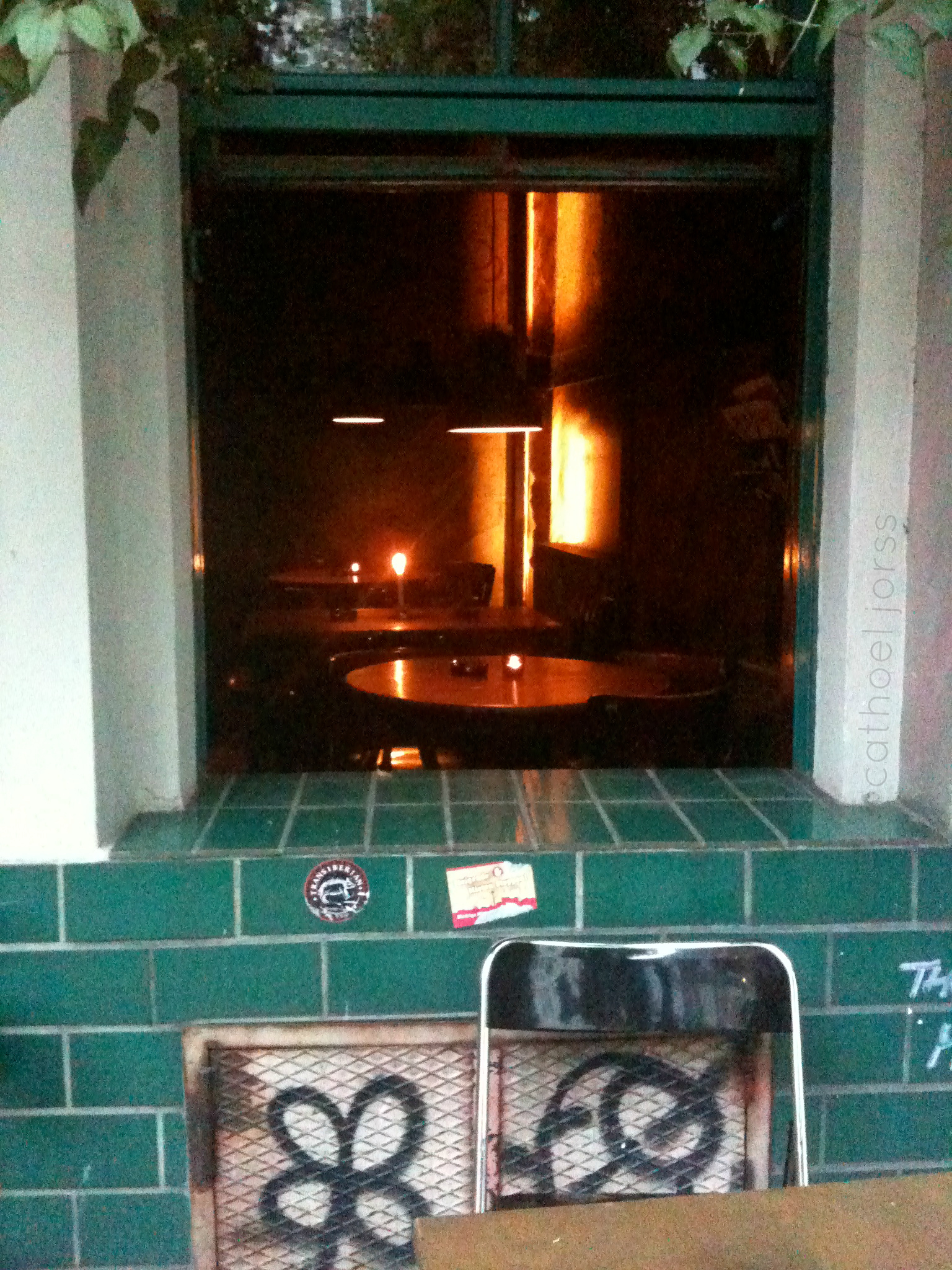
A bar in Berlin. I am greeted by a dog. “Na hallöchen! (‘little hello’) Wer bist denn du?” He is wiry and rough-haired and nuzzles my bag, clearly scenting the traces of Another Dog on its old leather. Then said Other Dog bursts in. Writhes himself in an ecstasy into my lap. Now we are three. Dog owner joins us: four. A lanky dude with his lanky red-headed setter lopes into the bar just as the music changes. Red-headed setter slides under our table where all the dog action is at. Berlin, I love how you let dogs into your bars. How a person thirsty but inconclusive and confused can say, Was war denn das? Was du gerade gemacht hast? What was that you just made? And the barkeep will explain. “A very old-fashioned Old Fashioned.” It was so good I sucked all the sugar out of the orange peel. A wreath of contented dogs round my feet lying like drunks. A man who sells Motz (homelessness magazine) came in and made his pleading spiel. Along the bar a line of hipsters sweet and tilt-headed as birds.