Tag: language

  • Eddie McGuire & Adam Goodes

    Eddie McGuire & Adam Goodes

    Eddie McGuire, prominent Australian broadcaster, compares Adam Goodes, respected Aboriginal footballer, to King Kong. The conversation, outraged on both sides, focuses on whether or not Eddie “is” racist. Thus it gets nowhere because no one can establish what lurks in the depths of his heart.

    If a child gets run over “by accident”, or because a distracted driver did not take sufficient care to prevent it, the child is still run over whether or not that driver “is” a “killer.” Let’s stop competing for most enlightened person who has the most Aboriginal friends, and focus on the damage and pain our unconscious, casual, lazy, habitual, over-entitled, selfish, spoilt racism inflicts.

    Even the fact that I label Adam Goodes “Aboriginal” and Eddie McGuire “Australian” shows racism. And ill logic, given that the truest possible “Australians” are indigenous. Let’s move this conversation on and start urgently examining and addressing our actions, our inaction, and their effects, before we get round to finally being more honest about the subtle motivations and conflicts in our hearts.


  • structural violets

    Group of academics at the breakfast table, they are five women and one man. “So it involves all of my areas of interest,” says one, “gendered language, and… I’ll be doing some structural violence…” She rolls her hand to indicate these topics are known and need not be enumerated. “Oh, interesting,” says her nearest neighbour. The group is companionable and everybody is talking at once. But as soon as the man’s voice is heard (“I did my thesis on that. ~My first thesis,”) everybody shuts up and when I look up they are five women listening in silence, clasping their cups to their bosoms in two cases, gazing at him as audience. In the tiny elevator I encounter one of the women and tell her what I saw. We ride up through the building in peels of laughter. She is clutching a muffin in a napkin, minutely nibbled. “Oh,” she gasps, “thank you, that’s really interesting! Oh, I’m going to reflect that back to the group.”

  • Neil Young’s baby

    Neil Young’s baby

    This cafe has changed its muserly, miserly, whispery music for Neil Young. He owns the business. His voice is quiet but sure and it penetrates. People gain confidence in such good musical hands, or seem to, and soon the hushed conversation level has risen like water roaring and the blond baby sitting on his mamma’s lap inside the window has piped up too, being part of things. “Ahb!” he says, dancing his feet: “Ah, ahb!”

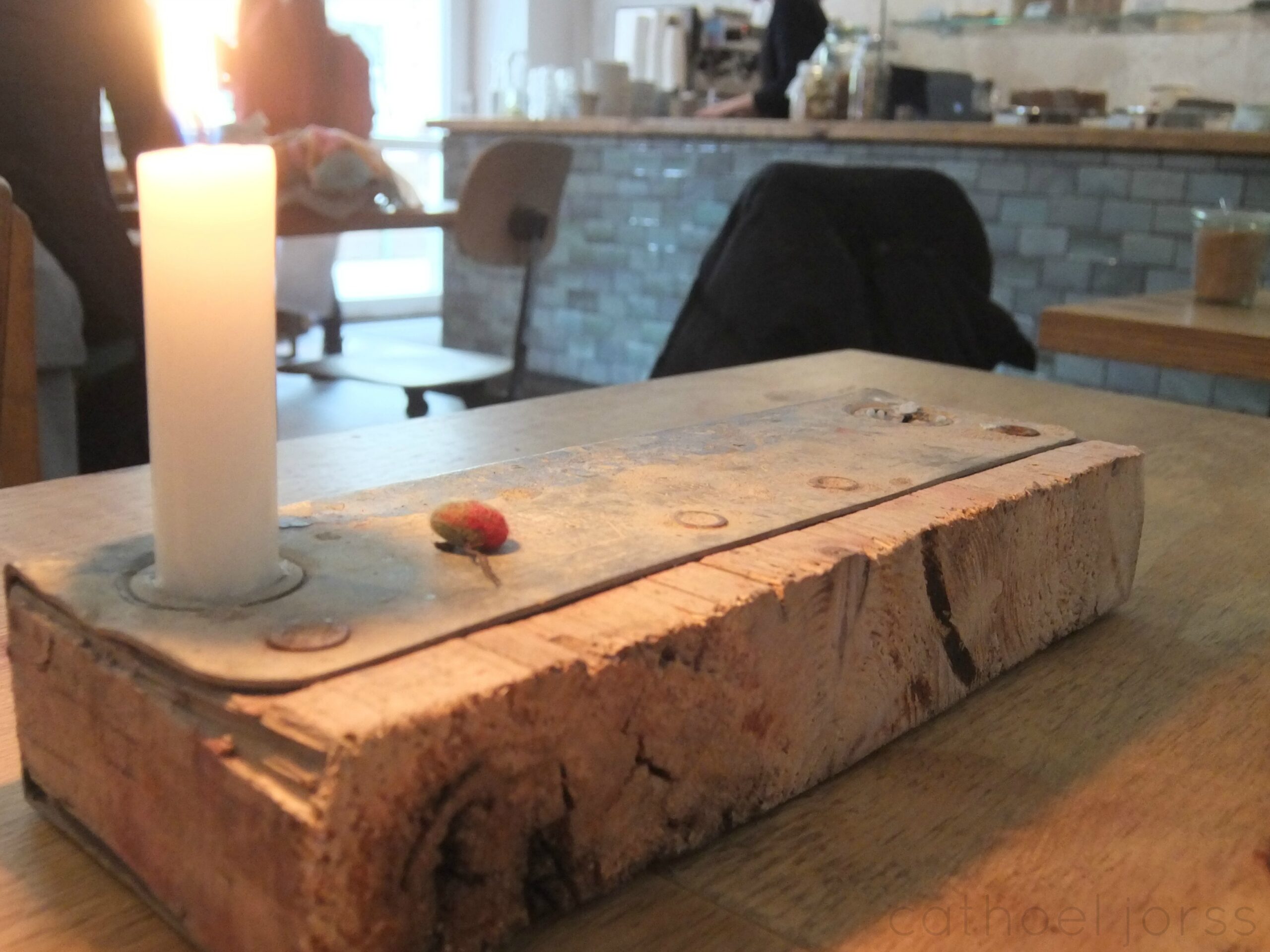
    H2O HoL breakfast candle

  • overheard

    overheard

    Girl on the tram, to her friend: “It made me wanna throw up. And not in a good way.”

  • shaped like a fish

    Pouring out dry biscuits for the cat I wonder: why are they fish-shaped?  It can’t be for her sake.  She’s not thinking, Hey, this reminds me of a fish!  Cats don’t abstract.  So though she is attached to me, and will follow when I move to another room waiting to climb back onto my lap, what she feels for me is not actually love.  If I were tiny enough, she would eat me.

    On the first day of life-drawing class the teacher said, the mistake you all keep making is, you are trying to draw the outline.  ‘The outline is an abstraction,’ he pointed out: ‘it doesn’t exist.’  If you glance down at the page & look up again with your head on a different angle, the outline you have started to draw no longer makes sense.  As the model tires and her hand begins to droop, everything looks different.  Now the lines you have made are unhelpful; are, in fact, an obstacle.  Abstraction becomes an obstruction.

    One of the challenges in learning to draw for the first time, as an adult, is to see past your own expectation of what ‘a face’ looks like.  Two eyes, and they lie parallel.  What ‘a body’ looks like: breasts are round.  Deftly the drawing teacher made sketches as the model stood patiently naked.  ‘Abstraction,’ he said, ‘actually interrupts us from learning to really see what we are seeing – and draw from that.’

    A 14-month-old child visited this week, the day he had just said his first word.  ‘Dog,’ he said.  Now the cat, crunching her fish-shaped biscuits, was ‘dog’, the birds in the flowering gum were ‘dog’ – he had learned that there exists a class of creatures who are warm and independently mobile, but are not humans.  His first steps into the abstract: now he can invent and worship gods, make art, fall in love.  There were three little stuffed toys in a row on the windowsill which we gave him to play with.

    They are three pigs, collected from op shops, each one different entirely to the others.  One is of pink plush and sits upright, with long puppet arms and a curling tail made of felt. Another is stout, almost legless, and looks more like a piggy-bank.  As sketches they appear almost unrelated, yet the mysterious principle of pigliness unmistakably joins them.  The cat will never be hungry for biscuits just because they resemble fish.  But in a few more years little Harlo will look at this array of furry inanimates and say, ‘three pigs.’