Tag: literature

  • collective noun a couch of potatoes

    I have no depth and everything within me is shallow and small. I waste this only thing time. I spend it as a charity on stultifying trivialities all pettifogging at the window’s pain like untrue love. I show off and on again. I’ve nothing. Not even that nothing. Only what is left by boiling too many bones too long: mostly, scum and smell and the evaporation of beauty; mostly, strong dark waters no one would drink, but for their health.

    I sit here, boiling far too many suns. But only as they fall across the water, winglike, saving daylight. Using words like jewels to deflect my nakedness and shame. A continual dinning sound like tinnitus, bling! bling! bling! Body fat and gemstones, a clattering cup’s old soup. Using time like words which can be flattened silent to the page. A couch of potatoes. A combine of harvests. A chapel of waysides. A nun of that.

  • in The Circle

    I decided to stay home from the Writers Festival and read, all weekend, in the hammock. Yesterday I read three Mills and Boons, today I am reading a novel by Dave Eggers. The writing is so beautiful it’s almost a liquid. It is modest. It does not proclaim about itself. It’s blood temperature, so I can move through it without noticing. But every now and then I turn the page and read some startling description that has to be reread aloud, like the summing up of the book’s character Mae, offered to her by a woman sitting in a deck chair, with her eyes closed, on a boat.

    I am that woman today, moored near an island. Outside of the hammock world, which is permeable, storm clouds mass up on the horizon behind the big spiky city. The camphor laurel tree whickers and sways. A sudden gust casts down a spray of its gentle, tissuey blossoms on me, and its red-veined leaves.

    A seed falls into the seam of my book and I tilt it and shake it away. The sky is blue but clotting with piled hulks of soft-serve cloud. It’s always blue but only when lit. As I watch, it grows colder, and the blue begins to sour into a sweet daytime stay-at-home white. A lamplit day, an indoor day. I’m outdoors, slung on a sharp hilltop. Outdoors is always blue but whitening now and filigreed with the leaves’ underbellies, which churn in the wind like a school of fish, and closer to home by the large open net I am lying in. Sky in the gaps. Today my own writing is not modest, it’s first-drafty like a camp bed slung between two trees, it takes a fancy word like ‘filigree’ and cuts it right open, filleting like a fish whose screams outside the water are conveniently inaudible. The writing and the day and its transience fill me with greed and contentment. I’m full’o’greed. My thoughts are sounds that make no sense and I’m so comfortable. Outdoors, and at home, all day.

    Down the street aways two crows seem to be boasting to each other. Ark, says one. I don’t believe you, says the other. I lay the book down open on my chest. Willing to be dragged through the day by my own brain and by another brain’s writing and communion. The grey cat, who is herself a hammock, turns into herself, bristles, and sighs. Far behind the big boat of this city and its festivals I ride the churning water. A long time later I pick up the book again, wishing it was heavier and fatter. I will read to the end today, then read it again, I’m so glad and relieved that greatness exists still among us, that it won’t all die when Shirley Hazzard dies, that it didn’t all fold down into the grave with Elizabeth Gaskell and her “kindly spirit that thinks no ill [and] looks out of her pages irradiate.”

  • that lamp

    I have a lamp that is shaped like a shell, was in fact a shell, is a home for a strange and retiring sea creature long now gone. It glows almost red when you plug in the bulb, a beloved’s ear with light behind it. Lately as the days are tropical cold and dim and windy we light the lamps tagsüber. Near the beer factory is a tiny art printer who lays on canvas and on fine rag paper people’s photographs and paintings. We left the lamp on at home and went out. He showed me some of his work. He opened a drawer and let me roll some of the beautiful paper in my hands.

    Nearby is a tucked-in kind of cafe which you can barely see from the road, it is screened. Inside is like a secret fish tank. The chalkboard says You like cake. We make cake. Cake CAKE. We ordered cake. “Eighteen fifty,” said the guy. Cake is expensive. I said, “Now that was a very good year.” “Huh,” he said. We sat down and went over the book I am bringing to print this week: page after page of it, is it still beautiful, does it still hold. You’re looking for the tiny cracks and nail holes that let seep gradually the water. At the far end of the place a handsome man lay back in his chair. Stroking lazily his little device. He didn’t lift his eyes off it. His daughter dressed from head to toe in pink ballerina costume lay in a pile on the concrete playing dreamily with blocks they have stacked down there, singing and rousing on herself. She was in her own world, he was in someone else’s. Two men came into the cafe and I heard the guy recycling my pale joke. “19.90,” he said, “now there’s a good year. You’d be finished school, out into the world…” Behind my back I could almost hear them gazing at him blankly. I felt bad about the failure of the wordplay I’d transmitted, as though I had set him up.

    Later the night turned out fresh and enchanted, so strange, those nights that bring home the spirits from the deep sea and the mountainside. I lay in the hammock between two large trees, watching as the wind rustled and tumbled like cities through surf, down to the bony ground again and again, carrying in itself everything whole and real, everything breathing. This month I don’t know if you’ve noticed but again the full moon was full or albert full for days and days. This always feels like some kind of special benediction to me, as though we have been given a treat, like we have pulled off a trick somehow and gotten away with something.

    I should end there but there is something more to say. You know the night? In the night if you lie in a hammock you are in the air, you’re in the water. I gazed up, mostly with my eyes closed, into the depths of the tree, the sparring webwork of the lazing bed, the night itself drawing its fleece across the stars. It felt like one of those nights you could climb up into, curled as I lay curled, and the night would heal itself round you seamlessly and simply carry you away.

    When I came in my partner called me over to his screen. He loves the new. He wanted to play me a piece of music, piano music. We were silent, listening to the climbing sounds. “Isn’t it beautiful?” Yes, I said, it’s beautiful. He said, “It’s the first piece of music not composed by human~” “What?” I stood up. I think I was shouting. “Why did you play me this? Why did you?” “What’s the matter?” “Why do you show me this stuff?” “I thought it would make you feel good! It’s not scary, it’s just beautiful. Listen how lovely that is.” When someone who understands doesn’t understand: the world is a cyborg desert already. I said, “I can’t take it. I can’t live in a world where machines compose music. I can’t live.” An ache spread inside my chest, despair, hopelessness, rage. Within me I felt the impaired moon, the night, the thoughts of serene pursuit drain like soap scum away. Poke the pearls and they are merely bubbles, evaporating, the >plink<. Someone let the plug out of the sky and I felt all the buoyancy of things drag slowly down, my heart is hot and sore and sleep seems more oblivion than restorative hammock in a sea of quiet leaves which sparkle like near stars.

  • tyre me down, sport

    .
    today the way
    the world is run and the
    people who run it making me tired
    tired of not saying “you make me feel”
    tired of I instead of you statements. You
    make me feel tired, I’m tired of you
    all and your folly
    footed in the mountainous earth on such
    a very large scale. You make everything
    small you make
    everybody suffer. You don’t suffer. Everybody
    does but I can’t see you can because
    if you did I would be
    living in a loving world
    like the world I live in in my home
    of my own head,
    if you did I would be
    heard and you’d be quiet
    all of us herd who graze here
    quietly among the grasses, writing
    poetry, well that’s what we call it, on our silent screens
    this is written as I type and won’t take ten minutes over it
    because it’s all going to flow away downstream
    the feed, and the feed-lots, the haverers & have-nots
    gone in an instant gratitude journal heart-shaped
    dotted i….. dotty, I, myPad
    cluttered with unwashed thoughts and all
    I have is caller ID for privacy and cyberspace
    where no one hears you screen.

    4.35-4.41pm, 5 july

  • Hazzard lights

    This morning I woke late and slowly and heavy and smiling, blindly at everything, the sun and the distant trains, heavy with the discovery unflowering in me: my heart is full of love. Heavy with love, impersonal love that is personal, dripping from me, in me, and through. Love is like honey through a window, as the great songwriter once said. Out of bed I took up my book, working slowly, carefully through the last pages of Shirley Hazzard’s impeccable novel The Transit of Venus. I’ve read it twice before and only now realise why, early in the second chapter, it forewarns us with such a light confidence:

    “In fact Edmund Tice would take his own life before attaining the peak of his achievement. But that would occur in a northern city, and not for many years.”

    I always wondered, why would he kill himself? When he has devoted his life to this one woman and finally, by the end, she realises him. Thinking about the delicacy and quiet triumph in the description of their long, dry, separated love I glance across my desk with its starburst of opened notebooks. A prong of a specific tree given to me for meaning lies dying inaudibly in its glass vessel. It shades a shallow basket filled with candles and pens. I go back to the book, pick it up in my hands like an album carried from a wreckage in a world now lost and gone, by fire, by water, by the toil of time which places everything behind us like a mirror. Her work is so perfect. “‘I work. I think of you. These are not alternating propositions – I think of you always. Since writing you last, I’ve been to a show of drawings by Leonardo, a one-man industrial revolution.’”

    Irreplaceable Shirley Hazzard, alone in her room, writing from a kind of understanding few can be bothered to share. I hear the ardour of her disciplined quietude beating behind the pages: “She would be better off in a home. Christian said this to Caro, who replied, ‘She has a home. You mean an institution.’” Like Jane Austen’s I ration her few novels, unable but afraid to wear them thin. Getting up out of the sunshine I say almost inaudibly to my companion, spilling the steaming cup of tea, If I could write like this I would never do anything else. Thinking of writing about her work I am “A big woman in violet [who] leaned against the mantel, empurpling the view.” These thoughts pass through me like tiny fishes, transparent in sunlight, as deep in love the echoed longing might come. If I could be beautiful like you, it wouldn’t matter, I read – or imagine. Turning the last page to the end I suddenly realise with a hot shock: she is about to die, the main character actually dies on the final page.

    I paid insufficient attention to the last two or three lines. Beforehand as he is watching her go there are people grappling for their status and their airbearable possessions. And “The passengers passed through the disembodied doorway, one by one. There was a woman in pink linen: ‘Does this machine spoil pearls?’” They are “claiming, clutching, harbouring.” The man who tried to make her see, an ophthalmologist, climbs aboard without recognising her. His death has also been foretold. Everything deep, light, ironic and sweet. The love that is wisdom, the wisdom of love comes and takes a seat quietly, far back in the aircraft. Then:

    “The roar could be seen, reverberating on blue overalls, surging into the spruces. Within the cabin, nothing could be heard. Only, as the plane rose from the ground, a long hiss of air – like the intake of humanity’s breath when a work of ages shrivels in an instant; or the great gasp of hull and ocean as a ship goes down.”
  • on not being a brand

    Had to write a blurb about myself – a bio – for Queensland Poetry Festival. Oh, the horror. Describing oneself & talking about one’s work… is there anything yukkier. I hammered out a couple hundred words, only to discover I had been too verbose (who whuddha thunk?) and they needed a brief 100 words for the website & for the programme, an even briefer 25.

    25 words! There is a reason I suck at Twitter. The deadline was rife. In a crowded wifi cafe I pulled something out from under my hat and I feel so boastful about it. Whaddaya think?

    100 WORDS: “2014 sees two new releases from Cathoel. Her new poetry collection is hailed by Robert Adamson as the work of ‘a born poet.’ The debut album of Cathoel & the New Government was recorded in New York, Melbourne, and at home, by a collective of twenty-eight jazz, folk, and funk musicians. 50s impresario Bob ‘King’ Crawford on first hearing Hey, Big Splendour said, ‘In my opinion you will be one of the greatest artists this country has produced.’ Even fresher new work can be found at houseoflovers.com.”

    25 WORDS (woot!): “Cathoel writes poetry and jazz. Robert Adamson says, ‘a born poet.’ Overland journal call her ‘a first-rate artist at work.’”

  • between the fingers of Fidel Castro

    between the fingers of Fidel Castro

    I know an eighty-year-old cafe where the day passes smooth and coiling as molasses poured out of a dented tin. I sit in the smokers’ room, not because I smoke but because of the candlelight and conversation. Today I stopped at an antiquarian bookshop that has trestle tables out front. A recent conversation reminded me I had never yet read Machiavelli’s The Prince. The bookseller had two copies, an Everyman and a Penguin; two different translators; a quick skim decided me I would buy both, and I carried them to my favourite table and curled up there, thinking if I read these two versions both at once, maybe I’ll be able to triangulate.

    I read very slowly, laying each book face down at the end of a chapter and taking up its companion. Three tall, lanky, and very good-looking men came through in waterproof jackets, carrying boxes and boxes of lettuce and potatoes. Afterwards they sat down at a small table under the pastel portrait of Fidel Castro (cigar) and drank coffee and argued for over an hour. I tried something new off the menu: it’s German food, everything is new. Fidel Castro’s fingers resembled an abstract of a human hand carved from potato. Everything carved from potato. After the War Berliners relied on an American Rosinenbomber (the “raisin bomber”) dropping boxes of foodstuffs and dug up the forest called Tiergarten in order to sow vegetables. I thought of the various cafes I know in Brisbane and wondered how it will feel to adjust. The temperature has plummeted, and isn’t that a most marvellous word: like a fruit yet unripened on the branch, that finally gives in and plunges to the ground. Last night returning from a long forest hike it was perishing, four degrees. I ate my Weisswurst and Brezel and thought about the differences between reading in a cafe full of other people reading, and the dinner experience of last night, in an unreconstituted jazz and blues pub, where the cute barkeep turned down his infestation of immemorial blues and turned on a large white roped-up screen. Oh, God: Tatort. The awful detective show Germans watch as Sunday religion. Somehow the roomful of unstirring people watching a fourteen-year-old girl’s character get raped – the oldest man put his head into his hand, others watched unmoved – was so blinding and so effing awful, we got up and left. That household full of habitual viewers sharing the dirty hot tub of popular TV had somehow less in common than the people crouched in corners at my newly beloved red checked clothed cafe: reading newspapers or, in three cases, books, we were each of us turned away from our commonality but yet reminded me of swimmers foraging deep in the saltiest water, where the sunshine is sweet, where the strands of warmer and colder waters pass over one’s legs caressingly and there is always something further to be discovered. In only the one ocean, in always the one sea.


  • a book’s a passport

    a book’s a passport

    A friend who was enamoured of it took one of my books to Hong Kong, and tried hard to get the lady in the passport booth to stamp it. She would not be persuaded. Instead I received a series of postcards through the mail: Dear Cathoel, it’s a beautiful day in Hong Kong and I am taking your book for a stroll by the river. Dear Cathoel, your book and I are having chicken noodle soup on the markets.

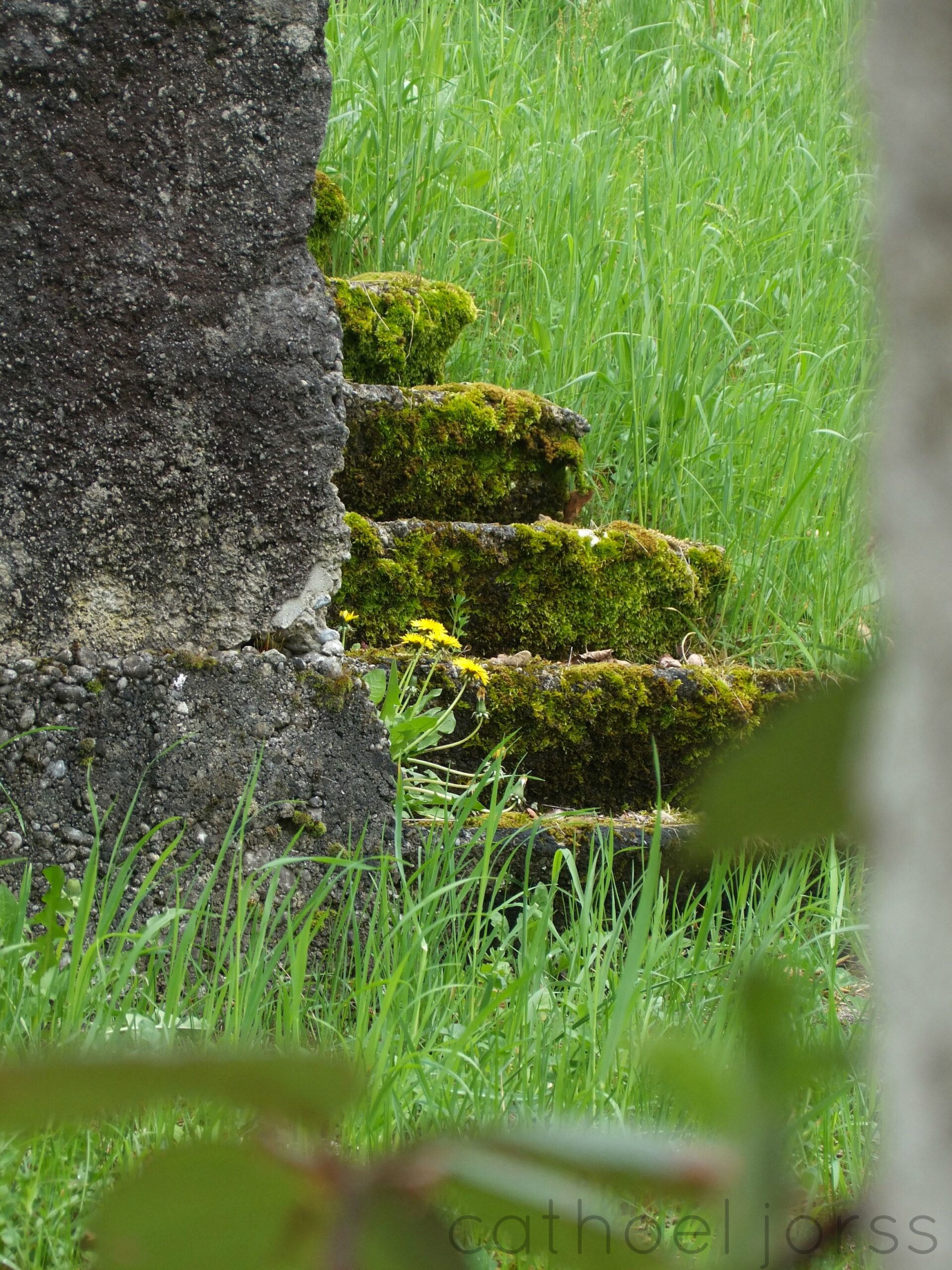
    H2O HoL mossy steps

  • all that love

    all that love

    Robert Peston’s preface to Sian Busby’s posthumously published last novel, as quoted in The Guardian. He transcribed the novel from her notes after his non-smoking wife had died of lung cancer. “My motive was selfish: I wanted to keep talking to her. I still do.”

    He writes: “Life became punctuated by terrible shocks and emergencies. Yet those who met her at pretty much any point in this ordeal encountered the Sian they had always known: solicitous, supportive, witty, insightful, unselfish. The cancer did not haunt us. If anything, it helped us understand what matters in life: family, first and foremost; work that fulfils; friends, beauty and fun.”

    As I read his words it occurs to me everything he values most highly in the face of bereavement is love. Even beauty is a form of love: isn’t it? A mechanism for our appreciation? “Work that fulfils” is our service to the world, as well as to our own character, daily life, and development. Love is all.

    H2O HoL handfasted