Tag: luxury

  • the young man with a long way to go

    The young man in the place where we are staying is Moroccan and comes from the desert, which he describes to me as ‘sympa’, sympathetic, a kind place. As opposed to the hustle and throng of the medina where people greet us ‘welcome, welcome,’ and return smiles with great warmth and ease and employ the most genteelly probing sales techniques in (they say) the world.

    This young man is named ‘given by god,’ or ‘gifts of god,’ and we looked up his name in a list of the 99 names of Allah which, I only slowly realised as we were discussing these names with a nearby restauranteur, are perhaps not so much names as qualities. God the good, god the great, god the compassionate, god the wise. Similarly it dawns on me, belatedly, decades after the life on Java I so cherished as a child where we lived between three mosques and stayed indoors during the ferment of election week, that the prayers which play continuously in some hole-in-the-wall shops in the souk are not petitions, in the sense that I would understand prayers, in the sense I sometimes grope for in extremis and despair, longing in the depths of my pained heart to have someone to pray to; they seem perhaps more like resolves embedded in long and winding stories. And so they came upon a beautiful oasis. And there they could water their camels and have something to eat. And so god said to them…

    I am improvising, here. Who has any idea what god might be saying? not even the solemn Jehovahs Witnesses who came to my door with their beguiling brochures and then, when I grew just a little too interested, felt honour-bound to warn me away from the technicolor gloriosity of the illustrations. “This only… artist impression of heaven.”

    Ah – then. But god or, as I would put it, kindness, knowing, understanding, meaning, the connectivity of us with the world and with one another – a kind of exalted humanness, in fact – speaks to me in the trees and in the wind pouring through them; a sort of devotional prosperity I have dwelt in since childhood, when I used once to wander the markets in Jakarta and the coconut groves on the shore opposite Krakatau in a scintillated state of constant and ever-changing concentration.

    So, Gift of God has come to the city in the north, leaving his desert homelands behind, and he tells me he has been here in Fès only three months. He had a job in another pension but it was a bad place. He came to this house a week ago. Ah! I say, cupping his shoulder with my hand, from the side rather than from above because of the war between affection and a horror of condescension. Then you have been here only four days longer than us! Yes, he says, creasing his face in a serious, shy smile.

    This morning as I was lighting out across the courtyard with my books in my bag this young man approached me on his soft shoes. Would I like my breakfast now? I said, You know, thank you, but actually I think I might go into the adventure and just eat somewhere on the markets, today. Oh! he said, and dropped his head and an expression crossed his face that hurt me, as though I had hurt him.

    “It’s not because I don’t like the food! It’s just – I wake up and go, I’m in Morocco! And so I just have to go out and…” On the sunstricken square my lengthy sweetheart joined me where I was so deep in the book I was reading, a book about politics that I find difficult to understand, that when he crossed the sun and grasped me by the shoulder I started. Around us gentlemen of Morocco discussed – I imagine – politics, I imagine their talk is dry and knowing and cosmopolitan, world-weary, courteous, and wise, I hear words which are the names of countries and think, they are speaking of world events. The first morning I was almost too shy to sit down and had to approach the cafe, whose restful shelter I craved, by way of a huge loop up and around the street before I could cross the road at a tentative, oblique angle and ask the courtly waiter diffidently in my execrable French, excuse me? am I allowed to come in here? even as a female? I was the only woman in the cafe, almost the only woman in the square, and when I wanted to go downstairs to the bathroom they flew into a flurry of small-scale preparations and I was handed a door handle, by which to access the second stall – for women and for, I guess, tourists, as it has a Western toilet and sometimes even a roll of paper.

    The second morning I sat down in the blaring sun at a tiny table and was moved almost to tears when the man who had been sitting by me yesterday and whom I had greeted said, inclining his head, “Bonjour,” and even asked, “Ça va?”

    To have a courteous neighbour, who is reading the newspaper in Arabic and a battered paperback in English; to sit in the sun, after months in wintry Deutschland – it sends me down into a contentment that is very much like sleep.

    The young man in the pension, Gift of God, smiled his grave smile on our third night in Africa when we asked, where would be a good place to eat. He told us he had made a very small number of ‘connections’ in Fès, since he came here three months back alone, and his friend Mohammed runs a good place, very cheap, under the large tree which is a landmark as there are so few trees in the medina at all. “That young man has a long way to go,” says my companion as we cross the square. and for a few moments I am startled, before it clicks into place: that he will go far. We eat at his friend’s cafe, treated royally. We practice the gesture courteous Moroccans use, of a hand pressed level across the breastbone, touched to the heart, moved, thank you, I am sorry. Walking the medina I also use the fellow gesture which takes place a little lower, pressing across the tummy with my other hand, saying, “On a manger.” I hope this means, thank you, we have eaten, and use it to reply to the touts who hand laminated menus outside every restaurant (“We have wine!”) My German companion thinks the tummy is called the stummy, and recently revealed in conversation that to him this is because the stummy is the seat of all stamina. This makes sense. Stomach, stumina, stummy for short. Now I find out he is calling the guys who hawk the restaurants ‘shouts’, perhaps a better word than touts. Meanwhile in German, he says, I make ‘sweet’ childlike errors in a thicket, or fog, of laughably elaborate courtesy. Elaborate formality – to a German! that kingdom where a Keep Off the Grass sign will begin: Very honoured forest wanderers and forest wanderesses, please be advised…

    So on our first week in Fès we navigate our way with his terrible French and my awful French and the few paltry words of Arabic we have learned: principally ‘choukran’, thank you (hand across heart), and ‘la choukran,’ no, thank you, to which I’ve improvised a kind of Bollywood head-waggle of the hand.

    By the fourth night the influx of new sensations and sights have exhausted us and we go back a second time to the same restaurant. Mohammed greets us with cries of warmth and manifests a place to sit when almost every seat was full. He flaps the fancy tablecloth like a magician producing a bunny. I watch him do this over and over, I remember the rapid-fire thought processes and sly courtesies of hospitality work and comment, when he comes by to tip more bread into our basket, that it is like surfing. “Yes!” he says, jubilant, “exactly – like surfing.”

    This man has learnt all his English by listening to customers and he asks, what is the word in German for I will be awaiting you. Germans sometimes say to him, “Vielleicht später,” maybe later, when he offers a menu. We search among our words before lighting on Ich bin für Sie da, I am here for you, explaining this is “very gracious,” making gestures of graciousness like a king. “Ah!” he says, satisfied, Moroccan: “Ah! Yes! That – is most important.” He asks us to speak it into his phone so that he can learn it, and I take a photo of the two them with their sweet heads together, listening in on one departed French or Spanish or German tourist after another, speaking in all their different voices the phrases which comprise his vocubulary, each of them adding a drop to his store of hospitality.

    To my right, five Chinese students are spending the night with their phones. They are so absorbed that even when food arrives they ply their forks round it, scrolling onwards through the fascinating replacement world. A commotion of drums festers in the distance, around a corner in the narrow lane which is hung with handicrafts for sale. “Hand mad” says a sign above the racks of point-toed slippers. “Prix fixe.” I have seen tourists walking through the busy markets with expressionless faces shielded by devices set to continuously record, and I wonder how it must feel to be videoed a thousand times in a year by people who don’t seem to bother to even acknowledge one’s humanity. The students issue their drink orders (avocado juice, banana and orange juice, freshly pressed, with sugar and without) free from any thank yous or any please and Mohammed presses his palm across his heart as though it aches, saying in English, “Thank you, guys, I bring it right away, great, please, certainly.”

    The clatter of drums is coming nearer and I am craning to see past the French family who have stationed themselves in the passage to wait for a table. Two men, gaily dressed in such bright robes and complex festoonments my eye cannot grasp them, holding up their tiny drums, the skin of the drum painted with henna, stamping their soft leather boots and singing splendidly – I ask if I can take their photo and the taller says, “Foto!” and they both fall to attention, and then he puts his cupped hand out and I realise I have no coins. Mohammed is passing with a clutch of creamy avocado juices from the stall across the way. On his way back I put out my hand. “Est-ce que vous pouvoir me louer un peau de l’argent pour les musics?” This doesn’t exactly mean, Can you please lend me some silver to give to the musicians? but it’s the closest I can get.

    Sure, he says, without pause, digging in his pocket and showing me the coins. He selects for me and presses them into my palm: three, four dirham is plenty.

    At the end of the meal we want to pay and I say, “Plus the four dirham,” and Mohammed looks puzzled. “You lent it to me, for the musicians,” I say.

    “Ahh!” He shakes my hand, pressing his heart. “My friend.” “Thank you so much,” I say, “We love it here, we love your restaurant,” and behind us the French family jostles forward, scenting seats at last, and we say goodbye to the other Chinese students on our other side who have been telling us they woke up this morning in tents in the Sahara and could see the ‘galaxy’ but it was spoilt rather because there was ‘no service’.

    “You went on a self-catered tour?” I said.

    “No service,” the good-looking leader repeated, jabbing his finger at the sky. We walk away, tired in the stummy and thinking as we come home how extremely gentlemanly, how classy it is of Mohammed to have lent me the money for the buskers and then to have instantly forgotten the debt. Morocco seems to me so complex and inspired, I have the feeling of a rich, fine intricacy, am rejoiced to see how gently and tenderly anyone with a disability is handed up the stairs or into vehicles, I see the brutality, I feel my heart aching with the real inevitable charge of life that in ‘our kindergarten countries’ as my Berlin companion has called them this week is simply absent, or at least invisible, and when we are not afforded the luxe protection we experience as our right, we sometimes grumble at god, who has not given enough, whom we can call on with praise for sparing the floods our children, as though this were not an insult to the humanity of all the other children swept and drowned, as though the Acts of God excepted in the fine print of every insurance policy were not just and not our desserts, but rather an interruption to the service we expect, and for which we would pay nothing but our words.
  • hair now gone to morels

    Today I had my hair cut and lost enough length to stuff a small teddy bear. Afterwards I crouched on the floor in the horseshoe swatch of paler wood worn on the black boards where the hairdresser stands every day in an arc that sweeps back and forth around each customer, and tamped up the soft, drying clumps in my fingertips, and put them in a paper bag they gave me. My hair had spread across a wide area and I gleaned back as much as I could. I feel a bit weird saying, Can you give me a bag, I want to take this stuff home: and even weirder about leaving it there lying on the floor. To get swept up. Mingled in with other people’s hair. Dusted in landfill, with its bad magic.

    I had chosen for this outing a place I felt safe in, in a chic part of town where women carry little dogs in their handbags. All the trees have sprung into service and the old buildings gleam. On my way home feeling lighter and breezier in the fresh afternoon Spring air I pulled the handles of the bag apart and peered in – a soft knot of washed and combed ends and curls lay there in a heap, big as my two fists, coiled on itself on the floor of the bag like some little dog lured from its home.

    I so hate getting my hair cut that it happens only once every year, or two years; for a long time I used to cut it myself, with the scissors on my Swiss army knife. The girl who took my appointment earlier in the day had a blond bob severely asymmetrical but her eyes were soft. “I will put you with Damir,” she decided. “He has an unusual name too.” Damir was very cool, as all hairdressers are cool, and reminded me of my friend M. Same quirked brow, same smooshed beanie on the back of his head; same deft hips. He let my hair out from its elastic and said, Ahh, in a tone of satisfaction. Took his time, handling the masses of it for ten minutes, parting and lifting it, weighing it, judging the curl and its spring and the way the colour grows. Only then did he say, “Let us go wash,” lässt uns waschen gehen. It was a pleasure to close my eyes and let myself be handled. He said, see how it’s much curlier at the back. See how it’s ginger at the ends, I said, and he said: that’s because you wear it up in a knot and that’s where the sun most gets to it. Right, I said, slowly, thinking: oh, riiight. How little one notices oneself.

    Would you like something to read? He went over to a low table by the huge windows and bent over, sifting and separating. In the mirror I watched him choose me out three magazines and order them into a stack. One had a photo in it of the beautiful photojournalist Lee Mitchell, shortly after the death of Adolf Hitler, in his apartment taking a bath in his tub. When Damir offered me a drink and I said I’d like some water he said, Still oder mit. This translates, “Still or with?” Germans ask each other these questions about water, still or sparkling? With or without. “With” means with gas: bubbly. The salon was huge and only one other person was getting their hair cut in it. How much was all this going to cost? “I don’t care,” I said to myself, trying to calculate when it was last cut: more than two years ago. It was peaceful there under his hands within the tent of my own hair. I remembered how I used to go to nightclubs just for the dancing, and would dance alone, all night, all night. When men came up to me I didn’t yet know how to get rid of them so eventually I would take the elastic out of my hair and let it fall across my face like this, making a thorough curtain through which I could see out but no one could see in. I used to smoke and I guess it was eerie to see a woman sitting smoking stolidly through the sheet of her own hair, certainly no one persisted past that curtain and this reminded me of that. I closed my eyes and let sensation scratch at me all round. The fingers brushing the back of my neck. The tugging as he lifted wings of hair up high to trim the ends. The soft feathering as it fell down over my face. The scent of tobacco from his fingertips, that lay on the hairs hanging combed straight over my nose. The faintly tropical, faintly chemical smell of salon shampoo. “You never blowdry it,” he said, and I said, “I don’t even own a blowdryer. Or a comb.” “You can feel it in the hair,” he said, letting it run through his fingers like water in sand.

  • desert smoke

    desert smoke

    In 1999 I published my first book. A week later the girlfriend who used to live across the road returned to Brisbane from the desert and said, do you wanna make a road trip? We set off on retread tyres and with (it turned out) not enough tools to help out when things went wrong. Just outside Toowoomba (an hour west) I phoned my Mum. “Mum the van’s overheated! We forgot to check the water.” Anyway we made our way west, west, west. Spent the night in a grand hotel in Longreach with verandahs broad enough to foxtrot on. In the morning I stashed my packet of tobacco in a potplant and that is how I finally quit smoking.

    We spent the third night in Alice Springs. By this time we had bonded and had told each other our life stories. I read her passages from my diary. She told me stories of her abused mother’s fight to shift her relationship with the now aging grandfather, using delayed cups of lukewarm tea, passive-aggression, and humour. Only 700km to Uluru (‘Ayers Rock’): we were on the home stretch! It felt like our own driveway. Then we blew a tyre. Like superheroes we got down and changed it, yay for us. Then we blew another. Two people who were travelling round Australia in a mobile home stopped to help us. The man was seamed and nuggety, he said, Don’t you girls dare go a whisker over 30 kays, now: you’ll blow the tread, and then you’re really rooted. So we crawled home to the tiny community of Mutitjulu where she worked – the short drive took us more than seven hours. We daren’t stop. When one of us needed to pee the other took the wheel and we hung our bottoms out the window. She was still smoking but somehow, I had lost the knack. I had last left Uluru when I turned 21 and quit my tour guide job. I spent ten days in a dream of homecoming, rolling myself naked in the red dust of an evening, walking out the door or her little house, magnetically drawn, almost every time I glanced up and saw Uluru. Crouching there like something, someone, it’s unsacred to speak of. I found the tiny second hand shop in the resort, run by a ranger’s wife, and consisting of things the high-turnover staff had left behind. I bought old-man’s underpants and a singlet and dyed them to form a swimsuit. After that I swam laps every day in the Sheraton pool. A rich lady befriended me at the bar and confided if you showed up at the front desk with enough confidence, you could ask them for the keys for a ‘poolside room’ (that is, on the asssumption that your own room was too far away upstairs) and so that is what I did. I lazed in the big white beds and had baths. I wrapped myself in dense velvety white bathrobes every day. I met interesting people from faraway places. And I kept going back to the sacred place, every day, every day. One night I cycled round the base as it grew dark and had to follow a very merry carload of local men home: I could not find which sandhill concealed the community. Never been so glad to hear a booming generator.

    I took copies of my book into the newsagent and they said, yes, they would buy some and sell them. I went out dancing on the same dancefloor I’d loved when I was 20, and danced til I could barely remember my own name. When I was ready to come home, there was a problem: at that stage I had never owned a car, and saw no reason to carry my driver’s license in my purse. So as well as no shoes I had no photo ID. There was a tiny library for staff and the librarian was a Justice of the Peace. I explained to her my dilemma. I showed her the book, whose title is Going for the Eggs in the Middle of the Night. I showed her how the poem titles were printed in my own handwriting. And how it has photos in it of our family when we were kids, photos of me and taken by me as a child. “Ok,” she said, “it’s you.” And after she’d signed an affadavit I was entitled to buy a plane ticket and fly across the detailed and sumptuous red plains, to Brisneyland.

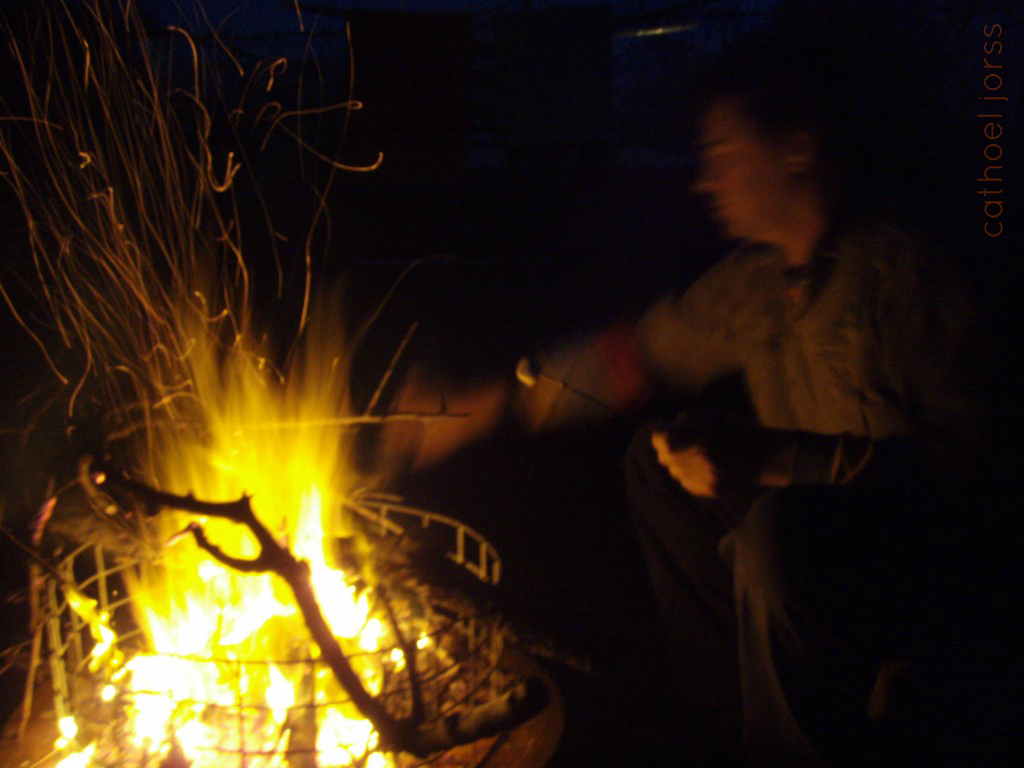
    H2O HoL ric with firepit

  • just entwined

    just entwined

    Found this unbelievable stationery store. It is vast and old-fashioned, everything neatly arranged. They had blocks of yellow writing paper, stacked in rows, some with no margin, some with a narrow margin, some with an extra-wide margin for some specialized purpose. They had gleaming jars of bulldog clips, silver ones, brass ones: pretty. They had all different kinds of string: hemp twine, sturdy and wrapped in a round ball the size of a baby’s head; and mean-looking black-and-white flecks, thin and strong; and a dreamy colourful cotton twine which came on a long tall spool and which I held in my hand for five minutes, warming it. Like an egg. They had a whole shelf of little cardboard boxes, the kind pastels and charcoal come in, held together on the corners by neatly folded staples. They had Moleskines designed by people who use Moleskines: the covers printed with one guy’s harbourside sketch of Hong Kong in pen and ink, another woman’s purling abstract with falling petals. They had slabs of plywood for balancing your painting on your easel and aisles thinly populated with drifters, holding up articles and musing on them, some of them wearing a kind of half-smile or fierce frown of concentration that seemed to me to indicate they were dreaming up what they would make with all these products.

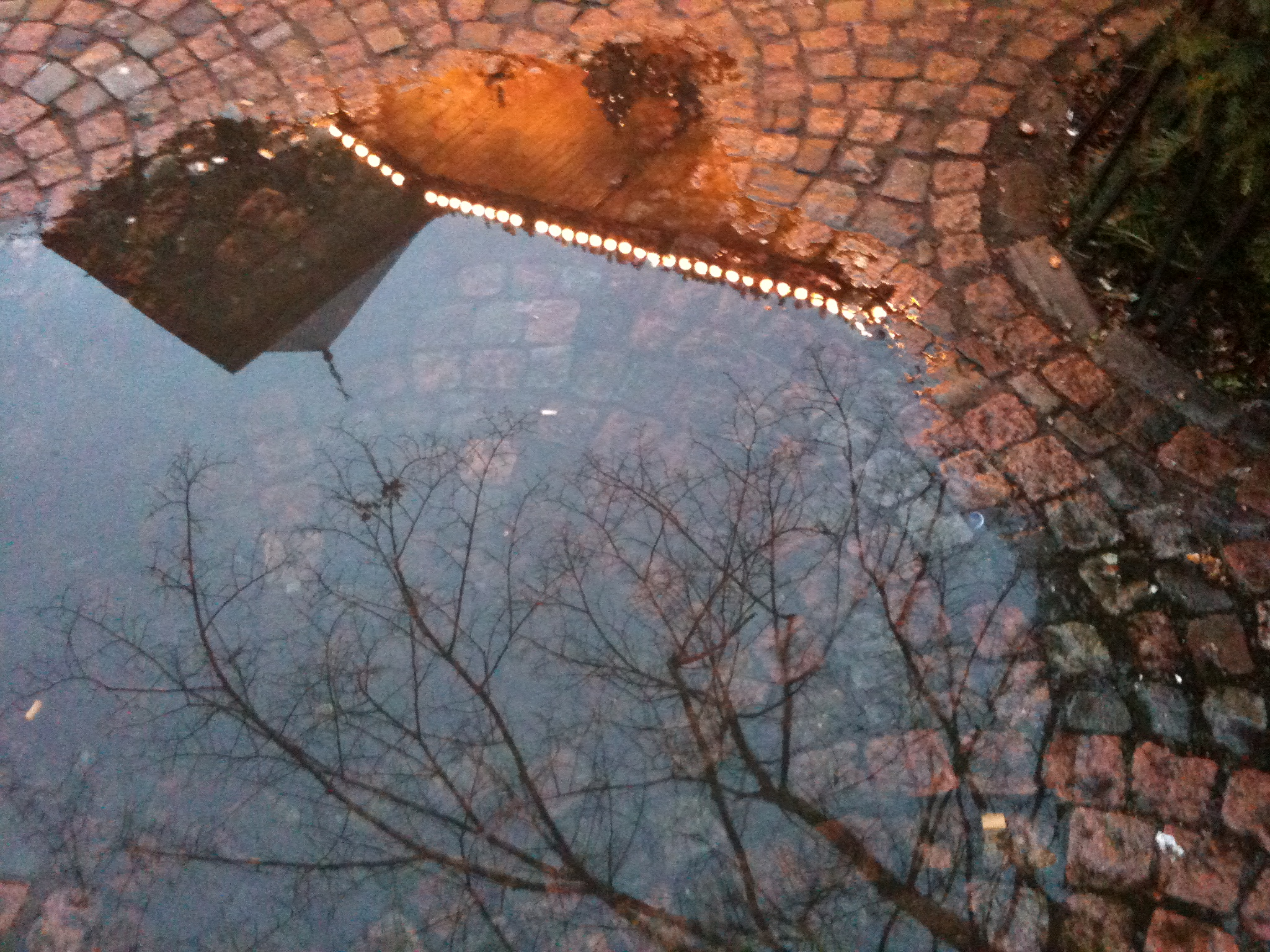
    This was in Copenhagen, which I visited at the age of 10 and again two months ago, and where if it didn’t cost twenty Kroner every second just to breathe, I would move tomorrow, and learn to play better piano and be a better jazz composer. In the teetering, cobbled old town I found five jazz clubs within a square kilometre; most of them filled to the gills; and the audiences ranged from age 20 to 70. What a lovely town. Cold and windy. But beautiful. And peaceful in the water.

    h20 HoL cobbles puddle copper

  • tom-tom cruise

    tom-tom cruise

    Why such strong reactions to this week’s cruise ship melodrama? Could be because as spoilt Western people with our five-planet lifestyle we resent other spoilt Western people exposing the scam? I am tasting an element of that in my own responses. I feel like: these Americans have finally experienced a thin glimpse of what it feels like for the majority of folk alive right now, who have no running water, no ‘staff’ to remove their bags of poo, etc. But I am aware I am not super keen to give up the luxurious amenities of space, privacy, and a home in order that the rest of the world can share more equally in the goodies we’ve colonized, stolen, enslaved and mined. Far easier to blame those richer or more obviously pampered than ourselves.

    H2O inside a golden boat, slant h2o lit square askew

  • I’m not sure you’re taking this entirely seriously

    I’m not sure you’re taking this entirely seriously

    Went to the outdoor store to try on their $1000 goose-down & coyote fur jackets. “Made in Canada,” the sales guy explained as I was falling about laughing at the price: “Canadian wages.” “Ah,” I said. “Everyone wants Fair Trade but no one wants to pay any more for it.” He leveled his trigger finger at me: You Are Exactly Right.

    Who has the money for this kind of malarky? They had a hat, with furry earpieces, a snip at 300 Euros. That’s, oh, around 375 Australian pesos. They had parkas in a seductive scarlet which have big hoods rimmed in fur. Magic. You put the hood up and you can’t see two feet in front of your face. The salesman folded the fur back for me: “Now can you see out?” “The street, yes. Stars, no.” He let his head fall to one side. “I’m not sure you’re taking this entirely seriously.”

    Finally I bought a more ordinary hat, very warm, so warm it made me want to strip off a couple of layers. Leaving the shop I saw the original salesman, who had been called away to another section, leaning on a display cabinet of vicious-looking knives. He looked so bored. I tapped on the window from the snowy footpath to make him look up. In pantomime I showed him the successful and awesome furry-hat purchase, drew it out of my satchel and put it on to demonstrate how it makes me look like a Russian farmer maiden. His face split in an enormous grin. Thumbs up, he said. Thumbs up, I said. Thumbs up, said his colleague over his shoulder. Warm in the brain. It only now occurs to me the word ‘demon’ is embedded (devilishly) in the word ‘demonstrate.’ So all those door-to-door vacuum cleaner salesmen in the 50s were maybe like the anecdote, I mean the antidote, to God’s helpers who spread out on the ground and say, You take the poor suburbs, I’ll take the rich.

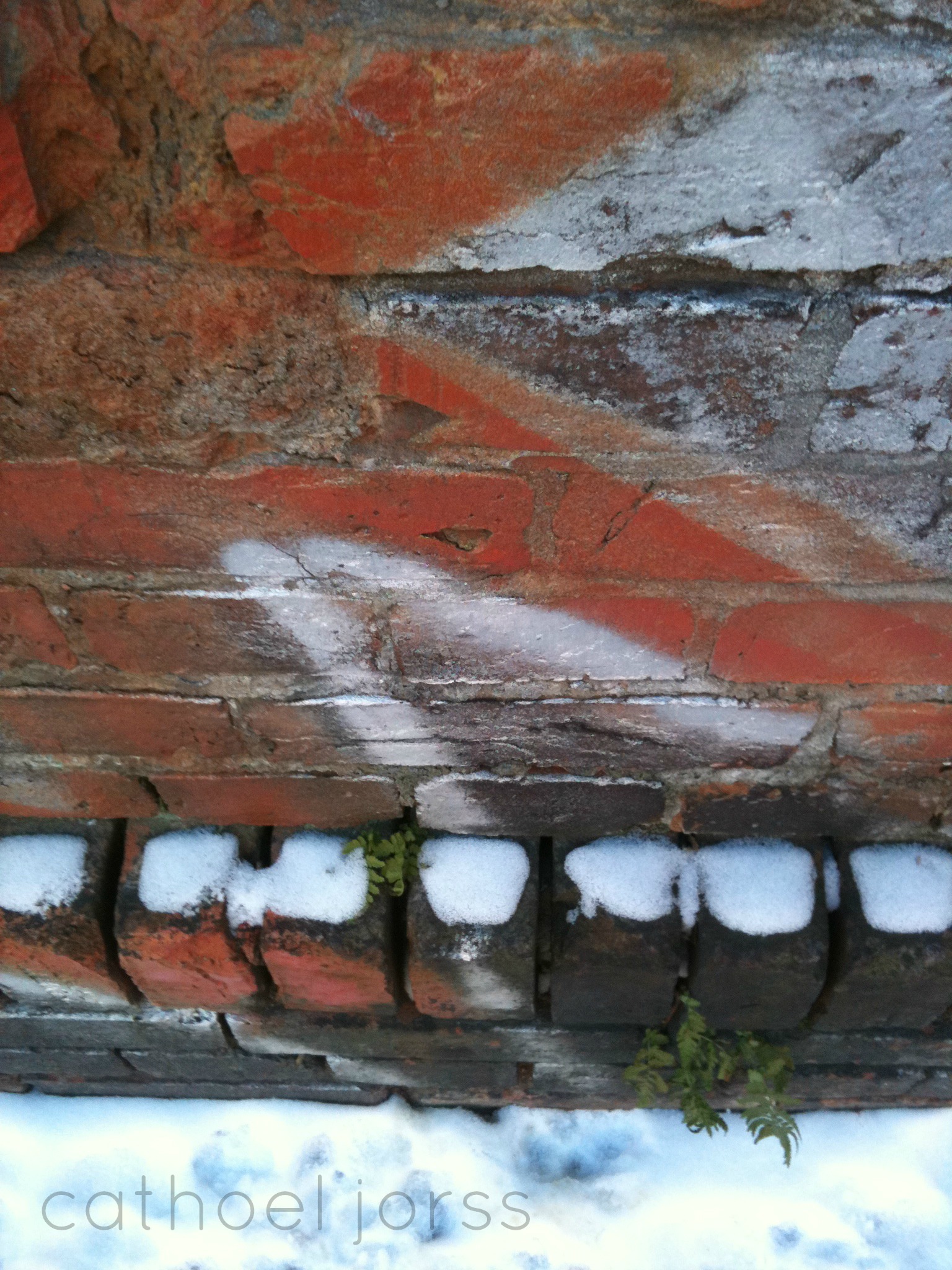
    H2O HoL brick wall base, fern & snow