Tag: money

  • the boast of Christmas past

    Last year and the year before that and four years ago too we went down on the train to West Germany, to a tiny village lying under the skirts of the old woods. This is where my sweetheart was born. His father was born in the same house and to me the village, the house, the family symbolised most of what I’ve longed for all my life – the continuity and cosiness of grandmother living upstairs and now sleeping in the graveyard, the grooming visits, where we trimmed her candles and scattered flowers for her; the dog racing joyously through unbroken snow; the stacks of firewood and the window dense with flickering lights.

    I felt so welcomed the very first year, when he and I had known each other only six months; his mother was kind and his father jovial yet somehow forbidding and she had saved for me the tree to decorate, “because you are an artist.” I persuaded him to go down there early in the season so we could hang out in his family, since mine is so fraught; and on December 9, 2012, four years ago today, we woke up at the other end of our long train ride and opened the door on a perfect world. Here is what I wrote:

    Waking up in a tiny German village. It has snowed and the snow extends away across the fields. The woods stand shoulder to shoulder up the hill. Opening the door I can hear church bells howling like dogs, everything is beautiful because everything is covered in snow, a white democracy. The phrase forms in my mind and a series of sour images ensues: what is white about a democracy? Everything in Germany is tinctured with its history, the way everything in Australia cries out black stories. Nonetheless this fairytale landscape has a hold of my mind, I feel relaxed and browsing, last night by the candleglow Christmas market I found a bookshop displaying eleven different editions of the tales of the Brothers Grimm in its front window. Tiny sparrows dart at the small wooden house outside pecking at seeds. A fierce wind has sprung up from, apparently, the Arctic Circle and I close the door thankfully. Good morning, winter world.

    Then last year, a huge family shindig. I should put ‘family’ in inverted commas because part of the substance of the fight – the potatoes perhaps, if not the meat – was that I was not part of the family, being a newcomer; therefore he had no right to bring me into important family discussions.

    This important family discussion was about money, aren’t they all. Previous family visits had been laidback, shambolic, tilted round long evening board games and wine. Now something was brewing, but I couldn’t work out what. All week we’d been trying to work out why everybody seemed so tense. Then January second I stumbled out of bed and down the dark hallway to find my honey and his father locked in fiery argument.

    I sat down and took my partner’s hand. To be locked inside a fire is grievous indeed. I had never heard this family shouting before, though the father’s a bit of a bully: our very first visit I had called him out on his treatment of his son, when the man whistled for him to bring something; He’s not a dog, I said, and the old man said: Doch. (“Au contraire.”) This visit he had been mocking us for our failure to produce a child; the sister, a thistly blonde, was swollen with her third and we had lost our baby and been unable, thus far, to bring forth a living sibling. The proud grandfather sat with his injured foot up on an ottoman, making my partner’s dog beg for walnuts; his son said, please don’t spoil my dog, it is I who will have to live with him, and the father said: “Well. If I had a grandchild, I would be spoiling the child. But as there is no grandchild…”

    These coarse country people occur in my family as well. Ours also drink too much and hoard things and are suspicious of fresh food. All week we had been walking in on whispered conferences which urgently suspended and then remained hanging in the air, swinging like baubles. Now the underwater fire had burst forth. It was a question of inheritance. They had cooked up an arrangement which seemed to me bitterly unfair as well as financially unwise, and I said so.

    My own family finds me outspoken, too. It inconveniences them to the point of injury. When I flew home for my father’s funeral and suggested, in sentences very tentative and clothed in sticky tact, a less sentimental poem for the ceremony, my brother said flatly, “That’s not open for discussion, Cathoel.” I said, “But – ” and he ranted, “See! this is why I was saying it would be better if you didn’t come back – you’re just this person who comes in and changes everything.”

    “You don’t belong in this family,” he had also said, on another occasion, and when I retailed this story after Dad’s funeral to my friend she said, bracingly, “This is perfectly true, of course. The only difference is, he doesn’t realise that it’s a compliment.”

    “She doesn’t belong in this discussion,” the father said now: “because you two are not properly married.” Well, I told him, wounded and enraged. When your daughter got married – it was on two days’ notice and in the town hall, because they’d worked out at the last minute they would save eight thousand euros in tax by becoming officially a couple – I had to borrow a set of unwashed clothes from the bride, else I’d have had to go along in my overalls. It wasn’t exactly love’s young dream.

    Well, but you have no children, he blustered, so you don’t really belong. And thus silenced me with pain.

    I told him some home truths and he told me to shut up. We had never spoken to each other like this before. I got louder. So did the dad, but I suspect everyone is so used to his roaring and his barked commands that they barely noticed. Afterwards I was accused of having said things that were beyond the reach of my imperfect German vocabulary. I reminded the father that he had told me several times to halt den Schnabel, hold your muzzle. They were so outraged at my insurrection “under my roof, to me, as host! in my Own Home!” that they had no room left over to contemplate what might be due to a guest, a vulnerable guest trying to celebrate their daughter’s umpteenth glowing pregnancy, a person separated from her own family and far from home. When I first saw the daughter, clomping on her sore ankles and complaining about the weight, I had followed her outside and asked that we could hug each other. “I’m so happy for you. It’s just painful for me, kind of, because we tried so hard – but I’m happy for you. I just wanted to give you a hug, you and your belly, and try to get myself used to it.” She embraced me with tears in her eyes. Now all of that was forgotten. I had called the messy patriarch of this outlander tribe a bully, to his face. I had said, inspired by rage and a kind of foaming disgust at his harassment and meanness, Your son – is a real man. He has manhood. I have seen him do terrible things and then hold himself to account. I’ve seen him struggling to learn and to make changes in himself. You should respect him. You should treat him with respect.

    I think we can’t bear when a woman speaks out. When a woman questions things. How dare she, how could she, and who does she think she is. The day after the fight we caught the train home to Berlin. I went up to the father, sitting at the table with his arms folded, and put out my hand. After a moment, he took it. I said, thank you for your hospitality and for having us in your home. The next morning a phone call. And the word, Hausverbot. This means, I forbid you my house. It is kind of a ‘don’t ever darken my door.’ In German, my partner said, very serious. You would give Hausverbot to a repeatedly violent pub guest who started a knife fight and stabbed somebody. Or to someone who’d been stealing in your store.

    The son, of course (they assured him) was welcome. But do not bring that woman under our roof. I spent January dissolved in tears, before distaste began to displace the other pain. You don’t belong in this family. All year long the wound festered. My father died and I went home. I confided how I was dreading this Christmas, worse than all the Christmases before. Afterwards my mother, in a bout of generosity, offered to send us both to Morocco for a holiday to replace the painful season. In an ancient Islamic city we could forget about the festivities we’d not share. We could put aside the sore points like the pregnant sister who didn’t bother giving either of us a gift, and whose kangaroo skin rug we had lingered over for an hour in the ugg boots store, wanting to bring her something luscious and Australian and Scandinavian for her comfy home, stroking every skin to find which was the softest. They are soft like the tender belly fur of a little cat. A day later, when all the piles of gifts had been opened and I was putting mine away, I asked her: hey what did you give me? I can’t seem to find it. Oh, she said – I just never thought of it. This hurt, and I told her so; not that she has to give a gift, but that she didn’t think. Now somehow this long-ago frisson of discomfort has been revived and painted glossy and put in the front window. We, who brought an extravagant gift we could ill afford, are designated materialistic, and grasping. My outspokenness is insufferable. My partner is greedy, because he feels sad and hurt at being all but cut out of his parents’ will. Last week the father, tricked past his pride by the wife who pretended his son had called first, finally rang. “I lift the Hausverbot,” he said, grandly. “You are very welcome and I hope you’ll come to us. But please don’t come to Christmas – your sister and her husband wouldn’t like it.”
  • buy for me

    Young, scruffy, insouciant Indian boy is walking by the greasy canal with his parents. Evidently he’s been showing them Berlin. Lifting his shapeless hand in a vague gesture towards the old, carved terraces he says:

    If I were ever rich –

    the slight rush of his r’s making it clear he quite expects this to happen, doesn’t expect it to be all that difficult –

    and they pass on, his parents well-heeled and looking rather bored as though Berlin in its filthy grey boilersuit does not impress them, barely glancing at the costly apartment houses he has chosen out for them to buy for him.

  • hair now gone to morels

    Today I had my hair cut and lost enough length to stuff a small teddy bear. Afterwards I crouched on the floor in the horseshoe swatch of paler wood worn on the black boards where the hairdresser stands every day in an arc that sweeps back and forth around each customer, and tamped up the soft, drying clumps in my fingertips, and put them in a paper bag they gave me. My hair had spread across a wide area and I gleaned back as much as I could. I feel a bit weird saying, Can you give me a bag, I want to take this stuff home: and even weirder about leaving it there lying on the floor. To get swept up. Mingled in with other people’s hair. Dusted in landfill, with its bad magic.

    I had chosen for this outing a place I felt safe in, in a chic part of town where women carry little dogs in their handbags. All the trees have sprung into service and the old buildings gleam. On my way home feeling lighter and breezier in the fresh afternoon Spring air I pulled the handles of the bag apart and peered in – a soft knot of washed and combed ends and curls lay there in a heap, big as my two fists, coiled on itself on the floor of the bag like some little dog lured from its home.

    I so hate getting my hair cut that it happens only once every year, or two years; for a long time I used to cut it myself, with the scissors on my Swiss army knife. The girl who took my appointment earlier in the day had a blond bob severely asymmetrical but her eyes were soft. “I will put you with Damir,” she decided. “He has an unusual name too.” Damir was very cool, as all hairdressers are cool, and reminded me of my friend M. Same quirked brow, same smooshed beanie on the back of his head; same deft hips. He let my hair out from its elastic and said, Ahh, in a tone of satisfaction. Took his time, handling the masses of it for ten minutes, parting and lifting it, weighing it, judging the curl and its spring and the way the colour grows. Only then did he say, “Let us go wash,” lässt uns waschen gehen. It was a pleasure to close my eyes and let myself be handled. He said, see how it’s much curlier at the back. See how it’s ginger at the ends, I said, and he said: that’s because you wear it up in a knot and that’s where the sun most gets to it. Right, I said, slowly, thinking: oh, riiight. How little one notices oneself.

    Would you like something to read? He went over to a low table by the huge windows and bent over, sifting and separating. In the mirror I watched him choose me out three magazines and order them into a stack. One had a photo in it of the beautiful photojournalist Lee Mitchell, shortly after the death of Adolf Hitler, in his apartment taking a bath in his tub. When Damir offered me a drink and I said I’d like some water he said, Still oder mit. This translates, “Still or with?” Germans ask each other these questions about water, still or sparkling? With or without. “With” means with gas: bubbly. The salon was huge and only one other person was getting their hair cut in it. How much was all this going to cost? “I don’t care,” I said to myself, trying to calculate when it was last cut: more than two years ago. It was peaceful there under his hands within the tent of my own hair. I remembered how I used to go to nightclubs just for the dancing, and would dance alone, all night, all night. When men came up to me I didn’t yet know how to get rid of them so eventually I would take the elastic out of my hair and let it fall across my face like this, making a thorough curtain through which I could see out but no one could see in. I used to smoke and I guess it was eerie to see a woman sitting smoking stolidly through the sheet of her own hair, certainly no one persisted past that curtain and this reminded me of that. I closed my eyes and let sensation scratch at me all round. The fingers brushing the back of my neck. The tugging as he lifted wings of hair up high to trim the ends. The soft feathering as it fell down over my face. The scent of tobacco from his fingertips, that lay on the hairs hanging combed straight over my nose. The faintly tropical, faintly chemical smell of salon shampoo. “You never blowdry it,” he said, and I said, “I don’t even own a blowdryer. Or a comb.” “You can feel it in the hair,” he said, letting it run through his fingers like water in sand.

  • hungry in Spain

    I saw three Spanish boys doing parkour in the gardens. I have run out of money and am hungry: it’s temporary. To a Spaniard gardens means a large, bare, gravelled expanse with formally clipped hedges and dark, clotting trees. The smell of the cyprus is familiar from home. I sat on a bench under the trees and watched these boys for half an hour. They were trying to climb a sheer twelve-foot wall using their speed and hands and concentration and willpower. To my right a couple in puffer jackets were smoking some excellent weed. I sat watching the three boys in their baggy grey pants intently concentrating, doing it for themselves, and was overcome with dark sexual longing. I adored them. They went at it over and over, always exactly the same, one of them actually scaled the wall and stood on top clutching the railing with both hands before he dropped lightly back to earth like an angel, I thought: were it not for tree-planting and feeding the hungry I think this would be the noblest pursuit a young man can throw himself into, in this messed-up, traffic-scarred, urbanised world.

    A child of four or five threw his teddy up in the air again and again for his mother to catch and hurl back to him. His teddy-loving days, I thought, are numbered, and not high. Another couple hid inside the boy’s parka hood and with intense delicacy grazed on each other’s faces. I saw a man cycle past guiding with one hand the back of his child’s tiny bicycle, he had a large paper butterfly she had hand-painted with sparkles attached to his backpack and flapping. Spanish girls with their luscious long hair. On every corner a hairdresser, a pharmacy. The underground train which is livid with voices laughing, chatting, like a big, relaxed club. The five elders sitting side by side, four men and one lady, formally attired and letting the last drops of sunlight fall on them along the lip of a large statue, in granite, of some soldier or some prince.

  • shop where they sell bottles

    I went into the bottleshop and found the most approachable face. A guy from Canada. I told him, I only drink red. Ordinarily it’s cheap. But I want to spend maybe four dollars more and buy a wine that’s gonna make me go: That is why people spend money on wine.

    His eyes lit up. An enthusiast. He asked me what we were eating tonight and what kinds of wines I liked. He guided me down to the back of the shop. Underneath the shelves of botrytis they had an opened box. This, he said, this you will like. It totally over delivers.

    At the counter I got talking with his colleagues about how I was trying to educate my palate. The blonde girl shook her head. That’s a great idea, she said, except… You were happier before? I guessed. She said, brushing his arm, We were just talking about this. How learning to appreciate French champagne ruins your palate for ~

    I interrupted. Ruins your life? Yes! she said, nodding emphatically. Or, I suggested: short bursts of happiness interlarded with long eras of works you don’t want to… Yes, she said, that too.

    Outside the shop the night had ripened like a blue-veined cheese. I passed a heavily-muscled man who wasn’t short but looked it, because of his thickened build. I was dressed in a long wool skirt over my pajama pants and he was wearing gym shorts. As we came towards each other we both tipped our heads back to see the sky, its golden flukes, its beckoning well of pale blue. Its sense of light being backed by the dark, like a painting on velvet.

  • what’s mined is ours

    I think mining is a really primitive way of making a living. You gouge it out of the earth and you ship it away. It can never be sustainable: unlike a forest, where you can say “Well, we plant two trees for every one cut and we leave behind the nests and the habitats, we use the forest for eco-tours and to teach about local Indigenous culture.” Once it’s mined it’s gone, it can never grow back: the uranium, ore, oil or copper and the mountaintop as well. We call them ‘mines’ when really they are ‘ourses’ or even ‘earth’s’. Australian Conservation Foundation point out the mines in Western Australia make close to a billion dollars profit a week taking minerals “they didn’t make, out of land they don’t own.” Mining turns irreplaceable materials into disposable products; it fuels industries which have not caught up with the parlous state of the poisoned world; it’s a primitive, dangerous occupation and I think it attracts primitive, dangerous people.

  • dentist, draftmaker, drill seargeant

    Whenever people ask, So do you make a living from your writing, I feel obscurely coal-hauled, if not outright keel-hauled. Does anyone ask this question of an architect, a dentist? It’s so personal and somehow lip-smackingly censorious. I hear behind it two subtext questions: 2: “So. Is your writing any good?” and 3: “And am I subsidizing it?”

    The hundreds of times I have been asked, “So: do you make a living from it?” the question has never once been accompanied by, “Ah! Is your writing for sale? Where can I buy some?” But I answer the spoken and the unspoken questions either to myself or, if asked rudely enough, out loud: 1: No. 2: Yes. 3: No, so you’re not my employer, so you can put those eyebrows down.

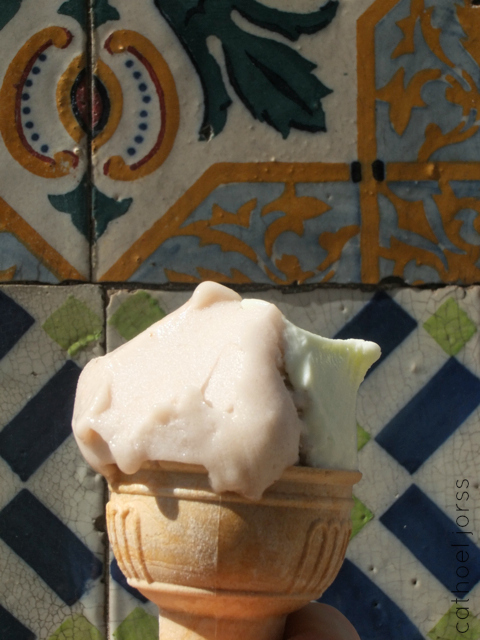
  • ice cream man

    ice cream man

    Something I dig about the guy I’m travelling with. We are staying with my folks and Mum, fielding a houseful of hungry guests, sent us down to the supermarket with her credit card, and her pin number written on my wrist. We did the shopping and then looked at one another. I said, “Hey! We’ve got Mum and Dad’s credit card! And access to everything they own! Mwahahah!” I was just about to make a joke like, “Wanna go buy a car?” when my Berlin companion opened his mouth. He said, “Wanna buy an ice cream?”


  • eggshellac

    Like a little eggshell in the sky. I have moved into my final Berlin sublet, just 3 weeks, and barely dare breathe. Everything is white down to the phone, painted roughly with house paint but still black on the inside when you pick up the receiver. In the little white bathroom a toilet with no lid and no seat. A tiny wooden vegetable brush perches primly across the back of the… mouth of the sewer. I said to my landlady, who is off to India for three weeks to translate Arabic manuscripts, “No toilet seat?” “Oh, did you notice that? Does it bother you?” “Well…”

    She said, “I guess it’s a bit cold, and kind of uncomfortable, but it broke and I just realized, I don’t really need this.” I foresee that within a few years she will be living cross-legged on the head of a pin. The place is quiet and curtainless and resembles a tiny Buddhist monastery. Floorboards painted white. White rugs which, she showed me, she cleans with a little brush. She pulled out a rush cushion from under the low white bed to show me: “This makes a great table, for eating.” Then she set off in the November rain through streets full of sticky wet leaves to fly south, with one little blue bag, wearing a pair of socks inside white sandals. Mysteriously there is no mat at the front door, yet everything within is pristine. My landlady had also painted her little computer white, including all the keys, but then had to scrub most of them back to the original black so that she could see what they were. Her patchy keyboard in the chalky white room was startling, a giant crossword. We exchanged money and keys this morning and she showed me around. “I have these two spoons.” Four plates, two bowls, and a couple cups, no pepper, oils, pans, forks, knives. “Poor little flower,” said the friend who helped me carry my suitcases. “You get the feeling that a gust of wind would blow her away.” I on the other hand will not be having that problem. In just 18 months my pile of cases and boxes has swollen like paper in water to twice their original dimensions. I think of the old cartoon of a bag lady pleading not guilty on a charge of shoplifting “by reason of static cling.” To get home I will have to divest myself of a rowboat full of leaves, intricately rusted bottlecaps, brochures and books that I picked up and brought home because they seemed beautiful or interesting. This might be the perfect place to do it. In between, I will loll in the tub and read, an egg in an eggcup in a large eggshell in the grey, minimalist skies over Germany.


  • the coins, the crowns

    the coins, the crowns

    Such a jolly lady in the village post office just now. She really made my day happier. Expertly popping up and then deconstructing one box after another until I could figure out which size I needed to buy, each with a hint of a flourish, like an auctioneer. “And here… we have the Number 3…. This one is the Number 4.” I opened my palm and showed her the mess of Swiss coins, fishing out extraneous Danish crowns, Euros, Australian dollars, and a shard of porcelain I found in Lisbon. “I’d really like to get rid of these,” I told her, picking through the various sizes and counting out the right change with agonizing slowness. “Sie haben gut gesungen,” she offered brightly: You must have sung really well. It took me a moment. “You mean because… people have thrown these… in the street?” “Yes,” she said, beaming, mocking herself just a little. “That is what we like to call Swiss Humour. You sang well.”

    H2O HoL wires in sky