Tag: Nazi

  • alles ganz frisch

    No Murdoch press and the sun has come out! How much fresher can Germany get. We have eaten a breakfast of thinly sliced things rolled on platters served with other, slightly more thickly sliced dark and chewy breads. My companion sinks into his first cup of filter coffee with condensed milk, “Aaahhh.” The familiar is sweet. He makes me smell its unmistakeable scent but I hand it back, unimpressed: “That is not the coffee to make me forget my vow.”

    Instead of The Australian and The Courier-Mail, with their perpetual racist beat-ups and photos of women murdered by their husbands who are described invariably as “decent blokes” who simply “got pushed too far” (by the serially battered victim, presumably), instead of a cover photo of some actor who happens to have dark hair and “swarthy” skin staged in an “ISIS” pose like some deranged hip hop artist, there are four pages of literature and art events with listings – in the plural – each day of readings and book signings. Some are in bookshops I recognise, one is in the genteelly decaying place round the corner where in the week I was first in Berlin alone I took my own book and asked would they sell it. They did. Its sole purchaser was a tall beautiful man whom I approached as he was turning over novels in the English language section, saying, “You should read this one, I wrote it.” “Alright,” he said, and bought it. That man was a bookshop and cafe owner in gorgeous Copenhagen and is now one of my dearest friends. He told me, before I ever thought to visit, his little shop sells “three of my favourite things – coffee, books, and records.”

    Much though I applaud the ferocious independence and gall of the newly established Saturday Paper back home, it feels wonderfully civilized to have a wide choice of newspapers all run by different owners and all presenting a variety of views. The Tagesspiegel, “mirror of the day”, has a long, two-page article titled “Wie Besser Helfen.” How you can better help: it details the “lonely elderly neighbour,” the “fallen person selling Motz” (a homelessness fundraiser similar to the Big Issue), the “prostituted girl”, and the “belaestigtes Maedchen” – I don’t know the word and wonder what kind of needing-help girl this could be: my partner, in labouring to describe it to me, reveals that he has heard the recently much-used word “cat-calling” as “scat-calling.” I want to go out into the streets of Berlin and feel the frigid sun on my face and get scat-called by traffic that stops and starts like a jazz composition on the right-hand side of the road. I want never to hear the name Rupert Murdoch or Tony Abbott again. I read the stories of “alcoholic apprentices” and lonely elderly neighbours, followed by short, pragmatic paragraphs contributed by people who know how best to offer help – social workers, for example – and I think how a country’s press can shape its social life. My partner reads out an article on an American novelist we met at the University of Queensland, who dropped his head when I asked a question from the audience and tore in a deep breath when I mentioned how Australia, “to our shame, leads the world in child suicide rates among Indigenous young people.” Last night we passed a synagogue with a police officer standing outside stamping in the cold, he had a little hut with Polizei written on it. Every Jewish gathering place in Germany is thus guarded, my partner says, and has been since 1949, “because we are guilty for a thousand years.” I suggest to him that there have been times when a German police guard would, to a Jew, not be very comforting. Like the escort offered in my homeland to its Indigenous people whenever they are picked up for not paying a fine, or for being drunk: a one-way train that leads to nowhere but the ironic and ferocious hell whose gates are tiled with good and insufferably pious intentions. The Murderochracy.
  • the hurly-berlin

    the hurly-berlin

    Berlin, Berlin. Familiar and overwhelming. On the train back from the airport a girl with an extraordinary voice hopped on and busked. At the end of the song, the guitarist accompanying her took a bow and people burst into applause. “Wow!” she said, opening up her hat. A cute couple jumped off and a guy with his afro razored up the sides leaned after them, silently proferring the phone and wallet the girl had left lying on the seat. Two muscular men slightly running to fat had their dog with them, a pug named Princess Sheba. We got talking. The one holding the dog on his lap obeyed signals from the other one who said, wiping his own eye, she has something near her eye, and so forth. Princess Sheba stood upright on her owner’s sturdy legs, balancing against the train’s movement like a surfer. These trains travel high above the street and at intervals feel like you’re lost in the woods. The cool breeze flooded in every time someone got on or got off. “Mind the gap,” the safety announcement said in English. Later in the evening a guy snarled at me for making eye contact and called my German companion a Nazi. He was walking along spoiling for it, followed us, taunting, through some misery of his own. “Like the black women in Brooklyn say,” he said, bitterly, chasing us, “stay away from white people.” Berliners smoke in cafes and the street is filled with old litter. If you eat out, people beg, and sell newspapers, and beseechingly play the harmonica. At the next table a middle-aged blond woman painted her lips against a little mirror while her boyfriend watched absorbedly. It took both of them to make her beautiful, it was their tradition. She made faces at herself as though she were having a very emotional, silent conversation. We saw two Romany boys whom I’d seen busking last summer, a year ago now, the little one is bigger and wirier and his chubby brother is chubbier. The younger plays the trumpet and has a loud ghetto blaster with which he drives away all the other musicians. But he’s getting better. Last year he was confident but terrible. I told him, your playing has improved! so much! you’re getting good! and for the first time in all the dozen times we have spoken he gave me his slow, curling, lopsided and personal smile.

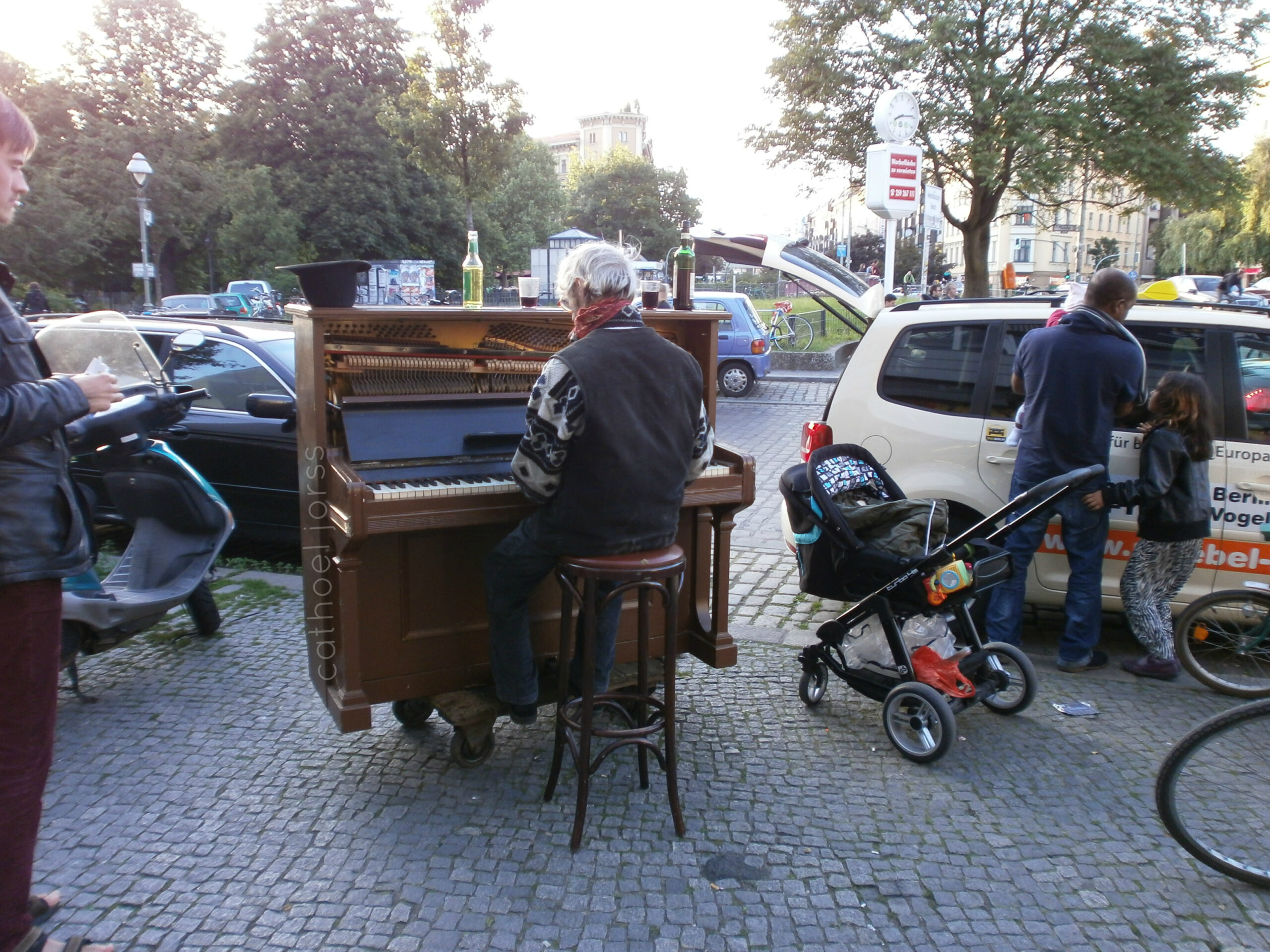
    H2O HoL browsing piano player

  • they were herded

    they were herded

    Gleis Siebzehn (Platform 17). Here is where ten thousand Jewish Berliners were herded onto trains. Only very latterly (1991) was a memorial opened. It is very simple and harrowing. No names, just numbers all the way down the platform: 29.10.1942/100 Jews/Berlin-Theresienstadt. 30.10.1942/100 Jews/Berlin-Theresienstadt. The second place name refers to the ghetto or death camp from which human beings never returned. The numbers are staggeringly ambitious: 938 people in one day; a thousand. Towards the end of the war they grow pitifully small: 32. 27. 26. 24. One of the panels has a yellow rose cast on it and on the ground behind it, among the birch trees now growing up through the tracks, last week’s yellow rose lies discarded in the snow; beheaded by its fall, in fact.


  • Felix Nussbaum

    Felix Nussbaum

    Today I saw the paintings of Felix Nussbaum who because he was born Jewish was murdered at Auschwitz in 1944. My friend described how ‘we Germans’ had done ‘the worst thing’ by industrializing mass murder. I had never thought of it this way. Apparently Himmler watched a group of detained Jews digging their own mass grave and then vomited each time one was shot and tipped into it. His response was, we need to find a cleaner way of doing this; so the gas chamber was devised. (Why not, “we need to stop doing this”?) Standing in front of Nussbaum’s sensitive portraits and seeing from the dates he had less than five, four, three years to live it was impossible not to weep. We wept and choked and kept our tears silent. The museum gave onto neat German houses through a series of crooked windows, it is called the Museum with No Exit.

    Afterwards it took a very long time to come to grips with my anger and fear and sense of terror and loss, with the grief, the resentment and yes, incipient hatred. I resented all of us for being here when so many sensitive and feeling people have died. I resented my own country, built on the backs of its own native populations and still dishonest about the murders in police custody and in jails. I could feel in my responses how easy it is to start blaming people and how delicate and difficult is the work of keeping one’s heart free of the pernicious weeds of resentment, envy, fear, and suspicion. How easy it feels to start to build on the seemingly empowering intoxication of self-righteousness. They, they, they. We, we, we. All the way home. Alright.