Tag: restaurant

  • Make Africa Great Again

    We went out to the white people’s restaurant, as he calls it, which is a street stall on a dirt laneway behind the supermarket. There’s no street lighting, no cutlery. Collapsible plastic tables are set up between the parked cars. Vivid local tunes blast from the tiny bar across the road, which brings icy beers in brands no one drinks in Europe. We sit there for hours eating chicken and fish with our fingers. Last week a white girl got up and went over to the bar, carrying her phone. She persuaded the barkeep, who is a rapper, to link up her tunes to his speaker. Within seconds this wholly fresh and salty sound bathed the scene, and at their work and in their seats everyone was dancing.

    Tonight a man sitting against the wall behind us had on a MAGA hat. A black man. I looked closer. MAKE AFRICA GREAT AGAIN. I got up and went over. Close up his red baseball cap read MAKE AFRICA HOME AGAIN.

    I crouched beside his table to say hi as I do occasionally when a table of visitors have stiffed the boy dancers. “We can’t afford to give money every day,” they say, reasonably, demonstrating they can afford to eat out every day and I spread my hands, “I know, me too,” and persuade them that it’s ok not to give, it’s not ok to turn your stiffened faces away and keep eating while someone is standing there, sweating with performance, holding out an upturned cap. He is standing there. Treat him like a human. You are not greater nor less. Make whiteness great again.

    Since so much of our cruelty comes from diffidence, I offer scripts. “I say, I’m so sorry, I cannot help you this time.”

    “But then they don’t go away!”

    “Just be direct. It’s courteous. ‘I’ve said no three times, you have to leave now. Bye.’” I tell them the dancer who stuffed fire down his pants but was yet to bloom in puberty “came to our table after you, and he just looked so wounded.”

    Poverty is all around us like jackrabbits in the grass. Poverty, hard work, resourcefulness and struggle. We are like big birds of prayer gliding like clouds across the sun, idle on the air and wondering which one next we will swoop on to assist or exploit. Building our bullshit churches, insulting sufferers with thoughts & prayers in place of action, rendering free men into slaves, free woman into sex slaves. Calling the children they raise from rape ‘half caste’, as though only that portion of their humanity fell into any class we recognised.

    Next morning four boys came to the low wall around our house which keeps the goats out. Their upturned faces were lower than the wall and I had to go and peer over, to hear. “Please, we want you go buy us four bicycles.”

    Oho! I said. Well I would love to buy you four bicycles. I wish I could. I explained that I would love to have a bicycle, myself. But of course, I meant a second bicycle, here in my second home at which I arrive by jet plane.

    The spokesboy suggested, “Or maybe a ball.”

    My heart flooded with regret and shame, yearning and heat. Why shouldn’t these smiling, reasonable, kindly, and well spoken courteous boys have a ball? A ball to play with. A boy standing behind him said, “Bicycles!” and got cuffed for spoiling the deal. I asked, “Ee gon be how much?”

    They reasoned. “Well, ee cost 25 cedis.” Five dollars. The spokesboy explained, you can get them for 18 cedis, but… “They get spoilt?” I suggested, using a word that in the wealth world we use to describe unhappy children but which here means, I had a phone once, second hand from the markets, and now it doesn’t work.

    I tried to respond to this adventurous, eminently reasonable, and brave request the best way. I didn’t want them to feel that if this ball got spoilt they could just come ask the white lady for another, that a ball was nothing to me. I didn’t want them to feel I gave something which was nothing, it seemed insulting. I explained I had little money right now. All Africans know little money. It’s the most usual form of money. “But I will try. I’m going to try to find some money for you so we can buy a ball. I can’t promise you,” I said. “But I will do my best. Do you get me?”

    Of course I’m going to buy them a ball. I just want them to have a week of looking forward to it. I see school children carrying their homework under the awning of a shop which has a light. I see people eating yam for breakfast, just boiled yam. If you have a sauce on your rice, the sauce is a couple of spoonfuls of garnish; in Europe garnish is the main dish. The man in the MAKE AFRICA HOME AGAIN cap made me at home at his table and we spoke for some few minutes. Neither of us mentioned Trump. We exchanged our numbers, as Europe and Africa should do. We are so few and have so much. They are many, and have little. We, they. We spoke about the music. The rapper who brings beers played his own song again. Coming back to our table I was dancing, a little. In Ghana I always want to give everyone everything and as I build my tiny business I am finding out a way we might be able to do that, one transaction at a time. It’s not giving everything: it’s not giving at all. It’s giving up what we can afford of what we stole. It’s giving part of everything back.
  • I spoke first

    In a crowded lunchtime cafe we were pressed elbow to elbow. The couple beside me talked and talked, while both scrolling idly on their phones. At last I turned to the woman, whose mouth was open and full of food, and asked her,

    “Excuse me, would you please be so kind (in German we say ‘so dear’ or ‘so love’) as to swallow first, and then speak?”

    Her mouth dropped open further. Her gaze sharpened. So I said, “It’s kind of gross. And I am also eating.”

    People who lack emotional honesty are often intimidated by it, I think. They turned to each other and went on as though I had not spoken, except that the woman changed her habit. But the man must have been revolving it in his mind, like the visible food in her mouth. I went on with my meal gazing into the beautiful day around us and was startled by his hand on my arm.

    “Firstly. You should ask more politely. And secondly. If it is you who doesn’t like it, it’s you who moves.”

    “That’s polite?” I said, almost laughing. But she gained courage from his hostility and soon they were both railing at me, jabbing hectoring fingers in my face, telling me off as only Germans can.

    “Look, if you want to have a fight about this, can you do it amongst yourselves? I’m not interested.”

    This outraged them further and the woman’s chest was heaving. The people at the next table looked shocked. The waiter came so I could pay and asked, how was it. And I said, truthfully, it was ok, thank you, it wasn’t super like it usually is.

    Five German gasps went up around me like balloons. The Vietnamese waiter laughed. “It’s because today I cooked it myself.” It is interesting to me and I sometimes experiment, how much you can frustrate a German by simply refusing to make eye contact – whilst jaywalking, for example – because they long to tell off the transgressor and shepherd them back into the fold, but lack the straightforwardness to tackle someone who has not spoken first.

  • this land is our land

    Was quite excited to work out last night by decoding the allergies notice in a Korean BBQ restaurant (‘alergia’) which began ‘en caso de…’ – ‘in case of…’ – that ‘casa’, house, must mean your case. It’s your shell. And mi casa es su casa. My case is your case, we all breathe the same air, death and the roiling adventure of this life will inflict us all.

    On the way home we passed again the man whose giant telescope, set up in the square outside the Teatro Real, has shown me on previous visits Jupiter, and her moons, and – unbelievably – Saturn, looking like a chalk sketch much stouter and smaller than I had always pictured Saturn. He busks with it. Drags it down there, I can only suppose, on the back of a small truck and sets it up pointed at whichever body in the heavens is tonight most significant, then he stands artlessly waiting, perhaps not polishing the lens but minutely adjusting the sights after each visit, inviting all and sundry to take a look through his machinery at the distant miracles now shedding some light on us – too little light, and too late. We didn’t stop to look through the lens again but my companion pointed out the joy on the man’s face, the way when someone steps up onto his wooden footstool to apply their eye to the eyepiece stooping to reach it he himself bends in, unconsciously it seems, and eagerly, as though he is sharing their experience and imagining their wonder. The first time I saw Jupiter in a long line of moons I was almost crying. Now every time the man and I wave to one another, satisfaction on our faces, a strange friendship. Mi luna es su luna, inevitably.

  • a fortunate wander

    Today a very fortunate wander took me into a place I adored: several places and all of them new. I couldn’t handle the surly manner and derisory service, the lack of smiles from the waiters who work year in, year out with tourists treating their town like a fun park, nor my fellow tourists themselves, not even the six English ladies made up like drag queens with giant, winged eyebrows painted on their pink foreheads who got drunk at the next table on Friday afternoon and asked the man, Is the chicken salad thigh or breast meat? And then when he didn’t understand, their ringleader (biggest brows) insisted, Breast! You know? Breast? putting her cupped hands under her own mammoth bust and jiggling herself at him invitingly. They made me laugh and they made him laugh but also, enough is enough. I went walking and kept walking, without looking at the map, just following whatever alleyway or lane seemed inviting and counting the geraniums in people’s windows.

    Down a steep hill I rounded a corner into this long, elliptical square – a rhomboid square – just filled up with Indian restaurants. There was a grocer’s selling plantains and yams and cheap calling cards, and on the other side where the pavement swung out from the houses maybe ten or a dozen restaurants ran down the hill. About a hundred tables were crowded with afternoon revellers. I found a seat under a giant umbrella and read from the cheap, fantastic menu. All around me people were eating and chatting, it felt like a very laid-back party. I put my hand round my jarra of beer and a terrific commotion struck from uphill, drummers, dancers, forty or fifty lanky African men came bursting slowly out of the narrow road between the houses and they had skin drums, shakers, all kinds of noise makers and were dancing. Really dancing. They tumbled down the hill gradually like an intricacy of shells washed in the surf. Round the hems of this raggedy band half a dozen fellows carried pots and hats, which they danced among the tables to offer deftly round. People remonstrated, laughed, threw in coins. They were irresistible. When I had done eating I got up from my chequered table cloth and followed downhill the shaggy brown dog who was carrying a whole soccer ball in his mouth. The ball was saggy and deflated but he clearly loved it. At the bottom of the road where it met the next street was another plaza, ramshackle and traffic-stained, where dozens of people lounged on bollards and under trees, many of them African. And as I was coming up again towards, I thought, the part of the old town I know I found a little bookshop open all day until midnight, in which quiet prevailed and concentration reigned so much that when people came in from the street they instinctively lowered their voices. It was like the opposite of the meat cave I had found on the shopping street, Paraíso de Jamon: it was a paradise of non-ham. Three people in alcoves and under bookshelves were writing. They serve coffee and the windows are encrusted with flyers. I sank down by the cardboard carton of old vinyl and took out my notebook and my pen. People turned pages and moved very little. The guy serving sat behind his computer peacefully reading all afternoon. We were there for hours.

  • shopgirl

    Tonight I walked into a Chinese restaurant alone and was seated at a tiny table in the centre of the crowded room. The smaller tables were set out in pairs running the length of the long restaurant; the gap between my table and the couple next door was about four inches. Idly I eavesdropped on their conversation, noticing how he invariably talked and she invariably supplied back-up: Mmm-hmm, yep, I know what you mean. Oh, my. Well, that’s fascinating! Good for you.

    When their meal was done and my meal had arrived the man picked up his unused chopsticks. He had eaten his dinner with spoon and fork and now wanted to know: Sind diese zum Mitnehmen? Are we supposed to take these home with us? His companion, who was older and had a wise, patient face though she had sat unmoved through his several recitations of what sounded like mind-numbing generalisations and prejudice (“they were obviously gay, or had spent time in prison, ha ha”) said, rather gently, “I think some people use them to eat with.” Some people like the woman at the next table, for example. He tipped the long paper bag to let the bright lacquered chopsticks slide into his hand. Playfully he mimed for her their various uses: scratching his scalp with a single chopstick, tucking it behind his ear like a newspaper man of the 1920s, trapping a long moustache under his nostrils by scrunching his upper lip. After that he bunched the two chopsticks together and slid them carefully back into their paper sachet and laid it back on the napkin on his untouched side plate.

    I felt my face squinch into an expression of disgust. The woman was so startled she broke the fourth wall. “What?”

    I said, spreading my hands, “Well – if you put those back into their case, they’re going to hand them on to the next customer.”

    The man looked blank. “And?” he said.

    I gasped a sort of soundless bark of laughter. “And, well you’ve just stuck them in your hair and put them behind your ear and… it’s not very nice, don’t you think?”

    He was so mortified he stood up instantly and began fumbling for his coat. He must have been trembling because it took him a long time to work his arms into the sleeves. For many minutes he stood there patting his pockets, clapping himself up the chest and back down and round the backs of his hips with two spread hands. His companion didn’t move and none of us looked at each other. I got on with my dinner and some time later the man reappeared, smelling of tobacco smoke, and slid into his chair beside me as though no time at all had passed. He began once again describing the world to her and she consented, nodding, agreeing, supporting. He slid the chopsticks out from their paper case and set them side by side in front of him. When I got up to leave I said, Wiedersehen, and got a nod from the listening woman but no acknowledgement from the crumpled, authoritative man.

  • little staves

    I wonder at the charmingly gap-toothed Engrish on the front of the chopsticks packet. Wonder hardens to wryness when I turn the packet over and see the flawless instructions on the back which show diners how they should use them. The front says, Welcome to Chinese Restaurant. Please try your nice Chinese food with chopsticks, the traditional and typical of Chinese glorious history. And culture. PRODUCT OF THE PEOPLE’S REPUBLIC OF CHINA.

    But the back says, Tuck under thumb and hold firmly. Add second chopstick, hold it as you hold a pencil. Hold first chopstick in original position, move the second one up and down. Now you can pick up anything. This is the brand of (oh joy) disposable Stäbchen (“little staves”) that are most commonly given away with even eat-in meals in Asian restaurants in Berlin, they must consume thousands of trees per annum and presumably are also designed to entrance hundreds of thousands of infatuated, patronising Western cultural tourists. Because by making use of people’s urge to condescend and correct, you can pick up anything.

  • I wish I drank more

    Accidentally went into a restaurant for dinner in which I realized too late all the men were wearing suits. I tore off my two layers of wool, hot from walking, and sat there in very shabby jumper with a t-shirt over it which I sleep in, pressing slices of bread into a bowl of olive oil, reading the menu. I felt so tired and overcome by thoughts I could barely read menuese: a first-world problem. My elbows through the sapped weave of my jumper stood on sharp crumbs on the white cloth.

    The waiter was an exhausted but mildly gleaming Woody Allen man with a soft sunken pavlova of hair not quite reaching the centre of his scalp. He brought me wine. I polished the excess oil into my fingernails and admired them by candlelight. At the next table a woman about a decade older than me was unleashing her ribald laugh for the delectation of her companion, even older still. She glanced at me over his shoulder and began to whisper. Her eyes were fixed not on my face but on my peeling jumper, my bony wrists thrust from it like over-plucked hens. “Unglaublich,” she said, “unbelievable.” I am shy and had stood outside the teeming with smiles restaurant for fully five minutes working up the courage to come in. But I let my eyes fix hers to let her know that she’d been understood. She looked away. It was almost fun. I watched her for several minutes while she looked everywhere but at my face. The power one gains by being (sometimes, not always) unafraid to look someone in the eye. The uninterestingness of power except as a kind of parlour trick, or party favour. The banality of parties, at which everyone who’s best dressed can resemble a tricked-out and groomed dog, leashed and booted, with a lampshade on their head.

    I wish I were a bulb, tonight. Either a “Glühbirne” or else the kind that grows under the soil. I wish I were a better dressed kind of human, or that I sometimes combed my hair. I wish I were 21 and radiant. I wish I drank more.


  • to stars

    to stars

    In an unpretentious Italian restaurant where all the pasta had been made by hand, the chatting-family atmosphere fell into something much deeper and richer and darker. A cellist had walked in and in his overcoat sat down on a backless chair in front of the servery and began to play. Something, I don’t know what. He drove his fibres of unholy sound into the great grail of all of us, each of us, like an ochre long-blown off the palm of his hand. I saw the small boy with dark lozenges of eyes climb down from his chair at the corner table in the second room and go to stand, unconsciously in the waiter’s path, his head a jar for the tadpoles of surety this man was making for us. He stood and stood, listening and watching, lost to every other thing. Behind him his parents and their friend kept chatting and only the older, grizzled, quizzical looking man at another table let his gaze rest on the little music lover so fondly, brimming with acceptance, and I let my gaze rest on him in turn and the music rested on all of us, like snow, that spares no needle in the pine forest and lifts its shifting darkness turn to stars.

  • decanticle

    decanticle

    I’m alone in the house and my heart feels filled with love. It’s a feeling like glass-slippered waves coming in over your feet on the sparkling, rough sand, so shallow you barely get wet but the softness of the water is inexpressible. Like water from stars, I mean light, I mean starlight, the salt water travels a long way to get to us. Maybe all of the love in my heart is from long-extinct volcanoes burning in other skies. I love the sounds of other people’s lives around me, I love the roaring restaurants that spill out along the street. I loved the girl dourly smoking Gauloises as her lover nuzzled into her neck. The little Thai restaurant, the bar on the corner with a waiter whose beautiful shoulders and tiny pigtail sprouting from the crown of his shaven head were so irresistible to watch. I love the sandpit at the playground with its no smoking sign. I love the little purling hair growing out of this soft mole on my cheek, its familiarity, its curve. I love the way the sky sets off immediately where the ground ends and goes, as far as we know, forever and ever and never ceases to be. Asking nothing and accepting everything. I love the blackness and the blue. The flowers that close up at night, like awnings. The irregular army of bottle-collectors, and people with spray cans and brooms.

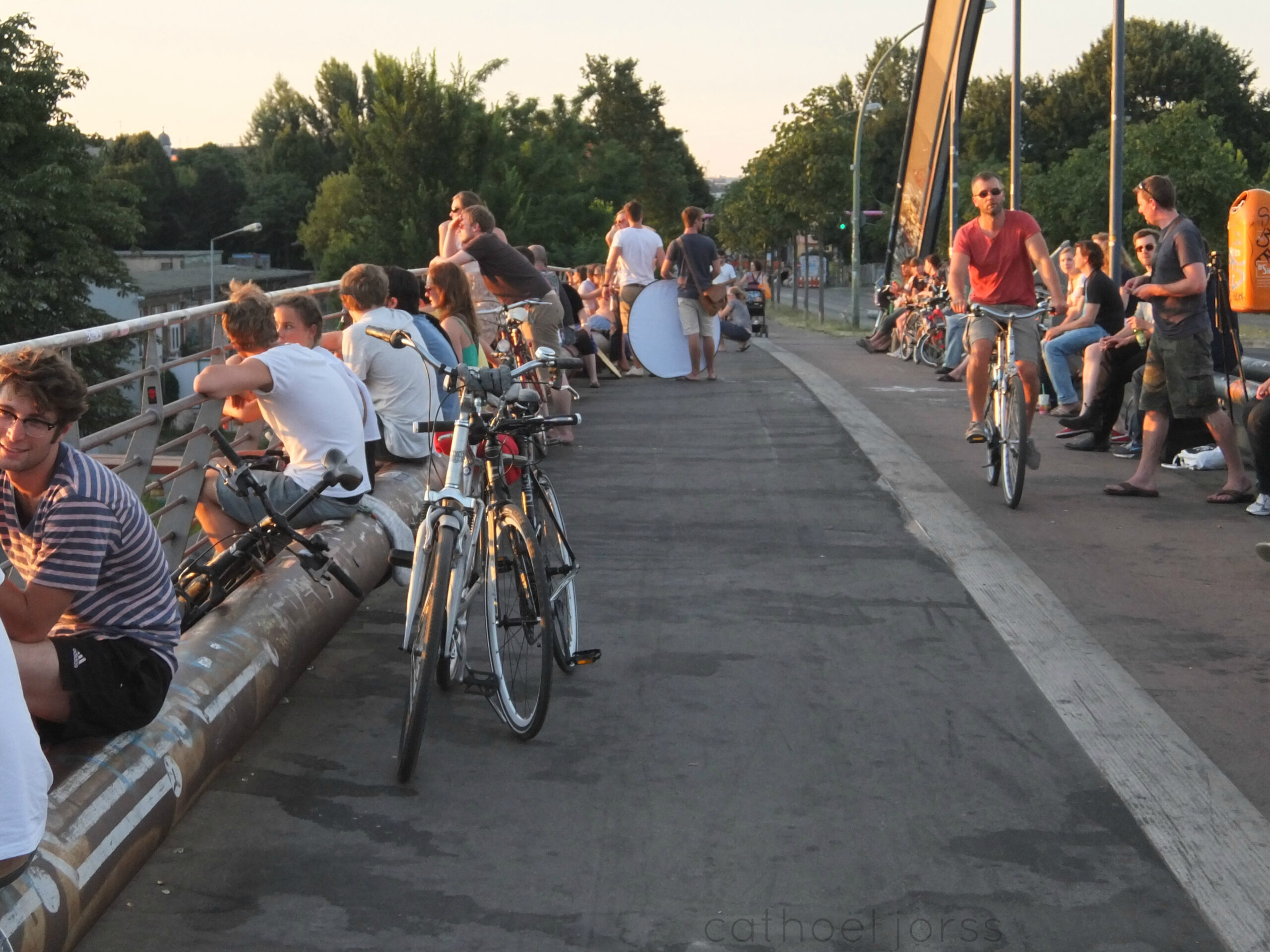
    H2O HoL berlin popular bridge 2

  • pearl-sheaves

    pearl-sheaves

    Ran across the same little punk dog we’d met with last week, a scruffy little dude with green dye in his hair. His name is Schnitzel. I know this because he came scampering up the street and this long knotted rope of a woman, with five colours in her hair and a goodly stomp on her, came bawling after him, “Schnitzel! Schnit-ZEL!!” “Typical punker name,” my friend told me, casually. Really? Schnitzel?

    We went to a new place, new to me, for a breakfast roll. “Let’s go to the Greek place,” he said. It’s a spacious, cool, shadowy deli, like an old-fashioned larder keeping its cool via the stone walls and not through the agency of frigid, piped gas. The proprietor Yannis has large colour photos of himself all over the walls, photos he says his customers have taken. Yannis frowning, Yannis carving meat, Yannis folding his arms. He has a wall of certificates for his olive oils. He sells spicy sauces brewed in this neighbourhood, and handmade Greek products with beautiful packaging: a tea made from ginger, mint, saffron, and licorice root. Watching him tenderly sloshing fresh, grassy-green olive oil on our bread and shaving a flapping slice of ham from the hock in his glass cabinet I feel filled with optimism and a sense of slow, rising well-being. Surely we can support small adventurous businesses whose response to a troubled economy is: I will make teas. Surely we can eat fresher, walk on the grass until we find a shady spot to sit, live longer. A dozen dogs tumble and writhe in the unkempt park whose waving dandelions and delicate pearl-sheaves of grass seed remind my lounging friend of “a punk hairstyle. This is how you can see this city has no money.” “It’s even green,” I say, remembering the little scamp Schnitzel. The arse of my dungarees slowly dampens on the dark, damp soil. It rained yesterday. The sun comes and goes like bees. Possibly wind sifting through high trees is my most beloved sound on this half-paved green earth. Wind in the trees, sun in a twitching lace like glass-slippered waves, waving green grasses and the white clouds still passing.

    H2O HoL berliner spass