Tag: suffering

  • why I blame myself for being raped (hint: not because it’s my fault)

    All my life I have been me. I didn’t realise it at first. Presumably, as we say of infants, I was an extension of the everything, was my mother, I was the flitting shadows of the leaves that made up the sky overhead. I was as wide as the ends of the world, as far as I could hear and see: I extended that far, from my drowsy solid wakeful little base in this body, a foot-long version of this body. I was the basis of everything that is. I was its essence.

    Now, they say, presumably, still I am all that; only I might need LSD or enlightenment, meditation to tell me.

    Childhood grew out of infancy. Adolescence sprouted – helped along, in my case, by the pills my mother gave me through a doctor on Wickham Terrace. The steep, repressive residency of illness in Brisbane was lined with psychiatrists. Specialists there had known my grandmother, a widow since birth. They would cock their heads and say wistfully, “You must be Audrey Jorss’s granddaughter.” We had just landed from Jakarta and were reeling in the grassy dry suburbs.

    When people say a hothouse flower they mean protected. Spoilt, and preserved from spoiling, because beauty makes girls more deserving. A hothouse shields flowers from wind, and the rain, but affords all of the sun: through glass. I was hothoused in the sense of force-ripened, and pushed into bloom. Artificial puberty was supposed to mature the body so I would at last stop from growing. They don’t talk about that theory anymore. And though it made no sense I felt for years afterwards because it had been sudden, that my figure was formed on the progesterone and oestrogen the doctor gave me in little white pills and which I swallowed every morning, only because it did not occur to me to flush them.

    Bus drivers wouldn’t believe I wasn’t sixteen, but I was twelve. I was far too tall already, a fact strangers never tired of pointing out to me. Beauty sprang. I didn’t know about this. Every week my mother brought home news of some comment, to impress it on me. People remarked on my appearance not just to note but to interpret it, and to impose. The principal of the infants’ school, outside Sydney, when I was four, had told my mother: “That girl will be Prime Minister one day. Just look at that determined chin.” So many people asked Are you a model that after the year of rapes ended I had a badge printed: Yes. I’m a model. The pills hadn’t worked, I’d unwound to the same height predicted by the doctor who had measured my wrist bone by X-ray, at 12: I was, I am six foot two. I was trying to become harder, tougher. Obscurity was forever out of my reach, I was public property, and the shyness was savage.

    Newly adolescent, I was beautiful in a way that had long made men lean over fences towards me, call after me yearningly, insult me in the street. To Indonesian men when I was ten, eleven, twelve, I looked adult, because of my height. And because I was white I looked American, and American girls were easy: I was getting explicit and frightening suggestions long before I’d begun to bleed. I used to feel like some property of theirs that was being passed from hand to hand, the chiefest hand my father’s, his was nearest and he liked to make fun of the budding breasts commissioned by his wife; and when the music stopped like pass-the-parcel I would be unwrapped, slowly I hoped and perhaps even lovingly, I would be discovered, I’d be naked, I would be safe.

    It didn’t happen that way. Not in any way at all.

    I can’t always say it. The R word. I say “there’s a word? that rhymes with… cassette tape?” I say, “attacked.” If I need to be sure to be absolutely clear I’ll say, “When I say attacked: I mean in my own body, by a man.” I wrote teenaged poems after this happened which featured sex as a kind of horror film. I was the white-bellied fish gasping on the spear, the vessel of sacred fluids with its cork yanked out who now slowly bled out her essence all over the filthy seamed pavement. Trying to accustom myself, I described the rapist as “my lover”. He was my first lover, though he never loved me.

    I’ve had other women hide behind me when a neighbouring junkie approached us with a knife. I’ve had men hide behind me, more than once. Many people imagine a tall, strong woman does not need protection, or comfort, or support. But I know the sword slides just as easy, and just as hard, between my ribs as any other woman’s here.

    What happened was this. I spoke Indonesian and French. We lived on Java, where the suffusing sense of engagement with the beckoning world, the community of trees thrusting at our windows and the red volcanic soil were overpowering and intensely near. My natural spiritual landscape. I began to bloom, and to explore. I taught myself to play the gamelan instrument angklung and composed long, complex pieces which I would memorise and perform, roping in my brothers to play keys and drums. We made a film. I invented a language. At our international school we were allowed to go barefoot and lounge on cushions. “Write me a story,” the teacher said, when I finished the term’s work in Maths and in English in the first weeks of term, every term. “A book of stories.” I was floating in my own world, truly mine. I owned myself, I loved my days. Then we moved ‘back’ to Brisbane, a sprawling sub-tropical town where only my father had ever lived; we knew our cousins, our angry grandmother, and her terrifying companion, a woman impossible to please.

    In our new life we went to a new school. A religious school, Lutheran, Germanic. It was like Catholicism, the terror, the guilt, but without any female influence. Rinsed clean of us: no Mary, no saints. They taught no Bahasa Indonesia and no French. I caught up on the German class. We learned the difference between Sie and du, and our teacher looked pitying when I asked, which you would you use for grandparents: the familiar? or the formal. In my final year at school our parents went travelling round Europe. They left us in the care of some woman who had had an affair with a friend of my dad’s. Having helped him to break up his home, she now had no place to stay. This qualified her to look after my parents’ three teenagers. We came home from school on our first afternoon. She had set out glasses of juice. From now on, no afternoon tea, she said: you must wait until dinner. We clashed. My brothers are growing boys, I said. Mummy always feeds us when we come home from school; the boys need to eat. She was so incensed by my colossal nerve and by the ensuing argument that she threw me out of the house. 

I spent a couple of weeks in boarding school. At the end of the year I won a scholarship to the Goethe Institut in Rothenburg ob der Tauber. On a train platform in Munich I felt faint and fell over, and crawled on my hands and knees endlessly to the cold locker room. I sat crouched on some concrete steps woozy and thinking: they’re going to assume I’m on drugs. I wasn’t sure what ‘on drugs’ meant, but mistrusted my pallor and sweaty, sudden weakness. A lady came up to me at length in her kindness and offered to fetch the Red Cross. I couldn’t stand, and a cheerful man in uniform wheeled me across the station. I’d become vegetarian in boarding school when a country student told me how animals were killed, after a class trip to the abattoir. “I think maybe I need some iron or protein,” I explained, earnestly. “We’ll fix you up with a good meal,” he said, “and then send you on your way,” before wrapping the blood pressure cuff round my arm and I pitched forward and blacked out into roaring space. His colleague rushed in from outside. She was as white as that wall! “Sie war blass, wie die Wand!” They took me to hospital in an ambulance. I lived in intensive care five weeks and was given sixteen bags of good Germans’ blood. Had the Red Cross nurses sent me on my way, the doctors told me, I’d have finished my bleeding to death within a couple more hours.

    I was released into the care of a family in Mainz my parents tracked down through the school. They’d been teachers there. Within a week I had started bleeding again, internally. No one ever established why, and for a long time I feared a recurrence. Another round of intensive care, and learning medical German, and swelling very slowly on bags of others’ blood, like a tick.

    Should I begin to bleed again, the eight hour legs of a flight home to Brisbane were too long, I could die on the flight. The airports with decent hospitals – said the German doctors – in those days were too far apart. My father came over to take charge of me, like an artwork. He signed a waiver for the airline. We got back to Brisbane out of snowy January into the blaring humidity of high summer. University was about to start. My friends had scattered. I was sixteen. On our first day we filed into the great hall that’s now a gallery and sat in rigid alphabetical. I imagine it’s now a gallery because students are kept up to date by text message, there’s no student body at all. In my student body I sat in the J row, right behind the Fs. Behind this boy. This man. His eyes hidden behind a fringe. He was my age but seemed like a king. His mask for the terrors of late adolescence was so much darker than mine.

    I fell in love and we dated. I had the hope, the fantasy, that one day he might kiss me. No one ever had. I was a year or two younger than other students and the clique I fell in with, this boy’s friends, liked to tell smutty jokes whose punchline was: she doesn’t get it. The pressure chamber of Lutheran school, where we had to be a metre from the nearest boy, exploded into terrorising open slather in the courtyard. There was the boy, his hair hiding his face. Like my mother, he was fascinatingly hard to please. And I loved him. I kept telling myself so. He was so much cooler than I would ever be. One afternoon when my mother wasn’t home I invited him, like a twelve year old girl, to come study at our place. We sat on my bed side by side. I fetched juice. I had lured him there, wanting him to kiss me. He did. Then he pushed me over. Such weight, such pain.

    I have lived all my life in this body, my only home. I learn from babyhood: this is me. Other people, no matter how horrible or cruel, are outside me – I can move away from them, I can leave. That’s them. I learn to define myself, choosing what I want to be close to and what I need to avoid. Now someone I have chosen has invaded me. They’re here in my borders, inside. To pass out from the pain is like nothing compared with the psychic rage and flailing that is left to me when the world looks so different. A rape, let alone very many rapes, brings the cruelty and injustice of the world into my body, where I live.

    Rape entangles the self and the other. I said, You’re hurting me. Enmeshed with the enemy, you become one creature. You’re sharing my body. You are not you. Not sovereign. You are one beast with the beast. Pronouns blur and boundaries slide. You’re interlocked. This hurts, and it’s happening from within, like an eerie prank call from inside your own house.

    The first assault was thirty years ago this month. Why was I so filled with tears and why was I not sleeping. I only slowly recognised the month, the year. An anniversary. I am older than I ever imagined I’d be: I always thought I’d die young, and I have. Part of me has stayed trapped in the unraped state which was my dreaming, sovereign and benign in my body and in my own mind, the soul of the stars that looked down on me, arranging all my days to be filled with what I needed: to work hard and study; to write; and keep writing; to knuckle down learning to make music, make art, swimming endless laps up and down the pool that my brothers and I had started to dig, in our ambitious impatience, as soon as the spot had been marked out.

    Once I realised, so slowly, that three decades had passed and I was still grieving my lost self, my freedom, I decided to talk to an analyst. Did you have some part in what happened, he said. I felt my heart narrow and close. If only the vaginal canal could squeeze like that, had those trapdoors. Defensively I began to theorise, or perhaps to lecture. People tell us it’s our fault, because we’re female, I said, or wore this, or went there or drank that. He said, blandly, it’s not fair to blame women for whatever they were wearing. His response felt to me vague, and far too allowing. I felt myself filling up with fury: with might. In a steely rage I spoke out, between my teeth, I spoke with great certainty and an incorruptible distaste: I felt my deep deep power, I felt myself rising up. Only later did I realise the delicacy and the skill in this release. Nuns get raped, I said, tiny babies get raped. Women get raped in uniforms, in hospital gowns. My voice broke with furious pride. There is no outfit you can choose, I told him, that is rape-proofing. If there was, we would all be wearing it, every single fucking day, and that’s how you would know. As though reflecting on something I’d taught him, he said: yes… it is very unfair to blame women. For being attacked. And I started to wonder for the first time: how can I stop being so unjust to myself.

    In German my heart travels in a basket, breast basket they call it: der Brustkorb. In English it is carried not like lilies before a bicycle but like some wild animal trapped who now cannot escape, nor be reached. The rib cage. Peeled away from Adam’s white bone.

    If you’ve never experienced rape it is impossible to imagine the rupture. I’ve never heard a person who’s lived through rape use the word metaphorically. It is literal. We do not rape landscapes, forests, communities, the ocean. It’s an ugly word for a vicious and profound theft. Theft of self. A colonising, on the point of the gun that’s a knife.

    You’re not being hit, but stabbed. This is an assault from within. Have you checked the children yet? You’re connected, psychically, physically, to your attacker in an overwhelming helplessness that alone defines the piercing hot word overwhelm, the word overpower. This with someone who has claimed to love me and care about me, or at least to long for me and want me – they are now of me, they’re inside my borders, they’re inside my skin. The boyfriend who is now a violent stranger is now my lover. I fight to fight him off. He is stronger. That makes me weak. However I plead and rage, my words are nothing. My strength is nothing. I am overcome, frightened, weakened, dismayed. My ferocity is drowned by shock. I cannot catch what’s happening. It happens so fast, happens so many times. Every thrust is a fresh rape. Wait, I haven’t caught up, stop, wait. He is stronger than me and does not doubt himself. He has occupied another whole person, king of the world, shitting in their nest. He is willing to vanquish them – vanquish me – for a fleeting pleasure when I will pay the cost of this occupancy all my life. I pay for his orgasm with my life and carry its echoes in my red walls. Pay with my freedom and sleep. Decades later I jump out of a deep sleep suddenly and slam into the wall, a stone wall in a stone house in another state, in the south, and carry the stain on my bruised nose for weeks as though some man has walloped me. This boy is at this moment at his cruelest and he is in my citadel with me, he’s tunnelled in under my walls. And I did this with him, this to myself, like my brother who used to take my other brother’s hand and punch him in the head with it, saying Stop hitting yourself. When I look out from myself from now on it seems the whole world has changed. I am filling up with someone else’s blood, a stranger’s capital. Crouched on the steps I am in danger today of bleeding to death from within. I’m a long way from home and I’m white as the wall. Strap me down.
  • that, and all the gods of grief

    For four weeks now, this terrible grief. It takes up residence in my throat, is heavy, slides into the sweet solar plexus where self-belief resides. Crushes back my breathing. Gives me the tired. It makes bed seem a dire, unavoidable residence, where I will spend my days: all of them. Though I enjoy so much in the world and spin always silks out of myself like a dim spideress, though I am happy and joyful, resolve to be joyful, and happy, the grief comes in big crashing waves and will not be turned aside, it comes over me from above or up from within, I can’t tell, turns me outside-in, a paper bag with only crumbs. It feels the grief displaces me, so I have to make way for its passage, a weight of a body in water. I hold it and I feel the weight. I am lonely with grieving and savage with it, and cannot turn it by.

    It’s been a month now since breadsticks at dawn, I have counted over the perfidies in my mind. I’ve tried telling myself it would hurt worse if he had found someone in any way interesting to or compatible with him. Within days he had started to outgrow the one weaving acid threads around him, her ‘devotion’ as he called it and her sudden love that reeled him in. This rancid manipulator and her stale routines. I guess it would feel worse, and it would also feel better. He told me how they wound up having breakfast together, because she rang him from outside his house one day: Oh hey! I just happen to be in your street. What, no – did I wake you? Have you had breakfast? Her first thought on climbing out of their consummated bed was to message me: can I see you? I am worried about you. The remorseful emails which that day began, from him, the trickery and campaigning of his superficial mistress, brought little comfort, and their literal fuckery, an eight-day wonder, hurt me unbearably. His weakness. His actions. His inaction. The lies.

    What man is proof against the machinations of a predatory woman. She had brought him it seemed to me only an assiduous, an arduous mimicry of human emotion. Are you ok? I am worried about you. Within a week he and I were talking again, missing each other, trying to reach us, even as he fucked her for good measure a couple times more. When we finally met up he seemed to be suffering that solitude that wrongful intimacy alone inflicts: the grief that is like mourning a suicide, as the suicide. I felt the lack of real connection, he said. I was just so sad she was not you.

    The sex wasn’t planned or premeditated: it just happened. Sure, I said. Not planned by you. What married woman does not carry condoms in her wallet? His weak passivity was gut-weakeningly terrifying to me. In debunking our closeness, so natural, so hard-won, to somebody so shallow, so utterly self-serving, he had pulled the plug out of the sea and it was draining. What mother would not leave her three-year-old at home all night to go out on the fuck? “That you chose that,” I ranted, “over me – it’s so insulting. It’s not even an honest comparison.”

    Meanwhile the everyday experience of foreignness, sharpened now: an aching displacement and fog. My visa, which cost us both some struggle, came through – kind of. Provisional and freeing. Immediately the terror and suspense ebbed away and I entered a teeming fugue of dismay: what am I doing here? I feel so sad. The chic little creameries on my street, in a neighbourhood where I am part of the rapid hated gentrification, the perplexing, frantically delicate flavours they manufacture and interminably sell: white chocolate and parmesan; matcha pistachio; ‘caramel fleur du sel.’ The American menus in New York last week which made me cry in booths in diners, over breakfast: actually cry. Home fried chicken – with waffles – and maple syrup – butter – and collard greens – why? I don’t understand, I whispered miserably to our host. I ate the American food, or a quarter of it, felt myself weighted and sinking to the bottom of a crowded bowl.

    The fortnight before, in still-familiar Germany, a sudden brain freeze at the local bakery. It is just an ordinary shop on a high street, but they sell so many varieties of bread I could not, half-awake in mid-morning, decide. The mechanically helpful German lady repeated, mechanically, Was darf’s sein. From hazelnuts. Sesame. Poppyseed, rye. The half loaf or the whole biscuit, the whole wheat, the full corn. I stood back from the counter and tried to count them, to marshall some sense out of the world. Counting was hard and I had to do it twice. This was a half hour before the announcement over breakfast that my beloved was falling in love elsewhere, when everything began to dissolve. Eventually I counted up 71 different kinds. These did not include strudel, incompetent croissant, sweet rolls, buns, fruit tarts.

    Summer is in full swing and all the seats are full, like a children’s game. I used at first to find it intimidating walking past those cafes, European, where all the chairs face out into the street. It is a theatre, I dislike treading the bored. Dispiritingly, every chair til June has a blanket folded over its back, so you can sit in the sunshine and enjoy the sun’s light on your skin when you’re too numb from the cold to feel your face. All that light without warmth, it’s confusing. Now disorientation reawakens my foreignness, if I had a hometown I would go there.

    I watched a movie where the woman dithers between her husband and a new alluring man. They are young, but they’re bored; at least, she is. The movie was quiet and slow, dimly glowing, like a fish tank. The husband is boring because he is just being himself. I wuv you, he says, routinely at night on the couch, unaware he is being compared. He is dull, he’s unable to step up for them both: I’d have left, too. But the doubting wife is working in secret, in the dark. She’s pursuing something that cannot exist: how tantalising. She is unable to say to her man, we are stale, you are losing me, and I want you to pull me back. I don’t want you to lose me, I want you to love me. Another man is making his intentions plain. If you want me you will have to speak, you will have to act.

    Call out for me, love, come claim me now. The double story of her wishful affair, his wistful half-knowing, made uncomfortable viewing. Somehow it was as if they were on a date that he’d been looking forward to; as if maybe he thought this girl might be the one for him; but that she was only speed dating.

    We made late night phone calls in whispers, walks where we both cried and cried. Our meetings were painful and very often angry, very often tender. “My beautiful Cathoel,” he said, wrenching my heart. Trying to touch me as I ducked away. Yet hope springs infernal. The affair had dwindled into a recital of her trauma, some of it so lurid it seemed to me almost improbable, an edge of lunacy, a frightening unhingedness; he took her to drug therapy, said she was in meltdown. Even three days after we’d first parted he told her, this is all happening too fast; I need some time, I need some space. Please don’t call me for twenty-four hours. This she took as an instruction, as controlling people do. Immediately there followed an announcement to the husband, I’ve been fucking elsewhere. She called, sobbing. I’ve told him! and he is so angry! The manufactured and the precipitated dramas, the tiny ideas in giant font, the three a.m. text messages, the darling self-regard. The improbable and faintly perplexing flavours, parmesan cheese with white chocolate. And his decision, more important in my world, to preference this over our everything. So you compared us, I said, and you chose, if only for eight lousy days, her. But you worked in the dark. Had you shone a light on it, she would have shrivelled in comparison. Because she lacks honour, depth, truthfulness, interest, and evidently, humour. She only had what you projected onto her. In another mood I would write, you too lack truthfulness and depth. So I think maybe the two of you are ideally suited.

    Dutifully he retailed her story of the nice guy husband who simply doesn’t understand her. When I started to laugh he looked less offended than surprised. He shared their emails with me. We began to talk anew. We had the opportunity, suddenly, to fly to New York, where he texted her: I’m thinking of you all the time. In a bar in the lofty blue brainspace dome of glorious Grand Central Station we got drunk when the American barman didn’t know how to serve pastis and brought us two brimming tumblers, four or five drinks apiece. Have you got a photo of her, I said. Yes, he said: are you sure? He went down to the bathrooms and I turned to the woman sitting beside us, who had been scrolling and scrolling on her phone for half an hour. I said, Can I ask you about something? Something personal. I need some girl advice.

    Yes, she said. She put down her phone. She turned on me her large, grave eyes. As rapidly as I could, I told her: my partner – indicating the empty stool – cheated on me. He told me he was falling in love. I’ve just asked him to show me a photo. Because otherwise it’s been tormenting me. Now I’m not sure. What would you do?

    Hmm, she said: that is hard. Of course you’d want to see, see what this is. See her face. But it might make you feel bad because she might be really… Yes, I said, and we both sort of smiled. She said, suddenly, I think – if it will put your mind at rest – then you should do it. But if you do it, then after that you have to really let it go. No reminding him, every time you have a fight. No throwing it in his face. You have to look her in the eye, and then forget it.

    I think you’re right, I said. My mind was lightening. Thank you so much. I put my hand on her arm. That is really good advice. You are wise. I asked about her own situation. She had moved here from India, with her husband. Now her husband has died. She’s decided to stay on. “I want to make a life here, have children.” I said, I know you will have really beautiful children. We smiled at each other. Then my ex-partner came back, slid into the stood between us. He showed me the photo. She was so plain and so winsome that I gasped, without meaning to, “Seriously?”

    Three years ago there were no ice cream shops in the street where I am now living. Now a fourth is being built, on the corner where the tiny meadow springs. Up and down the street graffiti blare. If you want to speak English, go to New York. Berlin hates you. I walk along among the summer bicycles, the tiny children pressed in folds of cloth, the strange stridency that some German women’s vowels have that carries in the open air. The American accents, belling and unwelcome on the street. It has taken me all afternoon to get dressed. In my favourite cafe the barista won’t meet my eye, he lets me stand by the counter and wait. I give him my order, the same order I give him every day. He spreads his hands and tells me, strangely, we’ve run out of honey, we’re not getting it again. Stupidly I think, But – I’ve only ever spoken German in here. I turn away without a word, my chest aching. Grief is an animal looking for its place in me. It displaces my salt ways of being in the world. Summer in Berlin is a time for rejoicing. Beer bottles stand empty on top of all the bins. People line the canals. A Russian woman with spiky lashes stops me, carrying a map: Excuse me please. Where are the shops? Some days I don’t leave the house til nightfall, and walk proudly, carrying my head on its stalk, defeating an agony of alienated shame. Under the trees I let men’s glances wander over me in the dusk. I wake in the night, which is when things seem hardest. I ask myself should I even be writing about it. For no matter how scrupulous, however fair-mindedly I try to write, I only have my own experience. I can only ever render some tiny sliver of the mosaic mechanism, a peephole, untruthful because partial. Life is complex and hard. The ache is acid, residual, lasting. In the mornings its breathing overcomes my breathing. It climbs down heavily to the chest, to the base of my ribs where I was torn from my Adam and I miss him, raw, sore, and hunting. There was only one man whose eyes I sought, on summer evenings: that will never now be true again for us. I get dressed again to go out at last. I feel the agony of love we neither of us had courage for, and have both betrayed, lost out there in the long blue evenings which alike are visitors to this iron country, a brief season uncharacteristic of the place which all too soon begins to gather in its deep chill, its oppressive dark. At weak moments feeling sad, and lost, tired, and bereft, I am asking myself, are you ok? I am worried about you.

  • spine

    My dad has cancer. They thought he had got rid of it but now, it’s back. It’s in his spine.

    My mother habitually announces things with enormous flourish. A printer jam, a forgotten shopping list: “We’ve got a major disaster on our hands.” This time she wrote an understated letter. “Not good news, my darling.”

  • til the day I die

    This morning carrying coffee I walked past the hostel where an old Aboriginal man, gold-chocolate skinned and with a round white beard, sometimes sits in a folding chair under the trees waking up slowly. He and I like each other and we often say g’day. “Might get some rain,” he said, and I said, “Feels like it, doesn’t it?” Above our heads the murky trees were cacophonous with bird squabble. These are the rainbow lorikeets who yesterday dumped a couple twigs on my head when I passed them by underneath. “Those birds’ve got something to say about it, too,” I said. Later in the day I was crying in the car, having had some unexpected news. It’s ok. The radio was spurling some country song I had never heard before, the lyrics masculine and earnest. That’s because I listen to Murri Country, 4AAA. Every time they replay their station tag, “Murri Country,” meaning, Aboriginal, Indigenous Country, I think: yeah, a good thing, too. I think of it like a drip drip on the stone that slowly might wear a hole. So the blood can come out, the more justice and kindness. The singer said something that made me laugh, a kind of watery giggle. “I’m not going to stop loving you,” he sang, “until the day I die.” Immediately I saw him in his death bed, primly folded in the neatly pressed hospital sheets, flapping his hand to get rid of the wife who has not realised this means, “but, girl – on that day you are on your own.” “You,” he says calmly, “get lost.” She says, “But we had a contract! You promised! You were gunna love me until the day…” He says, his voice gravelier now but the same voice still, “Yeah, love – actually you misread that.”

  • the bowled soul

    the bowled soul

    Today I had to face some things inevitable but leaving pain. They are not my fault nor anyone’s and there’s nothing I can do about them. But it’s ok. You know how you grapple til you get to grips.

    While I was grappling I walked the streets. As I walked I passed a very well-dressed woman talking with an equally well-dressed man. They were speaking in English. As I passed, she said: “and sometimes I feel like I could just lie down? and cry? You know?”

    The clipped question marks at the ends of her sentences showed me a desperate soul. How courageous to tell it all to this man who had on a leather jacket and who when she said these words put both of his hands behind his back. I wove round some parked bicycles and came up beside her. “Excuse me. Did I just overhear you say, sometimes you want to lie down – and cry?”

    Her eyes were blue and spiky with mascara. To her infinite credit their pupils did not shrink at this accosting by a stranger. “Yes,” she said.

    I put my hand on her arm. I have no shame. “I feel that way too… sometimes. May I just say – as a stranger – please – just do it.

    “Find someone who can hold you, and really hear you -” (we both inadvertently glanced at the well-dressed man, hovering nearby with a studiously disengaged expression on his face) “- or maybe a counsellor, and just do it. Don’t try to be brave.”

    She was wonderful. I just loved her. Her face crumpled into compassion – for me. Women are incredible. “Oh,” she said, “that is so kind of you.” She put her hand on my arm too, as though we were dancing. “Oh thank you.”

    As I walked on I felt the tears on my own heart lift and leave. How can this world be bad, that has such beautiful persons on it?

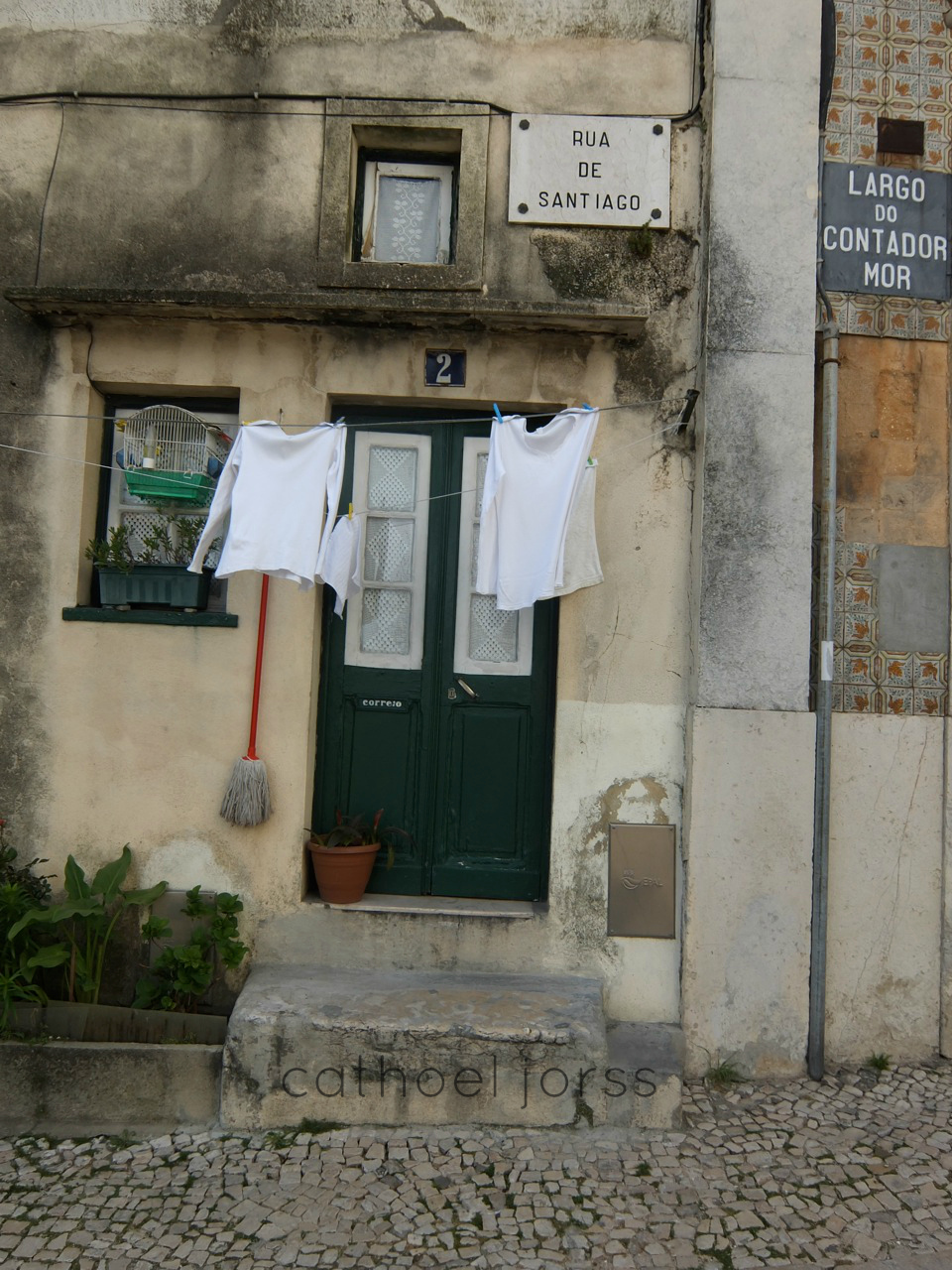
    H2O HoL lisbon laundry door

  • they were herded

    they were herded

    Gleis Siebzehn (Platform 17). Here is where ten thousand Jewish Berliners were herded onto trains. Only very latterly (1991) was a memorial opened. It is very simple and harrowing. No names, just numbers all the way down the platform: 29.10.1942/100 Jews/Berlin-Theresienstadt. 30.10.1942/100 Jews/Berlin-Theresienstadt. The second place name refers to the ghetto or death camp from which human beings never returned. The numbers are staggeringly ambitious: 938 people in one day; a thousand. Towards the end of the war they grow pitifully small: 32. 27. 26. 24. One of the panels has a yellow rose cast on it and on the ground behind it, among the birch trees now growing up through the tracks, last week’s yellow rose lies discarded in the snow; beheaded by its fall, in fact.


  • Felix Nussbaum

    Felix Nussbaum

    Today I saw the paintings of Felix Nussbaum who because he was born Jewish was murdered at Auschwitz in 1944. My friend described how ‘we Germans’ had done ‘the worst thing’ by industrializing mass murder. I had never thought of it this way. Apparently Himmler watched a group of detained Jews digging their own mass grave and then vomited each time one was shot and tipped into it. His response was, we need to find a cleaner way of doing this; so the gas chamber was devised. (Why not, “we need to stop doing this”?) Standing in front of Nussbaum’s sensitive portraits and seeing from the dates he had less than five, four, three years to live it was impossible not to weep. We wept and choked and kept our tears silent. The museum gave onto neat German houses through a series of crooked windows, it is called the Museum with No Exit.

    Afterwards it took a very long time to come to grips with my anger and fear and sense of terror and loss, with the grief, the resentment and yes, incipient hatred. I resented all of us for being here when so many sensitive and feeling people have died. I resented my own country, built on the backs of its own native populations and still dishonest about the murders in police custody and in jails. I could feel in my responses how easy it is to start blaming people and how delicate and difficult is the work of keeping one’s heart free of the pernicious weeds of resentment, envy, fear, and suspicion. How easy it feels to start to build on the seemingly empowering intoxication of self-righteousness. They, they, they. We, we, we. All the way home. Alright.