Imagine a lake. It is vast and extends, if you swim out to the middle and gaze round, at either end as far as the horizon. We set off very early in the morning from town and have cycled for hours, climbing endless sandy paths. It’s ferociously hot, nearly forty degrees, we have left the last village and are deep in the pines. With my narrow city tyres I have to climb off and push, slaloming again and again in the hot sand that grabs my wheels like bulldust in the outback and I sink aside and slew. The closest railway station is by now a long way back. Even where the path is harder, juddering pine cones tumble over the ruts. They are numerous and tiny, an infestation of bronze, authoritative and resplendent against the dense matting of their own gold blonde needles that lie in great drifts on the banquets of deep green moss.
Occasionally the trees stir and everything smells of lemon pepper from the pines.
We have reached the water and taken off our clothes, a duck floats past out on the artificial waves serene and glowing-eyed. A butterfly feeds for butterfly hours at the prongs of cow parsley nearest the edge. The underside of the bank is eroded and when a boat passes I see why. The slopping of the waves against the bank’s underside, a chain of caves under the roots, resumes a slurping, dragging slow ruction like the sound of sex. Two white swans sail under the sloping belly of a white boat, its glossy wood striped by the green tree stems lying along the water like city lights. On the back of the white boat a golden man is balancing naked, poised to jump.
This was a month back, one of the last hot days. We would catch the train as far out of town as it goes, then cycle on to the garden house where our friends spend their summer weekends at the edge of the forest by a lake. We cycled all day, stopped and swam, took photographs, arrived late and everyone had eaten. A cluster of a dozen bicycles stood inside the gate at the end of the road. A winding path engrossed the grass under tall dark trees to the little handmade house. We passed a kind of treehouse built up high above the sweet old-fashioned bathroom which had a tiny verandah, and later I took my drink up there and climbed the narrow steps and sat looking out at the night. I could feel the forest all around, its siftings and shiftings; its damp.
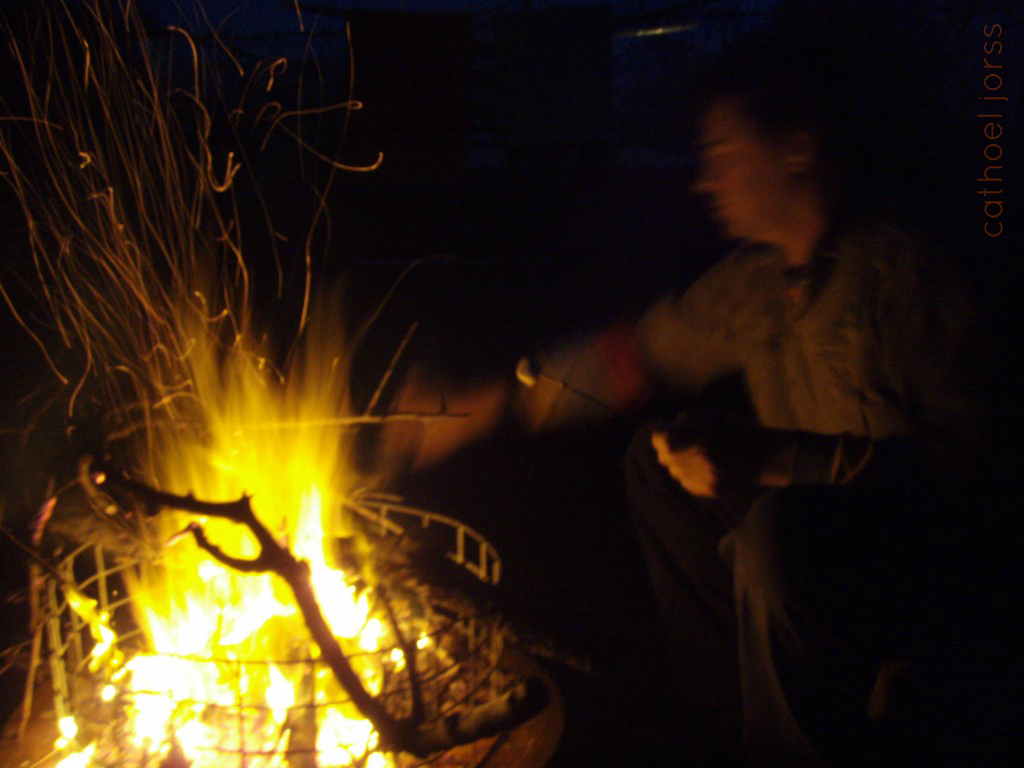
All day long travelling through green tunnels, further and further, deeper and deeper. A party in a forest, now settling to drowsy hums. The candles and lamps lit long after dark, the trellis glowing golden in the flickering green with a row of tiny lanterns in the vine. The little boy, maybe four years old, who wanted juice when all the juice was gone. He stood between our host’s knees in the open doorway of the fridge and gazed in. The large poodle thrust her head eagerly over his shoulder and all three faces were lit as the man showed him, patiently, what each bottle contained. A speckled rope of tiny bronze lights wound up the trunk of the tallest tree all the way to its distant canopy. The boy must be put to bed, slowly and peacefully, by both his parents at once. His father carried him into the magic tipi and his mother laid him down. He was so little. They knelt over him and it seemed they were talking to him. The little boy at the centre of the universe. I could not hear their soft voices but I watched from the candlelit table, fascinated, filled with terrible soft yearning. His mother had taken him on her knee and sat cheerfully on the luggage rack of someone’s bike, when we went down to the lake that afternoon and lazily swam. Now she lay down and curled herself around him, and the father sat back on his heels and they all three waited for sleep to come.
Late in the night the German voices began to blend into a fairytale nonsense tongue and I grew sleepy. I got up and went quietly up the back of the garden to the tipi where the little boy lay. Next to the softly sleeping boy I lay on my back, with my ankles crossed, in Kinderparadies, my eyes open and all the trees leading me up into the dark glinting complexities and simplicities of night. “Who’s that,” the mother asked her husband quietly, “in the tipi with Thomas?” “It’s me,” I said. “Ah…” And I lay there close to sleep myself, not just his but my own, until at length I heard people standing up and getting wakeful and we gathered all our things and took our bikes from the flock of bikes inside the gate, and we all mounted and swooped off down the hill towards the water.
It was nearly midnight, all the houses’ lights were dark. Freewheeling down the hill and making swoops of joy I realised: I was the only woman setting off to swim. My swimsuit in the bottom of my bag, damp and uninviting. At the little meadow by the lake I let my clothes drop in the dark and walked into the water unadorned and very slowly; and a soft furry nudging at my hip was Fleur, the lovely large piebald poodle, pressing herself to me as we went in together. “Oh!” I said, “You’re coming in with me, are you, lovely girl? And it’s just us girls.”
The water was silent and reeds stood quietly at either side of the shallow beach, only a few metres wide, where we stepped in. The men were joking and teasing behind us and joined the water gradually. The lake lay black as pitch to the horizon around us. The sandy bottom is soft and forgiving, as though filled with salt. Nothing dangerous lives here: I kept telling myself.
I turned my face up and could see the stream of stars, a river of frozen timelessness of which the dark clotting trees low on the ground were banks. Afterwards for the joy of silence I left my bike lights switched off. At the crossroads we set out to the left and our companions set out right, Goodbye! Thank you! Goodbye! Through the little village we were joined by another couple on their bikes, who came out of a side road silently, she had lights on and he hadn’t, as though we were their ghosts, or they ours.
We entered the forest, at the edge where it envelopes the road. The little train station lay the other end of this swarm of long-limbed trees, other side of the dark. It was so late at night and so quiet. The wheels. I left my light switched off and plunged in, following the leader bike whose own light swooped graciously, five bike lengths ahead. Everything was invisible around me but the sense of the tall trees, running for miles on either side. Riding fast I was enveloped in a blackness absolute and reaching, the forest spirits catching after me. I must trust that between his passage and mine, nothing will have changed, no dark animal jumped into the path with its big arms out to block and to swallow me, without a trace or sound.
When we arrive at the station the train is there, silent like all German trains. A dishevelled man standing with his dirty backpack on the platform is accosted by two blonde girls who climb out to say, Excuse me is there a late-night shop nearby? “Here? I doubt it. What do you need?” “Oh. We only wanted to buy some water.” “But this is great – look!” Opening his pack. “I have gallons of water. I made a bet with my friend that I couldn’t sell all this water before dawn. One euro per bottle. And would you like this free magazine?”
We lean our bikes up against each other and fumble at the ticket machine. We also buy water. We also decline the free magazine. It is one in the morning: yet again the first morning of the world. I slump down in a corner seat and with tiredness and satiety am almost swooning. I am thinking of the tall trees high above the tipi, whispering night sounds to themselves, the voices of the party adult and dark, the eyrie on its grassy rise, the sleeping child lost in no doubt the safest, nicest feeling in all the world tonight. Under my seat the pulsation of the train’s workings begins to climb, all doors are wide open still, and the glass breeze fills the cabin with freshness as if it were light, again and again, and then again and again.