Tag: tourist

  • peeling back the years as trees

    Oh, I love my little desk in my little borrowed room. At night the night is all around and silent, absolutely silent unless you hear the unending majestic progress as if across tundra after tundra of the wind. This desk is surrounded on all sides by literal towers of the possessions of the host who’s put up with us for three weeks now but in its centre in the circle of the lamplight I find peace. Television quacking in German from the far end of the house. The book I am reading face down with its spine open to the pool of gold. Robinson Crusoe. Incredibly racially presumptive. He saves the savage from himself. I wish that I could do that for me. Tonight I took my bowl of “Eierschnee”, that is, meringue mix or as they call it “egg snow” across to the family household three doors away closer to the mouth of the woods. I stowed it in their lovely oven; ours was blooming with pizza. “See you soon!” she said, and an hour or two later stashed with pizza we were back, for a round-table game of Risk. The man next to me said, That’s not in the rules, and I stuck out my hand. “Wanna bet a million, billion, squazillion dollars?” I said in English. “I’ve been playing this game since I was ten.” We somehow were laughing all night. Presumably because nobody actually cared about winning the world – or, as it is calling in the German language rules (snicker), “freeing” the world country by country. I acted out the illustration I had seen in an article on the US today: photo of a bold swollen warcrafty flying boat, which dipping through the clouds was labelled: “This is a Freedom Machine. It seeks out people who have no freedom and gives them some.” So there we were five of us around the table, giving each other some freedom.

    I had a long bath this afternoon and as I let out the water and stood up a name, or idea, came to me. How profoundly refreshing it feels to think none of such ideas or insights for three hours while we visit and a sixth person comes home, no, I don’t want to play, I just don’t want to talk, been talking all day and now I will just sit here and give advice. I understood what he said and what everyone said and thought, how proud I am to play a whole game, whole evening, in German, hooray for me. I am a guest. It is such sweet and cloudy relief, I have almost no thoughts, it seems. So long as I cook, sometimes, and wash up a lot, and let out my bath water and bring in wood; so long as the dog gets walked and there is someone to photograph the forest and to notice the seams and quiet crickles in the water of the old winding river as wide as a small moat; so long as I stop at the crooked gate to talk to the brown family of fuzzy goats who all crowd curious yet abashed on their hillside in case you have brought them anything sweet; then I have no other job while I’m here, and that’s why we have stayed so long, sleeping 13 hours a day and eating like a caterpillar, book after book, salad after greens, and one vista on another of the quiet level countryside where so many long generations of tall Germans have settled back into themselves after the various empires including their own. Shame is sodden in the ground here as almost everywhere. Pride and shame. The candles flickering all night in the little cemetery, the tap hung with half a dozen green watering cans. The wreaths on doors. The fact that among Germans, a game of mock war brings these stinging and pungent jokes quoting the Führer and certain words, “Tomorrow from 8.45 we fight back” for example, can reduce them all to weeping and slapping themselves on the thigh with mirth.

    Laughter is the only weapon of sanity that insanity cannot corrupt. So I will keep mine high. We walked round the block, which is a brown mown long field, and passed no more than a half-dozen houses with their scratchings in chalk year after year where the Sternsinger, the star singers, dressed in robes and following a star to Bethlehem have passed; he pulled out his harmonica and the medium dog ran his own way among the rivets, and I told him our story: We are just a minstrel couple decamped from our last home, passing under moonlight and the two large mother-trees. These trees are merely a bunch of sticks, like witches’ ravelled hands. We’ve nothing but our little dog, our mouth organ, our magic bag of words. We pass under the windows of the village, they hear us in their sleep. The land is settling, for winter, folding itself under into its ice. I will be gone by then and the land won’t remember because this is not any of my ancestral home.
  • hole in a glacier

    Climbed a mountain today in a steep mist. We had to cross a lake to get to it, this was from Lucerne, shared a table on board with a godfather and grandfather and their little charge, who had unbelievably long eyelashes. After his biscuit and orange juice he grew sleepy, the godfather pointed, showing me, “See? his pupils get smaller,” and when they handed him his favourite thing, a green handkerchief called Noushy, he made a point of the corner of it and prodded himself thoughtfully in the ear with that. Then he brought it to his opposite palm and touched himself gently, thoughtfully several times in the middle of his little pink palm with the handkerchief point; then back to the ear; to the hand.

    All four of us were laughing at him in the gentlest possible way. They said, he always does this: Handkerchief in the ear, handerchief in the hand. The little boy’s nickname was Noushy, too. What a solemn little fellow.

    At the far side of the long and complicated lake that covers it seems several counties, and incorporates a steep-sided volcanic-island-looking outcrop that appears as if it would house a villain from James Bond in an eyrie reached only by helicopter, we reached a tiny town like a picture. Having late lunch there after our descent we saw a freshly married couple get off the same boat and start up the hill towards the only hotel, wheeling one small suitcase. She was still carrying her bouquet but had changed into a chic red frock matched with hot pink spike-heeled shoes. The bell of her hair swung forward every time she looked down at her flowers. At the souvenier shop they paused to talk to an elderly lady and then the bride tucked her hand under the groom’s arm and they climbed upward again.

    Upward, upward; windward, snowward. Most of our climbing was done by train and part of it was done on foot. The train is scarlet and shiny, groaning and steep. A series of steel teeth run up the centre of the line to prevent the loaded car from sliding backwards. We got out and walked into a mist that raced down the sides of the mountain exactly as cold air snakes out of a fridge. In the mist we passed a large group of botanists standing with heads bowed as they listened to their group leader, who had crawled under the fence to grab a flower, describing something green and rare. Or something common and brown, I couldn’t tell which, to me Swiss German is an impenetrable dialect. Higher up we passed a woman in sturdy walking boots but dressed in immaculate white pants and a spotless white shirt. We passed many couples on alpenstocks, the cleated walking sticks you use on steep hills, wearing serious but also immaculate hiking gear. So many cows crowded round the dairy that was shaped like an after-ski chalet their bells clattered like a Tibetan or Bulgarian choir. My friend said, the farmer knows the sound, he can tell if one bell is not sounding. On our way back down from the sightless summit, where we had sat for an hour watching mist spurl round the base of the huge communications tower, one of those farmers left his house and picking up a sagging rucksack lying in the open doorway went striding down the hill, looking well-fed and cheerful. He lept the electric fence. We were both wishing we’d brought extra jumpers but this mountain man was dressed in surfer shorts and a dark blue t-shirt. In the tunnel into the summit that leads, mysteriously and lightedly, to a great double-doored lift that brings you up inside the giant restaurant and hotel, it was so cold I wanted to suck on my fingertips. I remembered touching the icy wet wall as we walked into a hole cut in a glacier when I was ten. It wasn’t so cold as that but the chill of forboding forbad me to wander any farther into the leaden heart of this mountain, I had to turn back towards the light.

    On the restaurant terrace I watched a woman who looked like Yootha Joyce smoke a cigarette after her meal. Her husband didn’t smoke and it was pretty evident from the way she took in the smoke that this was the love of her life. Her lips pursed on the orange cork-patterned filter sucked and fondled at it so slowly, so intently, I almost felt had she not had a hold of it with her long fingers the entire cigarette would have flown into her windpipe. It was like she was finally breathing. “Please fit your own mask before helping others.” The movement of her cheek muscles, langorous and strong, made me think of the little boy Noushy who had fallen asleep on the ferry.

    After the ride back down and our lunch we walked around the pretty foreshore. The Rigi, the mountain we had been on, is called by the Swiss “queen of mountains” and is where in 1903 I think the surveying process began. They built a marker there and from it measured to another mountaintop, and then a third, and then they triangulated. Now they have mapped out all of the surrounding peaks and beautiful etched steel landscapes showed what we would have seen had we been able to see anything. A sign cut into a steel plate fixed on the ground said, Sydney 16520km, with an arrow.

    The train down was filled with elderly people, many of them German. The town at the bottom is like a clam growing at the base of a mighty pier. Evidently people honeymoon there. The red and white striped awnings and terraced cafe feel so 1950s I kept fantasizing Sophia Loren was about to saunter around the corner, or maybe Frank Sinatra. It felt like Monaco. In the foreshore park a semi-circle of chairs faced a three-walled corrugated iron shed. A trio was playing, tiredly, dispiritedly, and on the concrete apron in front was an overdressed lady slowly spinning her plump son, chivvying in a sing-song voice, as though making a bear dance. The music was awful. Saccharine and slowed. As we walked past I said to my friend, It’s like the world’s dreariest private function. Writing that, now, I add in my head: I don’t mean all of Switzerland.


  • the human scenery

    the human scenery

    On my last day in Berlin I visited at last the Museuminsel, Island of Museums. It feels strange to ride an arched bridge onto an island on your bike. The island being castled with stately buildings filled with treasures only makes it the stranger. My favourite was the first, which holds treasures rescued or stolen from ancient cultures around the world, many of them excavated and painstakingly reconstructed by Berlin historians. Bits are still missing. You walk into a temple rebuilt under a soaring roof and begin to feature on a hundred fellow tourists’ documentary records. So few people were examining the faulted relief work with their eyes. They carried screens, like bashful eighteenth-century ladies shading their virtue with fans.

    I was wearing a comical and very old beanie bought in a bead shop in Copenhagen. The lady who sold it to me bought it in Cameroon: she wanted a good price, saying, I am too old now to go back there and find more of them. “Kings wear them,” she told me, and showed me a photo of several kings standing about splendidly wearing hats like mine – it is woven out of navy and soiled cream yarn, and has all over little inch-long prongs sticking out like a fully occupied pincushion, a sea anemone. I went back to the shop three times and every time I put it on my head I felt a warmth and powerful groundedness rise down in me. In the third chamber of the museum a vast and mighty gate became the most beautiful thing I’d ever seen. It was clad in tiles in marine blue, sea green, round white daisies plopped one by one along the base of each wall. So beautiful, so moving, when my companion who had been reading the signs sidled up to me and whispered, Babylon, all at once I understood and my eyes filled with hot tears. I stood in front of the giant gate with my head tilted back, lost in that world, feeling some shard or fragment of how it might feel to live in a city of Babylon. I could feel the song in my blood, you know the song you have as a child and that revisits at odd occasions. Like lying face down in the hot sun watching the insects burrow among grass-stalk forests. Like half-waking, half-sleeping. Like sliding into a lake. When I turned there was a scampering behind me as a small tableau dissolved. Three Japanese ladies, elbow-height to me, were posed less than two feet from me as their friend, holding a camera and shooing them together like school children, took their picture using me, the giant with sprouting head, as colourful blue background.

    Sure, we all do it. At least, I do. But I try not to hurt or molest or offend people. I either ask permission with a lift of the brows or if discovered, make a laughing confession out of it and offer to show the picture. Sometimes if I happen to take a beautiful photo that has someone in it, a stranger, I’ll go up to them with it and ask if they’d like me to send them a copy. These women’s refusal to meet my eye was irritating and unnerving. I spoke to them, gently enough: Excuse me. It’s not very comfortable for you to use me as human scenery. They put their heads down and scurried away, whispering to each other as though an animal had spoken. I wanted to be heard, to be human. I went over to the lady who was packing up her camera. “Excuse me, do you speak any English? I really wish you wouldn’t use me for your pictures without acknowledgement. It’s unkind.” She too ducked her head and backed, holding up both hands and waving them flat to ward me off, an invisible windshield. I could imagine the stories accompanying this picture in the slide show: And then ~ she attacked us~! I saw a security guard look up and went over to him, feeling assailed and dismissed, wanting to talk to someone. “I just had a kind of upsetting experience,” I told him, in German, “those ladies used me as human scenery in their photos and then when I spoke to them, they wouldn’t answer me.”

    The expression on his face changed minimally. “Lord,” I said, “this must happen to you, like, 57 times a minute!” He said, “I hide in the corner there sometimes to get away from it. They look past me like I’m not even there.” “How awful!” I said. We were smiled by now, we kind of loved each other. “And don’t you feel… it’s as if, if I photograph everything instead of seeing it directly… am I really actually here?”

    Leaving the museum hours later I waved to the guard and he waved back. “Danke!” On the way in his colleague who’d collected our tickets had said, pointing at my head, “Tolle Mütze!” “Danke!” I said. The old man who snatched a photograph when he thought I couldn’t see him I followed around the corner til he stopped, then raised my own camera and took his picture, expressionless. That felt better. But mostly my bones and my blood were immersed in the sacred, cool atmosphere of the place, a whiff of many places, the ‘first megacity’ Uruk which was one of the seats of writing. They had small clay tablets like gingerbreads propped on clear plastic feet and telling how many fish had been provided for the workers, how to repel the evil left behind by an expected eclipse of the moon. Afterwards we walked to the Bodenmuseum where people had carved marble into lace. Many many Marys and many small Christs, the repetition struck me as humidity does when you return home to a tropical climate. “I finally get it!” I whispered to my friend, on tiptoe (he is 6’8″). “The Mary worship – it’s about motherhood!” “Yes,” he said, shrugging, raised on the stories. “Mother and son. And the son becomes king. And is murdered for love.” I think that’s what he said, I was in a daze with the old, perfect works, the high wooden ceilings, the light lapping over them when you tilt your head back reflected from the green canal lying outside the Museum’s windows. At the top of the Bodenmuseum is a tea rooms with lovely long windows and not, when we visited, a single customer to absorb and be blessed by its splendid, gently-urging, lace-stitching music.

  • while it lasts

    One thing I love about Germany is that you can find local bakeries who’ll treat you like diners in a restaurant. You can choose a bread roll filled with lettuce and cheese, or raw mince and onion (“builders’ marmalade”), or some kind of iridescent preserved meat with cucumber, and order a cup of tea and have it all brought to your table outdoors with knives and forks and napkins and not pay until you leave. You can sit under the bower of greenery and watch a skinny mother with a pram and a cigarette flirt with the shaven-headed dude who just leveled a trigger finger at a passing flock of teenagers. One of the teenagers says to her friend, “Do we look like school students?” Yes, you do. Enjoy it while it lasts!

  • Tom Waits for no man

    Tom Waits for no man

    I somehow forgot Berlin’s imaginative beggars. This guy held open the door to the autotellers in the foyer of the bank, with a grand flourish, saying, “Welcome!” He was as confident as though he owned it. And he did! He was wearing a greasy navy-blue pinstripe suit like a boxer and had his hair slicked back. On the way out I gave him some coins and he snipped them up in the hand that was free from cigarette-rolling, clasped them to his breast, “Danke!”, kept rolling, grinning at me salty and devilish as Tom Waits. The joy of life is a great thing to share, if you’re a beggar or busker, if somehow you can manage it. Irresistible!

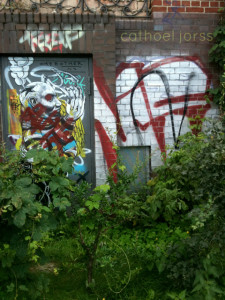
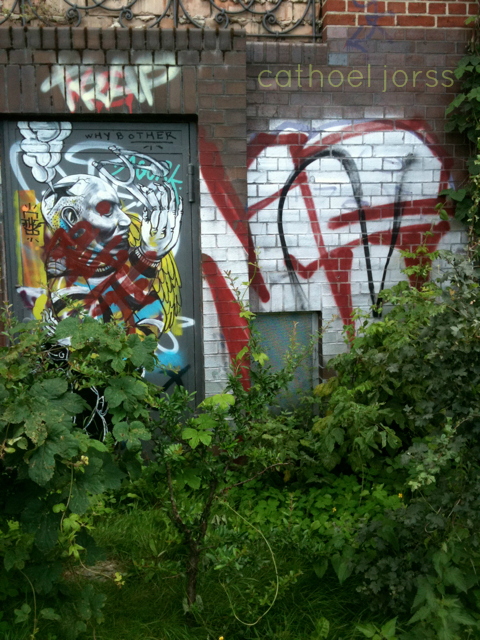
    H2O HoL grafitti hedge

  • sailor way

    sailor way

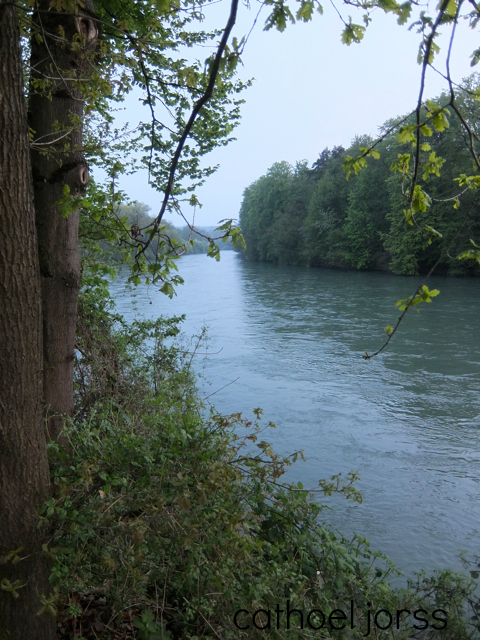
    By the river new wildflowers are now growing, the seasons progress with colour and line. Some of them are upright prongs of dark pink clovers and some, I suspect from the shape, might be buttercups. Buttercups are famous! I’ve read about them since I was a little girl, in English novels. But I think I’ve never seen one. Let alone the swards of white spear-flowers populating the nearby woods, which travel in a carpet as far as the eye can discern under trees…. On the river a lady duck surfs as lady ducks did on the swift green current with their husbands, three weeks ago. This one has babies aboard. They clutter her back, five dark brown bobbing heads, and she carries them smoothly and the water carries all of them, as time carries all of us, long may it be so if our enterprises and selfishness have not too deeply uncluttered the lifeless oceans and cluttered up the air and clogged with metals the water. Sail away, duck mum, smooth like a promise and find a better, greener place.

    H2O HoL sacred river

  • all of Switzerland

    all of Switzerland

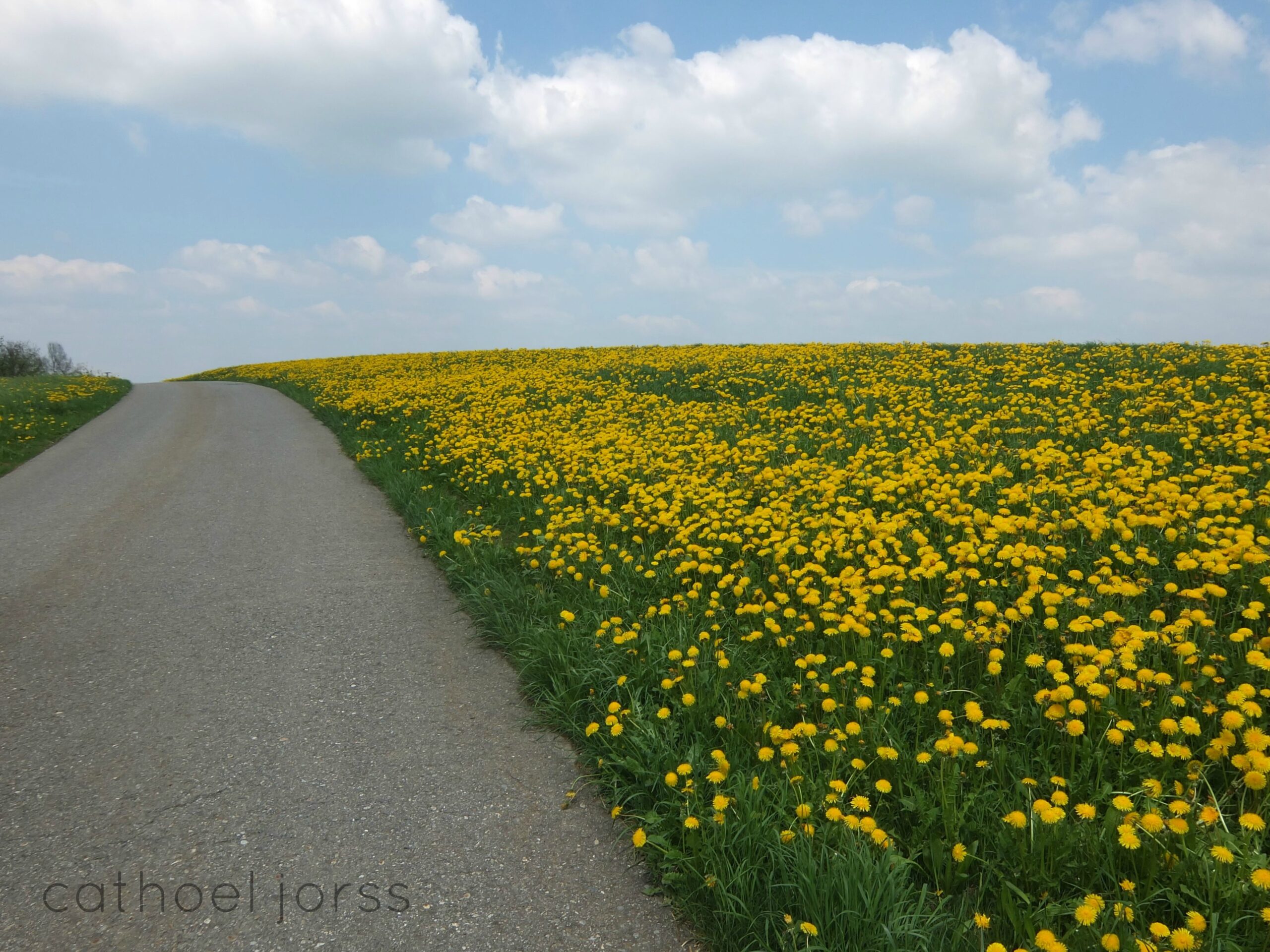
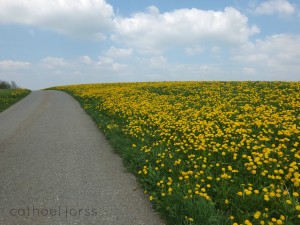
    At the top of a very high hill yesterday, what in Holland or Denmark would be called a mountain, with a view over all of Switzerland ~ so it seemed ~ my friend taught me to peel dandelion stalks so that they spring into pretty green silvery curls. Behind us a family with very young parents were playing hide and seek. They had built a fire and the father, when we showed up, was juggling with three sticks. As we sat on our sedentary bench facing the green nation, he sprinted round in front of us and flung himself panting on the ground, his eyes gleaming, intent on the figure of his youngest daughter who was counting “eis, zwöi, drü, vier, füf…” Our legs and the legs of the bench blocked him from her and pure animal concentration blocked him from us. It was as though he didn’t see us. My friend gazed down the length of his back then flung her spooling dandelion out into the green. “We used to play that when we were children, too,” she said to me.

    H2O HoL dandelion road

  • you are fire

    you are fire

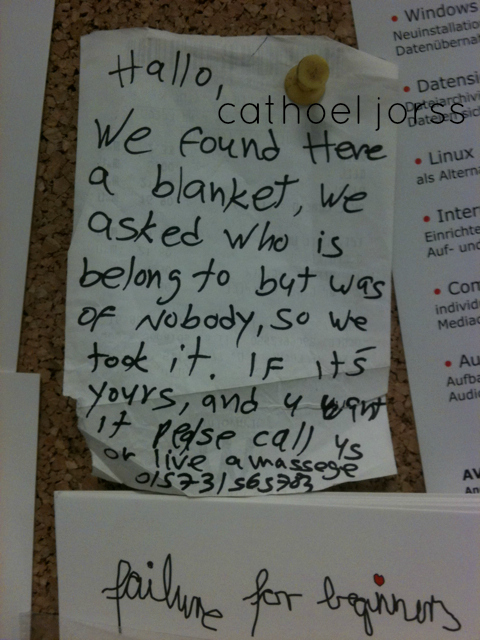
    Walking home past an outdoor restaurant in town that provides rugs for its hardier patrons. Everyone else was huddled indoors, it’s barely ten degrees and the wind is icy. A woman wearing a piled confection of blonded whipped hair drew on her cigarette as I passed and said, drawlingly, “…but it’s ok. I paid him in shag rate.” She saw me listening and fixed me with her eye and blew out a long, expressionless stream of blue smoke. Dragon lady! You are fire. I adore you.

    H2O HoL we found here a blanket

  • wedgwood sky

    wedgwood sky

    Afternoon cycle ride down to the shops. I say down, but I really mean up: this is Switzerland. We set off up the side of a steep quarry and my host, who is in her seventies, left me so far behind that I had some trouble once I reached the crest working out which side road she had darted down. She had a basket strapped to the back of her bike and rode upright in deep elegance.

    I would like to think this difference in speed was entirely down to our relative fitness but I suspect a small part of it was also blind tourism. It’s pretty here, pretty and industrial, and the blue and white sky this winter has been a long time coming. A Wedgwood sky, Monica Dickens called it. Or it may have been Agatha Christie.

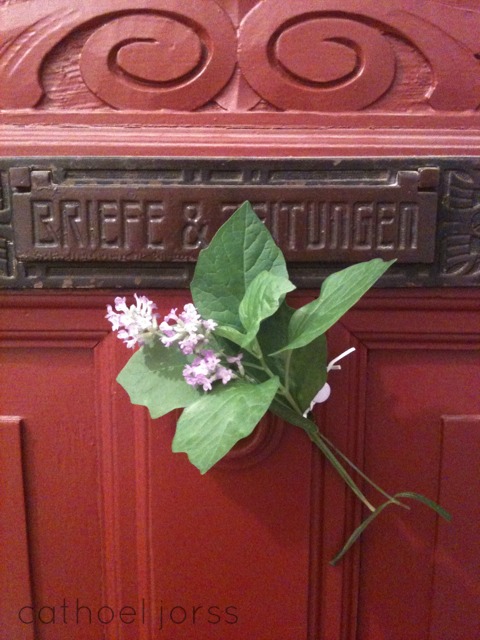
    Yesterday evening I was prowling with my camera and heard a cheery “Hi!” from behind me as I was crossing the bridge. It was my host, bicycling to her tennis club. She waved and I waved back. Then I stood under the willows and watched her becoming a smaller and smaller pink speck between the green, seamed fields. The evening had just begun to gather and tiny insectivore bats were bombing above the water.

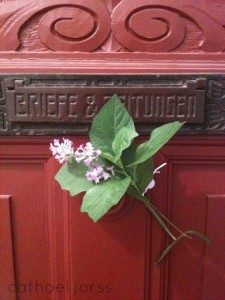
    H2O HoL briefe u zeitungen bouquet

  • I’ve been playing this music for many years

    I’ve been playing this music for many years

    Today I was walking by the river when a man accosted me for directions. His tone was accusing and he didn’t say excuse me or thank you. He was carrying a crumpled green flyer, and pointed. “Do you know This Street?”

    I turned to show him the sign. “That’s this street right here.” He frowned. “But I need the church on the corner of That Street.” I pointed. “Could it be…. this church right here?” We were standing right next to it. A leafless, skeletal tree waved its shadow over us, helpfully: or would have, had there been any sun.

    “You don’t understand,” he said, “this is very important to me. I’ve been playing this music for many years.” That’s right, he had a guitar over his shoulder. “Well,” I said, beginning to suppress a smile, “I’m pretty sure this is the place. What other church is there, on the corner of This Street and That Street, by the river?”

    Why does one pity selfish people? I guess it’s because they are innocent, and seem helpless. He pushed the flyer at me. “You should come to the concert. On Saturday.” I said, “Sorry, I can’t on Saturday. But good luck!” But my last words, possibly all my words, were wasted. He had turned away, sighing, “Yeah… well…” and was blundering into the churchyard, trailing his self-absorption like a long, dragging skirt made from stockings filled with bunched-up wet newspapers.

    H2O HoL I've been playing this music