In an unpretentious Italian restaurant where all the pasta had been made by hand, the chatting-family atmosphere fell into something much deeper and richer and darker. A cellist had walked in and in his overcoat sat down on a backless chair in front of the servery and began to play. Something, I don’t know what. He drove his fibres of unholy sound into the great grail of all of us, each of us, like an ochre long-blown off the palm of his hand. I saw the small boy with dark lozenges of eyes climb down from his chair at the corner table in the second room and go to stand, unconsciously in the waiter’s path, his head a jar for the tadpoles of surety this man was making for us. He stood and stood, listening and watching, lost to every other thing. Behind him his parents and their friend kept chatting and only the older, grizzled, quizzical looking man at another table let his gaze rest on the little music lover so fondly, brimming with acceptance, and I let my gaze rest on him in turn and the music rested on all of us, like snow, that spares no needle in the pine forest and lifts its shifting darkness turn to stars.
Tag: what we are
-
just married
Last night I had occasion to take a taxi and struck the cab driver from hell. Well, hell is an understatement: he was from purgatory. Drove with his hands in the air as he banged on to me about greenies and their so-called eco crisis, a plot to make money.
I couldn’t help it, I laughed in his face. “Gee, sorry. I think if I was out for a quick buck I’d be in oil wells, not solar panels.” “And what about palm oil?” he ranted. “All it’s doing is making money for the Indonesians.”
You can always tell, when someone lumps a group of people together and prefixes with “the”, there is hatred involved. Or at the very least, disrespect. “Palm oil’s not green,” I said. We charged down the streets. I changed the subject three times. “Isn’t it a wonderful night?” (It was.) “Have you been working long this evening?”
All ruses led back to Rome, and the Fall. He was breathing heavily with rage. Meantime an iridescent something had appeared in the road in front of us, it seemed to be some kind of fine streamer whickering in the air – “Did they just get married, you think?” I asked, pointing.
The car on the right had the same gleaming trail. “I think maybe they both just drove through an old cassette tape,” said the driver, and he was right. Long loops of glorious analog spurled through the air, dancing with light and with movement, a magic. He started talking about fisheries, how ridiculous it is to have quotas: because who is going to explain to the fish that they must not swim into the net? I wasn’t listening, I was watching the wind. The scarf that bore Isadora Duncan to heaven had unfurled itself from the car in front and whipped round the passenger-side mirror, inches from my hand. I unwound the window to let the night in. So beautiful, so triste. Because no matter how we block each other out – by hating greenies, by not listening to taxi drivers – sooner or later life slings its tendrils like lassos around our hearts and we have to wind the window down and let the night in.
-
some order
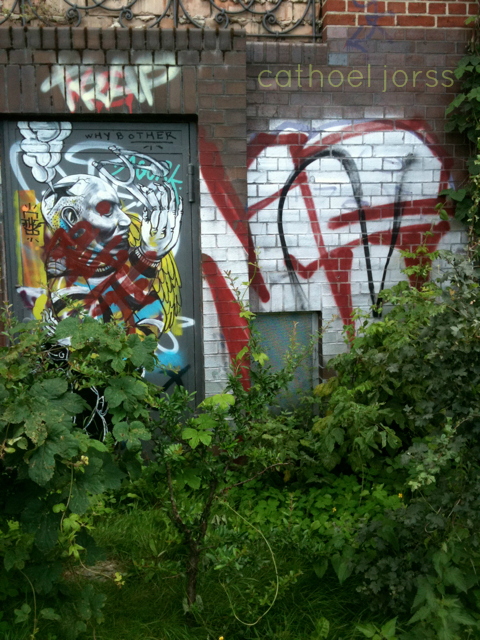
I find Berlin the most extraordinary city. Nothing is regular, not that in my life anything ever is. I guess in an individuality-seeking cult/ure this sounds boastful or false-meek, but I have spent a lifetime hunting the things I have (bountiful, it turns out) in common with other people. Went through the drug-dealer park this afternoon on our dog walk/bike ride to the river. Saw two pale-eyed people sharing a picnic of vodka, a scarfed family of women leaning wearily but free against the fence that divides (we hope) the water from the land, African men lissom in dreadlocks playing music & ball, metalheads holding a metal convention under a large chestnut tree all in black and with slogans and dark music dimly blaring; many couples making out that plenitude is privacy; dogs upon dogs upon dogs upon hounds; and a Turkish family playing cards and smoking spiralling blue cigarettes between thorny bramble bushes, just as though their country were not burning or perhaps as though they were all too aware, and were taking some time off from chaos, placing some orders.
-
Tom Waits for no man
I somehow forgot Berlin’s imaginative beggars. This guy held open the door to the autotellers in the foyer of the bank, with a grand flourish, saying, “Welcome!” He was as confident as though he owned it. And he did! He was wearing a greasy navy-blue pinstripe suit like a boxer and had his hair slicked back. On the way out I gave him some coins and he snipped them up in the hand that was free from cigarette-rolling, clasped them to his breast, “Danke!”, kept rolling, grinning at me salty and devilish as Tom Waits. The joy of life is a great thing to share, if you’re a beggar or busker, if somehow you can manage it. Irresistible!
-
punk snot green
Punker dog in Berlin, his hair matted and scrufflish, his gait insouciant. He has a green streak in his fur, top of the head between the ears, that matches the green quiff on his master. The thought of this dude dyeing his own hair like an old lady in a salon and then tenderly saying, Ok now we do yours, has undone me.
-
sailor way
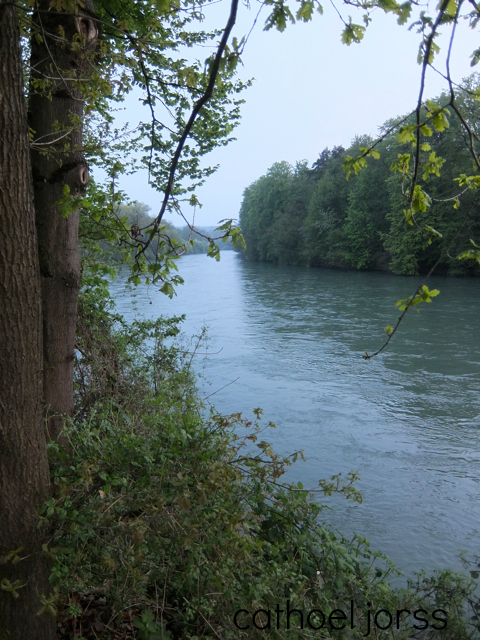
By the river new wildflowers are now growing, the seasons progress with colour and line. Some of them are upright prongs of dark pink clovers and some, I suspect from the shape, might be buttercups. Buttercups are famous! I’ve read about them since I was a little girl, in English novels. But I think I’ve never seen one. Let alone the swards of white spear-flowers populating the nearby woods, which travel in a carpet as far as the eye can discern under trees…. On the river a lady duck surfs as lady ducks did on the swift green current with their husbands, three weeks ago. This one has babies aboard. They clutter her back, five dark brown bobbing heads, and she carries them smoothly and the water carries all of them, as time carries all of us, long may it be so if our enterprises and selfishness have not too deeply uncluttered the lifeless oceans and cluttered up the air and clogged with metals the water. Sail away, duck mum, smooth like a promise and find a better, greener place.
-
København
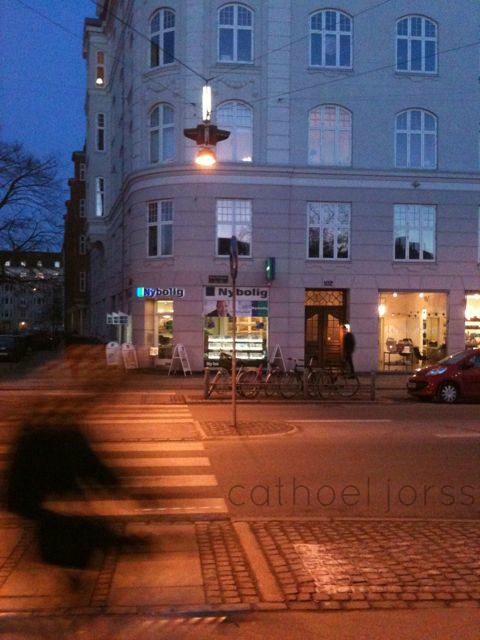
København magical, sunken in the deep, dark water like a turtle from the undersea land, and all of these strangers (to me) riding the waves on its back. The water stretches away into the dark, black and pulsing with lights. Candles in the windows, restaurants which opened in 1694, boats creaking in the wind which have sailed past the horizon, although the horizon keeps moving and we know it. It is our own. At the rim of the sea equidistant, seemingly, all the younger lands I’ve known in this dark and troubled lifetime, where everything I touch turns to silver like leaves. At the rim of the world darkness falls away, falls away but here it is so dark the stars crust the harbour sky like satellites. Creaking of the trees, creaking of the hawsers, creaking of the wind. *@,)
-
the dreaming
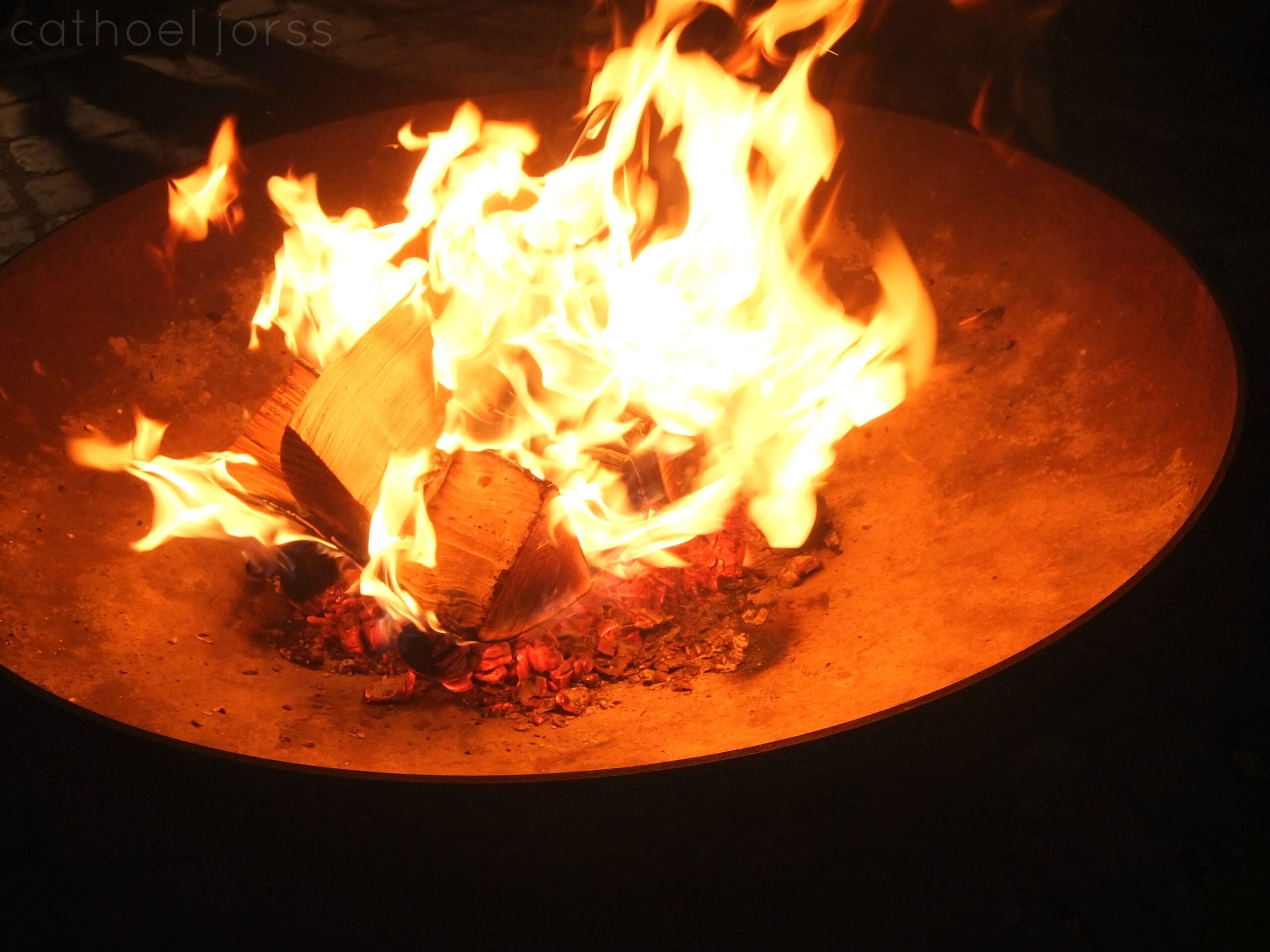
You see, I am still living in the dreamtime, where my ancestors are my brothers & sisters and trees my playmates. Sometimes I’m wiser and sometimes they’re wiser. We hold hands on the street. There are streets everywhere and everything is streets. Sometimes the world overwhelms me. I cannot move & I cannot speak, cannot use the keypad & the online booking form & can do nothing to understand anything at all. Would follow a guttering candle flame for miles along the quiet river in the dark. Stare in through the golden windows, row after row after row after row, longing for a way into the wilderness. That is the only world that tames my heart. I’m so lonely, I’m only longing, and I cannot settle. Underneath it all there is a roaring like fire or water.
-
waste land wastes us
In a sense it is true that every inch of every block of every city centre we have is wasted. As we’ve made a lot of cities – that’s a lot of real estate.
That’s real as in ‘commons’, ‘waste land,’ ‘abandoned land’, ‘no one’s putting it to much use.’ Oddly enough the same is true of many exceptional souls amongst us. True of each of us ourselves – to differing extents, and having had different opportunities. How can I bring all that I am to the world? Because otherwise I’m welshing out on a contract. The world needs you to be you.
Vacant land, abandoned, covered, skirted. We’ve got all these little beaches & lofts of it. Imagine it inhabited, thriving, farmed. A bearded man for years in Brisbane tended an extended family of parcels on the slope between the roads, among the sprawling Moreton Bay fig roots. It’s easier where there’s a tree. Like Charlie’s Bamboo Yard, which nothing is like – a song, fruiting and faced in luminous toy gardens by the bamboo where the industrial lots meet the river, in LA*. Charlie locks gates now against simple-minded defacers but when he’s there – he made it for people to enjoy, and as his home. I loved it & I’ve never even been there.
Why can’t any displaced person and most surely any indigenous community take up an unclaimed patch of land – as European settlers did in the year hereabouts in the far-distant land of notsolongago – and tend it? Make a sweet place: where they can feel comfortable, something they can profit from if they wish and greet the world from if they wish to? Where I grew up, there were street stalls: I miss that pleasure to walk past & walk amongst too. We have a lot of waste patches, unlike poorer countries. We got space. Pioneers can take up a claim. So it seems (look about you). Surely, then, they can build a claim shanty (look behind you). If they so desire.
To me anyone choosing to live this way offers so peaceably their own effort, authority and stewardship over some nook that they ought to be cherished, thanked, left intact. Independent, equably respected. Any buffer community that could thrive would only be an unthanked boon, surely, for the morale, sensibilities, and sense of personal urban grooviness of many city dwellers travelling about our own business.
The individual food-cart, the foldaway business in our nearest countries show the myriad ways a person without premises can be sovereign in his own manhood, in her own womanhood. In Melbourne fellows cartwheel through the traffic at the lights as if it were surf, tilting an almost irresistible bottle & squeegee toward windscreen after windscreen, light as a barista with the froth. They feel great about themselves, I feel great about them, it’s all good, we smile. Interacting with diverse and sifting communities can help us find out how we feel about each other and link actions with beliefs and in an amazing number of cases, this proves to be a good thing.
Men in Adelaide, on foot for long distances in the heat or the cold, barrel a trolley bulging with ingenious spinnaker to sift every gutter and bin for recyclables. There are many forms of service everyone benefits from, that take a kingly humility and resolve, leave a man sovereign, and do the rest of us a gracious service.
In a self-realised community, we all take our part of this beautiful effort. Look at traffic – a web woven, to an astonishing extent, of mutual co-operation.
When you look up – way above the street there’s as much outdoors in any CBD as there ever was. Like allotments, the outdoor blocks are raised individually to roof level then neglected. Most of any city’s veges & all of its aquaculture could be grown in the heart of its sky. A local transition group here can farm this – another over there – transition groups are forming all over and I’ve met two groups who lost members when locals showed up itching to get stuck into some transformative, world-regenerating project & there was nothing but meetings to offer them. It’s what people want to do – and we lack opportunity: be engaged in some way that’s real in our community. Here’s one way. Surely food that is organically grown but inner-city farmed yet eaten within hours cannot be worse for me than sprayed since a seed & sprayed to last on the shelf. Historians say, “neglect of history is a form of despair.” Howard Thurman (1899-1981) said, “Don’t ask what the world needs. Ask what makes you come alive and go do it. Because what the world needs is people who have come alive.”
-
built from junk
I wonder if the reason we are all so fascinated by vampires is that we are vampires, slowly draining the blood from our land. By our habits we suck the life out of the soil, the seas, and each other, turning workers into slaves in distant countries, buying surface sprays that promise to transform our homes into havens of immaculate lifelessness. Is that why we want to see this as desirable and glamorous? Is that why we long to confess?
It seems to me equally understandable that we are experiencing gluttony (obesity) as a leading cause of death, and sex as ‘an addiction’. These are the functions of survival: we need to eat, and we need to reproduce. At present our survival is threatened.* So naturally we can’t stop eating – or dieting, in some cases. We can’t stop thinking about sex – including all the primping, dyeing, shopping for killer shoes, posing, and choosing facebook profile pics.
I realise ‘we’ is a convenience, a generalisation so broad as to have very little meaning. But I mean it. We are in trouble.
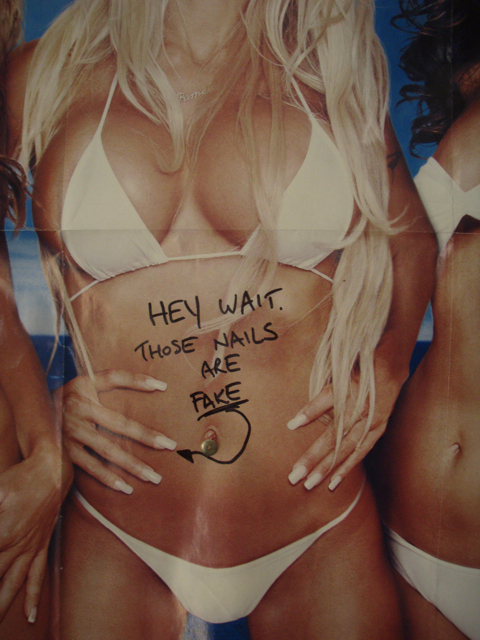
On the high street I have been noticing a giant poster advertising skinny jeans. The models stand in a pouting row, bare-breasted, coyly protecting their chests with splayed and manicured hands. These are porn poses – the kinds of postures that ten years ago I would have never have seen, unless I had sought them out in specialist magazines. Now they are normalised on the high street, a flagrant yet oddly unsexy display.
 Selected through a punitive auditioning process, photographed at the pinnacle of youth and freshness, these beautiful girls are highly socially desirable. To get here they have passed through the eye of the needle: dieted, dyed, denied themselves. The four of them embody what every eight-year-old girl dreams of. Yet on closer examination they seem weirdly unhealthy. That glowing skin tone has been artificially applied. Round the midriff they are pudgy with incipient rolls of fat. These beauties are not built as their mothers were out of fruit and fibre, vegetables and meat. In fact they are the first generation raised on hormones and additives, preservatives and complex fats. They are built from junk.
As Michael Pollan points out, processed foods that do not break down on the shelf are not in fact foods at all. And if microbes won’t eat them: neither should you. Drifting down the alleys of supermarket aisles in a torpid trance of sugar overdose, slow-moving with fats, we are all busy building ourselves out of junk. If fashion models show signs of deterioration at their physical peak – what does that say about the rest of us?
…………………………………………
*To those still clinging to the driftwood of climate change denial: your arguments are built from junk. If science is mistaken. If our actions, unprecedented and massive in scale, cause only some tiny fraction of the natural cycle of climate change. Therefore it’s overwhelmingly urgent we make every effort in that tiny percentile we influence. Use your logic: it’s imperative. All hands on deck at this point. You’ll be welcomed.
