Hey Europe! It’s like this. We stole the whole world from everyone. Retired behind desks to administer the plunder, lost our fitness. So we envy the godlike build of men who spent generations labouring enslaved. Fantasise about their sexual prowess/accuse them of rape. Racism is envy.
Now we mistrust everyone because they ‘want what we have,’ retreat to gated communities and single-person households. We imagine ‘them’ envying our riches and ignore that the reverse is also true: we are most of us longing for connection and family, searching for purpose and meaningful service. So we spend our days whining in five-bathroom houses with a pool table, “I’m so lonely. So depressed. So bored.” Consuming and disposing of the little left of everything that has not already been ruined — for comfort. The End.
Tag: white privilege
-
how white people got this way
-
defender of the vulnerable
I had a beautiful friendship once, with a woman who is also a writer. We read each other’s works in a kind of ecstasy of communion, making notes at every page. Our conversation was easy and delving, muscular and gracious, exploratory and frank. Then men who wore make up began appearing on the covers of magazines, complaining of oppression. Soon it was a lesser crime to rape than to call the rapist ‘he.’ My friend, who is older and perhaps old-fashioned, seemed terrified of falling out of grace. Her support of these men was tireless. She began following me into strangers’ conversation, making public denouncements: “I wish to publicly dissociate myself from Cathoel’s hateful views.” I am sad at the loss of this intelligent friendship and last week, after a lag of two years, I wrote to her. She wrote back still angry, and this is my answer.
.
Ach. I’m sad to see your salty wit and elasticity walled up in this frigid, pious convent.
What interests me about these eagerly conformist cries of Hatred! Hatred! is this: do people imagine their gender-critical former friends are too dishonest to recognise the magma of long-suppressed hatred that now finally has an excuse to pour out? too cowardly to name it? or too stupid to see it? Must be one or the other.
What an aching relief it must be for such people – finally to have found an outlet for the loathing of humanity we have been carrying around in secret for so long. Finally an escape valve for this pressing desire to bully and persecute some tiny, ultra-vulnerable minority. Orgasmic! You can almost taste it.
It’s a cult. A well-funded, white-privileged, male supremacist cult. You have been brainwashed and you sound increasingly ridiculous.
I hoped you might have read more widely since we last spoke, and evolved your thinking. I hoped to reach your better nature and that perhaps you might have had the generosity to tell me, I miss you, too, although we disagree. It’s sad you have simply seized on this opportunity to finger-waggle with such schoolgirl piety, trying to condescend to me about my supposed hatred when in fact even the mainstream conversation on this issue has now moved on and your recited certainties sound dated and ill-read.
You don’t see yourself as the brainwashed handmaiden of a privileged patriarchal cult. You are a defender of the world’s most vulnerable: misunderstood narcissist white men.
It’s a noble position. If somewhat replete with the blinding intoxication of self-righteousness.
What if some men are so privileged they experience being told there is anything they can’t have (the capacity to be a lesbian, for example) as hatred?
Every cell in our body is sexed and this does not determine who we are. This statement of reality is not hatred. I don’t have much hatred in me. Don’t have much capacity for it, being very much occupied with its opposites: attraction and curiosity, humility and devotion. But it’s interesting that in your defence of other people’s right to assert as reality how they feel, you feel entitled to tell me how I feel. Pippa Bunce, for example, the Credit Suisse banker, feels like a woman on 3 days of the week. I say he’s a man, an over-entitled, spoilt, middle aged wealthy man who rose through the ranks on male privilege and does not now offer to take the usual 28% pay cut (or get asked to make the tea) on the few days of the week he feels female. I say he should be free, as should everyone, to wear what he likes and express himself as he wishes, because men can be anything.
You say that’s hate.
So Pippa Bunce is the authority on his own feelings, but you are the authority on mine.
You seem to have no interest in reading or conversing widely in this intricate, complex, and evolving social conversation – you have your slogans and you just know they’re right. You don’t need to make friends or make peace with diverse genderqueer, gender fluid, trans, and gnc acquaintance, as every Berliner does in this most transgressive city. You don’t witness the pleading of confused baby lesbians trying to excuse themselves for the unforgivable transphobia of not wanting penile intimacy, the scorn and scolding they are subjected to. Within the echo chamber of this prissy, shockable, powerfully vocal cadre you are safe from thought.
These last two years I have been spending months at a time in Ghana. Ghanaians’ polite bafflement when I try to explain to them what is going on in the West is mortifying and edifying. What does it mean to be transgender? or demisexual, or any other label brewed in this rage of frothing narcissist fervour (a round hundred of them are listed below – not by me). To my African friends, it means – white people stole everything from us and they’re still not happy.
Have you not wondered why the world’s most violently homophobic nations have women’s football teams filled with trans-identified males? Have you ever asked yourself why in the West, all the most famous transgender people are men? Why almost all of the prominent spokestranswomen are white?
Telling a child they were born in the wrong body is abusive. I can’t see how anyone’s body is ‘wrong.’ It seems to me mutilating and medicating our bodies in search of the authentic self makes no sense. It is the outmoded and conformist gender roles, which fit no one, that have to change – not individual people who cannot fit them. Sterilising children (often gay, lesbian, and a large proportion autistic) seems to me a savage punishment for non conformity. Poor Jazz Jennings, the trans poster child now an adult and taking a year off before Harvard to wrestle with his misery, has ‘remembered’ under hypnosis (filmed and broadcast, because even in therapy he doesn’t deserve privacy) his alter ego as a lost young gay man terrified of not being accepted. Now his gametes will never mature and he will never experience libido or orgasm. He is cut off forever from some of the dearest intimacies human beings can share – and all because he liked boys and wanted to wear sparkly dresses. So insidious is our culture’s corrective homophobia that we’d rather a straight girl than a gay boy. Meanwhile, lesbians are being dragged away by police from Pride parades for daring to express sexual preference. Their dating sites are infested with sexual predators displaying ladybulge. For as soon as we say Trans Women Are Women, sexual rejection of them (ie sexual orientation) becomes transphobic. Lesbians have been told forever that they just need a good fucking and this is the latest manifestation of that creepy male sexual entitlement. It’s corrective rape.
No one has a gender. People have individuality, and to me that is precious. There is no such thing as trans. No one is cis. What woman would identify with the passive, demeaning, pornified gender role thrust on us. The singer Sam Smith now thinks he is a woman because he likes to dance. It’s so insulting. If you can’t see the awful sexism of this whole idea: that women are like this, men are like that, so if you are like that you must really be a woman – I don’t know what to say. For the sake of your public dignity and our friendship I would like to suggest you do some reading. Try Lily Maynard, whose daughter was trans, and Miranda Yardley, who is himself trans. I will hope for the reassertion of the kindly, salty, witty, sceptical, and generous soul I fell in love with which made me want to get close to you and be your friend. You are an idiot and I miss you. Goodnight.
-
Make Africa Great Again
We went out to the white people’s restaurant, as he calls it, which is a street stall on a dirt laneway behind the supermarket. There’s no street lighting, no cutlery. Collapsible plastic tables are set up between the parked cars. Vivid local tunes blast from the tiny bar across the road, which brings icy beers in brands no one drinks in Europe. We sit there for hours eating chicken and fish with our fingers. Last week a white girl got up and went over to the bar, carrying her phone. She persuaded the barkeep, who is a rapper, to link up her tunes to his speaker. Within seconds this wholly fresh and salty sound bathed the scene, and at their work and in their seats everyone was dancing.
Tonight a man sitting against the wall behind us had on a MAGA hat. A black man. I looked closer. MAKE AFRICA GREAT AGAIN. I got up and went over. Close up his red baseball cap read MAKE AFRICA HOME AGAIN.
I crouched beside his table to say hi as I do occasionally when a table of visitors have stiffed the boy dancers. “We can’t afford to give money every day,” they say, reasonably, demonstrating they can afford to eat out every day and I spread my hands, “I know, me too,” and persuade them that it’s ok not to give, it’s not ok to turn your stiffened faces away and keep eating while someone is standing there, sweating with performance, holding out an upturned cap. He is standing there. Treat him like a human. You are not greater nor less. Make whiteness great again.
Since so much of our cruelty comes from diffidence, I offer scripts. “I say, I’m so sorry, I cannot help you this time.”
“But then they don’t go away!”
“Just be direct. It’s courteous. ‘I’ve said no three times, you have to leave now. Bye.’” I tell them the dancer who stuffed fire down his pants but was yet to bloom in puberty “came to our table after you, and he just looked so wounded.”
Poverty is all around us like jackrabbits in the grass. Poverty, hard work, resourcefulness and struggle. We are like big birds of prayer gliding like clouds across the sun, idle on the air and wondering which one next we will swoop on to assist or exploit. Building our bullshit churches, insulting sufferers with thoughts & prayers in place of action, rendering free men into slaves, free woman into sex slaves. Calling the children they raise from rape ‘half caste’, as though only that portion of their humanity fell into any class we recognised.
Next morning four boys came to the low wall around our house which keeps the goats out. Their upturned faces were lower than the wall and I had to go and peer over, to hear. “Please, we want you go buy us four bicycles.”
Oho! I said. Well I would love to buy you four bicycles. I wish I could. I explained that I would love to have a bicycle, myself. But of course, I meant a second bicycle, here in my second home at which I arrive by jet plane.
The spokesboy suggested, “Or maybe a ball.”
My heart flooded with regret and shame, yearning and heat. Why shouldn’t these smiling, reasonable, kindly, and well spoken courteous boys have a ball? A ball to play with. A boy standing behind him said, “Bicycles!” and got cuffed for spoiling the deal. I asked, “Ee gon be how much?”
They reasoned. “Well, ee cost 25 cedis.” Five dollars. The spokesboy explained, you can get them for 18 cedis, but… “They get spoilt?” I suggested, using a word that in the wealth world we use to describe unhappy children but which here means, I had a phone once, second hand from the markets, and now it doesn’t work.
I tried to respond to this adventurous, eminently reasonable, and brave request the best way. I didn’t want them to feel that if this ball got spoilt they could just come ask the white lady for another, that a ball was nothing to me. I didn’t want them to feel I gave something which was nothing, it seemed insulting. I explained I had little money right now. All Africans know little money. It’s the most usual form of money. “But I will try. I’m going to try to find some money for you so we can buy a ball. I can’t promise you,” I said. “But I will do my best. Do you get me?”
Of course I’m going to buy them a ball. I just want them to have a week of looking forward to it. I see school children carrying their homework under the awning of a shop which has a light. I see people eating yam for breakfast, just boiled yam. If you have a sauce on your rice, the sauce is a couple of spoonfuls of garnish; in Europe garnish is the main dish. The man in the MAKE AFRICA HOME AGAIN cap made me at home at his table and we spoke for some few minutes. Neither of us mentioned Trump. We exchanged our numbers, as Europe and Africa should do. We are so few and have so much. They are many, and have little. We, they. We spoke about the music. The rapper who brings beers played his own song again. Coming back to our table I was dancing, a little. In Ghana I always want to give everyone everything and as I build my tiny business I am finding out a way we might be able to do that, one transaction at a time. It’s not giving everything: it’s not giving at all. It’s giving up what we can afford of what we stole. It’s giving part of everything back.
-
mud road
We are walking down the road in the middle of the night. The road is made of mud. Our new home is in a village and it has no address. An urban village, lapped on all sides with villages that make up to capitol, one storey high and crowded with tiny chickens and little soon to be eaten goats as far as I can see.
Should I look nicer, I said, tonight on our way out, rumpled in my unironed skirt. Oh no, he said, Cathoel you are a white lady – you always look dressed up automatically.
Every time he remarks, casually at the door when I have loaded him with parcels, “My loads are plenty,” or, when after a cross cross-cultural fight we start really finally hearing each other, or when he pronounces ‘automatically’ with its six distinct syllables as indeed it deserves, or when I say ‘hippopotamus’ and reduce him to peels of crying laughter — each time I fall a little bit deeper into love as though it were a big bowl of soup.
Here is a church. Already they are moaning and they’re wringing their hands. One lady paces foot to foot, waiting for transportation to start and eulogy to have set in. The whole road will have to listen to their dismal rejoicing. Further along, a few shops are still open. One is called Reggae Spot, selling tins of condensed milk and mosquito coils, though Ghanaians laugh at malaria.
On the weekend we rode nearly ten hours north on bad roads festooned with craters in a tiny bus leaking dust from its frayed with rust underside. Under my mother in law’s mango tree I asked her when she offered tea, do you have any condensed milk? No, she said, I only have normal milk – producing a tiny costly can of condensed Carnation milk, as normal as canned be.
In our village house the water is piped in from a truck to a large polytank on a concrete stand. A chicken is roosting on her nine eggs in one of the pots I have planted and I greet her every morning, “Good morning, Lady Chicken, still working hard I see.” I am reading Elizabeth Gilbert, another white lady dressed up in her handknit white life who took an entire year away from work and spent it in Italy (eating), in India (praying), and on Bali (falling in love). Her book Eat, Pray, Love became such a sensation and attracted so many privileged rich seekers to the island that Balinese took to wearing t shirts which said Eat, Pray, Leave.
In her ashram Gilbert riffs through two pages of the startling innocence that characterises unearnt privilege. Americans don’t know how the rest of the world sees them; men don’t know that women understand them all too well. When she writes of her friendship with her fellow floor scrubber Tulsi, she describes the girl as ‘cute.’ Tulsi is far cuter now that her glasses have smashed, and due to poverty she cannot afford to replace them. “Tulsi is just about the cutest little bookworm of an Indian girl you ever saw,” Gilbert writes, calling up one of a wardrobe of Indian tropes she has prepared earlier, “even cuter since one lens of her ‘specs’ (as she calls her eyeglasses) broke last week in a cartoonish spiderweb design, which hasn’t stopped her from wearing them.”
It doesn’t seem to occur to the author who is scrubbing floors voluntarily as part of her search into herself that looking out from inside that webbed lens might not be pleasant. That being unable to do without the glasses now smashed and damaged is not the same as a cute, manga-kid stubbornness refusing to give up a favourite garment which has torn.
Tulsi describes her prospects: she will turn eighteen soon and will be married off to some boy she dislikes, or is indifferent to. A “teenager, a tomboy, an Indian girl, a rebel in her family,” she loves hiphop and lists for her oblivious interlocuter, oh, so interlocutely, the flaws which can prevent a girl from marrying. Her skin is too dark. She is old, 28 for example. Her horoscope is wrong. Not one of these flaws is anything a girl can do anything about, except that she must not be too educated, or have had an affair with someone.
We’re left wondering if in the conversation itself Gilbert found the time to commiserate with her feisty, spirited, trapped companion or whether she just floated directly from this listing of someone else’s sufferings – so many someones – into fresh contemplation of her own inner self. “I quickly ran through the list, trying to see how marriageable I would appear in Indian society… At least my skin is fair,” she concludes, innocently. “I have only this in my favour.”
Meanwhile in this village house, which we intend to rent out as a kind of guesthouse so that other privileged oblivious whites can come here with their cameras and render all our neighbours objects in the background of their own selfies, I am scouring and cleaning too. When I bought this broom the woman who had made it asked, “But do you know how to use it, though?” By turning it upside down and stabbing the dirt I made her laugh. “Like this, right?” I am too shy some days to leave the house. I feel like an intruder. Daughter and grand daughter of intruders. We have stolen so much. Africa produces 75% of the cocoa that fuels the world’s $75 billion chocolate industry, and earns 2% of the profits. Like an American in her ashram I am doing what I can, so lazily, so slowly, to clear away the cobwebs and look out on this bold world more plainly. I am trying to become aware of the crazy-making stain of sharp edges that my Ghanaian boyfriend has to see past every time he tries to achieve anything at all. I am perceived as being well dressed without putting in any effort. I am addicted to my own comfort. And as I weigh my prospects I try to imagine how that effort spared in grooming and combing can best be spent.
-
Springlike
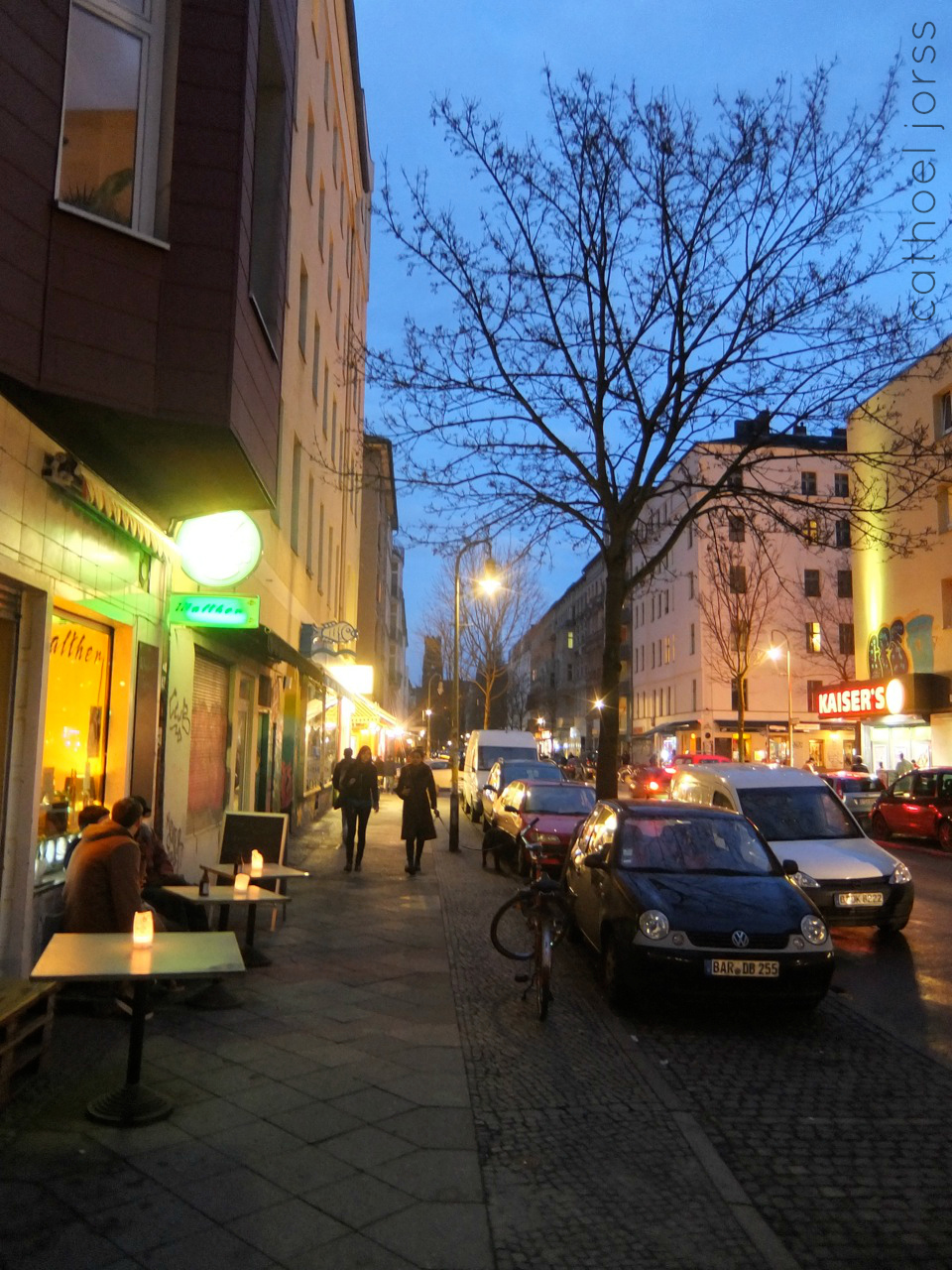
Whole streets in Berlin have grown into green tunnels while I was away in Africa. Trees so heavy with bloom they are almost touching sag together across the road. From above, they must resemble giant posies.
To resolve my sense of cultural and geographic dislocation I decided to focus on the sky and the trees, not looking so much at the buildings and the people. But Berliners are irresistible. I passed a park as it started to sprinkle with rain very briefly, and a whole mousecapade of people rushed out carrying round grills on three little legs in their arms, in a panic. One of them was carrying a fire of coals still burning. I saw a cool couple holding hands, two metres apart on their bicycles, slender in matching jeans. I all of a sudden remembered the balding man in his topless silver sports car who drove very slowly down a cafe street, stopping outside every venue to sing along, imploring with his hands and magnificently confident and loud, to “That’s Amore,” which was blasting from his excellent speakers.
A man pedalling his two small children home in the cart mounted on the front of his bicycle passed me on my bike, and the two blond little heads lolling out either side of the Kinderwagen reminded me of two tiny flopping soles you see when an African woman passes with her baby tied to her back. He got to the pavement and met a step up that might have jarred them awake, so he stopped and climbed down, came round the front and lifted the whole apparatus tenderly onto the footpath.
I rode past a Trödel shop of collectibles and junk and saw two women bent to a basket of broken, glinting strings of beads, lifting them out and delving with identical enthusiasm. One was the shopkeeper. She’s still loving it.
I saw three African and four Turkish men sitting at their ease on milk crates out the front of a coffee shop and had to stop myself from climbing down from my bike to say hello.
And I passed the Denkmal, which means, I guess, ‘think, why don’t you,’ a very simple plain memorial listing Germany’s crimes during the war, in rafts of black the names of all the awful prison camps, titled, “Places of Terror which we must never be allowed to forget.” It was standing on a busy shopping street because it was from normal streets that people were taken, from their own homes. A seedy-looking man with tattered blond dreads was sitting on the bench in front drinking his afternoon beer and gazing up thoughtfully. In the time it took me to get out my camera, two other men had stopped on their own bicycles, wearing suits, and stood there, reading the names and pointing them out to each other. Someone had left a huge, costly wreath with long red broad streamers printed with something I couldn’t read and the taller man got off his bicycle and wheeled it round to lean down and untangle the ribbons, dragging them so they lay more legibly on the ground.
I saw a survivor of those pogroms, a Romany man, crouched in the shade of a roadside tree with a flower garden built around it, and he was holding up a bunch of creamy snowdrops bundled with broad blades of green for one euro. I bought some flowers and asked if he would like to have a photograph of himself. So he allowed me to take his picture and gave me his phone number so that I could send it, later. His name was Yonut.
-
world war z
Just saw this terrorizing zombie flick which has Brad Pitt in it, he is rather good but every time he’s onscreen you go Oh look! It’s Brad Pitt! Such an awful experience and I feel traumatized. I feel like a zombie, if a zombie is the ultimate sociopath: no emotion, no response. Cycling home through the cool breezy night I was looking fearfully over my shoulder, left and right, cowering when a bus came past. Apart from fear I’m feeling nothing. Hackneyed exaggerations like ‘dead inside’ seem to me reasonable truisms. The friend I went with, a fan of zombie movies who found this gorefest ‘bloodless’, wants to know isn’t there any sensation of relief? What, that the movie is finally over? That of all the billions of diverse and pulsating people on this earth, one square-jawed blond actor and his immediate family, plus token brown-skinned boy, survived? This… is hope? All the nauseating violence and mean-skinned machine-gunning and desperate stratagems by ill-prepared people have worn me through. My emotions are spent. Then again it was melodramatic and ridiculous, but sore. I’ve never seen a film like this before and never want to again. It was so overwhelming that the nett result seems to me a sodden desensitization. Who made the word zombie, when was this thing dreamed up? Ugh. And only now, writing, do I realize the title of this terrible movie is literal as well as hyperbolic. How exhausting.
A side-note: Brad Pitt is extremely good-looking. I never really noticed it before. I guess that sounds ridiculous. I mean, he’s built well, he has a sturdy face that takes expression. My companion said: wasn’t there anything that you liked? I like that it’s over. I like that the artificial bowels-of-the-pyramid architecture of major cinemas does not prevail everywhere. I liked the girl who was brave when he cut her arm off. I found it amusing, or do I mean dispiriting, that they had four accountants just for payroll; 49 stuntpersons; five times as many digital effects artists. I liked the ice cream, from an Italian stall that was locked up when we came out. I liked taking off the 3D glasses. I like the quietude.
-
Eddie McGuire & Adam Goodes
Eddie McGuire, prominent Australian broadcaster, compares Adam Goodes, respected Aboriginal footballer, to King Kong. The conversation, outraged on both sides, focuses on whether or not Eddie “is” racist. Thus it gets nowhere because no one can establish what lurks in the depths of his heart.
If a child gets run over “by accident”, or because a distracted driver did not take sufficient care to prevent it, the child is still run over whether or not that driver “is” a “killer.” Let’s stop competing for most enlightened person who has the most Aboriginal friends, and focus on the damage and pain our unconscious, casual, lazy, habitual, over-entitled, selfish, spoilt racism inflicts.
Even the fact that I label Adam Goodes “Aboriginal” and Eddie McGuire “Australian” shows racism. And ill logic, given that the truest possible “Australians” are indigenous. Let’s move this conversation on and start urgently examining and addressing our actions, our inaction, and their effects, before we get round to finally being more honest about the subtle motivations and conflicts in our hearts.