Something annoying I remember from the endless days of smoking and working is how ganja made me very prone to toppling off the painstaking and yet somehow effortless vertical tower of rope bridge that is composition and new invention. I so easily got sidetracked into nitty-gritty nothingry. Looking back it was as if my mind, stoned, could not readily distinguish between these two states: thus I’d be sailing along with a belly full of sailing wind, writing some glorious new tale that had never in the history of Man been told before, and my mind would go: hang on a minute, is that really how you spell epiphany? Or I would look up hours later to find I’d been bogged down somehow in the endless researches or adminiaturism, a smaller and narrower form, a kind of thinking that is usually available to any poet when they’re not stoned, when they are bored, or when they can’t actually come up with a new poem to write. It was frustrating and I’m glad not to inflict it on myself no more.
Tag: writer
-
dancing friend
I can’t stop crying. A friend of mine, a musician from Berlin, just wrote to say, do I just use your online postage calculator to pay for a poetry book? I’d like to pre-order. The books themselves are sitting tidily by me as I write, in four perfect cartons, we picked them up a few hours ago from the specialist binder who opened one volume to riffle through, saying, “This paper! It’s lovely, it was lovely to bind.” I am rather surprised how many poems have found their way into the collection, it is a lovely square-edged, strong-shouldered, upright beautiful book containing all the good work I have done in verse form since round about Y2K – when the world was intact, computers were optional: way back then. My friend wrote, I have been reading your story about how the printing got done. He said he liked it, “just as I immensely appreciate every post you make.” I hadn’t realised he was reading me, it feels like a sweet subtle connecting of our souls over all the cold lonely dark miles of sea and air. He wrote, “Time to pay back – literally.” Then my partner, another Berliner, gasped from the other room. He was fixing something on the site he built for me: this one. I ran in to see. My friend had bought every book I’ve ever published plus a download of my album. He bought the lot. He paid about forty-five dollars in postage. I sat down and put my hands over my face and cried and cried. After a few minutes my lover came closer and touched my hair tenderly. “Are you sad?” he wanted to know. “Oder freust du dich, or are you rejoicing?” I nodded, could not speak. “All die Jahre der Dürre,” he said, gently: all the years of drought.
-
print’s charming
When a poet walks into a printer’s and says, I have written a book, I want to publish it, their eyes light up like neon stars. “It has to be on sumptuous papers and beautifully bound,” says the poet, and the printer’s salesman purrs, “Right this way, madam,” and leads her into an impressively empty boardroom. He is all attentiveness, spreading paper samples before her like red carpet, laying on shitty coffee and shit-eating grins. When he phones his colleagues to check the price of this or that component he is telling them, “I have here a young lady who’s written a book of poetry, we might be quoting a poetry book!” ~ possibly to alert them that, as the poet will learn to say later that same week, “there’s some air in these prices.” She is not a chain of real estate agents, who print up their repetitive brochures week in and week out and have cycled through every local printeria and copy shop, learning how to mistrust them. She is not a pizza bar who distributes six thousand pizza-shaped leaflets every month and shaves the price of each slice they serve by one sliver of prosciutto and an anchovy. She is more like an engaged couple planning their hand-cut wedding invitation. Nothing is too good for her baby and money raises no objection. This customer’s a poet.
The trouble with this theory of sales is: poetry’s earnings are poor. Poets have no money to waste. They cannot expect much profit from their enterprise so this is a different kind of investment. Some poets have even printed books before today and have learned, via painful experience, the wily weaselly ways of printers’ salespeople.
Ten days ago I first met S, sales rep for a local printing house. He took me upstairs to the abandoned boardroom and scattered paper samples before me. He made calls, he made coffee. He was excited.
I drew out the books I have published already and pointed out to him their beauties and their flaws. His excitement dimmed visibly. He tried to rally, with a story about his little bookworm daughter, to whom he had confided after our phone call the afternoon before that he was preparing a quote for a poet, and “We might be printing a poetry book!” How old was the daughter, I wanted to know. He told me, “She’s 8. She loves poetry. She reads it all the time.” “That really is remarkable,” I said. “Seriously. I’ve been writing poetry all my life, started when I was maybe nine or ten. I don’t think I’d even seen any poems before that, it just sort of happened. And I certainly wasn’t reading poetry at the age of eight! I was reading Milly Molly Mandy.” He looked discomfited. My tone was warm and inviting, and yet… “Maybe your daughter is some sort of prodigy!” I said, brightly.
What happened in me over the course of this week is at long last I taught myself to project-manage. I was in trouble. The poetry festival is a week away and on Thursday I’d still not found an affordable printer. It was starting to seem as though S – nice guy, big innocent blue eyes, he had the little bookish daughter – was lying to me. He talked me into a more durable and expensive form of binding called PUR, based on polyurethane, which made the price leap up by seven hundred and fifty dollars. It took me days to work out that when he had added in the PUR to his second quote, the total price had gone up but not down – in other words, he had added in the PUR but had not taken out the simpler “perfect binding” method he’d first quoted on. So I would be paying for the book to be bound twice. Could this be right? I couldn’t believe anybody would be so underhanded, so shamelessfaced. He came to our house to deliver a sample of the colour prints included in my design and rambled on about how beautiful everything was. There was a crack in his character somewhere but I couldn’t find it.
I asked him about the double-bind my book was in and instead of answering, he tried to sidetrack me with faux earnestness. “Ah, that $750,” he said, “yes, that’s what it actually costs. That is what I will be paying them. That’s actually what the binders charge me.” And then in his enthusiasm to bamboozle me with extraneous detail – a technique assault specialist Gavin de Becker likens to scattering tin tacks to stop a large truck – he made a tactical error. He gave me the number of his specialist binder, a guy I’ll call W, and told me to ask him directly about the advantages of the PUR binding so that I wouldn’t have to feel S himself was “talking me into it.”
I rang W. What a lovely guy. He hesitated to drop anyone else in it. But he had to say, when I mentioned the PUR price, “Ah, no. That is not what we would charge him.” He told me printers, naturally, add in a margin of profit for themselves on every component of the job. But, he said, when you take one back out – which in this case S had neglected to do – ordinarily you leave the margin in there. “Is that a way of sort of paying themselves for the time and effort they waste quoting?” I asked. “You could say that,” said W, reluctantly.
He took me in hand and explained how the industry works. I was right, he said, to have felt that when I walk in talking about poetry they will instantly see dollar signs. At last he said, “Listen. If you’re serious about this – if you really want to go on producing books of a high quality, in short print runs, and it’s important to you to turn out beautiful work – then you need to learn how to project-manage. Call the paper merchants yourself, and ask them for a price on the paper. Call the binders – not just me, get other prices. Then call every printer and ask them the exact same questions each time, so you’re comparing like with like.” He said, “Say to the printers, listen. All I want from you is to print onto my own paper, and stack the pages. Then I’ll bind it. How much is that?”
This conversation and W’s honesty and generosity sparked a revolution in my heart. I felt a wave of confidence arching up to sweep away the nervous insecurity I’d always had because I did not understand the print process and lacked the vocabulary to find my way. I rang the paper merchants, whom we had already visited recently in our quest to find an unfashionably unslick, chalky, handmade-feeling paper (“the whole market’s gone glossy” he’d told me as we leafed through the samples) for my other print project, an album of jazz and folk and funk songs recorded in New York which I want to publish in a photographic book. The paper merchant remembered me and gave me a figure. I knew it was a good price because S, who interlarded his outright lies and his evasions with bullets of honesty for me to bite down on, had mentioned a similar price for the lovely fine papers I’d chosen, in order to justify his unjustifiably high quotes. And besides, the paper merchant begged me not to tell any printers the price we had come up with. He said, normally I charge you more, because they buy so much all the time and you have kind of walked in off the street. “With my sheaf of poetry under my arm,” I said, glowing with effort and the sense of belatedly returned goodwill.
The binder quoted me $648, a hundred dollars less than what S had sworn he was going to pay directly. We chatted about my band and his band. He described the recording equipment he had bought when a studio in Sydney closed down and how he was building a space for it under his house. After we rang off he sent me a beautiful email saying he would like to offer me PUR binding for the price of the much cheaper perfect binding, because “it’s not often you meet really genuine people in this business.” I burst into tears. Within 24 hours this impossible project which would have had to sell for forty-five dollars a copy just to break even had come clean. And just through my favourite deviations: honesty, kindness, respect, and decent real communication.
Emboldened by this progress and able, now, to brief more effectively for the quote, I rang five other printers. “It needs to be done on the Cadillac,” I said, referring to the machine S had so proudly shown us – the HP Indigo – which turns out digital prints almost indistinguishable from the traditional offset. I named the paper and told them where to find it. I asked them to quote on plain printing “supplied flat”, and also on fully completed, bound books. I chewed my nails and somehow found space, in between all of this overwhelming and stressy business talk, to clear the waters for my own work and forage through the manuscript one last time, making tiny and crucial decisions about a word that was too many here, a comma there which intruded. Resurfacing to field calls from printers’ sales reps I negotiated by comparing one quote against the other. I was awesome: I’m not normally awesome in that way. Scrabbling back and forth through my forty pages of closely-written notes and scrolling from one tab to another on the screen I brought the price down by nine hundred dollars. Camaraderie, kindness, and art will out. For now at least, in this one tiny meadow of enterprise and effort, poetry prevails.
-
alone at last
I have this really long poem which I have rewritten decisively – indecisively – thoroughly over about four or five years. It’s five pages long and it’s called Reaching for the Remote – about our longing despite celibacy for gods. Did I say celibacy? I mean atheism. This poem is one of three reasons the book I completed six years back cannot yet be published. It’s infuriating. I love the book. I want to hold it in my hand. Its title strikes me as genius, listen up: Comb the Sky with Satellites, It’s Still a Wilderness.
The other two reasons are a poem called We and Yet We, about colonialism, which I rewrote yesterday and think I may finally have wrestled to the mat, and the cover, which is made from salvaged cement bags, which I have sourced and designed and all of that only I cannot find anyone who can print in full colour on this brown-paper surface. Anyway today I dragged out all six major versions of the poem. I set them all side by side on my tiny screen. I made a big pot of tea and banished the cat. I set to work. Mumbling aloud and compiling slowly like an ant dragging large crumbs of earth these ideas which stand larger than I do, weaving them all in the way they seem (today) to best speak for each other. Like a entire school called before the headmaster and no one will dob anyone in. Anyway I’ve done it. I read it three times. My eyes are swimming, my brain is numb. I think I have completed it, I’m so pleased and relieved, now the book can go ahead. Or it could be just today. You know how you need to leave things several weeks to be sure they aren’t playing tricks on you.
-
on not being a brand
Had to write a blurb about myself – a bio – for Queensland Poetry Festival. Oh, the horror. Describing oneself & talking about one’s work… is there anything yukkier. I hammered out a couple hundred words, only to discover I had been too verbose (who whuddha thunk?) and they needed a brief 100 words for the website & for the programme, an even briefer 25.
25 words! There is a reason I suck at Twitter. The deadline was rife. In a crowded wifi cafe I pulled something out from under my hat and I feel so boastful about it. Whaddaya think?
100 WORDS: “2014 sees two new releases from Cathoel. Her new poetry collection is hailed by Robert Adamson as the work of ‘a born poet.’ The debut album of Cathoel & the New Government was recorded in New York, Melbourne, and at home, by a collective of twenty-eight jazz, folk, and funk musicians. 50s impresario Bob ‘King’ Crawford on first hearing Hey, Big Splendour said, ‘In my opinion you will be one of the greatest artists this country has produced.’ Even fresher new work can be found at houseoflovers.com.”
25 WORDS (woot!): “Cathoel writes poetry and jazz. Robert Adamson says, ‘a born poet.’ Overland journal call her ‘a first-rate artist at work.’”
-
plain clothes police
This cafe installed in a loading bay has floor-length open windows, I am sitting with my back to the sun reading an ambitious local free paper. It has a row of Brisbaneites each standing holding their sign, the sign of what they’d love best to see, the signs of the kind of world they want. Invariably, or infinitely variably, it is a form of ‘everyone accepted for themselves’ or ‘a world without prejudice’ or ‘an end to war’. However underneath the idealism are pragmatic and tousled lists of self-love, love in the most measly sense: what I’m wearing? Label X jacket, shoes by Label Y. Even the youngest, even the oldest, are able to parse their outfits breezily, ‘a loafer,’ ‘a pant.’ Where I like to eat? Groovy Bar Z.
Last week we read an earlier issue of this publication in the same two seats in the loading bay, then as now a cold breeze running through the crooked, open space like large, stately passages of cool sea water. A fly tried to drown in my eggcup of honey, I fished him out with a teaspoon. Flung him out into the sunny breeze and he flew free, a kite trail of honey sprinkling the grass. Moments later my companion nudged me: Butterfly! Indeed, as if out of thin blue sky, her brown wings velvety light and tremoring she supped the round drops of honey. She laid her wings open in an ecstasy. I scooped a little more out and flung it wide, see if I could make her dance. She did.
A police car pulled up under the tree. A man in casual clothes got out. He was unshaven and looked rumpled and sweaty. He slammed the door then thought better of it, reached back in to retrieve something, a folder, locked up behind himself and came past the long draughty doorway. I began to laugh and pointed past him at the police car, accusingly. “Did you steal that?” “No,” he said, surprised, good-humoured. “I know,” I said, “just it would be so funny.” I cracked myself up. My tablemate reported the off-duty officer was still laughing when he crossed past the open passageway which is their galley kitchen and which ends in a slice of street. Two men came in and sat across from each other at our next table. The table was white-legged with a polished wooden top; of a series of mismatched chairs the guy in neon pink singlet drew out the one painted egg-yolk orange. I went over to them and crouched by their table. They looked startled. “I’m sorry to interrupt. I have this friend who’s obsessed with orange. Would you mind if I took a photo of your shirt and the back of that chair?” He waved his hand and the other guy barely smiled. “Sure, knock yourself out.” But twenty minutes later when they had finished talking and I had filled three more pages of my notebook they got up to leave and stopped off with us. “Did you get it?”
-
dentist, draftmaker, drill seargeant
Whenever people ask, So do you make a living from your writing, I feel obscurely coal-hauled, if not outright keel-hauled. Does anyone ask this question of an architect, a dentist? It’s so personal and somehow lip-smackingly censorious. I hear behind it two subtext questions: 2: “So. Is your writing any good?” and 3: “And am I subsidizing it?”
The hundreds of times I have been asked, “So: do you make a living from it?” the question has never once been accompanied by, “Ah! Is your writing for sale? Where can I buy some?” But I answer the spoken and the unspoken questions either to myself or, if asked rudely enough, out loud: 1: No. 2: Yes. 3: No, so you’re not my employer, so you can put those eyebrows down.
-
a bowl of apples
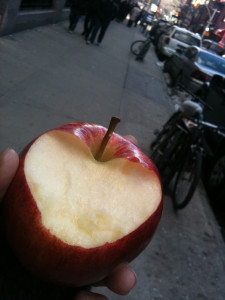
Cafe I used to work in, in Berlin, had sometimes a dozen Apple computers (mine included) lined apple to apple, cheek to cheek across the counters. People forget ‘branded’ is what they used to do to the rumps of cattle. To show they are *owned by somebody*. We think it means, “Now I Own This.”
‘Maverick’, incidentally, comes from the name of the one guy who refused to burn brands into his cattle. So when a steer turned up who had no sign of ownership, they knew: one’s a maverick. But for all those who so proudly claim the term: still means you are somebody’s property. It’s just that the chains are invisible.
-
smoosh-smoosh
A German friend trying to understand a phone call from a Polish colleague just asked me could I stop typing… as I was rattling away at a fine old pace and it was very distracting. I learned to type on an old manual typewriter where you had to exert actual pressure to get the keys to move… so my typing is, he has said, like “a herd of gazelle.” Afterwards he apologized, in faulty idiom. “I didn’t mean to smoosh-smoosh you.” “Ah it’s ok. You can shush-shush me. I know I get overexcited, writing.”